Le Grazie

When we first travelled to Italy, we didn’t get the chance to see Cinque Terre so this time we were determined not to miss out. When I started planning, I soon realised that staying in the coastal villages was nigh on impossible with a car to park. Instead, I found a B&B in Le Grazie that suited our needs, or so I thought. After driving around for an hour trying to find the place, it turned out to be virtually inaccessible to anyone with more than hand luggage, down fifty or so very steep stone steps. With no Plan B, we were very lucky to find Hotel Le Grazie had a room available for two nights, a very nice room at that.
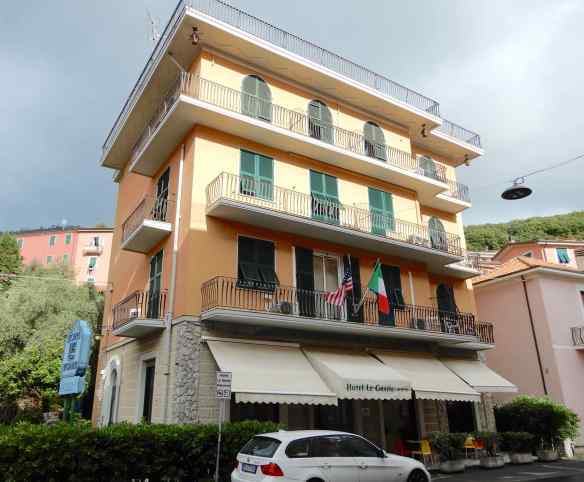
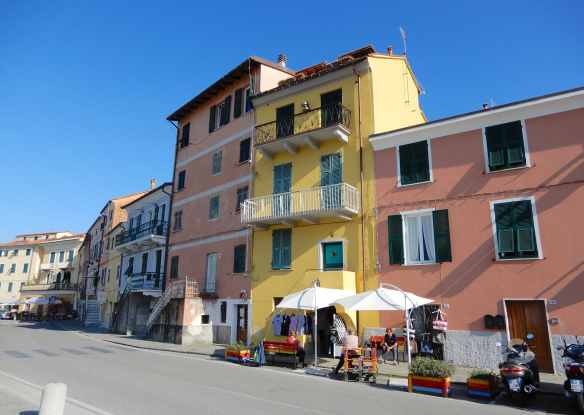
1.Hotel Le Grazie

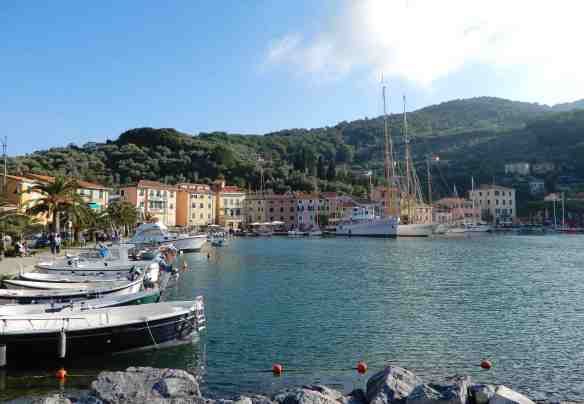
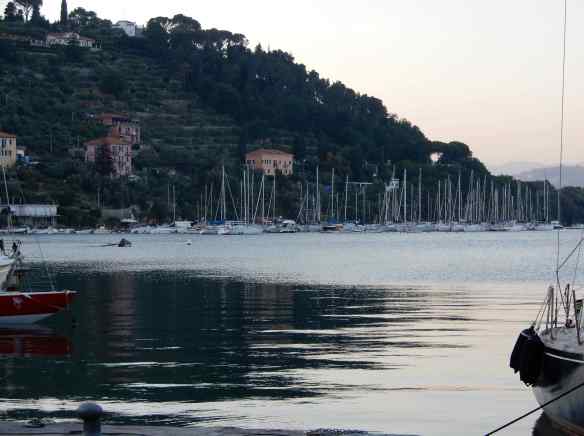
In need of solace after our ordeal, a short stroll around the corner rewarded us with the tranquil vista of Le Grazie harbour.
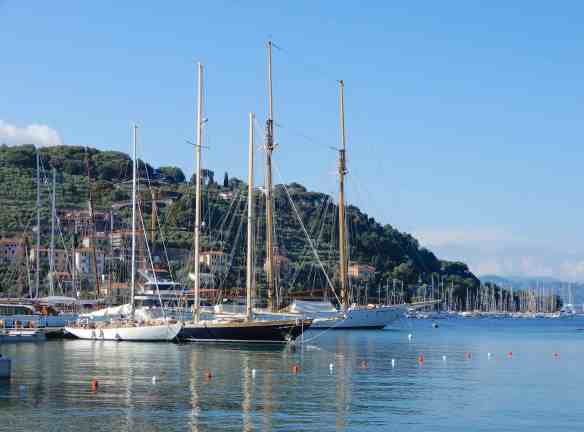
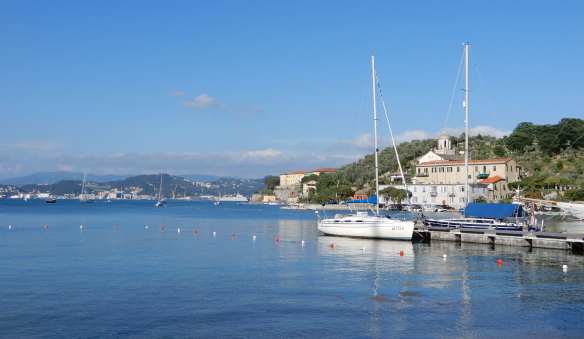
2.Le Grazie harbour3.Le Grazie harbour

Nestled in a sheltered inlet between La Spezia and Porto Venere, this gorgeous village seems to have escaped the teeming tourist numbers of the neighbouring towns. The inhabitants have a reputation for being proficient divers and have thrived for centuries on boat building and fishing. Adjacent to the boat construction yard, the pine wood offers a shady meeting place for locals. A war memorial honouring  partisans, civilians and military personnel and an old cannon remind us of a less peaceful time.
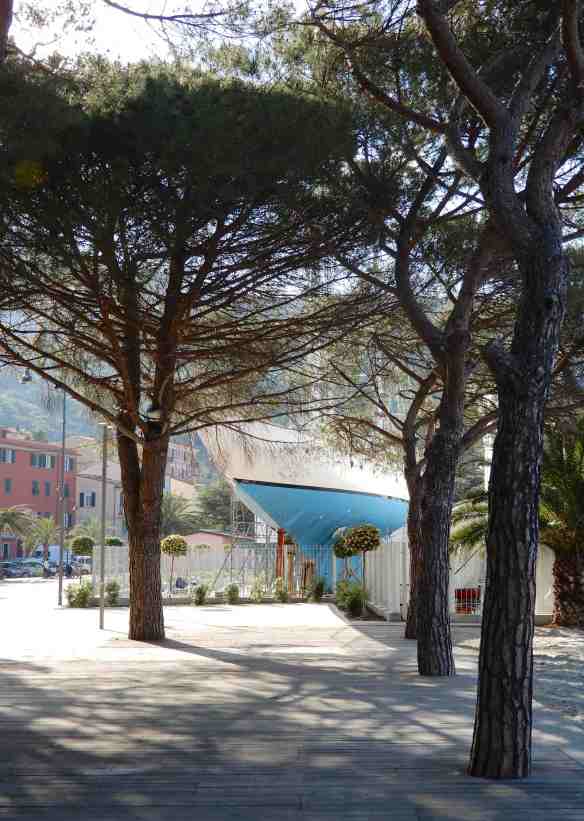
4.pine wood

The roundabout, marked by a solitary cycad, seemed somewhat superfluous on a straight road.
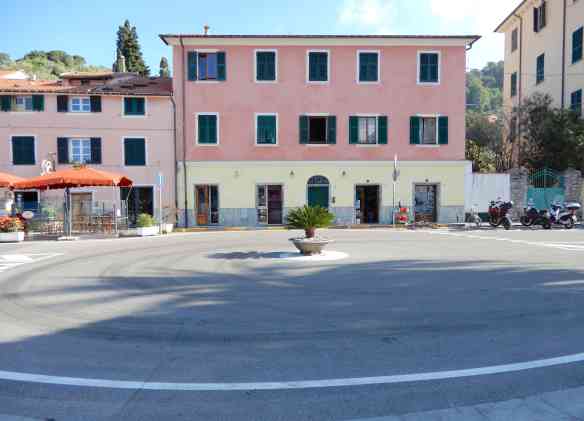
6a.roundabout Le Grazie

After a restorative Prosecco we wandered further, past colourful buildings
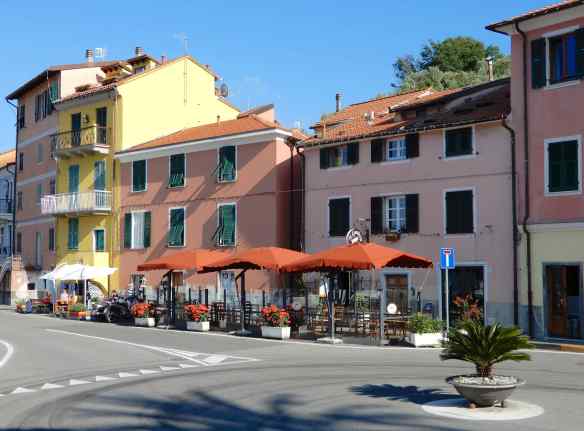
7.Le Grazie8.Le Grazie

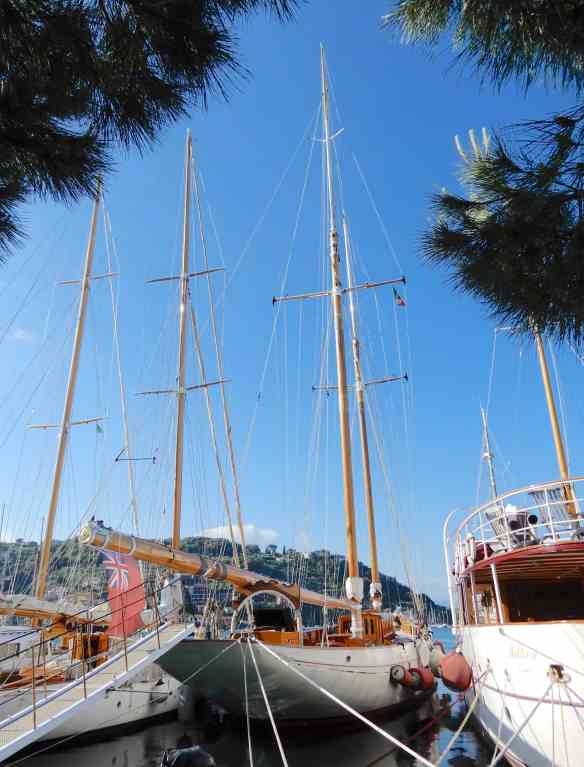
and beautiful boats moored in the marina.
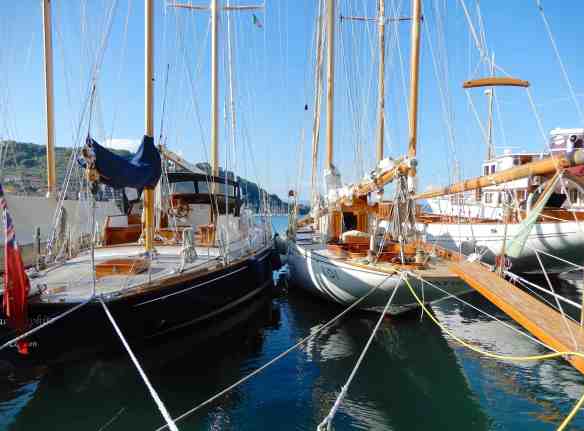
9.yachts, Le Grazie harbour10.yachts, Le Grazie harbour

The village takes its name from the Santuario Nostra Signora delle Grazie (Sanctuary of Our Lady of Grace). The church dates back to the 11th century when a group of Benedictine monks came from the island of Tino. The present church and monastery were built in the 15th century, though the monks were driven out in 1798 and the church became a parish church. The ancient convent is now a private residence and I am lost for words.
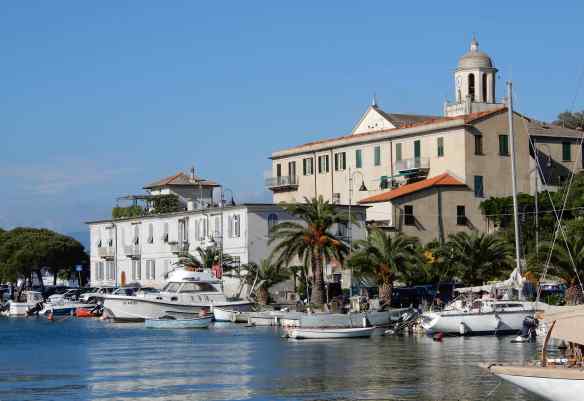
11.Santuario Nostra Signora delle Grazie

It seemed a good time to rest for aperitivo
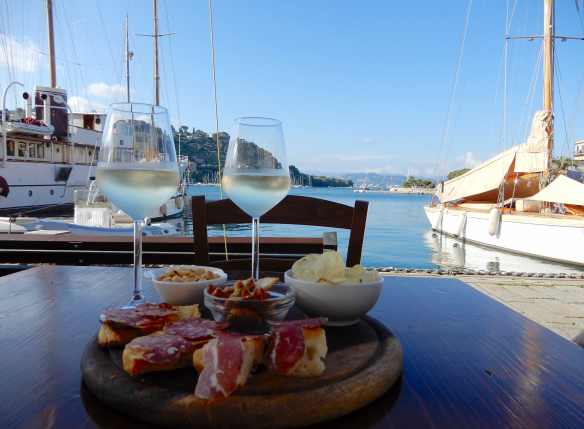
15.aperitivo, Le Grazie

while soaking up the atmosphere and sunshine.

20.Le Grazie harbour

We continued along the promenade until we could go no further.
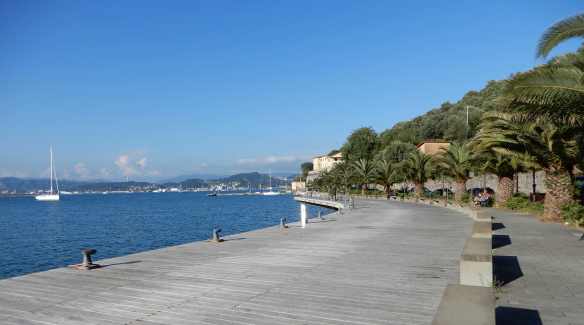
21.walkway

The Varignano Fortress, built in 1724, dominates the headland. Originally used as a storage facility and quarantine station, it then became a hospital before being taken over by the defence forces. Since World War II, it has been the headquarters of the Navy Divers and Raiders Group, named after Major Teseo Tesei who invented the human torpedo. No prizes for guessing how he died.
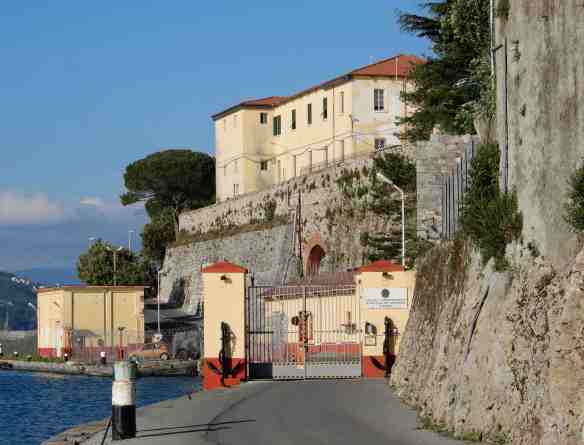
22.Varignano Fortress

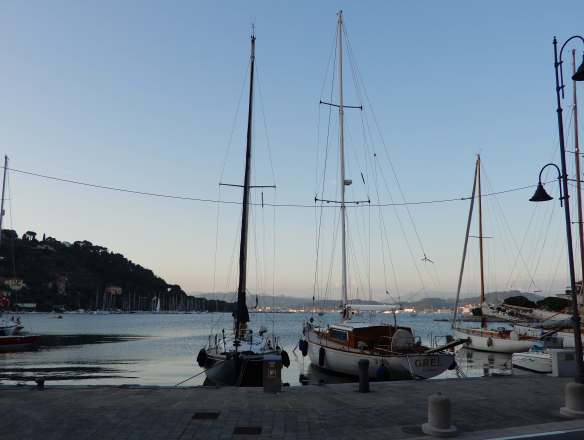
With the descending sun glistening on the water, we ambled back to seek sustenance.
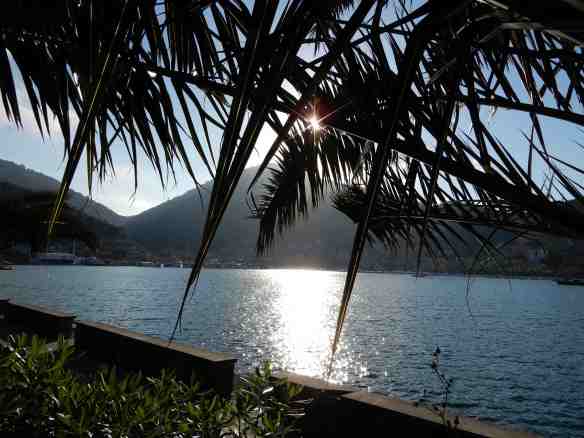
23.Le Grazie harbour

Ristorante Il Gambero was the perfect setting

to observe life in the village and harbour
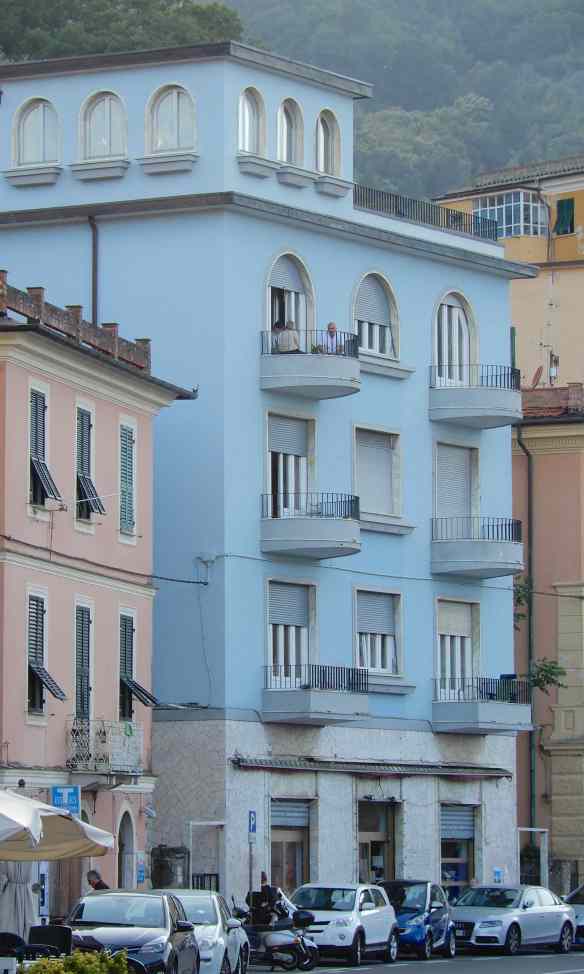
27.Le Grazie30.Le Grazie harbour

31.Le Grazie harbour

while enjoying delicious fresh seafood.

There is only one way to end a perfect day.
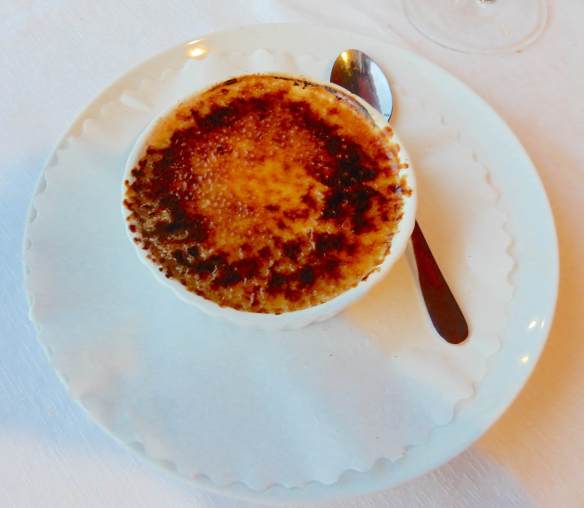
35.crème brûlée

Maroondah Dam

The day we had planned for a scenic drive from Healesville dawned wet and windy but, with limited time, we forged on regardless. Ten minutes down the road, we parked at Maroondah Dam and braved the elements to explore the beautiful gardens. Landscaped in the early English style after the completion of the dam wall in 1927, exotic and native trees cohabit. Some had shed the last remnants of their autumn apparel

1.Maroondah Reservoir Park

while evergreen stalwarts proudly displayed their verdure.

2.Maroondah Reservoir Park

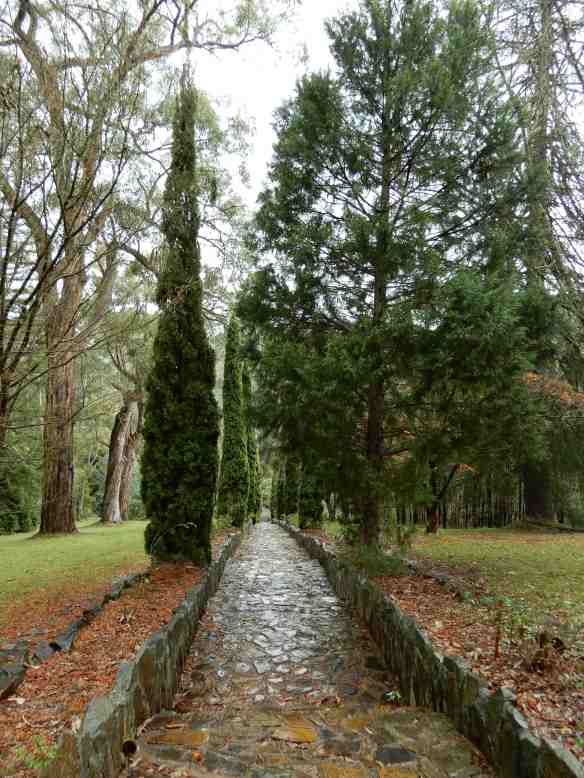
The Rose Stairway, constructed in the 1940s, was so named because the stone steps were originally flanked by roses. For some reason, they were replaced around 1980 with Golden Pencil Pines.

3.Rose Stairway

We ascended the stairs to the small rotunda at the top and,

4.Rotunda, top of Rose Stairway

following a signpost to the dam wall, passed another of the five rotundas in the park, the Bell Rotunda.

5.Bell Rotunda

The path led across the dam wall to a lookout on the other side but we weren’t willing to challenge the ferocious wind.

6.dam wall

With camera in one hand and inverted umbrella in the other, I ventured far enough to catch a glimpse of Maroondah Reservoir. The 26,000 acre catchment area is entirely eucalypt forest and no human activity is allowed on the water.

7.Maroondah Reservoir

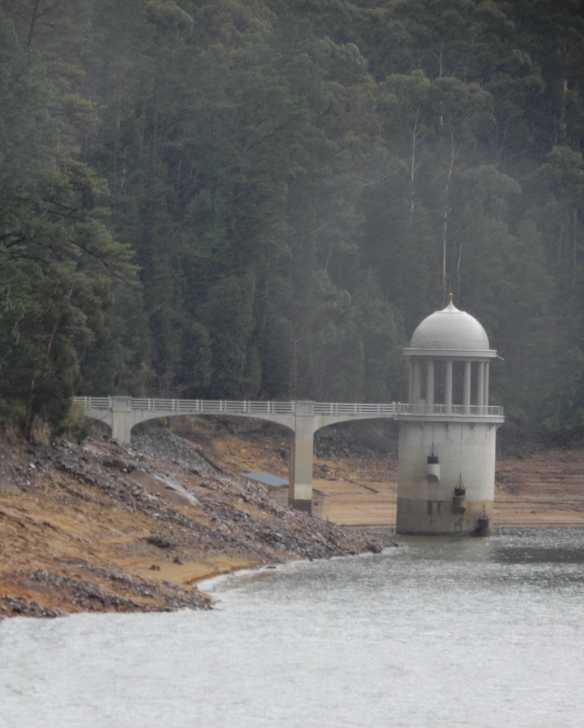
Risking life and limb, I was determined to get one shot of the temple-like outlet tower.

8.outlet tower

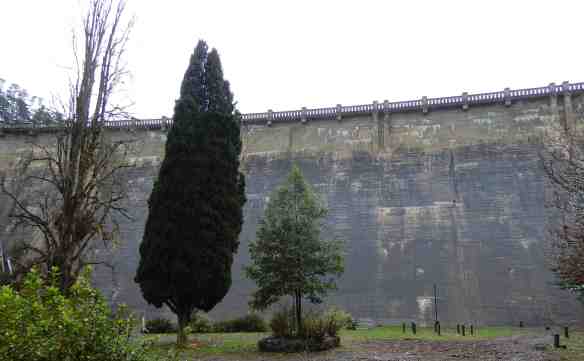
The impressive 41 metre high concrete dam wall is arched to withstand the pressure of the water upstream.

9.dam wall

We beat a not too hasty retreat down the Rose Steps, hoping to avoid spectacular slippage,

10.Rose Stairway

stopping to admire a very late or very early Azalea bloom.

11.Azalea

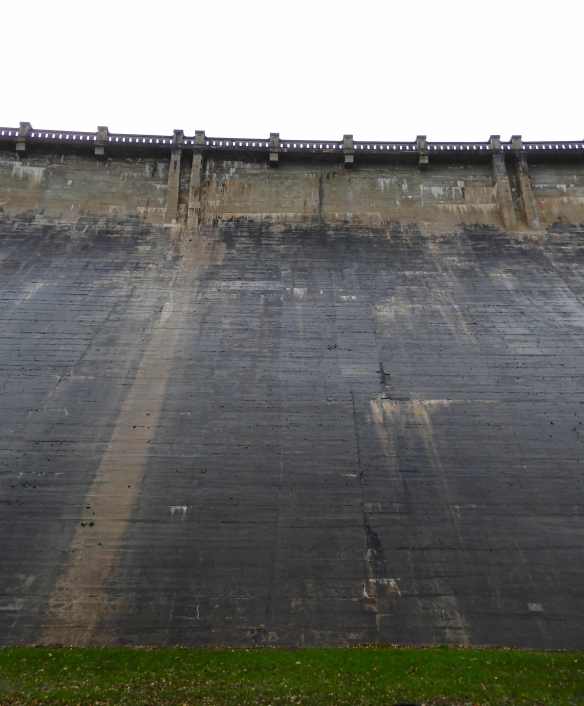
The towering dam wall is even more dramatic when viewed from below.

12.dam wall13.dam wall

The valve houses have stood the test of time and are even more beautiful wearing nature’s adornments.

14.historic valve house

Seemingly a serene lily pond, the compensation channel is the point where water released from the reservoir flows back into the Watts River.

15.pond

Spring would be the perfect time to explore the park, stroll along the walking trails and perhaps enjoy a picnic. We will just have to return one day.

farewell Ireland

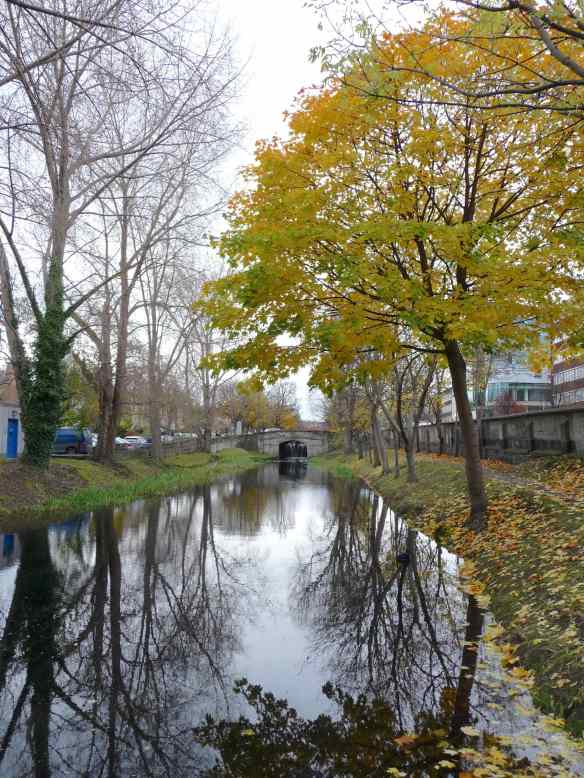
The final hours of any holiday are difficult, what to do to make the most of the remaining time before the impending trip to the airport? We set off from the hotel in the direction of the Grand Canal, the same one we discovered on our first day in Ireland at Edenderry.

1.Grand Canal Walk

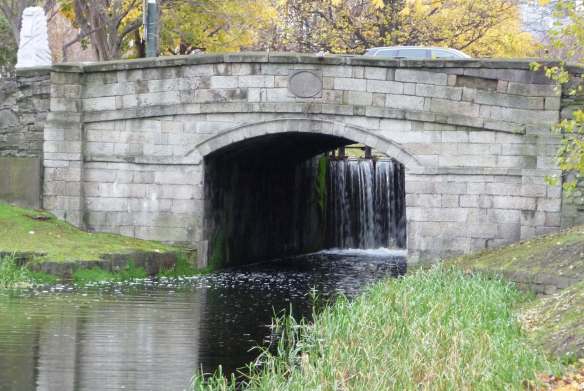
The canal begins in Dublin at the River Liffey and, 43 locks later, connects with the River Shannon 131 kilometres away.

2.Grand Canal Walk

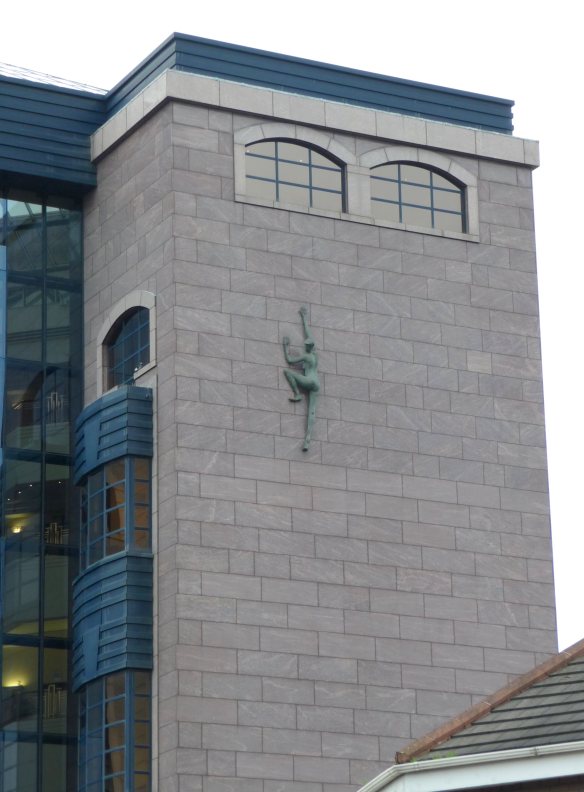
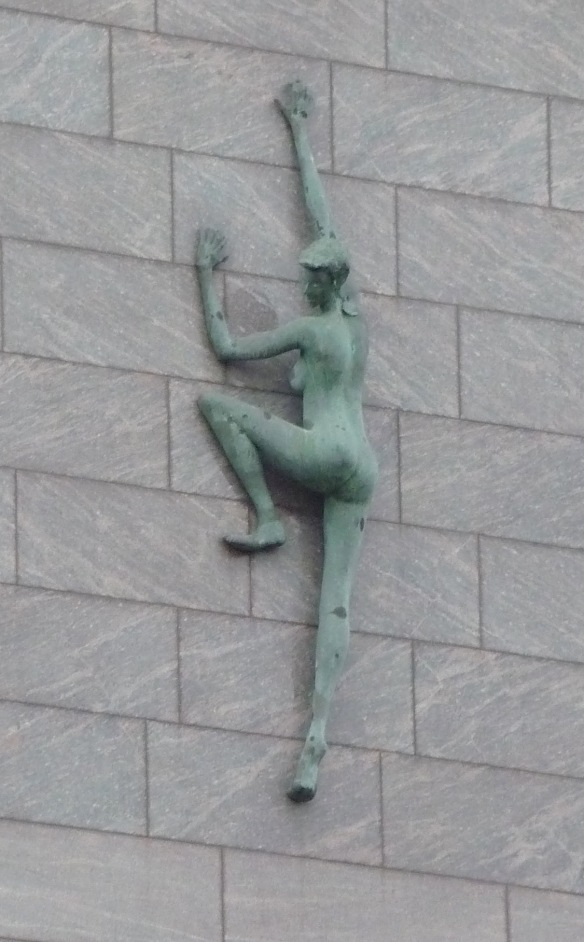
We noticed a naked female figure seemingly climbing the wall of the Treasury Building.

3.Liberty Scaling the Heights

The sculpture is titled Aspiration – Liberty Scaling the Heights by artist Rowan Gillespie and was installed in 1995. Representing Ireland in the struggle for freedom that took place in 1916, it is fitting that this building was once occupied by Éamon de Valera who was a key figure in the Easter Rising. He was arrested and sentenced to death but instead, was released and went on to be President of Ireland from 1959 to 1973. Although the figure appears to be made from bronze, it is actually foam-filled fibreglass.

4.Liberty Scaling the Heights

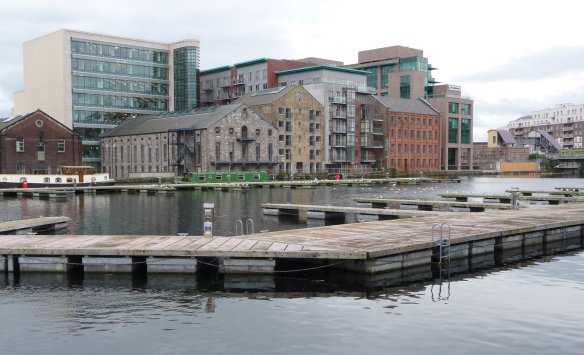
We wandered further to Grand Canal Docks, the world’s largest docks at the time they opened in 1796. With the advent of the railways they fell into decline and by the 1960s were almost completely derelict. The land was rendered toxic by a history of chemical factories and tar pits until regeneration began in 1998, with millions spent on decontamination. Since then, significant redevelopment has seen the docklands become the location for multinational companies.

5.Grand Canal Docks, inner basin

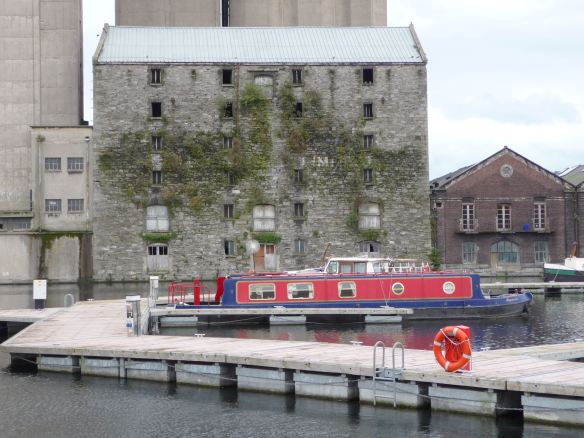
A functioning mill until 2001, the gorgeous 19th century stone block building of Boland’s Mill is a protected site. The concrete silos, however, have since been demolished as part of the Boland’s Quay reconstruction.

6.Bolands Mill

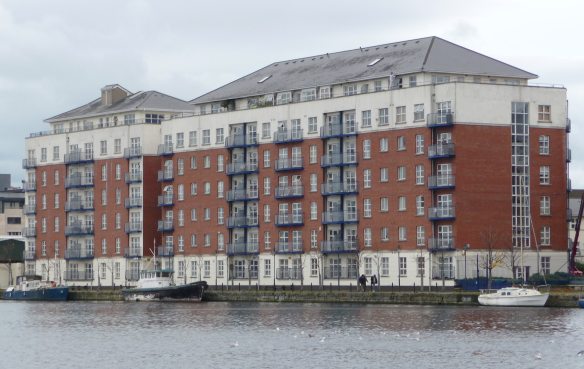
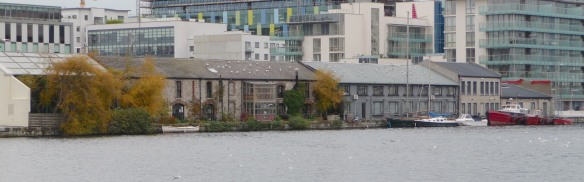
I could imagine living in an apartment overlooking the docks,

7.Grand Canal Docks

although new construction was encroaching on some of the characterful older buildings.

8.Grand Canal Docks

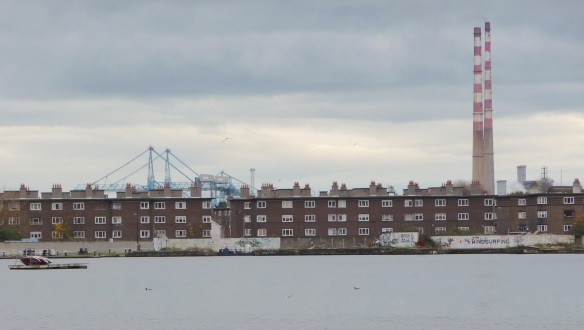
The chimneys of the Poolbeg Power Station, known as the Poolbeg Stacks, dominate the skyline to the east.

9.Poolbeg Stacks

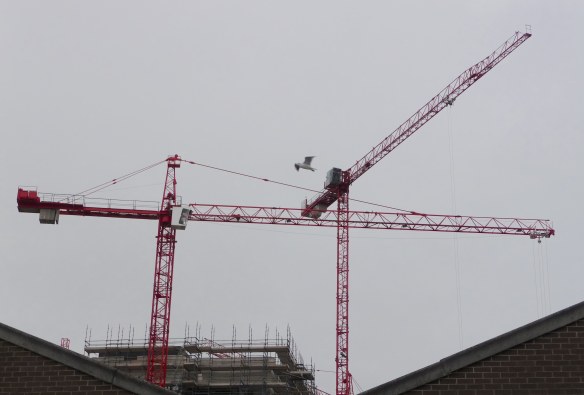
It seems that construction will be an ongoing enterprise in the docklands,

10.credit crunch construction

something to keep the resident cormorants interested.

The time had come for us to make our way to the airport and one more taste of Ireland before boarding the shuttle to Heathrow.

17.Dublin Airport

Palazzo Davanzati

While staying at Villa Boccella our lovely friend, Deb (not the same lovely Deb that lives in Launceston), escorted us on a day trip to Florence to share the wonders of a city she knows well. Without her, we never would have discovered Palazzo Davanzati. Built by the wealthy merchant Davizzi family in the 14th century, the palace was purchased by the Davanzati family in 1578, their coat of arms is proudly displayed on the façade.

1.Palazzo Davanzati

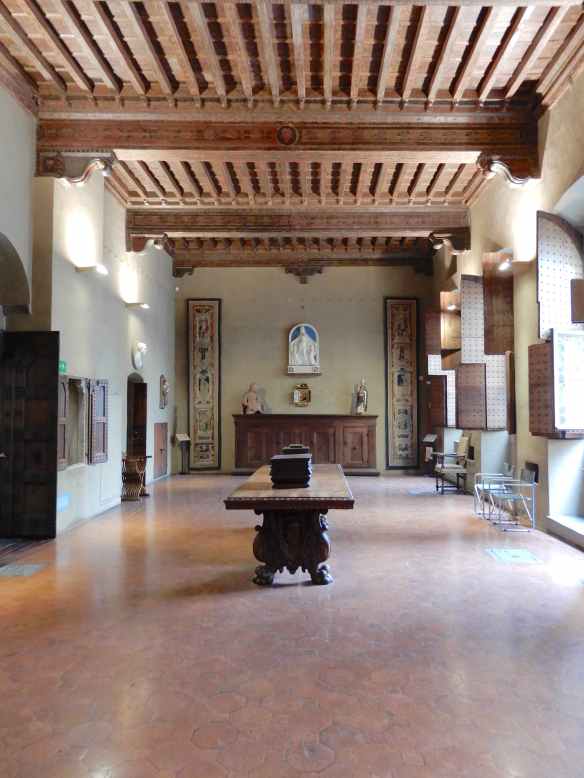
They retained possession until 1838 after which the residence was divided into flats. In 1904, antique dealer Elia Volpi rescued, restored and furnished the property before opening it to the public as a museum in 1910. Ownership changed hands again in the 1920s and eventually the Italian state took over in 1951. The museum has undergone major restoration in recent years, the result is nothing short of spectacular. We entered into an internal courtyard, instantly boggled by the grandeur.

2.looking up from courtyard

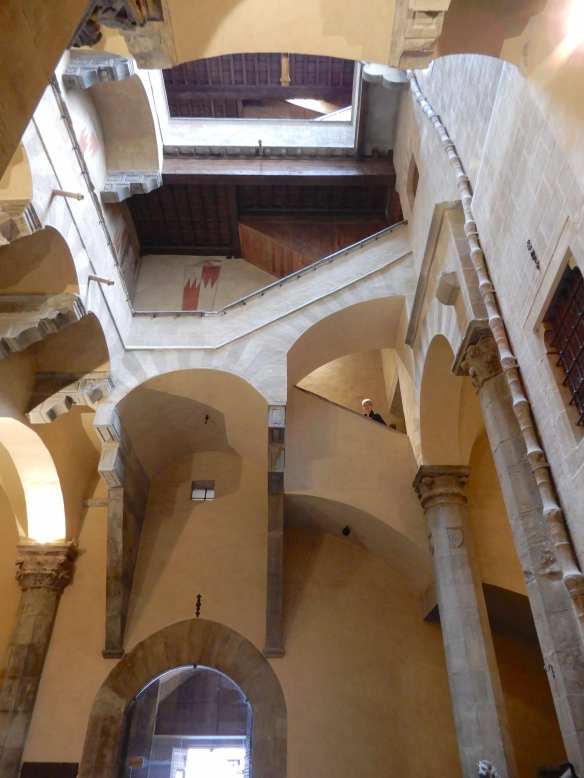
The rooms on the upper floors are arranged around the central courtyard, gazing upward the architecture resembles a labyrinthine puzzle.

6.looking up from courtyard

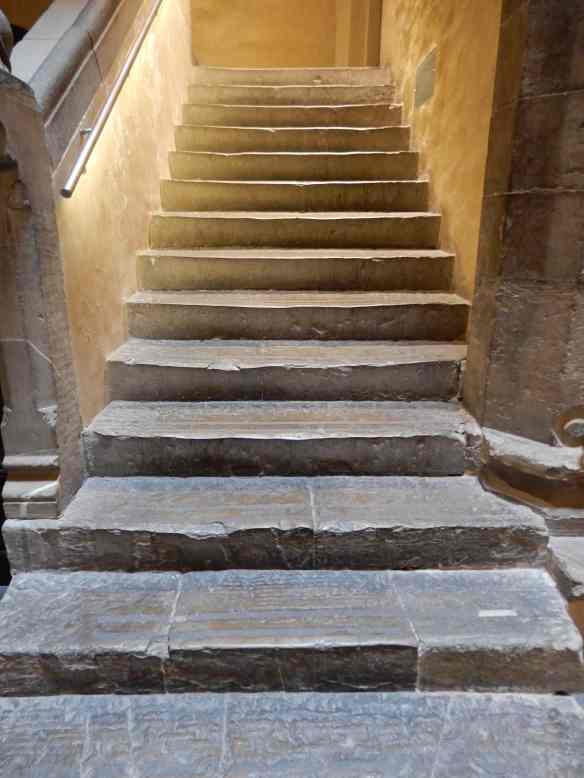
We climbed the worn stone steps to the first floor

7.steps

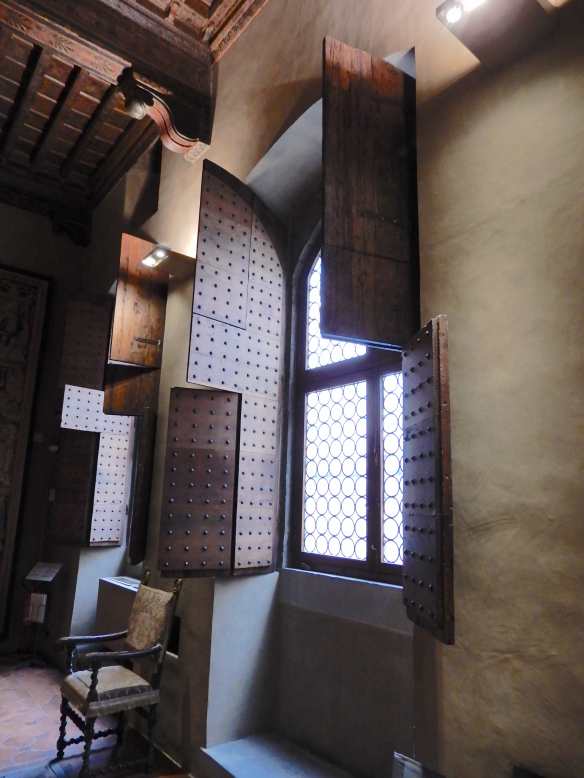
and entered the Great Hall, a room that would have been used for conducting business. The trapdoors in the floor in front of the windows open up to the loggia below so visitors can be identified before granting entry.

8.Great Hall9.Great Hall

The intricate ceiling detail is stunning, though I wondered about the comfort of the furniture.
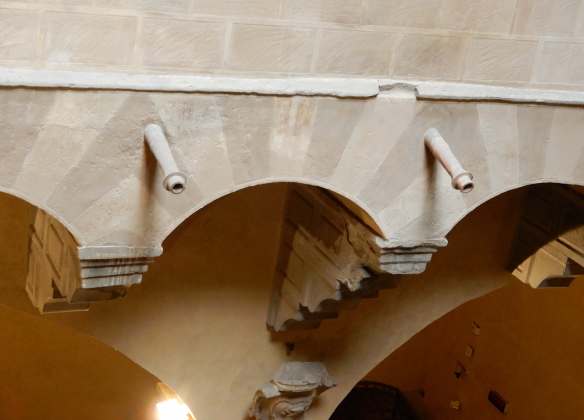
Water can be hauled to all floors from the private well in the courtyard via pitchers on a pulley system.

On the same floor, the walls of the Parrot Room are decorated with a geometric patchwork design, motifs of the birds are painted in the lattice separating the blocks.

14.Parrot Room

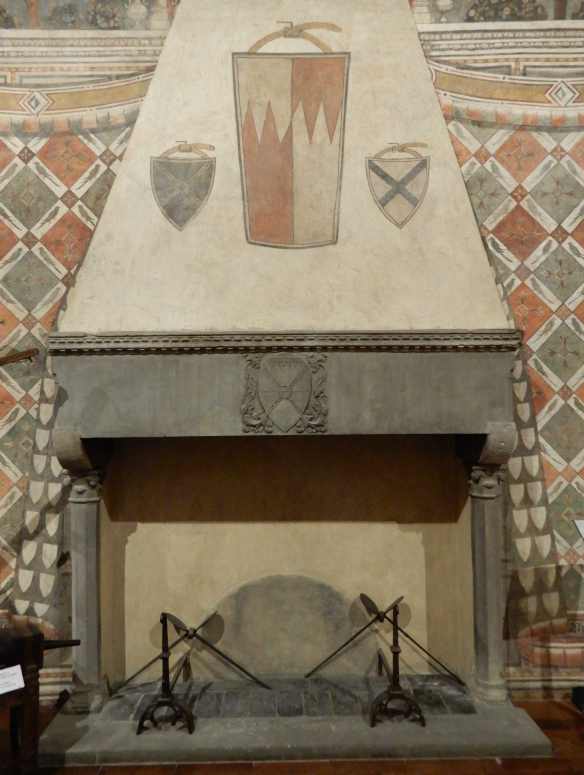
The huge fireplace is adorned with the red and white Davizzi coat of arms with emblems on either side representing the Ridolfo and Alberti families who married into the Davizzi family.
15.Parrot Room fireplace

The frescoed wall of the adjacent bedroom incorporates coats of arms of families allied with the Davizzi. The beautiful bed cover is a copy of the Guicciardini Quilt, the only known surviving example of medieval quilts. The original, made in Sicily in the second half of the 14th century, resides in The Bargello less than a kilometre down the road.

16.Peacock Room

Even though it would have been a luxury at the time, the ensuite bathroom is small and not conducive to a good long soak.

19.ensuite

There is a room displaying sewing and spinning implements as well as exquisite examples of lacework.

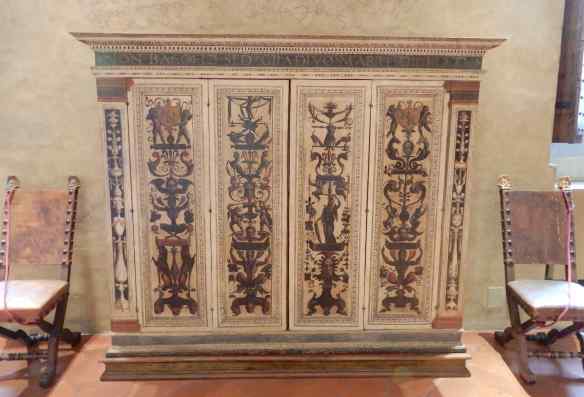
Another room exhibits furniture from the 14th to 19th century: delicate porcelain, timber cabinets, chairs and storage boxes fill the space.

24.cassone

30.chest

26.armour cabinet, Audience Room

A small water closet hides behind a very substantial timber door.

31.water closet

Obviously, there is indoor plumbing, these appear to be breather vents

32.breather pipes

and the drainage pipe snakes its way down the internal courtyard wall.

On the second floor, the frescoes in the most sumptuous bedroom are inspired by the tale of the Chatelaine de Vergi (I love this version, I was enthralled), a tragic medieval story of friendship, love, loyalty, betrayal and the consequences of all the aforementioned. An unusual choice for a marital bedchamber or perhaps a constant reminder of the benefits of fidelity?

35.bedroom of the landlady

38.bedroom of the landlady

The addition of the ensuite bathroom was again unexpected.

39.bathroom

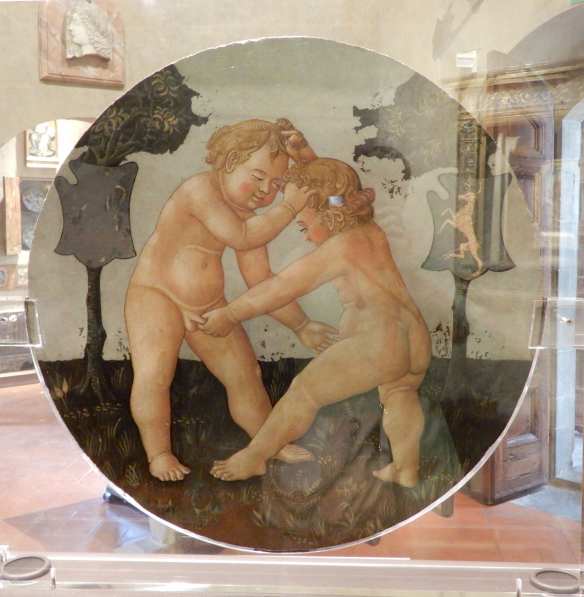
There is another bedroom on the third floor, as well as the kitchen, I don’t know why I haven’t got any photos of them. Interestingly, the kitchen is on the top floor to avoid cooking smells in the lower living areas and contain damage in case of a fire. Just when I thought we’d seen everything, a circular painting caught my eye. The timber platter is a birthing salver, circa 1450, originally used in Florence to bring food to pregnant women and then became symbolic gifts for a successful birth. The cherubs are engaging in a game of civettino where the players have to maintain a certain distance, the right foot of one touching the left of the other. The aim is to avoid being slapped by your opponent, although ‘slapping’ is probably not the most appropriate term to explain this depiction.

40.birth salver

Kilmainham Gaol

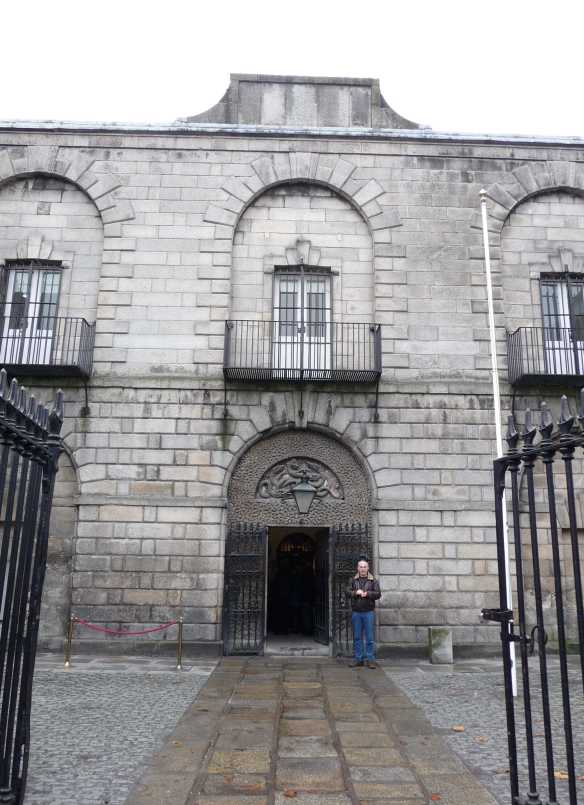
A suitably gloomy Dublin day accompanied our visit to Kilmainham Gaol, a prison built in 1796 and remembered for the incarceration and executions of the leaders of the 1916 Easter Rising. Decommissioned in 1924, the property was left deserted and neglected until 1960 when volunteers set about restoring the site to preserve it as a museum.

1.Kilmainham Gaol entrance

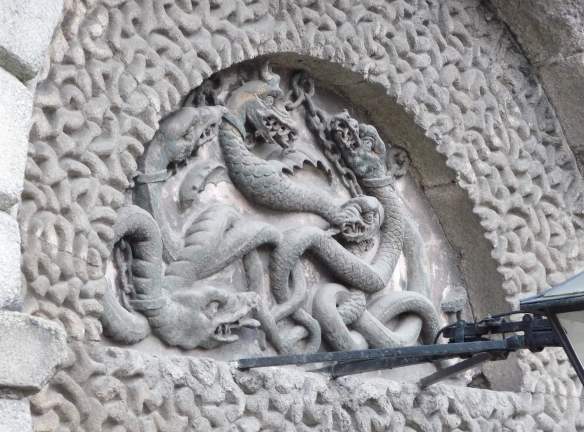
Above the entrance, a carving of five serpents in chains represents the five most heinous crimes: rape, murder, theft, piracy and treason.

2.Five serpents in chains above entrance

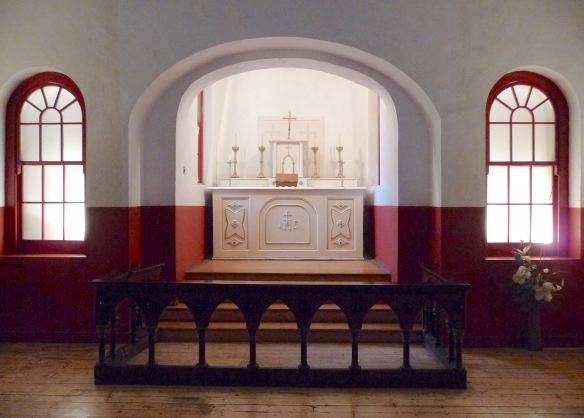
The restoration was completed in 1971 with the re-opening of the chapel after reconstruction of the altar. One of the leaders of the Easter Rising, Joseph Plunkett, married his fiancé Grace Gifford in the chapel just hours before he was executed.

3.Chapel

The West Wing is the oldest part of the gaol, the corridors are long, dark and cold.

4.West Wing5.West Wing

The limestone walls gave no insulation and the windows had no panes, an attempt to reduce the incidence of disease with the flow of fresh air.

Poor health and hygiene was inevitable with five prisoners sharing a cell built for one. There was no segregation between men, women and children and a single candle provided the only light and had to last two weeks.

9.cell

An inscription has been scratched by a former prisoner over a doorway , “beware of the risen people that have harried and held, Ye that have bullied and bribed”. The quote is from the poem, The Rebel by Patrick Pearse, one of the authors of the Irish Proclamation of Freedom and a leader of the Easter Rising.

10.Padraig Pearse quote

The Great Famine contributed immensely to the problem of overcrowding in the West Wing with more people found guilty of stealing food and those committing crimes deliberately so they would at least be fed regularly. Adding to the numbers were convicts awaiting transportation to Australia and people with mental illnesses.

11.West Wing

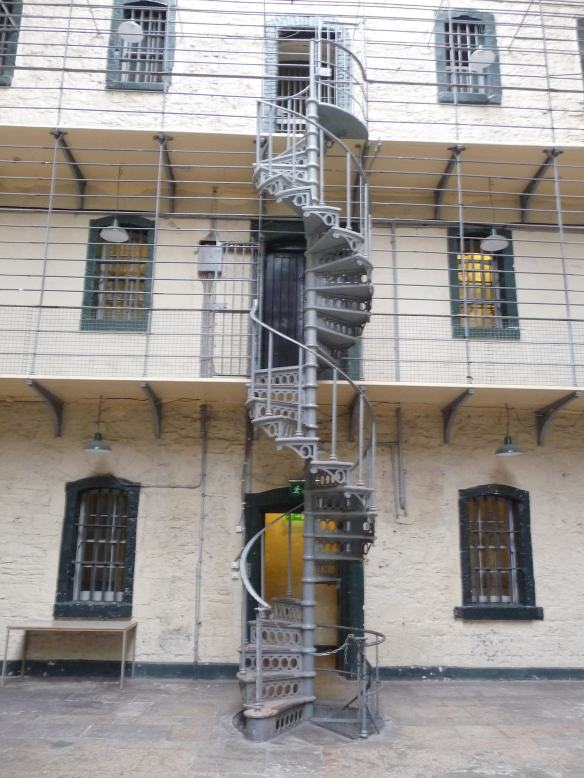
The situation was alleviated somewhat in 1862 with the opening of an additional ninety six cells in the new East Wing. The Victorian era brought different ideas on the reform of inmates and the new addition was more open and much lighter.

12.East Wing Main Hall13.East Wing16.East Wing

The cells didn’t seem to be any bigger but definitely less draughty, a bonus for the men who were moved to the East Wing. The women stayed behind in the dark, cold cells of the West.

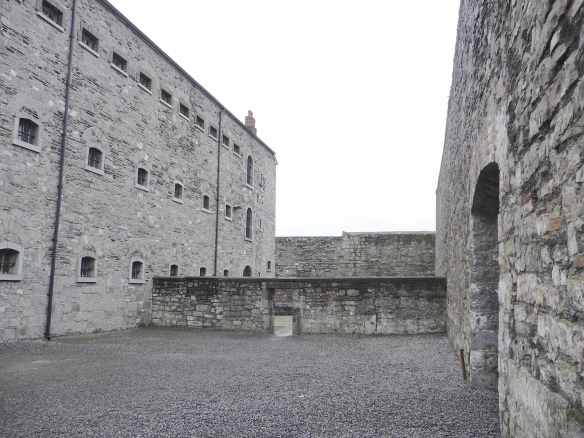
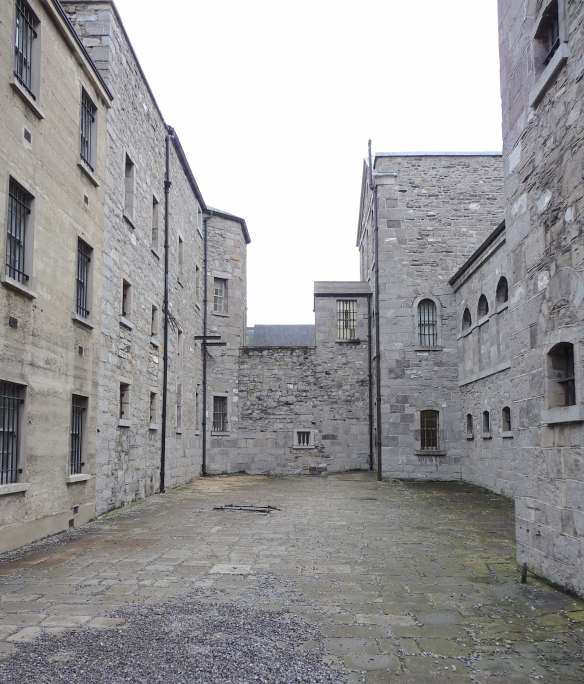
With the new wing came exercise yards where the prisoners spent one hour a day, silently walking in a circle. Another hour was spent in church and the remaining 22 hours confined to their cells.

19.exercise yard East Wing20.exercise yard East Wing21.exercise yard East Wing

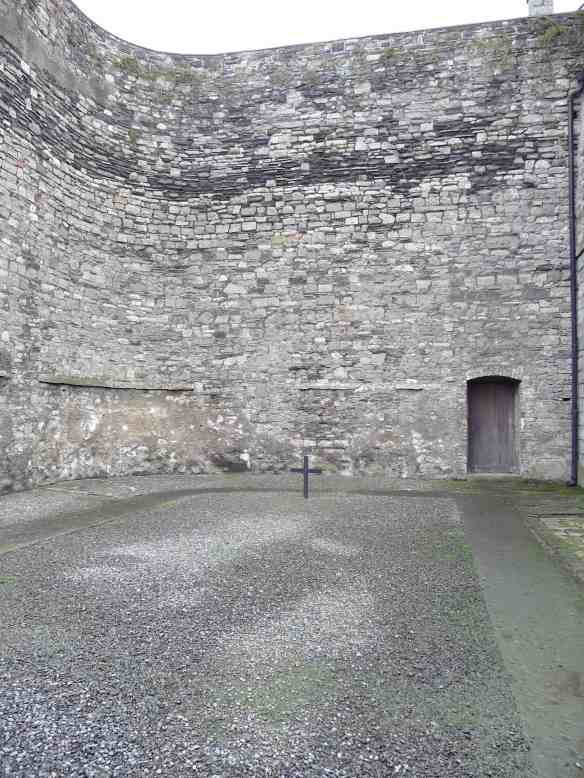
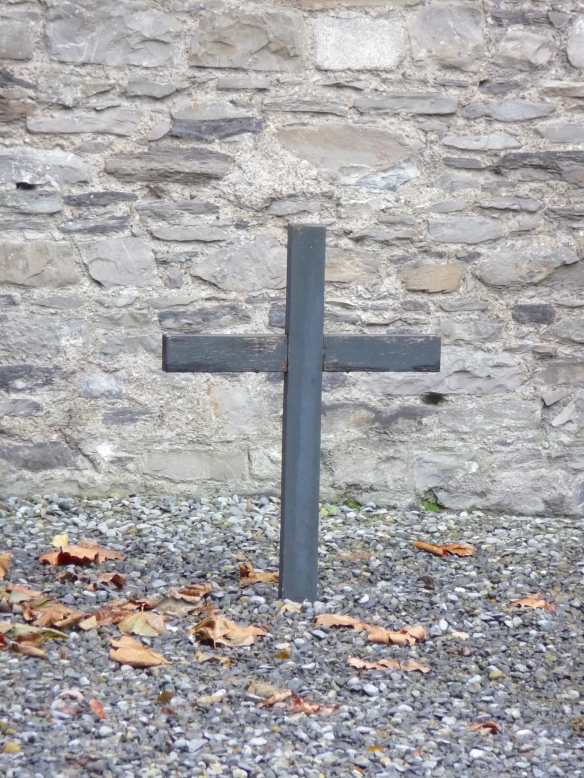
The Stonebreakers’ Yard was stunningly silent, a palpable ominosity hung in the air. Between May 3rd and May 12th 1916, fourteen men, leaders of the Easter Rising, were executed by a British firing squad. The first was Patrick Pearse, a cross marks the ground where he and the next twelve died.

22.Cross marking the place of execution of the leaders of the 1916 Rising

James Connolly was the last. He had been badly wounded in the uprising and, even though he only had a day or two to live, was brought to the courtyard on a stretcher, through the gate.

23.Stonebreakers' Yard gate where ambulance brought James Connolly

Unable to stand, instead of being marched to the other end of the yard for execution, he was tied to a chair and shot. A second cross marks the spot where he died.

24.Cross marking the place of execution of James Connolly

It seems fitting that the Irish tricolour flies between these two crosses, a symbol of the independence these men fought so hard for.

25.Irish tricolour between crosses in Stonebreakers' Yard