Connemara

Leaving Bundoran early on a crisp, autumn morning, we continued our drive through County Donegal heading southwest through County Mayo toward Galway. The journey was broken by the necessity to stop and take photographs of the beautiful scenery. Solitary stone ruins scattered the countryside

1.ruins

and gentle waterfalls tumbled a tune.

2.waterfall

Rivers skilfully traversed rocks before disappearing beneath ancient stone bridges.

3.river4.stone bridge

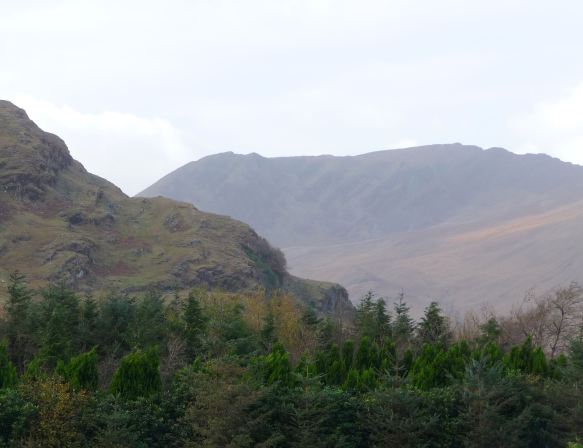
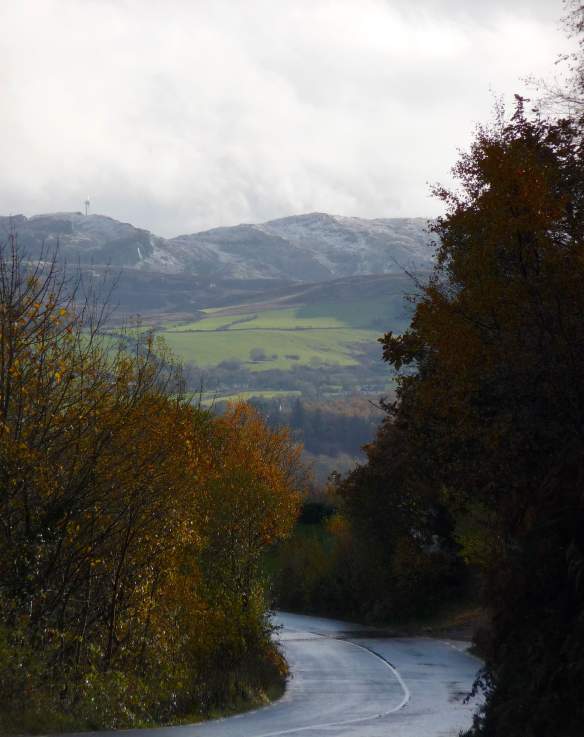
Shafts of sunlight shone briefly on the mountains before retreating once again behind the clouds.

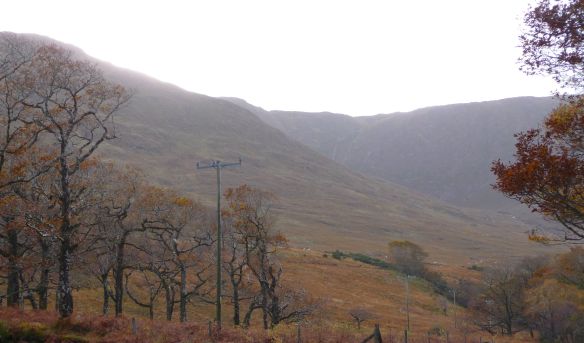
5.mountains6.mountains7.mountains

As the landscape changed, gentle streams meandered through farmland

8.stream

and  flowed calmly under stone arches.

9.stone bridge

Despite our distractions, we reached Connemara in good time, this old caravan by the side of the road presented a subliminal suggestion.

10.old caravan

We arrived in Leenane in time for lunch, a peaceful village at the head of Killary Harbour. Extending 16km toward the sea, Killary Harbour is the most westerly fjord in Europe, majestic mountains rising on either side make for a spectacular panorama.
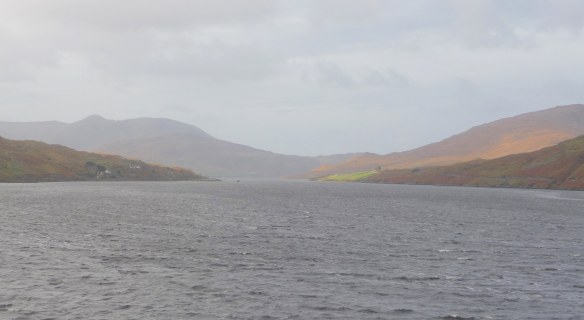
11.Killary Fjord12.Killary Fjord

The cemetery has prime position.

13.Leenane cemetery & Killary Harbour

Further along the shore we had a different perspective of the fjord

14.Killary Fjord

and a breathtaking view of Mweelrea, the highest mountain in Connacht and County Mayo.
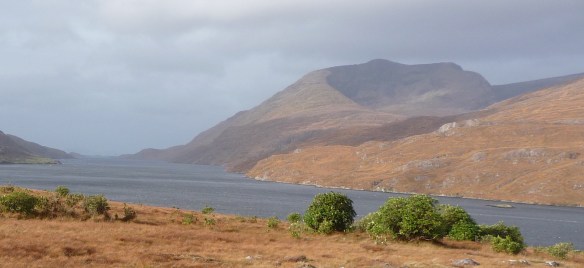
15.Mweelrea, Killary Fjord

We were looking forward to exploring Connemara, a region in west Galway known for its National Park, stunning coastline and fishing villages. Our intention was to drive to Clifden on the far west side of Connemara and continue the loop back to Galway. Unfortunately, we hadn’t gone far before a police roadblock informed us the road was closed due to an accident. Taking a detour, we came across a pub in the middle of nowhere and sought to assuage our disappointment with a tasty beverage. Entering the establishment, we were greeted with indifference by the three men at the bar who had seemingly already partaken of the amber liquid. The barman disappeared, presumably to prepare for customers. We waited at the bar, then took a seat at a table while the three aforementioned persons spoke to each other in Gaelic and furnished us with less than friendly stares. We were a bit slow on the uptake but, when the barman failed to return, we beat a hasty retreat and, without looking back, made a beeline for Galway. For those of you who have read of our disgruntlement with Holly, our satnav, here is evidence. She is unable to comprehend that we are already on a road!
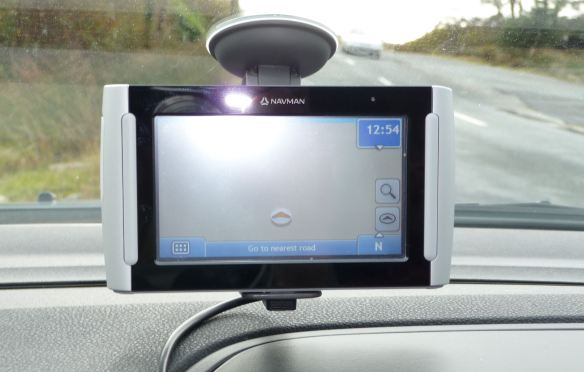
16.Holly

The Colosseum

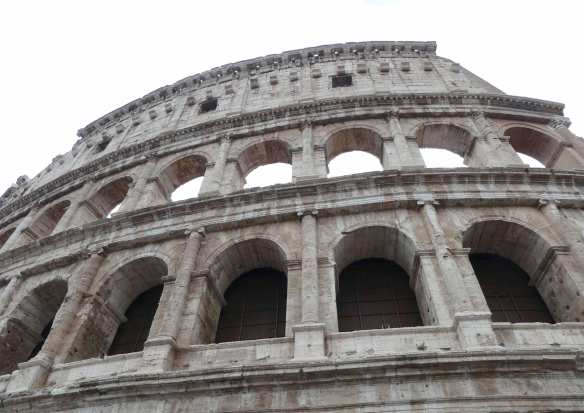
We were both looking forward to seeing the Colosseum while in Rome and had booked a tour well in advance. Not just any tour, one that would take us underground through the  tunnels and dungeons where gladiators and animals awaited their fate. Having to fit in around other plans, we only had one day available to do this and it was a national public holiday. We were very disappointed to learn, two weeks beforehand, that the decision had been made to close the Colosseum on that day. Instead, on a drizzly Roman morning, we boarded a “hop-on hop-off” bus to see the sights. Approaching the Colosseum, it became apparent that it was, in fact, not closed that day. The sheer size of the construction was breathtaking.

1.The Colosseum

We easily arranged another tour with a small group, it didn’t include the dungeons but it was a fabulous experience with a very entertaining guide. We had time to admire the Arch of Constantine before the tour began. The largest surviving Roman triumphal arch was erected in 315 AD to commemorate the victory of Emperor Constantine over Maxentius. The arch is decorated with an array of intricate Roman sculptures.

2.The Arch of Constantine

Originally known as the Flavian Amphitheatre, the Colosseum was commissioned in 72 AD by Emperor Vespasian of the Flavian Dynasty. The nefarious Emperor Nero had built a huge palace for himself after a great fire destroyed Rome in 64 AD and then took his own life four years later. Vespasian gifted the land back to the Roman people and built the arena as a place for public entertainment. The amphitheatre opened in 80 AD, celebrating with 100 days of games in which more than 2,000 gladiators lost their lives.

3.The Colosseum

The exterior has three storeys of arched entrances supported by semi-circular columns of which each storey has a different style.

4.The Colosseum

More than 50,000 spectators, with numbered pottery shards as tickets, would enter the stadium through passageways that led to a tier of seats.

5.steps to seats

The best seats were allocated to the Emperor and the Vestal Virgins, followed by the senators. Some of the areas have names carved in stone, presumably reserving the seats for the notables.

6.The Colosseum7.reserved seating

The rest of the tiers were filled according to social ranking, with standing room only at the very top for those less worthy. Gravediggers, actors and former gladiators were among those banned from the Colosseum entirely.

8.standing room only at the top

Measuring 190 by 155 metres, the Colosseum was the largest amphitheatre in the Roman world.

9.The arena

The maze of tunnels underneath the arena

11.the hypogeum12.the hypogeum13.the hypogeum

were connected to the outside to allow for animals and gladiators to be brought in. There were elevators and pulleys for lifting caged animals as well as scenery and props.

10.tunnels

It seems to me that modern arenas have followed the ancient Roman design, nothing much has changed. At ground level, there are eighty entrances, each one numbered, so the venue could be filled and emptied quickly.

14.exits15.exits

The stadium was used for four centuries, until gladiatorial combats were no longer considered the height of entertainment. The Colosseum was abandoned  and used as a source of building material. Along with vandalism, earthquakes and natural weathering, two-thirds of the original structure has been destroyed. I know I always say this about ancient technology but the complexity of the stonework never ceases to amaze me.


There were many different types of gladiators in ancient Rome and each had his own set of weapons and armour, some fought only specific foes. They are represented in these preserved bas relief sculptures.

21.Bas relief of gladiators fighting22.Bas relief in the Colosseum of gladiators fighting23.Bas relief in the Colosseum of gladiators fighting

Various popes sought to conserve the arena as a sacred Christian site in the 18th century. In the early 19th century, triangular brick wedges were added to shore up the walls


and in the 1990s, restoration efforts began in earnest. We caught a final glimpse of the Colosseum as we went in search of lunch and the opportunity to ponder life in ancient Rome.

26.The Colosseum

County Donegal

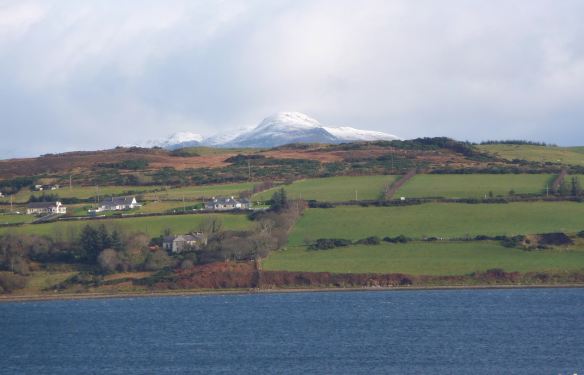
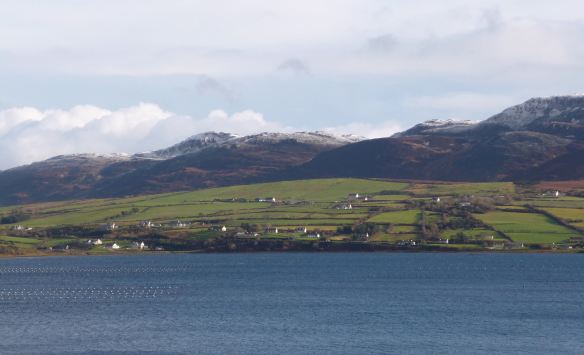
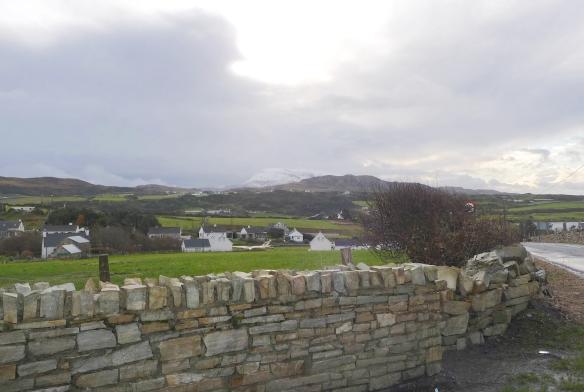
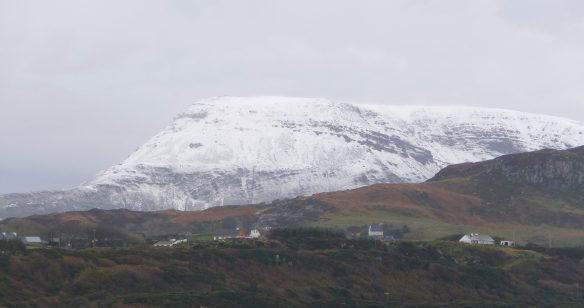
After a very comfortable night and hearty breakfast at the Ramada Hotel in Portrush, we took an early morning stroll to admire the scenery before continuing on our circuitous journey of Ireland. The small seaside resort town was quiet this time of year, the snow-capped mountains confirming the advent of winter.

1.Portrush2.Portrush

A panoramic ten minute drive

3.drive

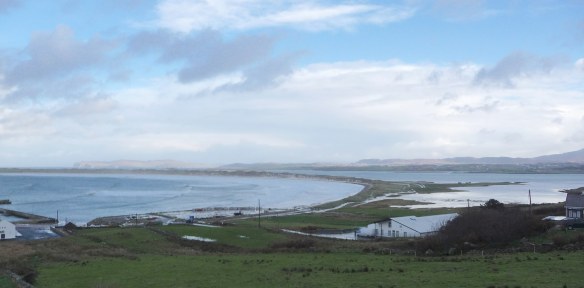
delivered us to Portstewart. Founded in 1792, this fishing village became a popular holiday destination for middle-class Victorian families. The two miles of golden sandy beach are still popular

4.Portstewart

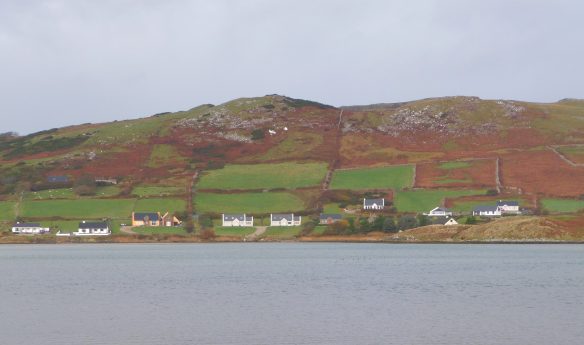
and waterside homes have a stunning backdrop.

5.Portstewart

The spectacular Derryveagh Mountains accompanied us on our route through County Donegal,

6.Derryveagh Mountains7.Derryveagh Mountains

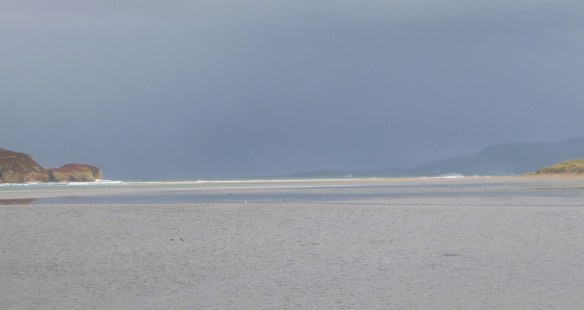
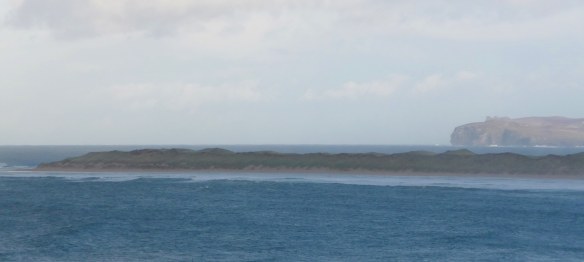
until we met the coast again at Ardara. The beautiful beaches, perfect for swimming, were serenely deserted.

8.Ardara9.Ardara10.Ardara

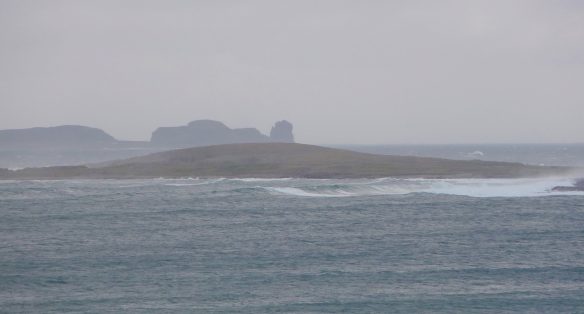
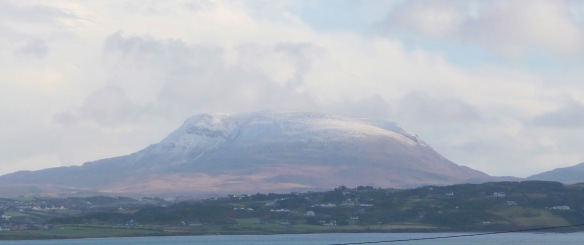
To the east, the Blue Stack Mountains loomed out of the mist.

11.Blue Stack Mountains

We stayed the night at the Holyrood Hotel in Bundoran, the tourist season was obviously, well and truly over.

Deredia a Lucca

There were some interesting additions to the city of Lucca on our last visit. Spectacular sculptures by Jiménez Deredia graced the main squares, their smooth, spherical lines a startling paradox to the surrounding ancient buildings.

1.Deredia a Lucca

Jorge Jiménez Martinez was born in Heredia, Costa Rica, in 1954 and began sculpting at the age of 13 after attending an art workshop. His signature style was influenced by the pre-Columbian sculptures of the Boruca tribe, monumental granite spheres he had seen in a museum as a young child. We came across the first sculpture just outside the city walls at Porta San Pietro, Genesi Costa Rica.

2.Genesi Costa Rica, Porta San Pietro

Martinez moved to Italy when he earned a study grant at the age of 22 and started working in marble and bronze. He graduated from the Academy of Fine Arts in Carrara, the marble from the Carrara quarries has been used for centuries for both building and sculpture. Juego was waiting at Piazzale Vittorio Emanuele, her bronze curves impossibly smooth.

In the early 1980s, Martinez changed his name to Deredia. He created a series of works known as Geneses in 1985, representing the transformation of matter and his belief that we are all just stardust, transmutating over time. Reclining in Piazza del Giglio, Recuerdo Profundo looks comfortably serene.

6.Recuerdo Profundo, Piazza del Giglio

Mistero seems incongruous against the 13th century façade of San Michele in Foro.

7.Mistero, Piazza San Michele8.Mistero, Piazza San Michele

Feminine qualities feature strongly in Deredia’s work, from motherhood, fertility and birth to different stages of life after birth. There were another three sculptures in Piazza San Michele, Germinacion,

Encuentro,

12.Encuentro, Piazza San Michele13.Encuentro, Piazza San Michele

and a very contented Plenitud.

14.Plenitud, Piazza San Michele15.Plenitud, Piazza San Michele

Sentinella was waiting in Piazza San Giovanni

16.Sentinella, Piazza San Giovanni

while the perfect spheres of Essenza and Transmutazione continued the theme of fertility in Piazza San Martino.

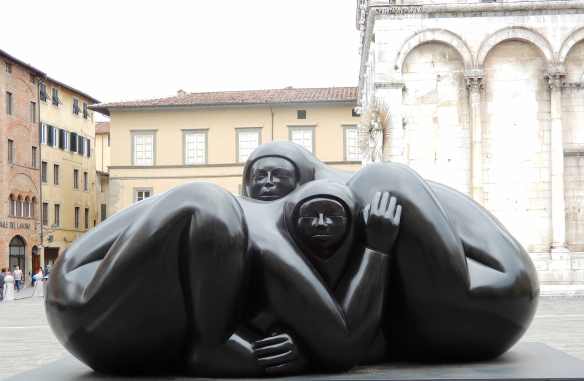
The sheer size of the sculptures was breathtaking. Pareja in Piazza dell’Anfiteatro with a breadth of more than three metres, was a beautiful, imposing presence of two women leaning on each other, the roundness of their bodies reflecting the light.

19.Pareja,Piazza dell'Anfiteatro

It was a privilege to experience Deredia in the enchanting city of Lucca.

Central Market

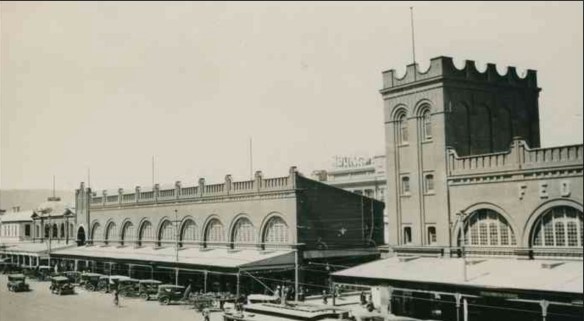
There was one place I simply had to visit on a recent trip to Adelaide. My memories of the seemingly endless stalls of fresh produce, the tantalizing aromas and vibrant atmosphere had me yearning to return. Adelaide Central Market began in 1869 and until redevelopment in 1965 was known as City Market.

1.Central Market Photo courtesy of SA History Hub

Photo courtesy of SA History Hub

With the establishment of Chinatown in the 1980s came traditional Chinese archways guarded by lions, pagoda style roofs and lanterns decorating a street lined with Chinese restaurants and grocery stores.

Central Market has an interesting history but that’s another story. This is about food. Meeting my two accomplices at the southern paifang (Chinese archway), we embarked on our journey of discovery. Join us as we wend our way along each aisle to ensure we miss nothing.

10.fresh produce

The House of Health offers bulk wholefood from grains, lentils, beans, rice, flours, nuts, seeds and dried fruit to Chia, Cacao and Hemp Seeds.

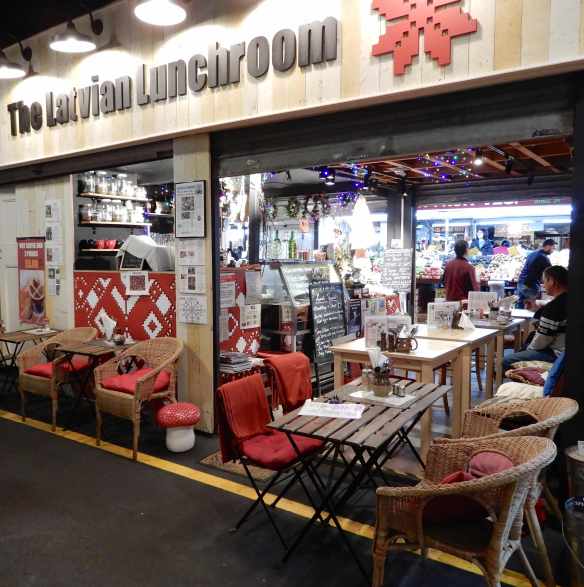
For authentic Latvian and Baltic foods using traditional recipes, the Latvian Lunchroom has a quirky cosiness.

13.The Latvian Lunchroom

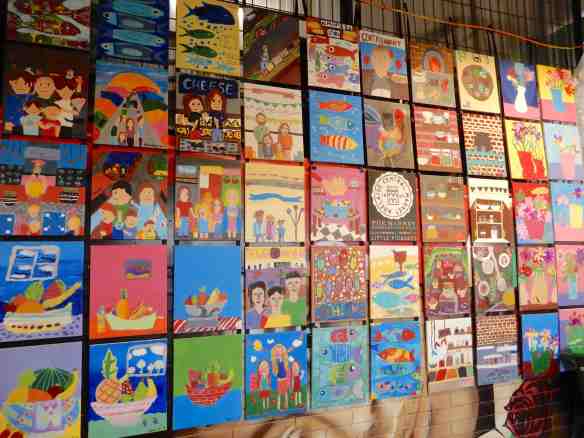
The wall opposite presents part of an exhibition entitled, ‘The Market Through Our Eyes’, by Little Picassos Art Studios. 400 artworks fill the walls throughout the market for four weeks, capturing the spirit of Adelaide Central Market through children’s eyes.

14.Little Picassos

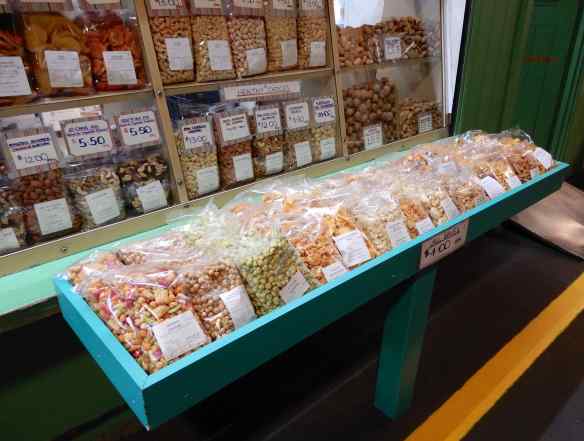
A wide selection of nuts, dried fruits and confectionery waited at The Carousel Nut Bar

15.Carousel Nut Bar

and Michael’s fruit & veg…well, it speaks for itself.

Something Wild is Australia’s first indigenous native greens, native game and meat wholesaler.

They have collaborated with Adelaide Hills Distillery to produce the unique Green Ant Gin.

20a.Green Ant Gin

The Green Ants are known for their medicinal benefits and protein content among indigenous societies and are harvested in the Northern Territory by the Motlop family of the Larrakia people. We enquired as to the flavor of the ants and were presented with a sample to taste. The intense citrusy lime flavor was quite unique and not unpleasant, ants are something I had never contemplated eating.

21.green ants

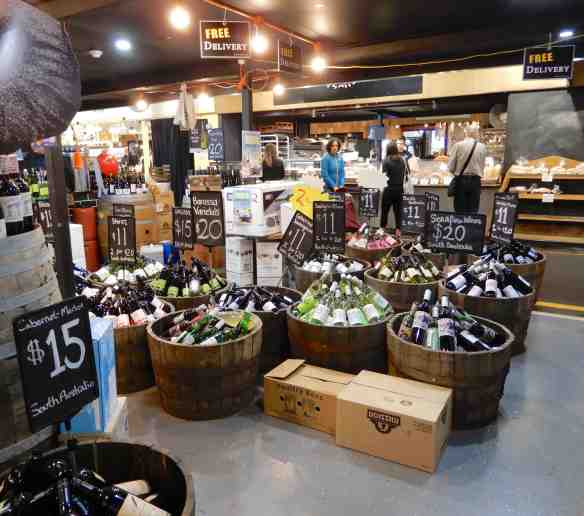
The Olive Tree Food & Wine is the cellar door of the market, stocking South Australian wines, olives, marinated antipasto and extra virgin olive oil.

22.The Olive Tree Food & Wine

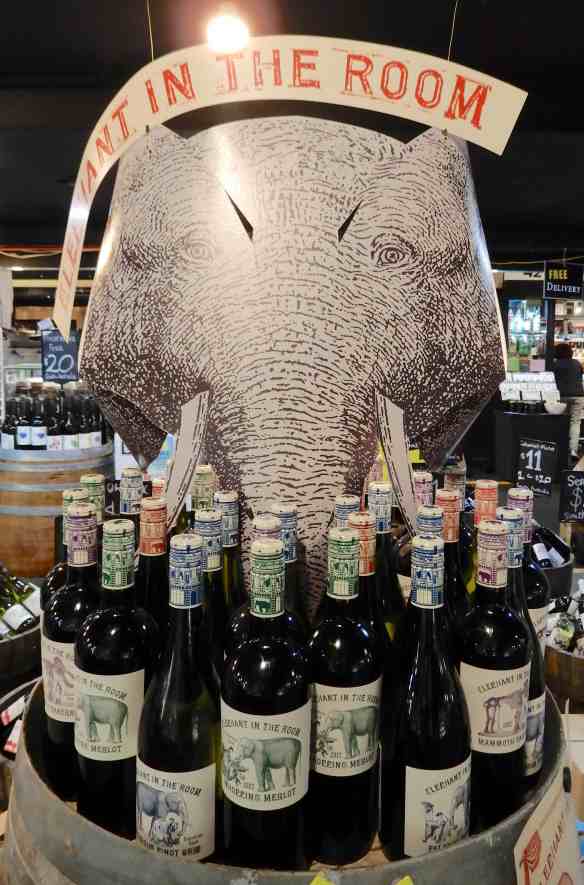
The Elephant in the Room couldn’t be ignored. The wines are sourced from the cool climate vineyards of the Limestone Coast region in south eastern South Australia, they are now on my shopping list.

23.Elephant in the Room

We were all smiles at Say Cheese, lingering a while to sample some of their local and imported cheeses.

The range of breads next door at Dough were boggling, I don’t know how we resisted the mouthwatering patisserie delicacies.

Even the simple egg looked enticing at the Happy Little Clucker.

Our cheese adoration came to the fore at The Smelly Cheese Shop,

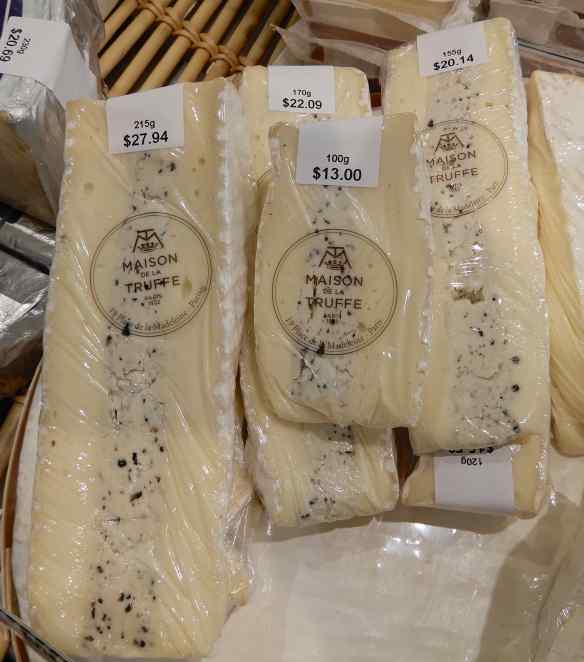
the creamy Maison de la Truffe won my heart and my tastebuds. The Brie de Meaux style cheese is layered with fresh truffle pieces and tastes like heaven. I hope I can find it here in Tasmania.

38.The Smelly Cheese Shop

Jamface by Poh (some may remember Poh’s Kitchen on the TV) is an eclectic structure of reclaimed timber and mismatched windows. A popular stop for coffee or lunch in a relaxed atmosphere.

There was a huge variety to choose from at The Mettwurst Shop, all naturally smoked, nothing artificial and you can try before you buy.

We could have stayed at the market for hours, something new to discover at each stall.

Unfortunately, my baggage allowance and border control prevented me from purchasing goodies but I did get a little something from The Mushroom Man. After tasting mushrooms cooked in butter and tossed in Truffle and Black Garlic Salt, I couldn’t resist.

52.Truffle & Black Garlic Salt

I will return to Central Market one day, soon I hope.