when in Rome…

When in Rome, it is impossible to not be in a permanent state of awe. With limited time, we overdosed on the history, architecture and general magnificence of this city in one day. Walking from our hotel, we turned the corner at the Fontana dell’Acqua Felice, built in 1587 to mark the completion of the Acqua Felice, an ancient aqueduct that provided the neighbourhood with fresh water. It is also known as the Fountain of Moses, a large statue of whom stands in the central niche and is flanked on either side by reliefs depicting biblical scenes. Four water spouting lions relax in front of the columns framing the niches.

On the other side of the street, two very grand 19th century buildings seemed to line the entire stretch of Via Vittorio Emanuele Orlando. The first is the boutique Mascagni Hotel, then the luxury Dependance Mascagni occupies the top two floors of the second building.

It wasn’t long before we were standing in the Piazza della Repubblica, the majestic Fontana delle Naiads is the stunning centerpiece of a huge roundabout. Constructed in the late 1800s, the original four lion sculptures were replaced by statues of nude water nymphs in 1901. Each figure lies on top of an aquatic animal, representing four aspects of water; a sea horse for the oceans, a swan for lakes, a snake for rivers and a lizard for subterranean streams.

6.fontana delle naiadi

After wandering around the Basilica di Santa Maria degli Angeli e dei Martiri (you can read more about that here) I noticed this intriguing doorway. The inscription reveals that this is the portal of the Annona Olearia, a series of wells excavated in 1764 to store olive oil. Pope Clement XIII had the foresight to ensure a supply to the city and thereby controlled the price of the product. Each of the ten wells could hold 44,000 litres.

7.portal of the annona olearia

The morning drizzle wasn’t showing any signs of abating as we bought tickets for the Hop On Hop Off bus and settled in to admire the shops along Via Nazionale.

8.via nazionale

The Basilica di Santa Maria Maggiore, dating back to 440AD,  dominates the piazza of the same name. The core of the original structure has been retained, although there has been much restoration and extensions over the centuries with the present façade commissioned in the 1740s. The bell tower, from the year 1300, is the tallest in Rome at 75 metres and the side chapels were added in 1500.
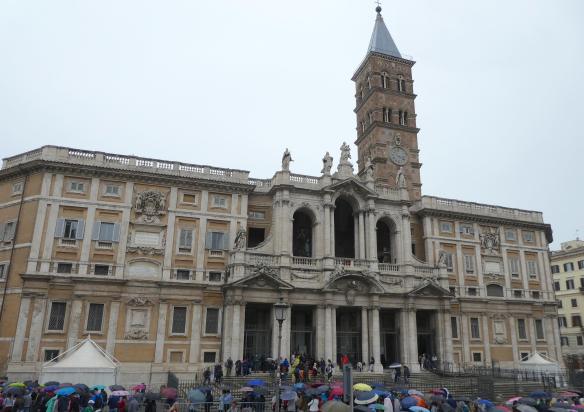
9.basilica di santa maria maggiore

The back of the basilica, in Piazza dell’Esquilino, looks very different with the semi-circular apse added in 1600. Standing in the centre of the piazza is a 15 metre high pink granite obelisk, originally found at the entrance to the Mausoleum of Augustus and moved here in 1587.

10.basilica di santa maria maggiore

The Princeps Boutique Hotel occupies the fourth floor of this impressive palace, one of the oldest in the district. The view from the rooms must be spectacular.
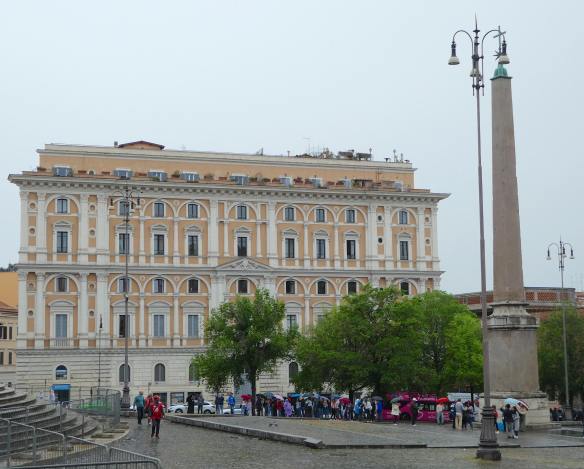
13.princeps boutique hotel

Travelling down a rain soaked Via Cavour,
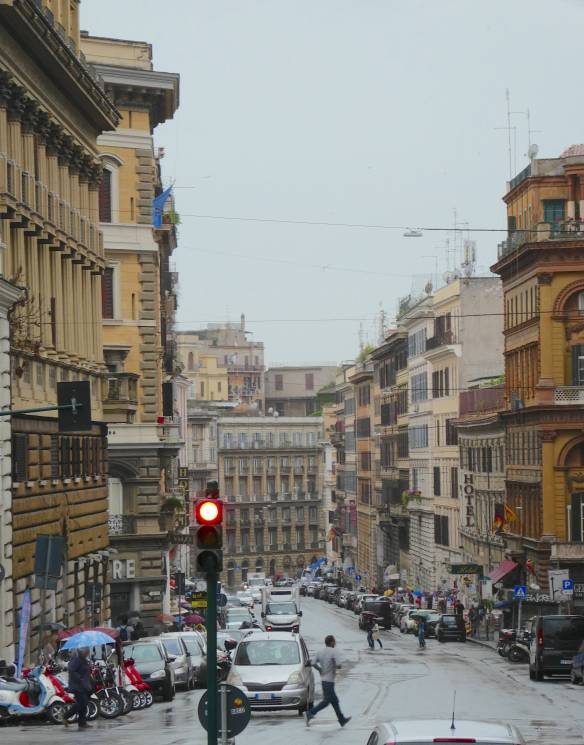
14.via cavour

the traffic stopped us alongside an amazing set of steps that disappeared into an archway. The steps lead to San Pietro in Vincoli (St Peter in Chains), a church named for the chains that held St. Peter when he was imprisoned in Rome and Jerusalem and are on display. It is best known for Michelangelo’s statue of Moses, created for the tomb of Pope Julius II. To add more drama, at the top of the steps is an alley where, apparently, the daughter of the 6th king of Rome killed him by running him down with her chariot. Probably no surprise that her husband was the 7th king of Rome.

15.steps from via cavour to san pietro in vincoli

We left the bus at the Colosseum for a couple of hours and embarked on a guided tour, you can see that post here. The Temple of Venus and Roma caught our eye as we sought a venue for lunch. Thought to be the largest temple in ancient Rome it was designed by emperor Hadrian and took twenty years to complete from beginning of construction in 121AD.

17.temple of venus & roma

After lunch, we wandered among the ruins of Palatine Hill

18.palatine hill

from where we had an uninterrupted view of the Temple of Antoninus and Faustina. Begun in 141AD by the Emperor Antoninus Pius, the temple was dedicated to his deceased wife, Faustina. When he died twenty years later, the temple was re-dedicated to both of them by his successor, Marcus Aurelius. The temple became a Roman Catholic church, San Lorenzo in Miranda, in the 7th century.

19.temple of antoninus & faustina

We could also see two statues atop a building in the distance, though at the time, we didn’t know where they were (stay tuned for that one).

We hopped back on the bus which took us past Circus Maximus, the first and largest stadium in ancient Rome, mostly used for chariot racing and now a public park.

22.circus maximus

The seemingly unassuming church at the top of these steps, Santa Maria in Aracoeli, dates back to the 6th century and houses the Santo Bambino of Aracoeli, a wooden statue of the Christ Child, that is believed to resurrect the dead. The 124 step marble staircase was completed in 1348 to celebrate the end of the plague in Rome. It is believed that those who climb the staircase on their knees will be rewarded with a miracle.
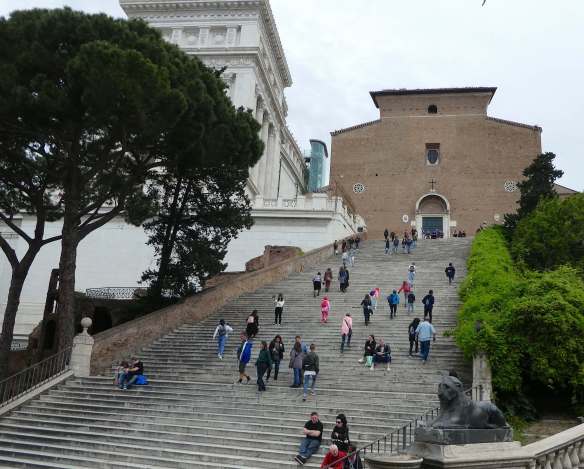
23.steps of santa maria in aracoeli

A quick glimpse of the Palazzo Venezia
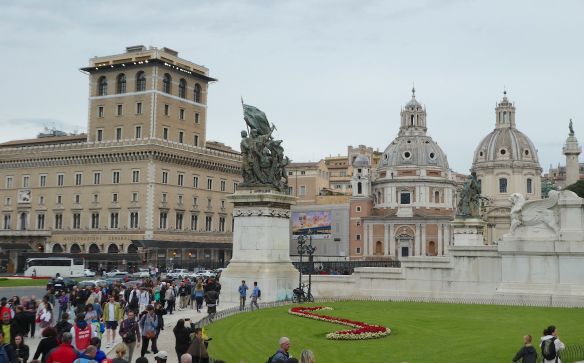
24.palazzo venezia

before our attention was drawn to the most impressive façade of the Altare della Patria. The National Monument was built as a tribute to Vittorio Emanuele II, the man credited with the unification of Italy and first king of the new kingdom proclaimed in 1861. The focal point of the huge white marble edifice is a 12 metre long statue of a horseman, a representation of Vittorio Emanuele II. We could now see the location of the two statues we had spied from Palatine Hill. On the right, the bronze goddess Victoria riding on her chariot represents freedom and on the left, unity. They were added in 1927, sixteen years after the monument was inaugurated. There has been much controversy surrounding the monument, the uncomplimentary nicknames include “the wedding cake”, “the typewriter” and “the dentures”.
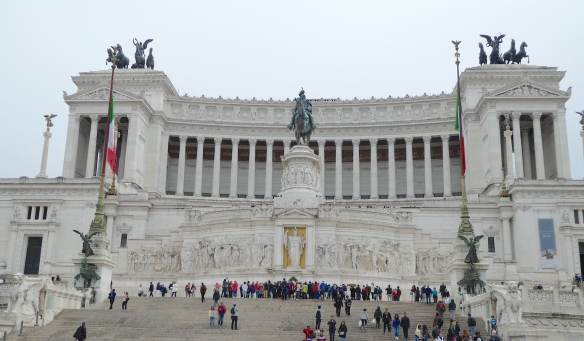
25.altare della patria

Leaving Piazza Venezia, we passed the Carabinieri headquarters (apparently with limited parking spaces)
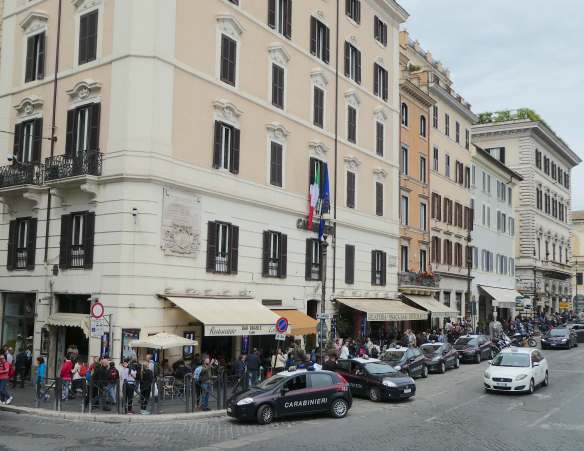
26.carabinieri, piazza venezia

and the most enormous gift shop I have ever seen, Sorelle Adamoli.
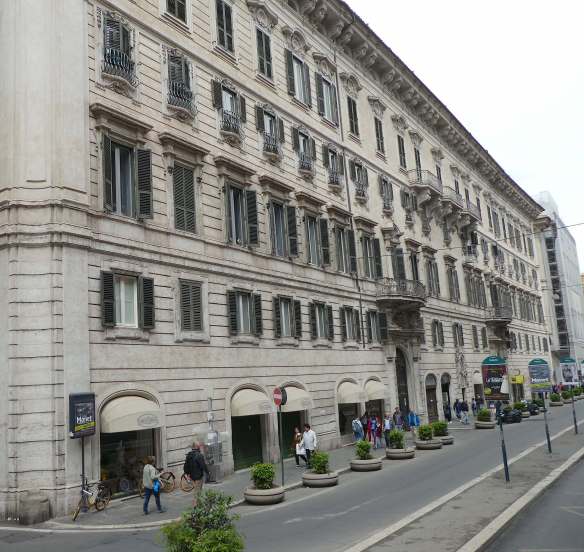
27.sorelle adamoli

The former Palazzo Strozzi is now occupied by the Marco Besso Foundation. A banker and writer, Besso bought the building in 1905 and set up the library in 1918 while the first floor became the family home. A great admirer of Dante, the library has rare editions of his work, some printed pre 16th century. I would love to explore beyond the doorway.

28.palazzo besso

We passed Santa Maria in Vallicella, also known as Chiesa Nuova, the principal church of the Oratorians. This congregation of secular priests, founded in 1561 by St. Philip Neri, was recognised as a religious group and given the church in 1575.

29.santa maria in vallicella

At the end of Corso Vittorio Emanuele II, we turned right and followed the river, gaining a limited view of Castel Sant’Angelo on the other side.

30.castel sant'angelo

Commissioned by Roman Emperor Hadrian as a tomb for himself and his family, the building was erected between 134AD and 139AD. He also had the travertine marble bridge, the Pons Aelius, built to connect the mausoleum with the city centre.

31.castel sant'angelo

We hopped off the bus at Piazza Trinità dei Monti, where the 16th century church of the same name dominates the top of the Spanish Steps.

32.spanish steps

The 135 steps were built in 1723 to link the French owned church with the Spanish Embassy at the bottom. Yes, there really are steps beneath those bodies and a 17th century fountain in amongst the crowd.

33.spanish steps

At the bottom of the steps, the Piazza di Spagna was heaving with humanity, obliterating any evidence of the stairway. Incidentally, the building on the right is the house where English poet John Keats lived briefly before his death in 1821. It is now the Keats-Shelley Memorial House, a museum dedicated to the English Romantic poets. The building on the left is Babington’s traditional English tea shop, established in 1893 to provide a tearoom and reading room for the Anglo-Saxon community in Rome.
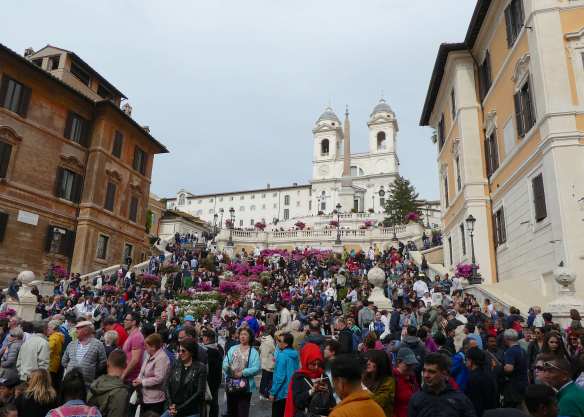
34.spanish steps

There was one item left on the ‘must see’ list. Although Fontana di Trevi was less than a kilometre away, the crowds created a challenging transit. The origins of the fountain date back to 19BC when it formed the end of the Aqua Virgo aqueduct. After many years of work, the fountain, as it is today, was completed in 1762, the name derived from Tre Vie, at the junction of three roads. It was impossible to capture the entire fountain due to the crowds so I opted for some sections.

Just as we were walking away, I saw an opening in the throng and pounced.

39.fontana di trevi

There is so much to see in Rome, and so much more than meets the eye. I think it would take a few lifetimes to even come close.
City Park

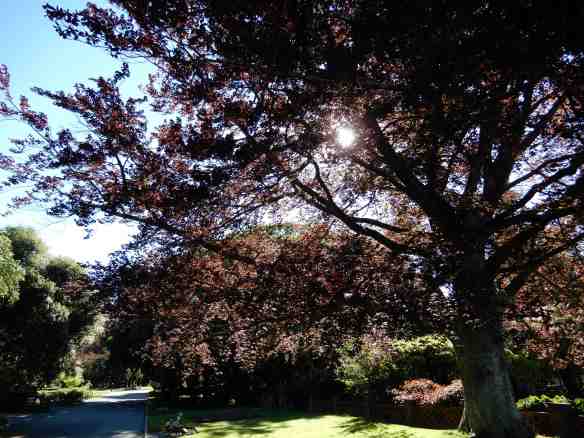
A stroll through Launceston City Park on a perfect spring morning is a lovely way to start the day.

1.City Park2.City Park

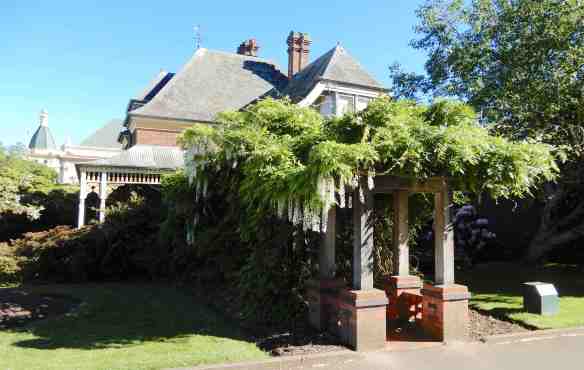
Established in the 1820s by the Launceston Horticultural Society, the park was handed over to Launceston City Council in 1863. Entering the western gate, the 19th century former caretakers cottage, now the studios of City Park Radio, has one of Australia’s oldest wisteria vines, planted in 1837.

3.City Park Radio

The John Hart Conservatory was erected from the John Hart bequest in 1932 and refurbished in 2010. John Hart was a mariner, merchant and parliamentarian who spent most of his career in the 1800s in South Australia. He died in 1873 at his home, Glanville Hall, at Port Adelaide. He must have felt some connection to Launceston having arrived there on the ship, Isabella, from London in 1837, even though his stay was brief. The same plans were used to build a conservatory at Parramatta Creek in the 1970s. You can see that post here, The Conservatory

4.John Hart Conservatory5.John Hart Conservatory

The garden beds at the front of the building were blooming with a stunning display of violas.

Myriad plantings edged the spacious interior, the tranquil ambience invited us to linger.

8.John Hart Conservatory

9.John Hart Conservatory

Majestic orchids thrived amidst lush greenery.

Outside, colourful poppies bounced in the breeze and the bees were already busy collecting their nectar.

There are many magnificent mature trees in the park. Apparently, the English Elms are all clones of a single tree brought to England by the Romans. Their descendants arrived in Australia on ships hundreds of years later to be planted in parks like this one. The tallest trees, the Sequoias, presumably arrived in the same manner.
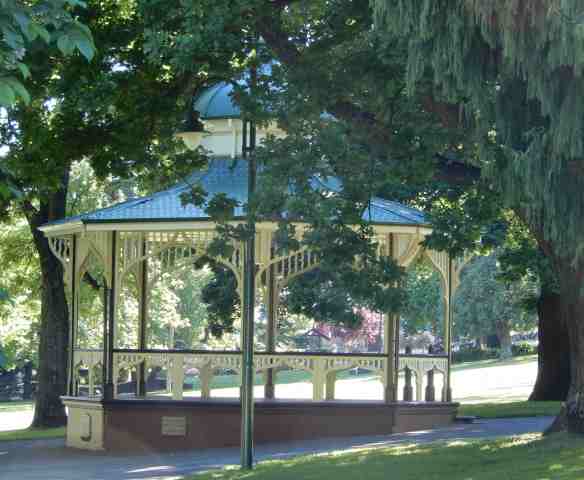
The band rotunda was built in 1908 and is dedicated to Chester Edwards who joined the Launceston City Band at the age of 10 and conducted from 1906 until 1958. A plaque reads, “Erected in appreciation of the sterling services rendered by Chester Edwards in the musical activities of the City of Launceston.”

29.rotunda

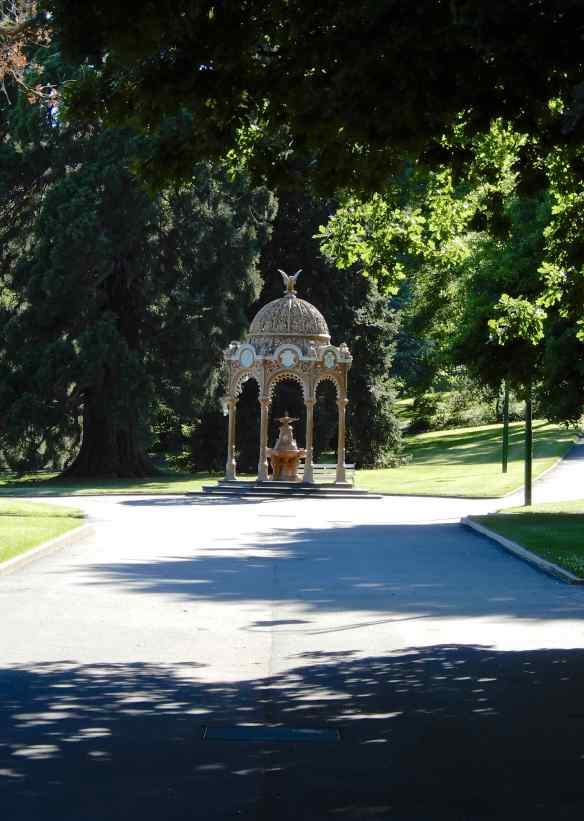
The ornate drinking fountain was intended to be a gift from the children of Launceston to commemorate Queen Victoria’s Golden Jubilee in 1887.

30.Jubilee Fountain

Things didn’t go quite according to plan. The fountain was ordered from Saracen Foundry in Scotland, however, the funds were not raised in time and the installation was postponed until the Diamond Jubilee in 1897. The moulded shields above the arches depict both dates as well as a bust of Queen Victoria.

The fountain was initially positioned outside the main gates and was moved inside the park in 1908. The design incorporates symbolism popular in Victorian times; griffins are guardians of priceless possessions, lions symbolise guardianship, cranes for vigilance and eagles represent immortality.

34.Jubilee Fountain

A bronze statue of Ronald Campbell Gunn stands proudly in the shade. Arriving in Tasmania in 1830, he became Superintendent of Convicts and Police Magistrate. His career path soon led to politics but he is best known as a botanist. He collected, recorded and sent many specimens back to England (as well as a living Tasmanian tiger in 1858).

35.Ronald Campbell Gunn

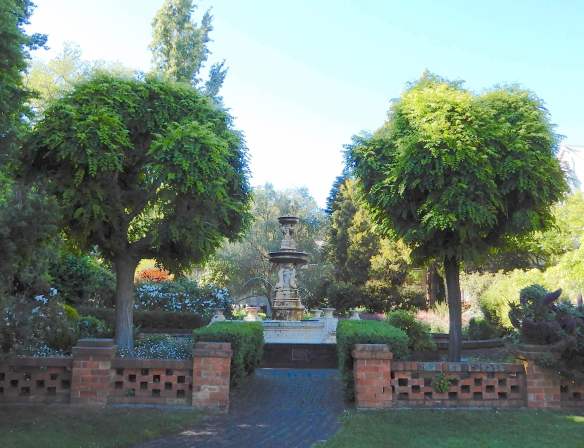
The ‘Senses Garden’ was created in 1978, raised beds are filled with plants selected for their aroma or texture

36.Senses Garden

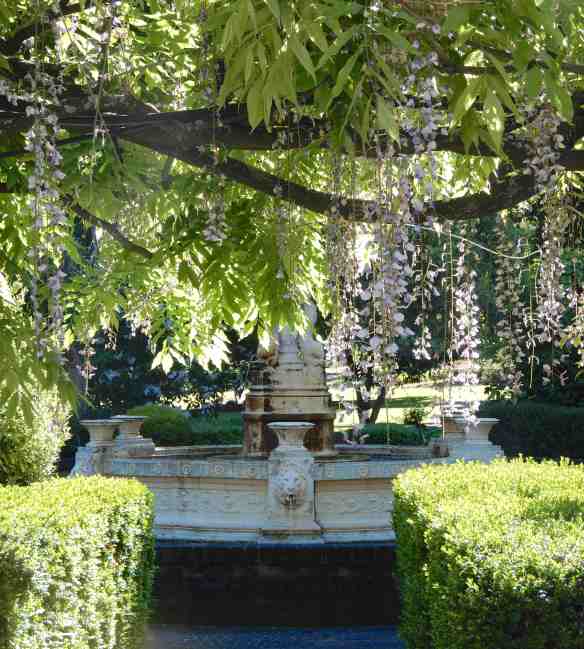
and the terracotta dolphin fountain has centre stage. The fountain was initially erected in a different area of the park in 1861 and is the second oldest fountain in Australia (the oldest being the Val d’Osne Fountain in Princes Square, less than a kilometre away).

37.Senses Garden

Reluctantly, we tore ourselves away from the garden, there were more adventures awaiting.

40.Senses Garden

Galway

We arrived in Galway late afternoon and found accommodation at the rather salubrious Park House Hotel. One of the advantages of travelling out of season is that these fabulous hotels are within budget.

We ambled our way into town in the hope of experiencing some live Irish folk music. Taaffes fit the bill perfectly, a traditional pub in a gorgeous building dating back over 400 years. We settled in with a pint or two, Michael got some tips on playing the Irish bagpipes.

Next morning we set off early to explore this beautiful harbour city. Galway started off as a small fishing village located where the River Corrib meets the Atlantic Ocean and became a walled town following the Anglo Norman conquest in 1232. European traders frequented the docks and in the 16th century a fortress was added to the town walls to protect the merchant ships from looting. The only remainder of this bastion is The Spanish Arch, built in 1584 and presumably so named because of the trade with Spain and Spanish galleons.

10.Spanish Arch

The Skeffington Arms Hotel, built at the time of the Irish Rebellion of 1641, overlooks Eyre Square, the city’s hub and popular meeting spot.

11.Skeffington Arms Hotel

Galway was dominated by fourteen merchant families, known as the Tribes of Galway, between the mid 13th and late 19th centuries. One of these was the Browne family, the doorway to their townhouse has been moved from Abbeygate Street and now stands at the north end of Eyre Square. Dating from 1627, the door was moved in the early 1900s when the original building became a ruin and is now supported and encased in plexiglass to help preserve it.

12.Browne Doorway

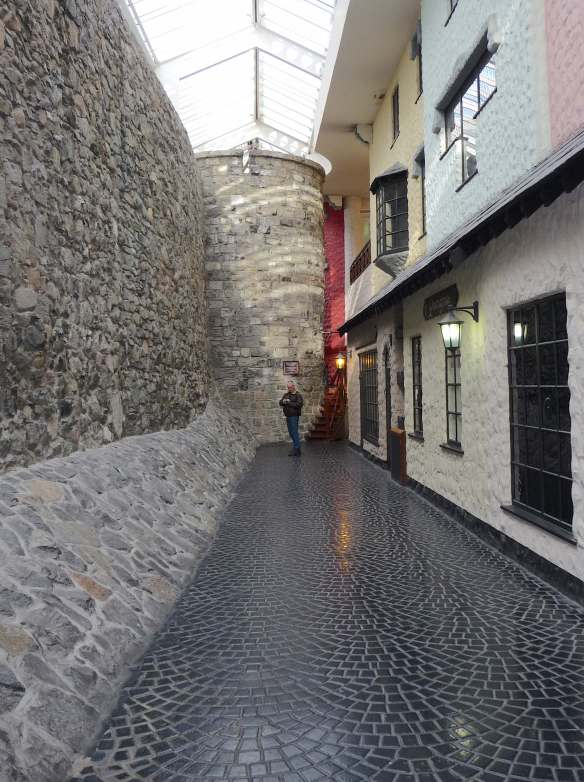
We were surprised to find remnants of the medieval town walls within Eyre Square Shopping Centre.

13.Norman Wall Eyre Square

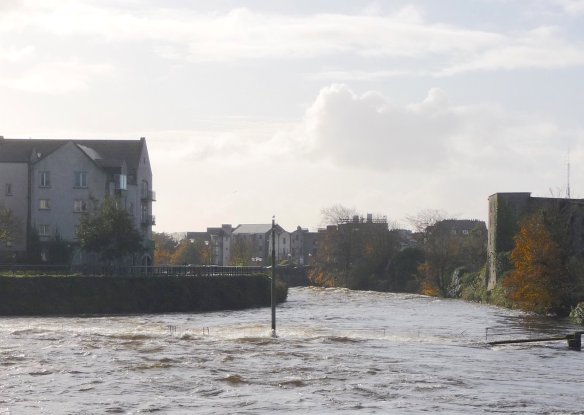
The River Corrib flows from Lough Corrib to Galway Bay and, at only six kilometres in length, is among the shortest in Europe.

14.River Corrib

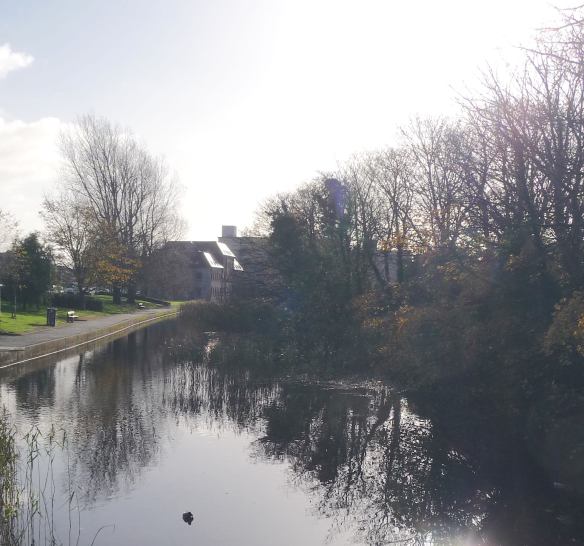
The main channel leaving Lough Corrib is known as Friar’s Cut and was the first canal to be built in Ireland in 1178. The friars of Claregalway Abbey created the artificial cut to avoid the long trip to the west to enter the river. The cut became the main course of the river and has been widened since.

15.River Corrib,Friar's Cut

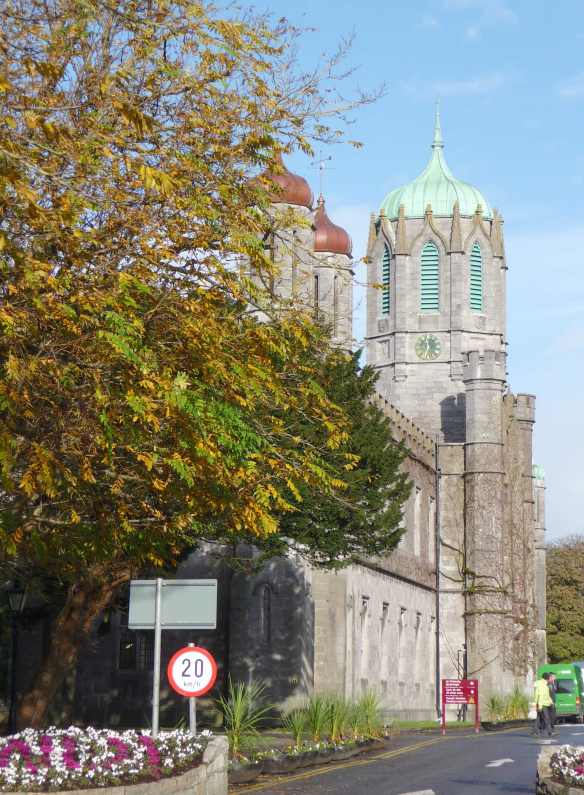
Despite its Renaissance appearance, the construction of Galway Cathedral didn’t start until 1958 on the site of the old city prison. This last great stone cathedral to be built in Europe was completed in 1965. There has been much controversy over the years, mostly aimed at the appearance of the building. It was recently referred to as a “squatting Frankenstein’s monster”. I think it is quite spectacular and sits comfortably in its beautiful surroundings.

Opposite the cathedral, a figure emerges from a stone wall. Equality Emerging represents the struggle for equality and the suffering because of its absence.

19.Equality Emerging

Our walk took us past Eglington Canal

20.Eglinton Canal

and the National University of Ireland

21.Galway University

before we returned along the river toward the city centre.

The William O’Brien Bridge was the first of the four bridges spanning the River Corrib. Originally a wooden structure, the current bridge was rebuilt in 1851.

25.River Corrib,William O'Brien bridge

After a wander around the quirky shops in the town

26.Galway

there was only one thing for us to do…….return to Taaffes for another evening of music and Guinness.

27.Taaffes

Artentwine

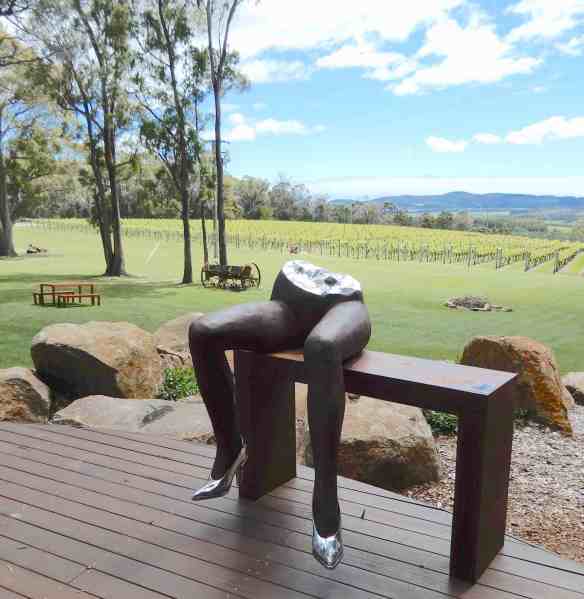
I recently spent a weekend in Launceston with my sister who was here on holiday. Not that we needed an excuse to visit wineries, but the Artentwine sculpture exhibition was added incentive. The biennial competition started in 2014 and features contemporary sculptures by Australian and international artists, displayed at five wineries in the West Tamar. After driving up the East Tamar, we crossed the Batman Bridge and began our adventure at Goaty Hill. The three sculptures on display were set against the backdrop of beautiful vistas and vineyards. The bronze Seated Figure by Jason Farrow caught my eye and was still my favourite at the end of the day. I’m not going to include all the artist statements or this would be a very long post, but I found Jason’s summation quite moving; “Walking under the iconic coke sign of Kings Cross, Sydney, I noticed this guy, sitting there on the steps. Deep in thought, lost in anguish, you couldn’t really tell. Wherever he was, was a long way from here.”

1.Seated Figure

Jason Farrow, ‘Seated Figure’

2.My Other Half

Nicole Allen, ‘My Other Half’

3.CAUTION. This Is Not a Life Saving Device

Christopher Trotter, ‘CAUTION: This is not a life saving device’

Armed with two bottles of 2016 Goaty Hill Riesling, we moved on to Iron Pot Bay Vineyard. We only saw four of the five sculptures as they were positioned in rooms where people were eating and a little difficult to view. Simon Pankhurst’s, The Battle Between Needs and Wants, had been displayed upside down, not the best angle.

4.Wintery Mood

Peter Steller, ‘Wintery Mood’

7.The Night Hunter

Mela Cooke, ‘The Night Hunter’

The man in blue, poised in the garden, sported an outfit knitted with baling twine. My sister and I had been at Deloraine Craft Fair the previous weekend where we had seen numerous knitters eagerly creating something with the blue baling twine. It seems artist, Grietje van Randen, has enlisted volunteers to help complete a double life size Blue Farmer to be sited on a local farm to raise awareness of those living with depression and as a reminder for us all to be Looking Out For Each Other.

We added a bottle of 2016 Pinot Grigio to our collection and drove the short distance to neighbouring Holm Oak Vineyard where a further eight sculptures awaited. The setting was magnificent, unfortunately Smultronstalle and Impression VI were presented back to front, a little disappointing for the artist I would imagine.

18.Smultronstalle

Christie Lange, ‘Smultronstalle’

20.Impression VI

Paul Murphy, ‘Impression VI’

11.Monument of Indifference

Gene McLaren, ‘Monument of Indifference’

14.Water Light

Lisa de Boer, ‘Water Light’

15.Fisherman & Fisherwoman

Sallie Portnoy, ‘Fisherman & Fisherwoman’

19.Perpetual Growth

Vlase Nikoleski, ‘Perpetual Growth’

21.Tall Poppy

Peter Rozario, ‘Tall Poppy’

The competition was won by Wayne Hudson for Pledged which will become a one and a half metre diameter sculpture for the public. A light will be positioned below the ring and shine through the centre, I think it will be quite spectacular.

12.Pledged

Wayne Hudson, ‘Pledged’

A bottle of Duffy 2018 Rosé accompanied us to the next location, Moores Hill Estate. Some of the twelve sculptures were difficult to photograph against the background of corrugated iron and I was disappointed to see Fate had been damaged – the boat should be suspended within the frame but the supporting wires had broken.

23.Fate

Jamie Dobbs, ‘Fate’

Ask and thou shalt receive by Al Roberts was my close second favourite, the man’s face had so much character. It is no wonder it won the People’s Choice award. The artist’s statement is worth sharing here; “ I wanted a turtle dove as an artistic reference for a potential sculpture. I spoke to a friend of mine that is a hunter and she agreed to acquire one for me on her next hunt. Shortly after our conversation my friend arrived home, and by strange twist of fate, she immediately heard a thud behind her on the glass door. She looked down on the ground outside to see a small turtle dove twitch and take its last breath. Feeling guilty, even though the bird died of natural causes, and unsure what to do now my ‘wish’ had been granted, I decided that I needed to make the most out of its life by immortalizing it as part of my sculpture. As with many things in nature and life, we have been given exactly what we need, but still have no idea how to make to the most of it.”

22.Evidence of Passing

David Doyle, ‘Evidence of passing’

25.Changing Tracks

Mary vandenBroek, ‘Changing Tracks’

24.Kanamaluka

Catherine Phillips, ‘Kanamaluka’

29.Illusion

Ben Fasham, ‘Illusion’

30.Continuous

Ben Beams, ‘Continuous’

31.Star Finder

Di West, ‘Star Finder’

32.Nudibranchor

Dan Kershaw & Sara Ferrington, ‘Nudibranchor’

33.Bait

Lynette Griffiths, ‘Bait’

35.curious dream of an architect

Fatih Semiz, ‘curious dream of an architect’

37.Twitter Birds

Cheryl Sims, ‘Twitter Birds’

The views from Moores Hill were breathtaking, as was the 2016 Chardonnay and 2017 Riesling that I just couldn’t leave behind.

38.Moores Hill Vineyard39.Moores Hill Vineyard

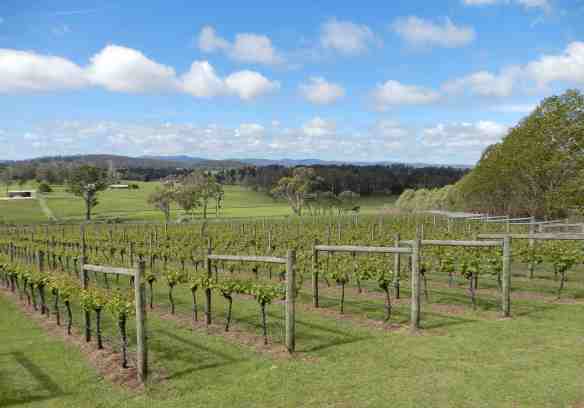
Our final venue for the day was Tamar Ridge Cellar Door, in an enviable position with magnificent panoramas of the Tamar River.

40.Tamar Ridge Vineyard

Ten sculptures were on display throughout the extensive premises, although we only found eight. We didn’t partake of tastings here, I will have to return on my next trip to Launceston.

41.Changing Landscape

Keith Smith, ‘Changing Landscape’

43.Finding the Lost

Anita Denholm, ‘Finding the Lost’

44.Brigid of the West

Robert Boldkald, ‘Brigid of the West’

45.Estuary

Rob Ikin, ‘Estuary’

47.Discourse

Craig Ashton, ‘Discourse’

50.Formation

Ben Beams, ‘Formation’

51.Panspermia

Christina Palacios, ‘Panspermia’

52.Above and Below

Barry Smith, ‘Above and Below’

For more insight into the sculptures, the artist statements can be found in the catalogue.

Artentwine 2018 Catalogue

culinary capers

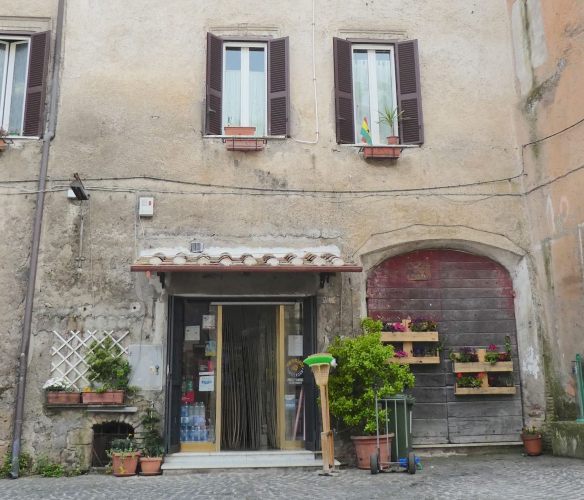
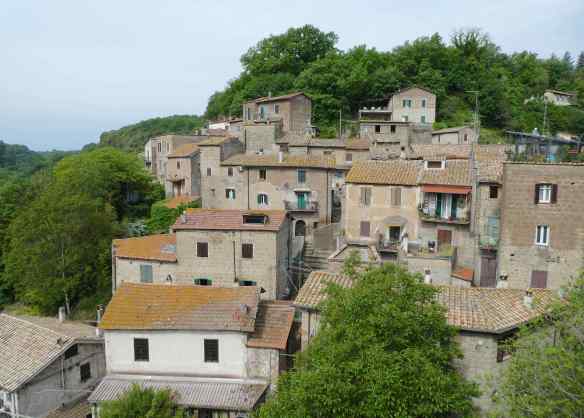
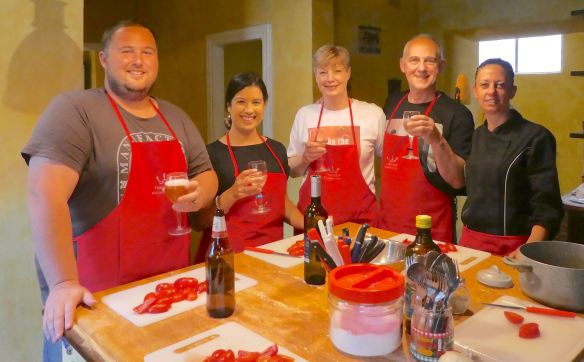
We had an inkling, when we were planning our trip, that after a day in Rome seeing the sights and battling the throngs we would be ready to escape to the countryside. Consequently, we signed up for a cooking class and did just that. There were only four participants, the others were a lovely young couple from Melbourne, Ash and Mel. We were picked up at 8.30am by multi-talented driver and sous-chef, Roy, and enjoyed a very comfortable 45 minute ride to the medieval village of Mazzano Romano. There, we met our chef, Elisa, who guided us through the process of purchasing our ingredients. Firstly, to the macelleria where vegetarian Mel opted to wait outside.

Next was the green grocers, bursting with colourful, fresh produce.

The last stop was for cheeses and smallgoods, so much choice in one small shop.

12.shop

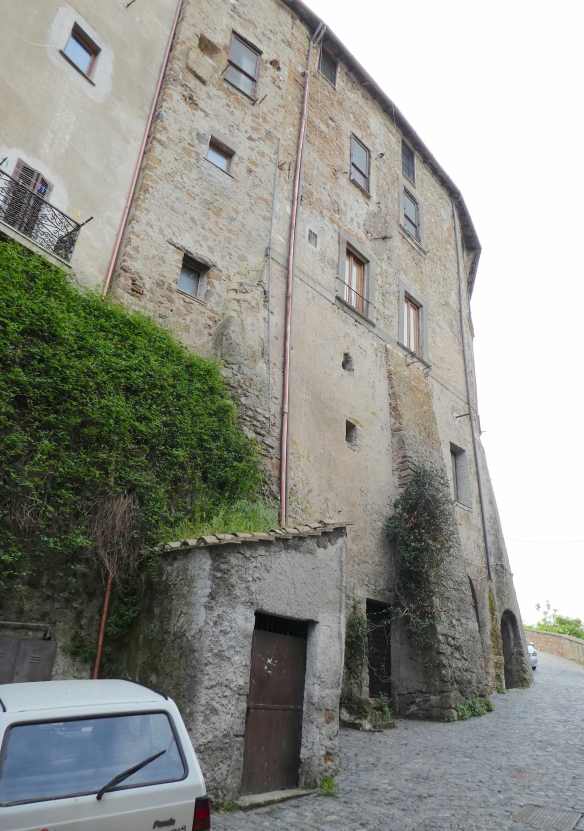
Sharing the load, we made our way along narrow cobbled streets, climbing higher into the village.

16.Mazzano Romano17.Mazzano Romano

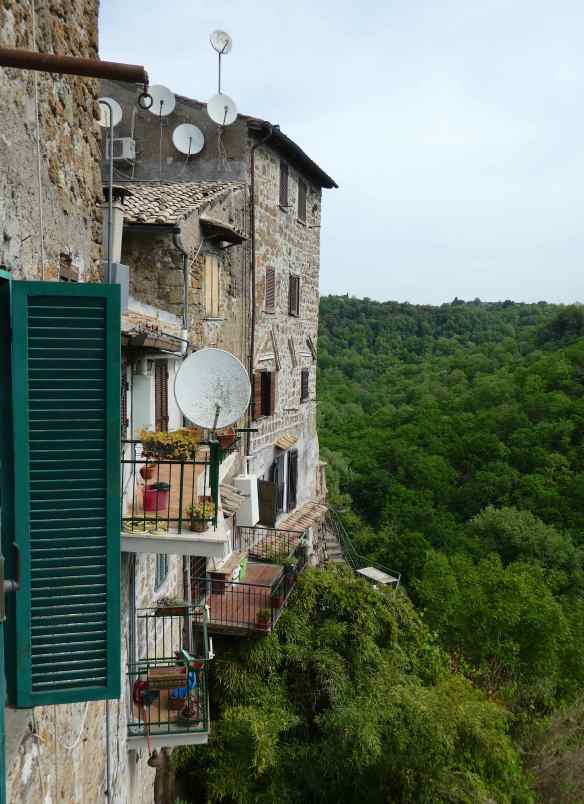
Arriving at the apartment, built around 1300 AD, we wandered around in awe at the beautiful interior and breathtaking views.

29.neighbours

The kitchen awaited us, ready to create our culinary masterpieces

and the essential ingredient was poured.

34.pre-cooking

Michael’s first attempt at tossing salt in a pan was somewhat overzealous but with a little more tuition, he soon mastered the art.

We were shown some handy tips when it came to preparing vegetables, including an easy way to prevent eyes from streaming when chopping onions. Take a mouthful of water and hold it in your mouth while cutting the onion – no tears. I have it on good authority that it also works with a mouthful of beer! Michael was assigned the task of making the dark chocolate lava cake, I’m not sure how Elisa knew he would embrace the challenge with such gusto.

Meanwhile, Elisa shared her grandmother’s recipe for pizza dough using flour and sparkling water. Served with three different toppings – potato & rosemary, red onion and tomatoes with mozzarella – they were deliciously crisp.

Elisa had a great sense of humour and Michael didn’t mind being the fall guy. Presented with a pot of cooked tomatoes, he was asked to separate the skins and seeds and was much relieved to discover Elisa had a handy gizmo to do the job.

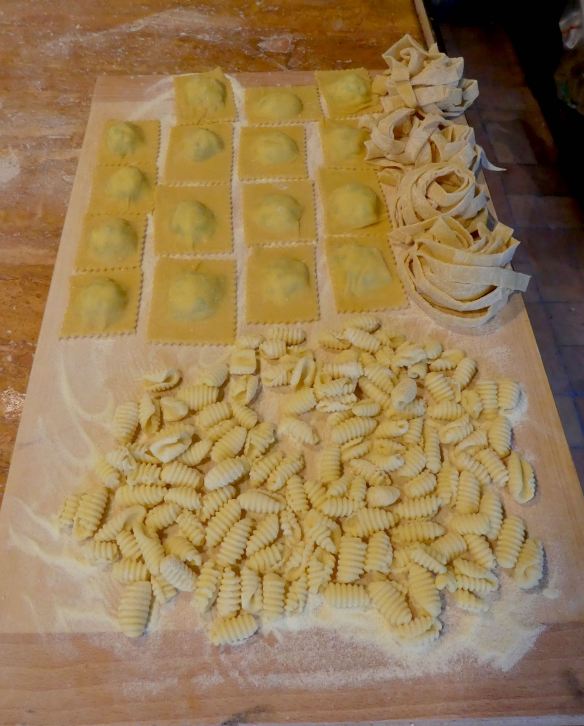
We learned how to make three kinds of pasta,

shaping the gnocchi on garganelli boards required a certain technique.

Rolling the pasta through the machine was more than a one person job.

We quickly produced enough pasta to cook

53.ravioli, fettucine & gnocchi

and Elisa impressed us with her presentation of the ricotta & spinach ravioli,

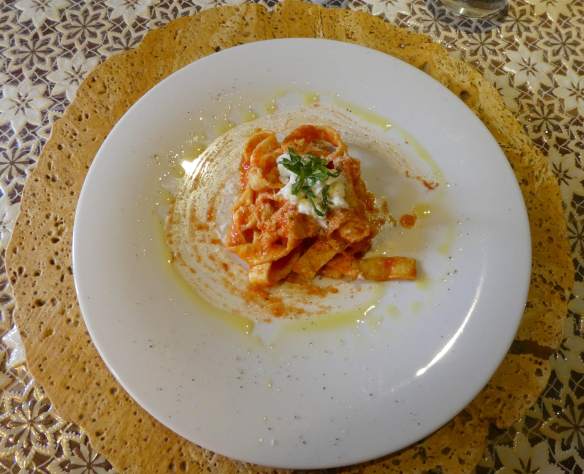
fettucine with tomato based sauce

57.fettucine

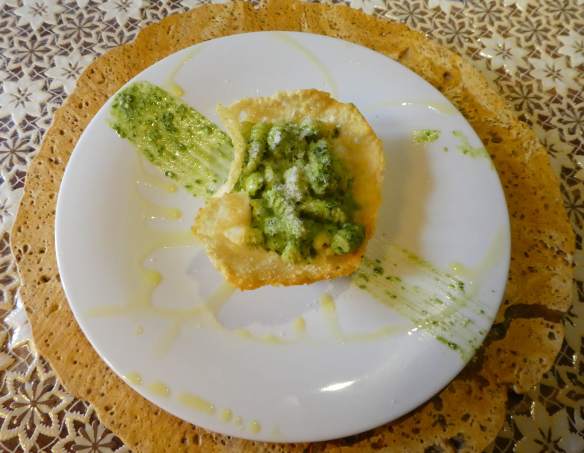
and gnocchi with pesto sauce.

58.gnocchi

We had prepared a salad to accompany the veal saltimbocca, savouring all courses with the obligatory bottle of vino.

We had just enough room for the exquisite chocolate lava cake, prepared with enthusiasm and cooked to perfection.

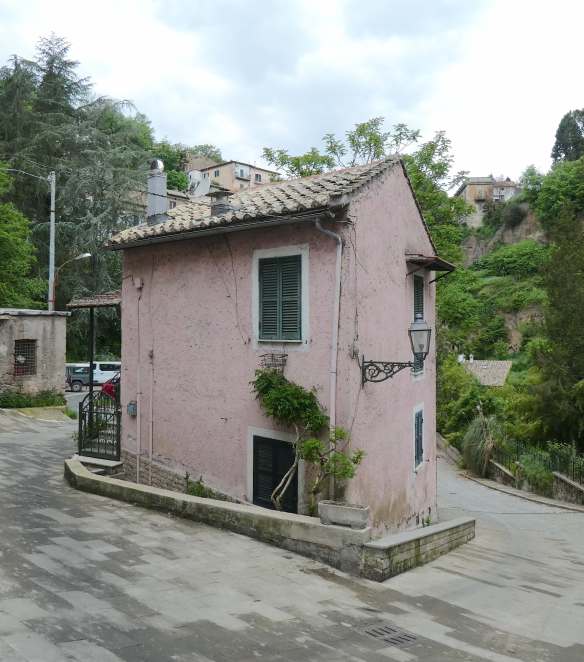
The time had come to wend our way to the car for a much quieter trip back to Rome. I hadn’t noticed this gorgeous little pink house on the way in, I wonder how many centuries it has guarded the village.

63.pink house