Caernarfon Castle

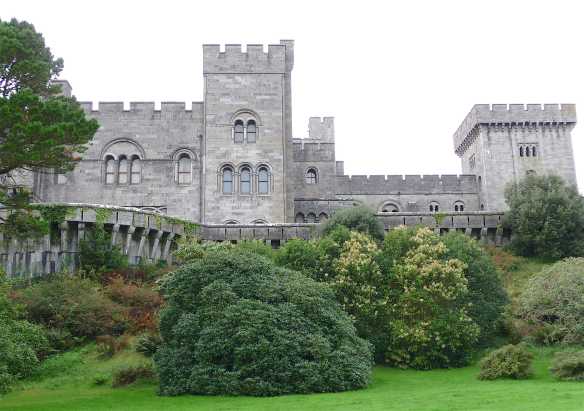
Continuing northward through Wales, we stopped to admire the majesty of Caernarfon Castle. The original Norman castle on this site was replaced in 1283 when King Edward I began building his stone structure.

1-looking-to-upper-ward-chamberlain-tower-right

The walls were built to suit the lie of the land which resulted in the internal grounds being shaped like a figure eight. The towers within the walls were not the usual round ones of other Edwardian castles but polygonal, each with a different number of sides.

2-tower

All were accommodation towers, the grandest being the ten-sided Eagle Tower. It has three turrets which were once decorated with stone eagles that have since weathered away.

3-eagle-tower

Walkways within the castle allowed for a closer look at the workmanship.

4-tower-interior

From above we gained a different perspective of the towers

7-queens-tower-eagle-tower8-tower

and could really appreciate the expanse of the castle.

9-caernarfon-castle

The views of the River Seiont

10-river-seiont

and harbour were captivating.

11-river-seiont12-caernarfon-harbour

I would love this pair of cannons for our driveway entrance.

13-cannons

Long before there was a castle, the Romans built a fort nearby to defend the north Wales coast. Established around 78AD, Segontium held about a thousand soldiers.

14-segontium

The fort was abandoned in the 4th century and there is not much left to see of the ruins.

15-segontium

The stone was plundered and used to build King Edward’s Caernarfon Castle.

Desert Park

The last day of our Northern Territory holiday had arrived and we made the most of it at Alice Springs Desert Park. The ridge of Alhekulyele (Mt. Gillen) is a stunning backdrop to the 3,000 acre park.

We arrived in time for the Nature Theatre show to be entertained with demonstrations of free-flying birds of prey.

4-wedge-tailed-eagle

8-whistling-kite

10-barn-owl

The bush stone-curlew stole my heart again.

The park has three re-created desert habitats to explore: Sand Country, Woodland and Desert Rivers. The Woodland habitat includes enclosures for dingoes

and kangaroos.

It was a bit early for the wildflowers but they were lending some bursts of colour.

The Desert Rivers habitat was full of life, from the magnificent perenties enjoying the sun,

39-perentie40-perentie

to the black cockatoos posing majestically in the trees.

41-black-cockatoo

The waterholes were popular

while some preferred dry land.

We had the opportunity to learn more about the wedge-tailed eagle

50-wedge-tailed-eagle

and he very kindly posed for a photo.

51-wedge-tailed-eagle

The reptile house was home to some cute lizards

and snakes.

58-snake

The tawny frogmouth looked very regal.

59-tawny-frogmouth

Our day at the Desert Park was amazing

60-path

and we left with some very special memories.

Benabbio doors

One of the things I found fascinating in the Tuscan villages was the seemingly infinite array of doors. Wandering around Benabbio, I was intrigued by the lives unfolding behind these portals and what may have been in the past few hundred years. There were many green doors and I wondered at the significance.

1-green-door

I found some interesting insights, from suggestions of traditional values, caring about home & community,

2-green-door

to being ambitious and good with finances.

3-green-door

Green insinuates health, safety, tranquility and harmony.

In ancient times, green was worn to appeal to nature spirits for protection.

4-green-door

Whatever the reason, I think green is a fabulous colour for a front door.

Some doors were quite opulent

9-door

or at least, displayed a certain style.

Others exhibited their many years of service.

16-door

Then there were those that haven’t been opened in recent times.

I wonder what this mysterious little hatch was used for?

24-not-door

Makers’ Workshop

Makers’ Workshop opened in Burnie in 2009 as a place to honour the history, makers, innovators and artists of northwest Tasmania. The building, although criticized by some, won the Tasmanian Architectural Award in May 2010.

1-makers-workshop

5-entrance

It is a marvellous place to wander and absorb the myriad resident artists and their creations. From hats and jewellery

to glassware

14-glassware

and hand-painted silk scarves.

16-scarves

There is an area set out to watch the artisans at work.

17-leatherworker

18-basketmaker22-ripping-yarns

The fantastic retail space showcases the work beautifully and makes it very hard to resist a purchase.

After all that hard spending, you can relax in the café with something delicious

26-cafe

or take in the latest exhibition in the gallery.

29-gallery

Both offer a panoramic view of West Beach, moody on an overcast day.

30-view-day

The diverse produce of the northwest coast is proudly promoted, our world famous cheeses are irresistible.

We can learn about the local potato and poppy farming

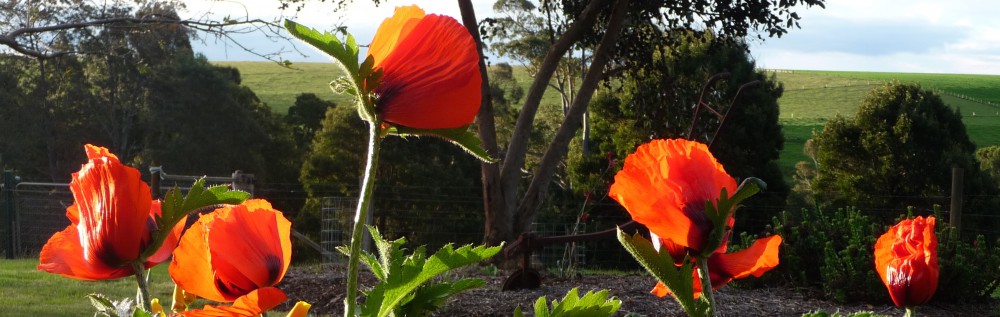
33-poppies

and see the exquisite workmanship of talented luthier, Maria Perez-Pulido.

34-luthier

You can try your hand at making paper under the guidance of experienced paper makers. Many different fibres are used, including roo poo and wombat poo, apple pulp, lavender and rainforest leaves.

35-wombat-poo-paper

The beautiful folios, journals, cards and paper products can be purchased.

There are numerous large papier mâché characters in various poses, created by artists Pam Thorne and Ruth Rees between 1996 and 2007.

This magnificent garment was made by Pam, patiently twisting sewing pattern paper into lengths of ‘yarn’ to then carefully knit a gorgeous jacket.

45-paper-fashion

The northwest coast of Tasmania has so much to offer. If you are passing, do drop in.

46-makers

West Wales

Following our exploration of Cilgerran castle, we found a lovely place for lunch in nearby Cardigan.

1-castle-kitchen-restaurant

I thought it would be nice to buy a cardigan in Cardigan, but I didn’t. Instead, we strolled along the River Teifi

2-river-teifi3-river-teifi

before continuing our drive north. Not far from Aberystwyth was our inviting B&B, Awel-Deg, at Capel Bangor.

4-awel-deg

The views were stunning across the gorgeous Rheidol Valley.
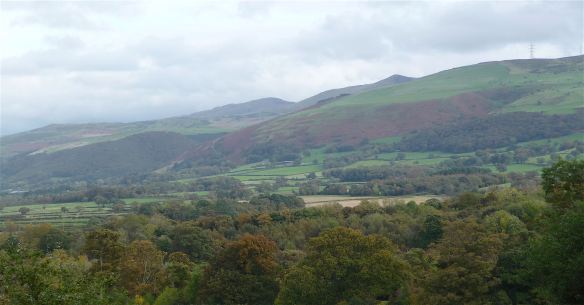
5-rheidol-valley6-rheidol-valley

We walked to the Tynllidiart Arms for dinner

7-tynllidiart-arms

and sampled ales brewed at the smallest commercial brewery in the world. Bragdy Gwynant is a five foot square former men’s toilet where, since 2004, beers have been brewed for the Tynllidiart Arms.

8-bragdy-gwynant

The next morning, we detoured to Devil’s Bridge. There are actually three bridges built on top of each other, the oldest dating back to the 11th century. The stone bridge was then built in 1753 when the original became unstable and the most recent iron bridge was constructed in 1901.

9-devils-bridge

The bridge is at a point where, before reaching the River Rheidol, the River Mynach drops 90 metres down a steep and narrow ravine.

10-devils-bridge

As we descended the steps

the bridge rose above us.

13-devils-bridge

At the bottom, the water created wonderful waterfalls as it cascaded through the confines of the gorge.

14-devils-bridge15-devils-bridge16-devils-bridge

According to legend, the original bridge was built by the Devil. He was visiting Wales and came across a lady whose cow had wandered across the river and she couldn’t get her back. He offered to build a bridge in return for the soul of the first living thing to cross the bridge. The next morning, the lady returned but she tricked the Devil by throwing bread so her dog went across first. The Devil wasn’t happy and was never seen in Wales again.

17-devils-bridge

We continued our drive north through Snowdonia National Park, 823 square miles of stunning landscapes,

18-snowdonia19-snowdonia

as we headed for the coast.