paper on skin

The inaugural paper on skin competition transpired in 2012, the brainchild of Burnie denizen, paper artist Pam Thorne. The concept of wearable art links a strong history of paper making in Burnie with the creative talents of local and international artists. When we learned the major sponsor had withdrawn, we didn’t hesitate to offer our support and so, Design Eye Creative paper on skin 2020 became the new incarnation. Usually, the competition culminates with a gala parade and award evening, however, with the advent of social distancing regulations, a new strategy emerged. The award ceremony was live-streamed through Facebook followed by an exhibition of the garments at Burnie Regional Art Gallery for four weeks. In lieu of the catwalk parade, a series of films have been produced to allow a greater audience appreciation. We were privileged to witness some of the filming at the Burnie Arts & Function Centre. Tasmanian artist, Marion Kennedy, was on hand for last minute adjustments to her entry, Fathoms

and the seemingly simplistic Flow will be explained later.

The movies will be released on 4th September and I will publish the links when available. Meanwhile, join me at the exhibition. The competition is not themed and each entry, which must be made from at least 80% paper, has its own story. Guardian of the Southern Convergence, made with hand dyed indigo kozo paper by Liz Powell & Dr Denise N Rall (NSW) is based on the Antarctic Convergence, the threat from environmental change and the alliance of countries protecting it from exploitation.

Over 2,300 folded paper and silk paper spheres have been mathematically engineered and sewn together to create Flower of Life. Brielle Killip worked with Chris Geissinger & Jennifer Garber (Denver Colorado, USA) to produce a garment that is both a bold statement and is comfortable to wear, earning them the $2,000 Runner-Up Award as well as the $500 Public Vote Award.

When Queenslander, Karen Benjamin, conceived her idea for Flow, she had no idea how pertinent her entry would be. Made from toilet paper, each circle has been coloured with permanent marker and hand stitched, creating the illusion of flowing water. The degree of difficulty was enhanced when pandemic panic buying brought a halt to production but, on the up side, the idea for the face mask accessory was born.

Burgeon is an interesting collaboration between Portuguese paper artist and jeweller Renata Fukuda & fashion designer Marta Lisboa, playing with proportion in unpredictable ways.

Lorreny Vera from Victoria has tapped into her Venezuelan roots to create Queen Guacamaya, the queen of the jungle.

Toyo paper braid is the basis for Calligraphica by RR Pascoe (NSW) who has been creating artworks from reclaimed and sustainable materials for more than two decades.

Jade Kahle (VIC) has mastered the art of knitting and crocheting with paper string, enjoying the texture, stitch definition and sculptural effects to culminate in her entry The Esther Dress.

Paper card was the material of choice for Janine Hilder (VIC) for her pastel creation, Lantern Lass.

Although we had a preview of Fathoms at the filming session, I hadn’t realised the detail of the underwater world featured on the gown.

It may not have won any awards but Connie’s Coat stole my heart. A wonderful collaboration between Anne Gason, Barb Adams, Chris Rose, Chris Smith & Gail Stiffe (VIC), the handmade paper gives the illusion of a well-worn coat with a treasure in every pocket. There is a story behind this garment; “The Coat of Connie McBride: Connie sailed from Dublin to Melbourne in 1885 with her brother Darcy. After a few years trapped in the city slums they travelled to Jamieson VIC to prospect for gold. Darcy moved to Beechworth, but Connie befriended the publican of the ‘Diggers Exchange Hotel’ where she worked until it closed in 1911 due to the actions of the ‘Liquor Licence Reduction Board’. Connie lived until she was 95 (died 1970).”

46.Connie's Coat

Plotting paper has been used by Laila-Inga Mueterthies (Germany) for her piece, Papyria.

Stunning by design, the kozo and recycled paper entry Snowy Mountains Dreaming by Polly Crowden (NSW) pushed the boundaries of ‘wearable’.

Technology, art and fashion synthesise in Rockabetty by Tara Morelos & Liz Bradshaw (NSW).

If you have ever enjoyed a cup of tea you will appreciate the ingenious re-use of tea bags in New Life. Denise Lamby (QLD) spent hours drying soggy tea bags to reincarnate them in a fabulous, colourful art form.

The throwaway culture of the fashion industry is highlighted in the entry from Kate Dunn (NSW), Exposure.

The enigmatic Foggy Lady by Mali Klein (Netherlands) comprises an ensemble of handmade paper dyed with natural pigments.

Local Burnie artist, Joan Stammers, has created a spectacularly grand costume using recycled papers. The floral trimmings on Let them eat cake would be worthy of any garden competition.

With her 100% paper entry, Loong (Dragon) Tale, Simone Guascoine (NSW) has used sewing techniques taught by her grandmother to create her Japanese themed outfit.

The winner of the $5,000 Major Award, Amanda May (VIC), designed a beautiful, bright representation of the Australian native flower, Waratah. The vital work of our Australian native bees hasn’t been forgotten with the eco-addition of a Blue Banded Bee.

The pretty Pretend Print-cess by Kelcie Bryant (NSW) is reminiscent of a feminine sundress accompanied by a playful rabbit mask.

Handmade paper has been used by Amee Dennis (NSW) for her creation, Study of Grass.

The TasmAsian by Cynthia Hawkins is an intriguing fusion of her Malaysian roots and adopted home of Tasmania.

A second entry by Laila-Inga Mueterthies (Germany), Showtime, is truly stunning. With the use of plotter paper, we are taken back to a time when style meant elegance and sophistication.

Another local entrant, Chloe Townsend, has successfully transformed her concept to reality with the aptly named Flame.

With so many fabulous entries, choosing one for my public vote wasn’t easy but Musings On Things Ethereal by Kathryn Wilkinson (NSW) was outstanding. Mulberry paper, teabags and silk organza combine perfectly in this stunning creation, I would love to add this to my wardrobe.

Donna Vo (NSW) has used artisanal Japanese washi paper along with paper raffia for her composition, The Shedding. Her piece, “represents the shedding of ideals placed on a female as a child, a young adult and as a mother.”

Inspired by the natural world, Svenja (QLD) has shared her fascination in her design, Cosmic leafy sea dragon.

Unfortunately, two artists missed the judging due to upheavals in the postal system. Romanian Antoaneta Tica was selected as a finalist but her work was stranded when international freight and postage lines closed. However, she organised a photo shoot and it can be viewed on the paper on skin Facebook page. Tony Williams (Cleveland Ohio USA) also encountered problems with freight and his three entries arrived after the judging and filming but in time for the final week of the exhibition. Tony’s spectacular creations can also be seen on Facebook.

131.Film

Arts Centre Market

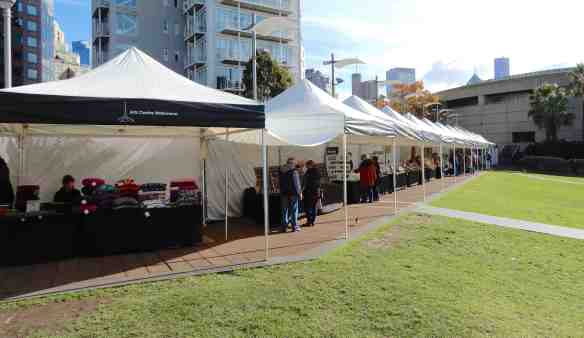
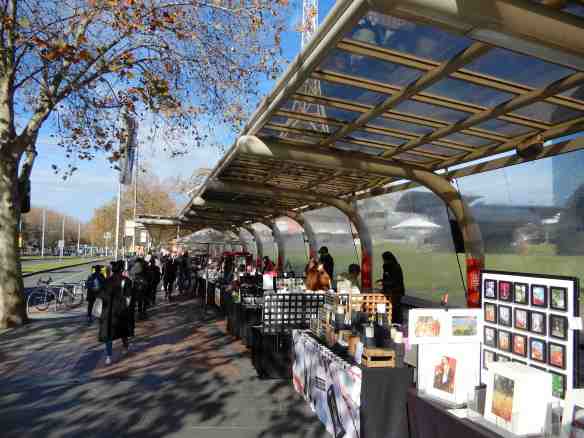
There is no shortage of markets in Melbourne and of the few I have experienced, the Arts Centre Market is my favourite. The setting, on the lawns adjacent to the Arts Centre and along St. Kilda Road, allow plenty of space for browsing without feeling confined. The landmark spire towers 162 metres above the skirt, designed to represent the billowing of a ballerina’s tutu.

On the same theme, a bronze sculpture by Melbourne artist David Maughan, Les Belle Hélène, depicts two female ballet dancers who seem to be celebrating the sunshine on this magnificent winters day.

We arrived early and took our time investigating the unique treasures on offer and enjoying the bucolic atmosphere. Stallholders are selected based on the quality and originality of their locally produced wares, there was no end to the temptation.

5.Arts Centre Market6.Arts Centre Market7.Indian Myna

Following our noses to the origin of the delectable aroma wafting through the air, we found Choo La La and their French praline nuts. As if the salivary glands weren’t already in overdrive, the free samples helped us choose between peanuts, almonds and macadamias (actually, they didn’t really help – we bought all three).

8.Chooh La La

After a perusal of the roadside stalls

9.Arts Centre Market

it was time to think about lunch. There were many options but we couldn’t resist a ham & Swiss cheese crepe from the mobile French style Creperie, Street Crepes.

10.Street Crepes

Once the artist had created his masterpiece, we found a convenient bench by the National Gallery on which to sit and enjoy the result. It was delicious, just enough to fortify us for an afternoon ambling around the exhibitions at the NGV.

17.NGV

autumn leaves

Autumn is a lovely time of year in the garden. The sun is lower in the sky, casting shadows that hint of winter and the deciduous trees shrug off their coats, revealing gangly limbs ready for pruning.

1.autumn trees2.autumn trees

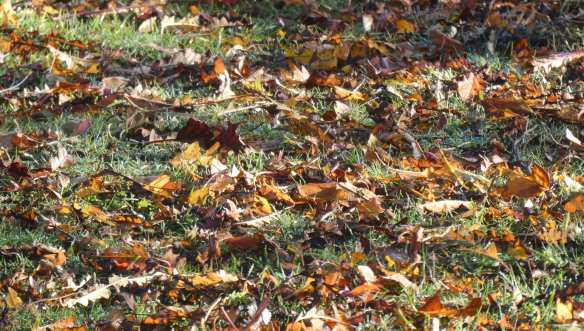
Only nature could paint the colours in the leaves as they turn from green to gold before relinquishing their hold to lay a carpet below.

4.autumn leaves

The blueberry leaves are a stunning shade of red prior to their partition.

7.blueberry leaf

Golden foliage of the Ginkgo slowly descends until only the frame remains.

8.ginkgo

12.ginkgo leaves13.ginkgo

Our gorgeous Ash tree protects the fern garden through summer,

14.Ash tree

relinquishing her frondescence to bathe lilies and irises in winter sunlight.

18.Ash tree

Before long, the buds of spring will appear……

Liquid Light

While in Melbourne last year, we were fortunate to see the Liquid Light: 500 years of Venetian Glass exhibition at the NGV. The island of Murano in Venice has been home for hundreds of years to local artisans who have created the world famous Venetian glass. Evidence of glassmaking in Venice has been found as early as the 7th century but it wasn’t until the mid 15th century that Murano glassmaker Angelo Barovier produced a new glass formula, named cristallo, for its resemblance to rock crystal. The elaborate designs and vibrant colours have changed over the years but the exquisiteness is a constant.

1.installation

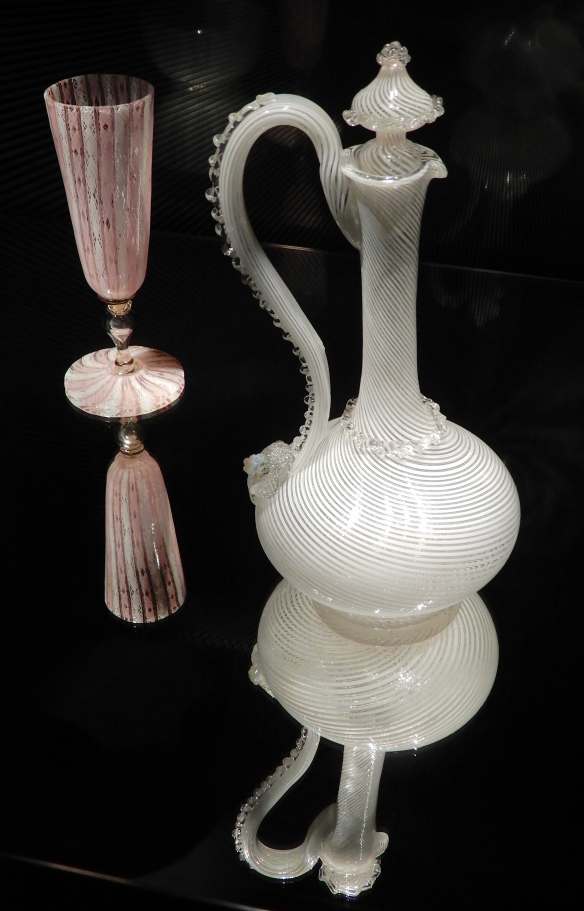
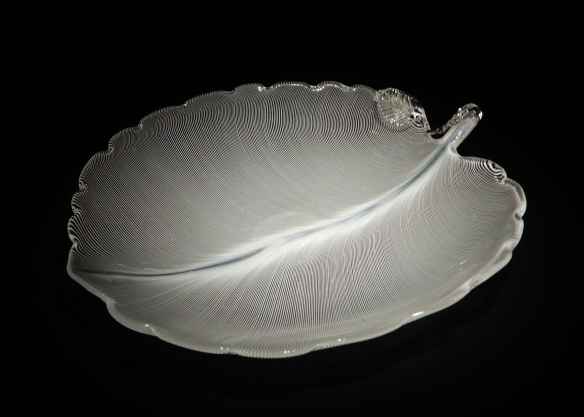
A new form of decoration called vetro a filigrana (filigree glass) emerged in the mid 16th century. Canes of white glass are embedded into the cristallo, the result is stunning.

4.wine glass & decanter 1880

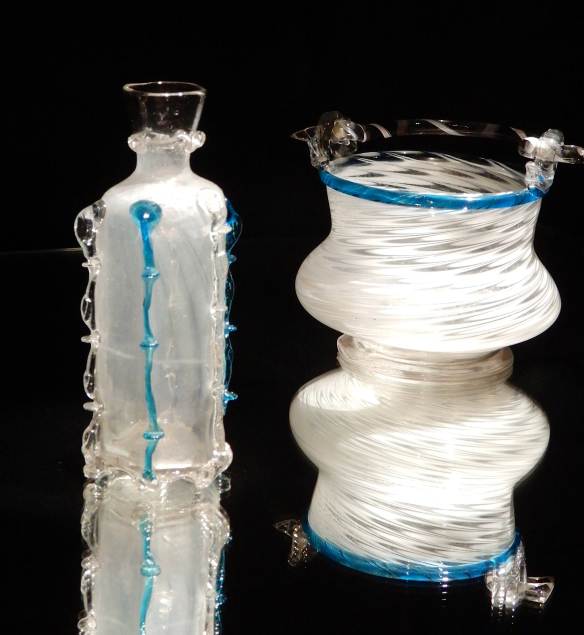
Another process that was developed around this time produced an opaque white glass, known as lattimo. It became popular in the 18th century when it was used to imitate porcelain.

5.bottle & bowl

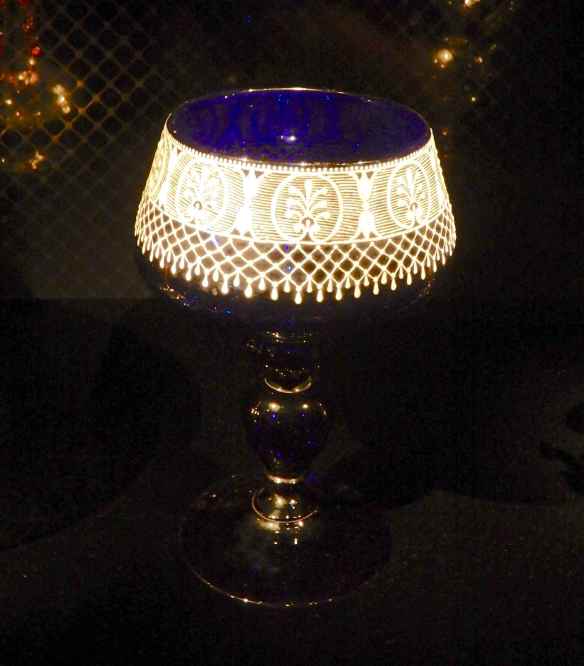
The earlier wine glasses weren’t a lot different to those we use today,

8.goblet 1880

except for the goblets with the ornately embellished stems. I would be very nervous drinking my wine from one of these.

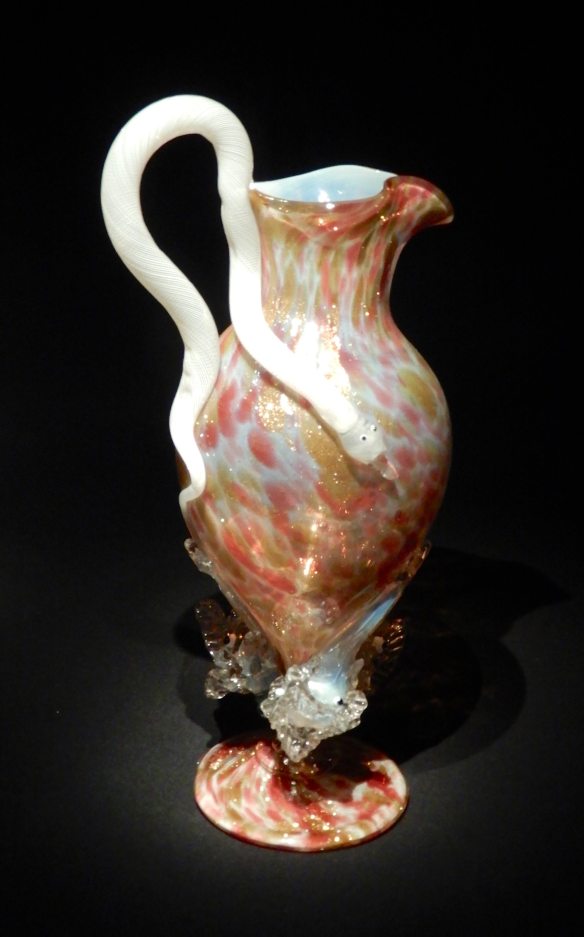
The Venetian glass industry suffered a decline in the 17th century in the wake of a financial crisis following the Italian plague of 1629-1631. A less expensive version of Venetian-style glass emerged and undercut the market for the authentic cristallo. Things went from bad to worse with the Napoleonic Wars and the industry all but collapsed by the mid 19th century. Fortunately, in 1866, The Venice and Murano Glass and Mosaic Company Ltd. was established and the glass making techniques of the 16th and 17th centuries were revived. It seemed that vases and jugs took on a simpler form

16.ewer 1880

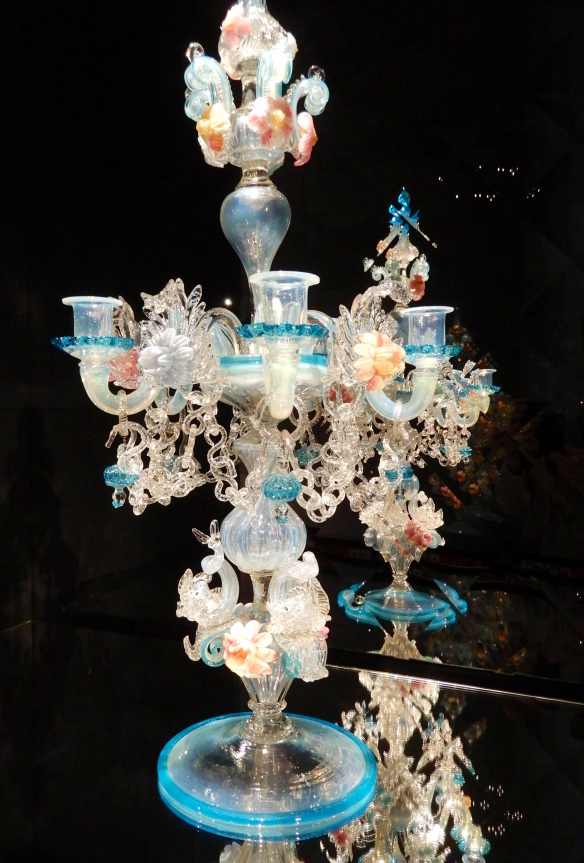
although the same can’t be said for this candelabrum.

17.Candelabrum 1880

Moving into the 20th century, the same techniques were used to produce some beautiful, elegant pieces. Designed by Swedish Tyra Lundgren in 1938, this leaf dish is made with very fine vetro a fili decoration (white glass threads).

18.Venini & Co leaf dish 1950

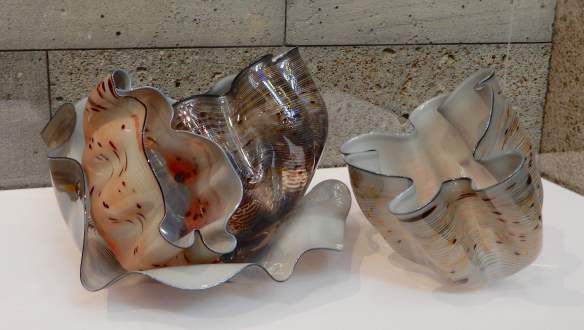
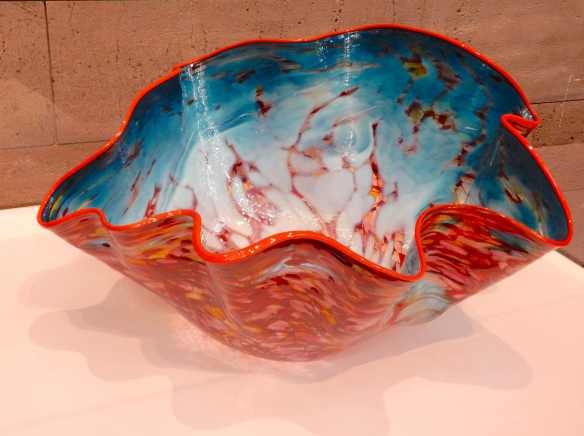
In the 1960s, Dale Chihuly was one of the first Americans to study glassmaking in Venice and in 1969, established the Pilchuk Glass School in Washington where he worked with Toots Zynsky and Richard Marquis. Chihuly began his Macchia series in the 1980s, named for the speckled effect of colours in the shell-like forms (macchia is Italian for spot).

19.Macchia series 198220.Macchia, Dale Chihuly 1993

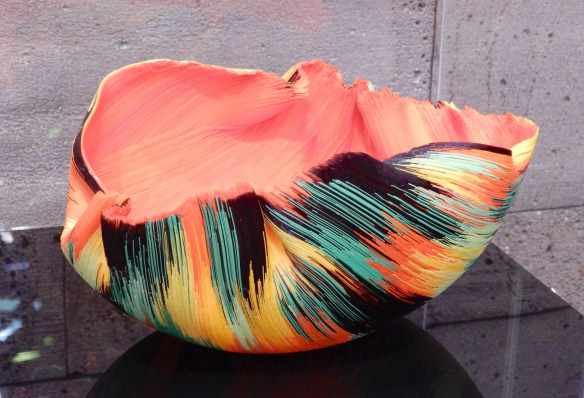
The vivid colours of the fine glass canes in this fascinating piece by Toots Zynsky were inspired by the plumage of exotic African birds.

21.Toots Zynsky 1990

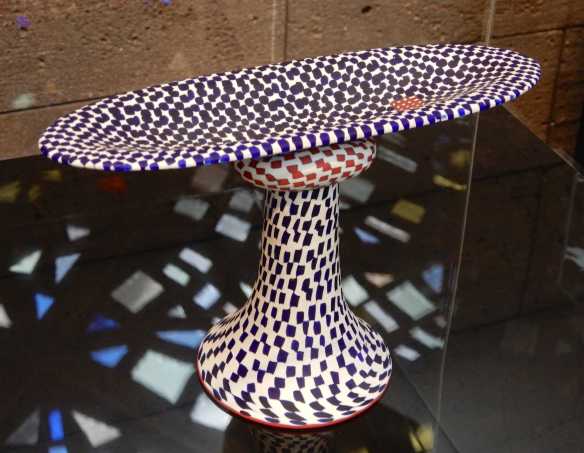
The name of the Marquiscarpa series is a combination of Richard’s surname and that of Carlo Scarpa to pay homage to the Italian architect. The footed platters have an intriguing mosaic appearance, created using glass canes sliced into cross sections.

22.Marquiscarpa #9, 1991

In the 21st century, the Venetian glass industry has to compete with the incursion of cheaper imports. Hopefully, ongoing collaborations between Muranese workshops and outside artists will secure its future.

avian interlopers

Our garden has no shortage of birdlife. The wrens bob around happily keeping the insect population down and the honeyeaters commingle with the bumble bees around the flowering plants. Sometimes, all is not so peaceful. In summer the swallows appear, desperately seeking out their ideal position for the new seasons arrivals. This year, they built a cosy nest under the eaves at the southwestern end of house, not anticipating the unseasonal gale force winds that ensued. Plan B was in the more sheltered northeastern corner but they must have found a Plan C because there was no evidence of them using the nest. I’m sure they will be back next summer.

3.swallow

Kookaburras are one of my favourites, they are so handsome and their distinctive calls that sound like anything from a chainsaw starting to a raucous belly laugh always make me smile.

4.kookaburra

Our relationship was tested when our goldfish started disappearing and one day, Michael observed the kookie culprit. We really didn’t want to put a net over the pond and, knowing kookaburras are territorial, installed a metal facsimile to guard the pond.

5.metalbird

It seemed to work for a while but, long story short, there is now a net over the pond and our new fish are safe.

6.pond

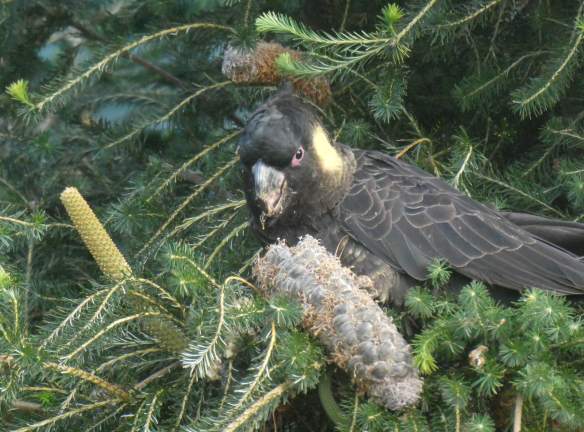
We often have visits from the yellow-tailed black cockatoos, usually for water from the stock troughs. I like their mournful, wailing call and they work together as a team with one keeping lookout while the others have a drink. They, too, have recently tested our hospitality. We have a beautiful banksia that has finally reached the perfect dimensions to disguise a rainwater tank – the very reason it was planted.

7.banksia

One afternoon, the cockatoos decided to bring the family and feast on the seed pods.

8.yellow tailed black cockatoo

About a dozen birds created havoc, breaking branchlets and flinging debris in all directions. They have returned numerous times, hopefully the tree will survive the onslaught.

11.yellow tailed black cockatoo

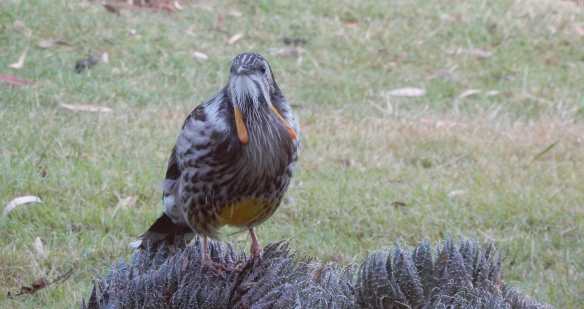
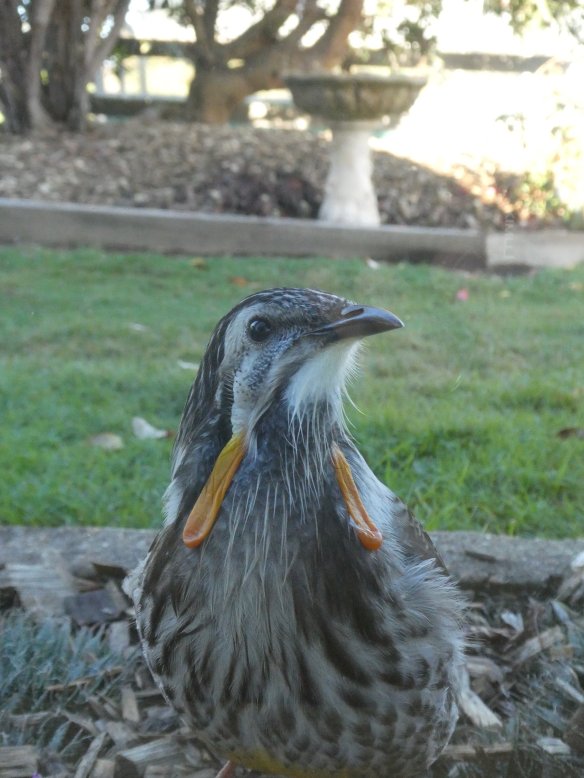
The lounge window has always attracted birdlife, the double-glazing provides a flawless reflection. Most of them just look at themselves, some will tap and flutter against the glass while others will stand there and call incessantly. Tasmania is the only place you will find the Yellow Wattlebird, Australia’s largest honeyeater. It has a range of distinctive calls, all of which are very loud and not of the soothing variety, more like a soprano cough. One recently became completely enamoured with his own reflection, I took a closer look.

12.yellow wattlebird

He retreated to the safety of the nearby birdbath and scanned the area

before returning to his mirror. In the meantime, I had adjusted my perch for a bird’s eye view.

17.yellow wattlebird

Back to the bath for a quick dip

and he seemed satisfied with the result.

20.yellow wattlebird

It is lovely to have so many birds around. Despite my grumbling, I wouldn’t want it any other way.