Arts Centre Market

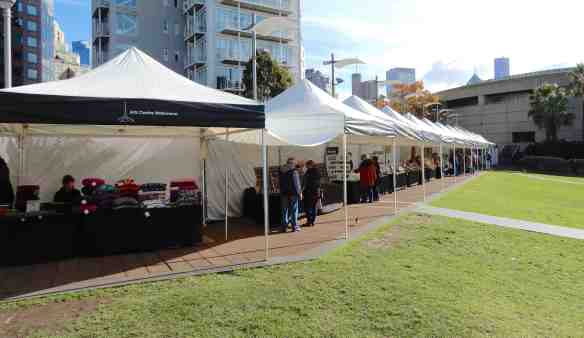
There is no shortage of markets in Melbourne and of the few I have experienced, the Arts Centre Market is my favourite. The setting, on the lawns adjacent to the Arts Centre and along St. Kilda Road, allow plenty of space for browsing without feeling confined. The landmark spire towers 162 metres above the skirt, designed to represent the billowing of a ballerina’s tutu.

On the same theme, a bronze sculpture by Melbourne artist David Maughan, Les Belle Hélène, depicts two female ballet dancers who seem to be celebrating the sunshine on this magnificent winters day.

We arrived early and took our time investigating the unique treasures on offer and enjoying the bucolic atmosphere. Stallholders are selected based on the quality and originality of their locally produced wares, there was no end to the temptation.

5.Arts Centre Market6.Arts Centre Market7.Indian Myna

Following our noses to the origin of the delectable aroma wafting through the air, we found Choo La La and their French praline nuts. As if the salivary glands weren’t already in overdrive, the free samples helped us choose between peanuts, almonds and macadamias (actually, they didn’t really help – we bought all three).

8.Chooh La La

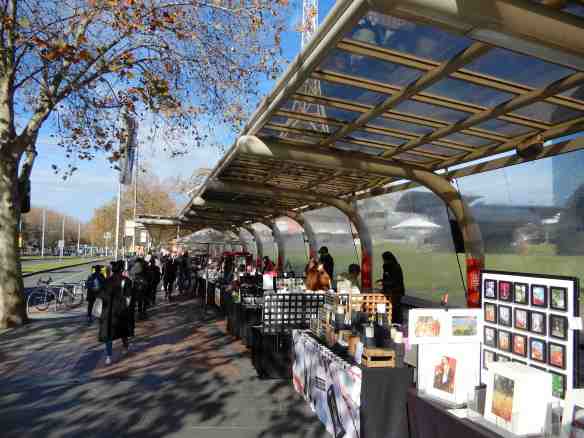
After a perusal of the roadside stalls

9.Arts Centre Market

it was time to think about lunch. There were many options but we couldn’t resist a ham & Swiss cheese crepe from the mobile French style Creperie, Street Crepes.

10.Street Crepes

Once the artist had created his masterpiece, we found a convenient bench by the National Gallery on which to sit and enjoy the result. It was delicious, just enough to fortify us for an afternoon ambling around the exhibitions at the NGV.

17.NGV

autumn leaves

Autumn is a lovely time of year in the garden. The sun is lower in the sky, casting shadows that hint of winter and the deciduous trees shrug off their coats, revealing gangly limbs ready for pruning.

1.autumn trees2.autumn trees

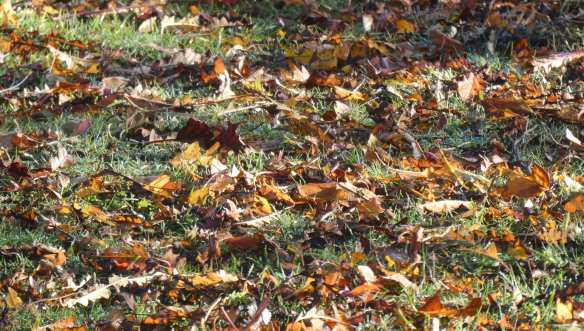
Only nature could paint the colours in the leaves as they turn from green to gold before relinquishing their hold to lay a carpet below.

4.autumn leaves

The blueberry leaves are a stunning shade of red prior to their partition.

7.blueberry leaf

Golden foliage of the Ginkgo slowly descends until only the frame remains.

8.ginkgo

12.ginkgo leaves13.ginkgo

Our gorgeous Ash tree protects the fern garden through summer,

14.Ash tree

relinquishing her frondescence to bathe lilies and irises in winter sunlight.

18.Ash tree

Before long, the buds of spring will appear……

Liquid Light

While in Melbourne last year, we were fortunate to see the Liquid Light: 500 years of Venetian Glass exhibition at the NGV. The island of Murano in Venice has been home for hundreds of years to local artisans who have created the world famous Venetian glass. Evidence of glassmaking in Venice has been found as early as the 7th century but it wasn’t until the mid 15th century that Murano glassmaker Angelo Barovier produced a new glass formula, named cristallo, for its resemblance to rock crystal. The elaborate designs and vibrant colours have changed over the years but the exquisiteness is a constant.

1.installation

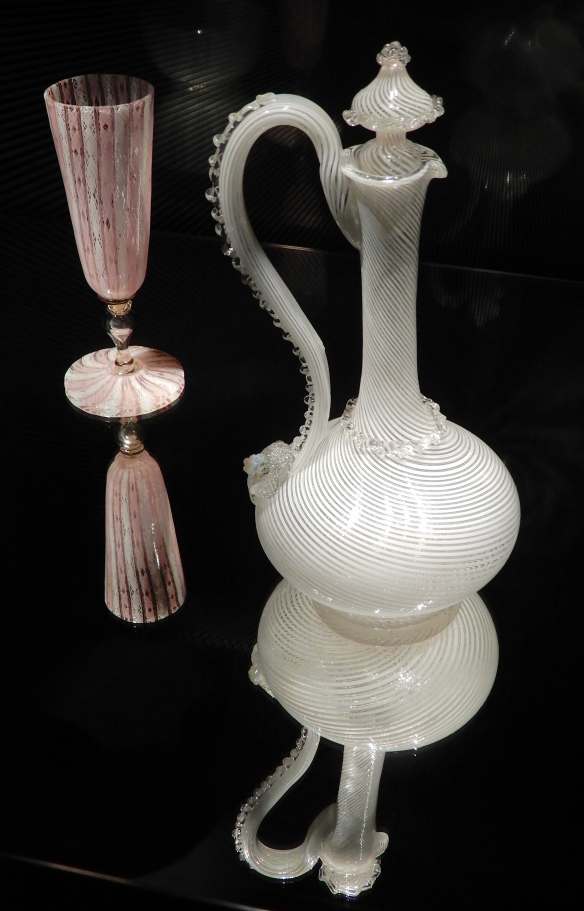
A new form of decoration called vetro a filigrana (filigree glass) emerged in the mid 16th century. Canes of white glass are embedded into the cristallo, the result is stunning.

4.wine glass & decanter 1880

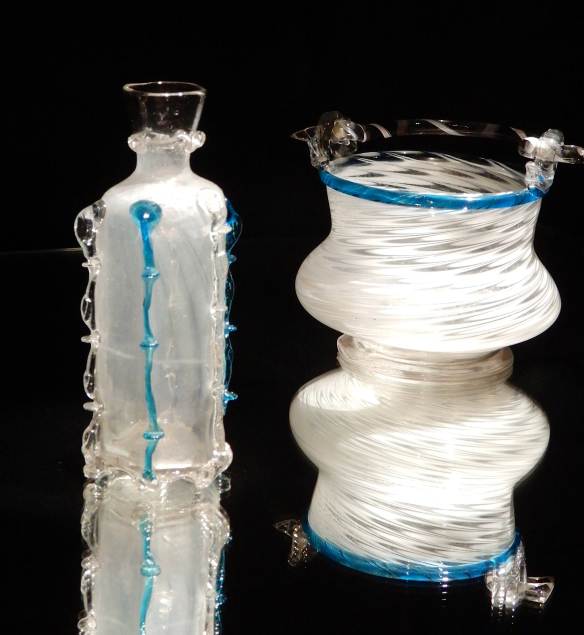
Another process that was developed around this time produced an opaque white glass, known as lattimo. It became popular in the 18th century when it was used to imitate porcelain.

5.bottle & bowl

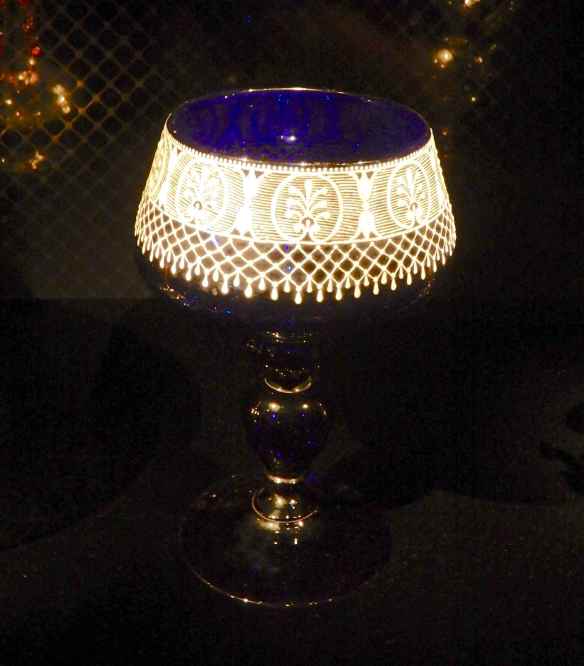
The earlier wine glasses weren’t a lot different to those we use today,

8.goblet 1880

except for the goblets with the ornately embellished stems. I would be very nervous drinking my wine from one of these.

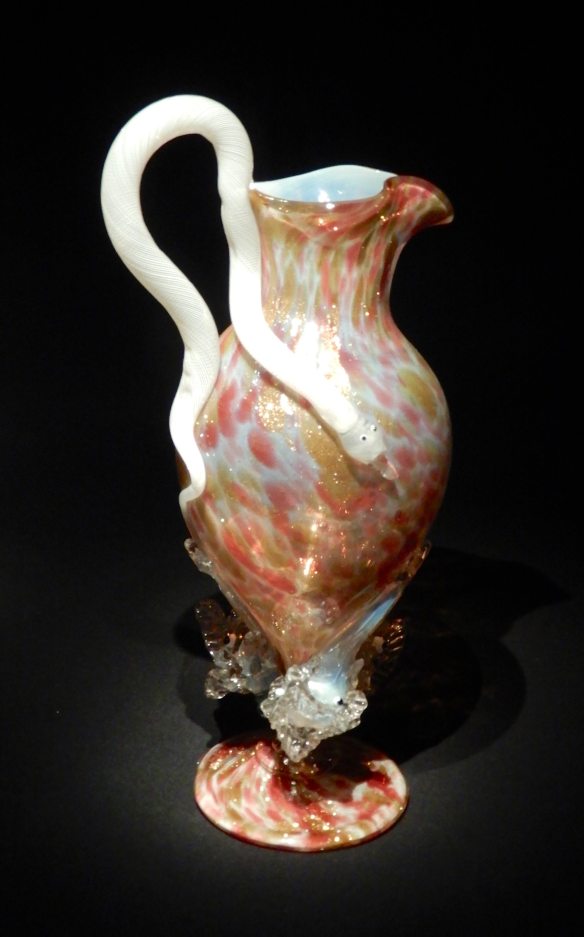
The Venetian glass industry suffered a decline in the 17th century in the wake of a financial crisis following the Italian plague of 1629-1631. A less expensive version of Venetian-style glass emerged and undercut the market for the authentic cristallo. Things went from bad to worse with the Napoleonic Wars and the industry all but collapsed by the mid 19th century. Fortunately, in 1866, The Venice and Murano Glass and Mosaic Company Ltd. was established and the glass making techniques of the 16th and 17th centuries were revived. It seemed that vases and jugs took on a simpler form

16.ewer 1880

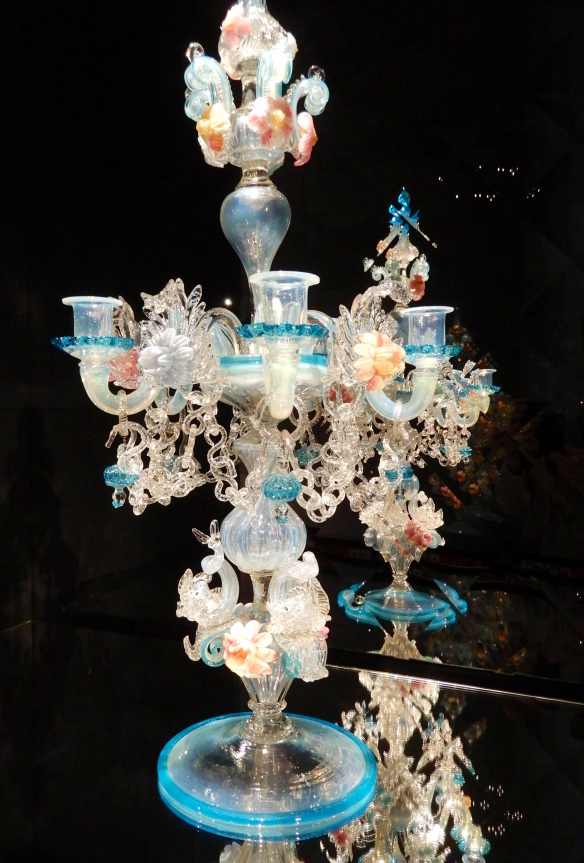
although the same can’t be said for this candelabrum.

17.Candelabrum 1880

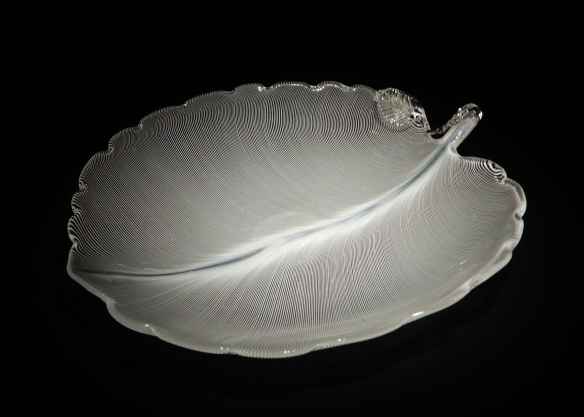
Moving into the 20th century, the same techniques were used to produce some beautiful, elegant pieces. Designed by Swedish Tyra Lundgren in 1938, this leaf dish is made with very fine vetro a fili decoration (white glass threads).

18.Venini & Co leaf dish 1950

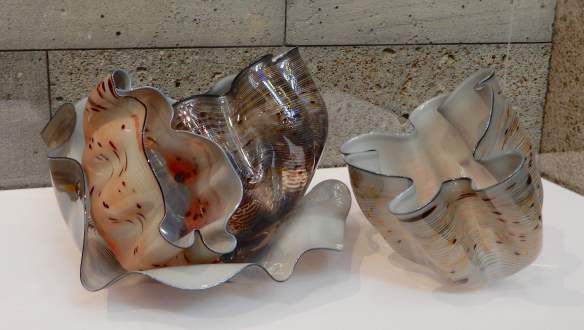
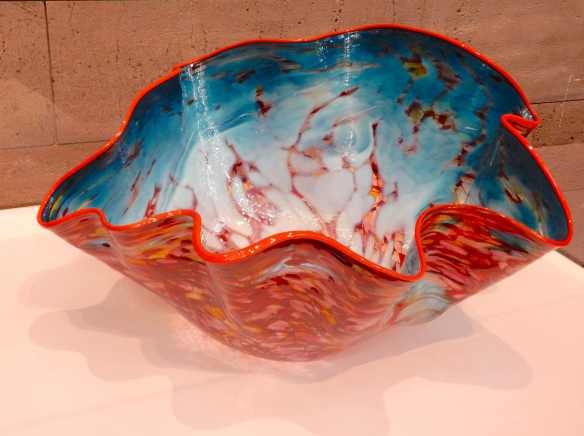
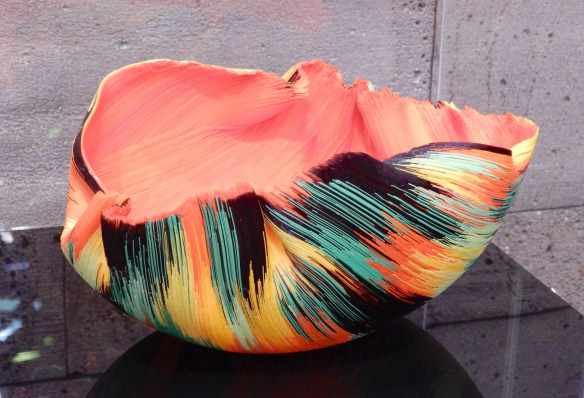
In the 1960s, Dale Chihuly was one of the first Americans to study glassmaking in Venice and in 1969, established the Pilchuk Glass School in Washington where he worked with Toots Zynsky and Richard Marquis. Chihuly began his Macchia series in the 1980s, named for the speckled effect of colours in the shell-like forms (macchia is Italian for spot).

19.Macchia series 198220.Macchia, Dale Chihuly 1993

The vivid colours of the fine glass canes in this fascinating piece by Toots Zynsky were inspired by the plumage of exotic African birds.

21.Toots Zynsky 1990

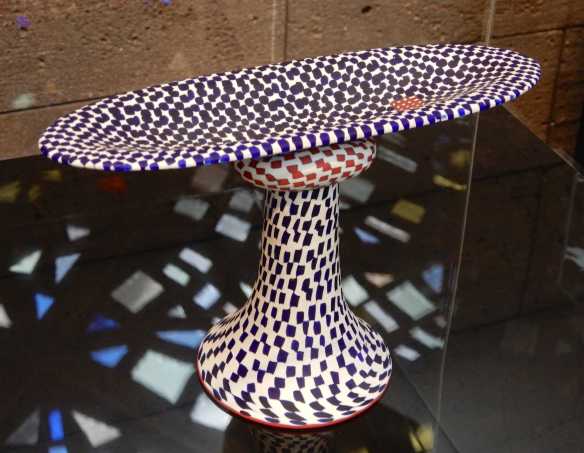
The name of the Marquiscarpa series is a combination of Richard’s surname and that of Carlo Scarpa to pay homage to the Italian architect. The footed platters have an intriguing mosaic appearance, created using glass canes sliced into cross sections.

22.Marquiscarpa #9, 1991

In the 21st century, the Venetian glass industry has to compete with the incursion of cheaper imports. Hopefully, ongoing collaborations between Muranese workshops and outside artists will secure its future.

avian interlopers

Our garden has no shortage of birdlife. The wrens bob around happily keeping the insect population down and the honeyeaters commingle with the bumble bees around the flowering plants. Sometimes, all is not so peaceful. In summer the swallows appear, desperately seeking out their ideal position for the new seasons arrivals. This year, they built a cosy nest under the eaves at the southwestern end of house, not anticipating the unseasonal gale force winds that ensued. Plan B was in the more sheltered northeastern corner but they must have found a Plan C because there was no evidence of them using the nest. I’m sure they will be back next summer.

3.swallow

Kookaburras are one of my favourites, they are so handsome and their distinctive calls that sound like anything from a chainsaw starting to a raucous belly laugh always make me smile.

4.kookaburra

Our relationship was tested when our goldfish started disappearing and one day, Michael observed the kookie culprit. We really didn’t want to put a net over the pond and, knowing kookaburras are territorial, installed a metal facsimile to guard the pond.

5.metalbird

It seemed to work for a while but, long story short, there is now a net over the pond and our new fish are safe.

6.pond

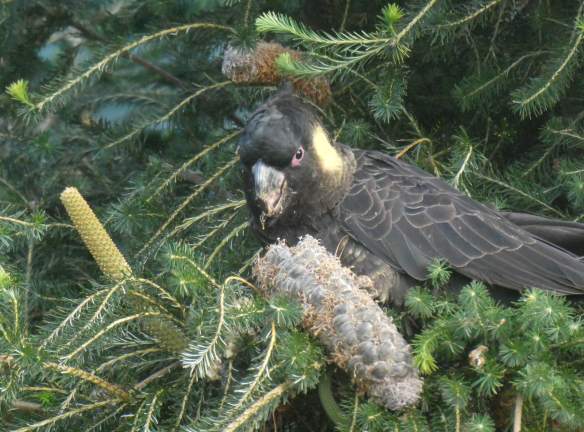
We often have visits from the yellow-tailed black cockatoos, usually for water from the stock troughs. I like their mournful, wailing call and they work together as a team with one keeping lookout while the others have a drink. They, too, have recently tested our hospitality. We have a beautiful banksia that has finally reached the perfect dimensions to disguise a rainwater tank – the very reason it was planted.

7.banksia

One afternoon, the cockatoos decided to bring the family and feast on the seed pods.

8.yellow tailed black cockatoo

About a dozen birds created havoc, breaking branchlets and flinging debris in all directions. They have returned numerous times, hopefully the tree will survive the onslaught.

11.yellow tailed black cockatoo

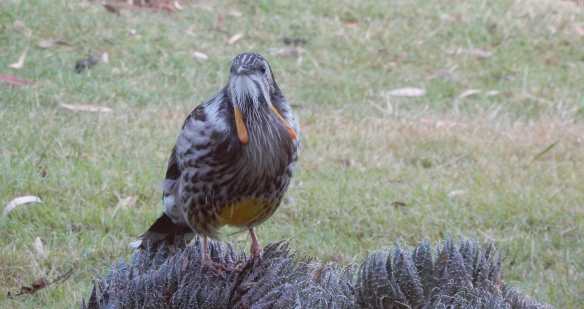
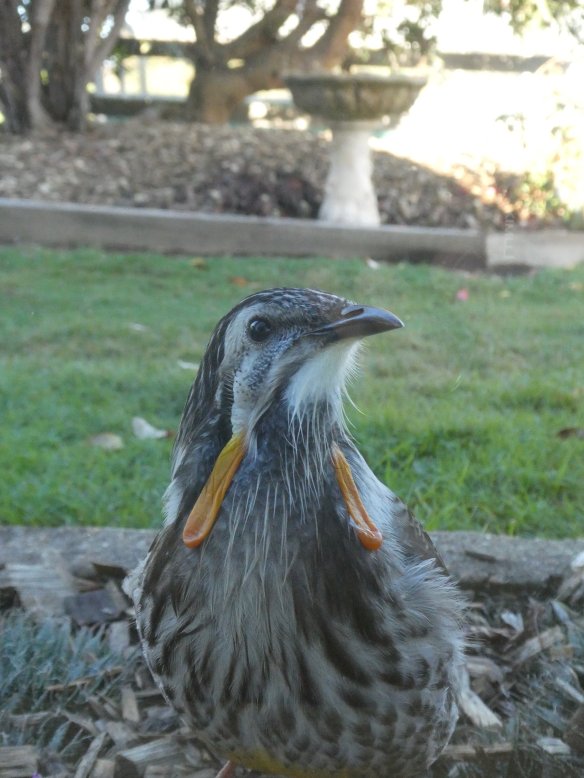
The lounge window has always attracted birdlife, the double-glazing provides a flawless reflection. Most of them just look at themselves, some will tap and flutter against the glass while others will stand there and call incessantly. Tasmania is the only place you will find the Yellow Wattlebird, Australia’s largest honeyeater. It has a range of distinctive calls, all of which are very loud and not of the soothing variety, more like a soprano cough. One recently became completely enamoured with his own reflection, I took a closer look.

12.yellow wattlebird

He retreated to the safety of the nearby birdbath and scanned the area

before returning to his mirror. In the meantime, I had adjusted my perch for a bird’s eye view.

17.yellow wattlebird

Back to the bath for a quick dip

and he seemed satisfied with the result.

20.yellow wattlebird

It is lovely to have so many birds around. Despite my grumbling, I wouldn’t want it any other way.

RAAF Museum

Just when we thought we had seen everything Werribee has to offer, we discovered the RAAF Museum just 10km down the road. Point Cook is the birthplace of the Australian Flying Corps (AFC) which was renamed to the Royal Australian Air Force (RAAF) in 1921. It was the Air Force’s only base from 1912 to 1925, when RAAF Laverton was built 20km away. The two became amalgamated in 1989 under the one name, RAAF Williams, named after Sir Richard Williams. The first military pilot to graduate from Point Cook in November 1914, he is considered the ‘father of the RAAF’. We felt a sense of privilege as we were handed our permits to enter the facility at the security gate.

Having only seen these aircraft in movies, I was awed by the magnitude of the de Havilland Canada Caribou on display between the hangars.
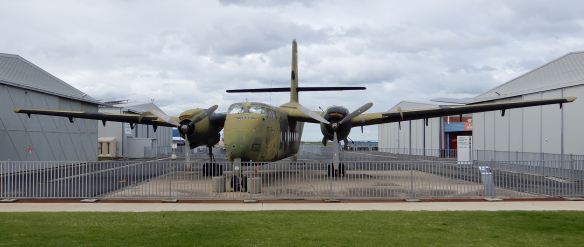
3.de Havilland DHC-4 Caribou A4-152

The RAAF Museum was established in 1952 to preserve aircraft, documents and memorabilia associated with the Air Force and opened to the public in 1972.

There is so much to see, even before reaching the aircraft hangars. This little woollen airman doll was carried as a good luck mascot by Squadron Leader A.S. McCracken in his Halifax bomber during World War II. A.S. was thrown through the cockpit canopy following a crash landing in 1944 and survived unscathed. The medals belonged to Air Vice Marshal Sir George Jones who shot down seven German aircraft during World War I. He became Chief of the Air Staff during the World War II and led the RAAF until 1952 when he retired.

6.mascot & medals

The information accompanying various displays of uniforms, rations and kit made for very interesting reading, far too involved for me to summarise.

The exhibits continued throughout the hangars with the added dimension of magnificent aircraft. We started in the Training Hangar to see how RAAF training has advanced over the years. To me, some of the earlier aircraft were real works of art with the use of beautiful polished timbers and complex mazes of wires. The Maurice Farman Shorthorn was the first armed aircraft to engage in aerial combat in World War I. Known as ‘Rumpety’ to the students because of the noise it made while travelling over the ground, it was used to train pilots until 1919.

Used by the RAAF throughout the 1920s, the Avro 504K was the first training aircraft that could be flown aerobatically. It is also linked to the first death in training of a RAAF airman at Point Cook following an accident in 1921.

The Tiger Moth on display was built at the de Havilland factory in Bankstown in 1942 and entered service in November 1943. It has been restored to original military configuration including the training colours of its wartime service.

The aircraft silhouette changed dramatically after World War II with the single-seat fighter, Vampire, initially in RAAF service in 1949. The two-seat trainer version was introduced in 1951 and the first ejection performed in Australia was from a Vampire in September 1952.

20.de havilland Vampire T Mk 35

The Winjeel, designed to replace the Tiger Moth as a basic trainer, first flew in 1951.

The Winjeel was replaced in 1972 with the CT4 Airtrainer. It was nicknamed the ‘Plastic Parrot’ because of its lightweight construction and green and yellow colours.
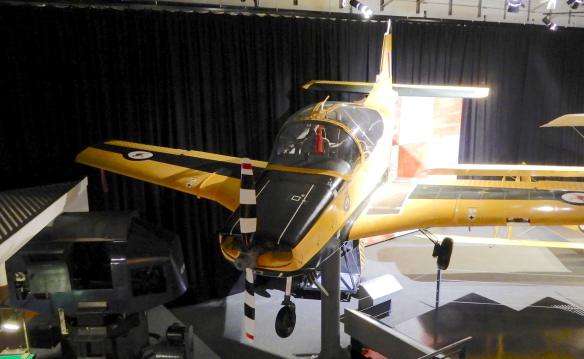
24.CT4A Airtrainer

The Italian designed Aermacchi MB 326H on display, known as the Macchi in Australian service, was the first received by the RAAF in October 1967.

Simulators are an important part of training, the RAAF now have a simulator for each aircraft type in service. The older models might have required a certain amount of imagination.

Manufactured shortly after World War II, the ‘Pie Cart’ was used to teach students how to hand-start an aircraft engine. It was nicknamed the “Terror Machine” for its ability to inflict serious injury. The yellow and black safety stripes are a recent addition.

We ventured next into the Technology Hangar to experience the evolution of military aviation, stepping back in time once again to 1913 and the magnificent wood, wire and fabric construction of the B.E.2a.

The SE 5 is an exact replica of an aircraft that entered service in 1922. The original was damaged in 1928 when it taxied into a DH9 and again, a month later, in a forced landing. The run of bad luck ended when it was eventually destroyed by fire in June 1929.

36.SE 5a

I can only describe the Supermarine Walrus as extraordinary. It looks like the most cumbersome and least likely to stay aloft aircraft ever conceived. On the contrary, it was designed to be catapulted from warships and was used for reconnaissance and air-sea rescue until 1946.

37.Supermarine Seagull V:Walrus

Suspended from the rafters, the Iroquois helicopter is one of two involved in the mission to re-supply ammunition to ground troops at Long Tan in 1966. After retirement in 1984, the aircraft was used as a training aid at the RAAF School of Radio before being transferred to the RAAF museum in 1993 and restored to its Vietnam War configuration.

38.Bell UH-1B Iroquois

The Vampire F-30 began service in the RAAF in 1950 and five years later, was converted to a target-towing aircraft with the addition of a hook and release mechanism below the cockpit. The striking paint scheme was designed to prevent the towing aircraft being mistaken for the target.

The Boston Bomber on display arrived in Melbourne in 1942 and carried out missions from Goodenough Island until it crashed on the airstrip due to battle damage a year later. It was recovered from there in 1987, restored and transported to the RAAF Museum in 1998, the only survivor of 69 Bostons operated by the RAAF.
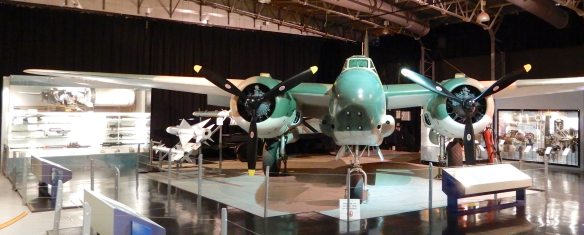
41.Douglas A-20C Boston Bomber

An assortment of missiles are on display, including the Bloodhound surface-to-air missile of the 1950s and the more recent ASRAAM heat seeking air-to-air variety.

We finished off with a quick peek in the Restoration Hangar, a boggling collection of aircraft in various states of repair (or disrepair, depending on your viewpoint).
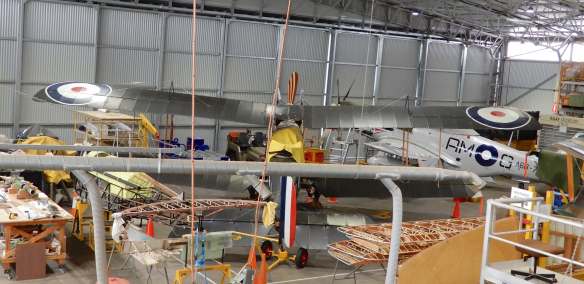
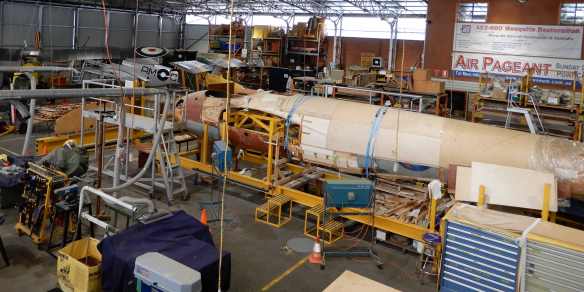
44.de Havilland DH-60M Gypsy Moth45.de Havilland DH.98 Mosquito

If you want to read more about the de Havilland DH.98 Mosquito restoration, take a look at Aces Flying High, Deano is a mine of information.