Star of the Sea

For many years, I have been fascinated by a beautiful red brick church perched on a hill at one of the main intersections on the highway here in Burnie. Beside it are other similarly constructed edifices, one of which appears to be a school with the year 1912 above the doorway. To satisfy my curiosity, I recently took a closer look. The Catholic Church of St. Mary’s Star of the Sea opened in January 1891.

Designed by respected architect Alexander North, whose work includes Holy Trinity in Launceston, the church is an excellent example of the High Victorian Gothic style. There is no door at the front of the church, the entrance is via a porch on the eastern side wall above which is an elaborately carved white cross imported from New Zealand.
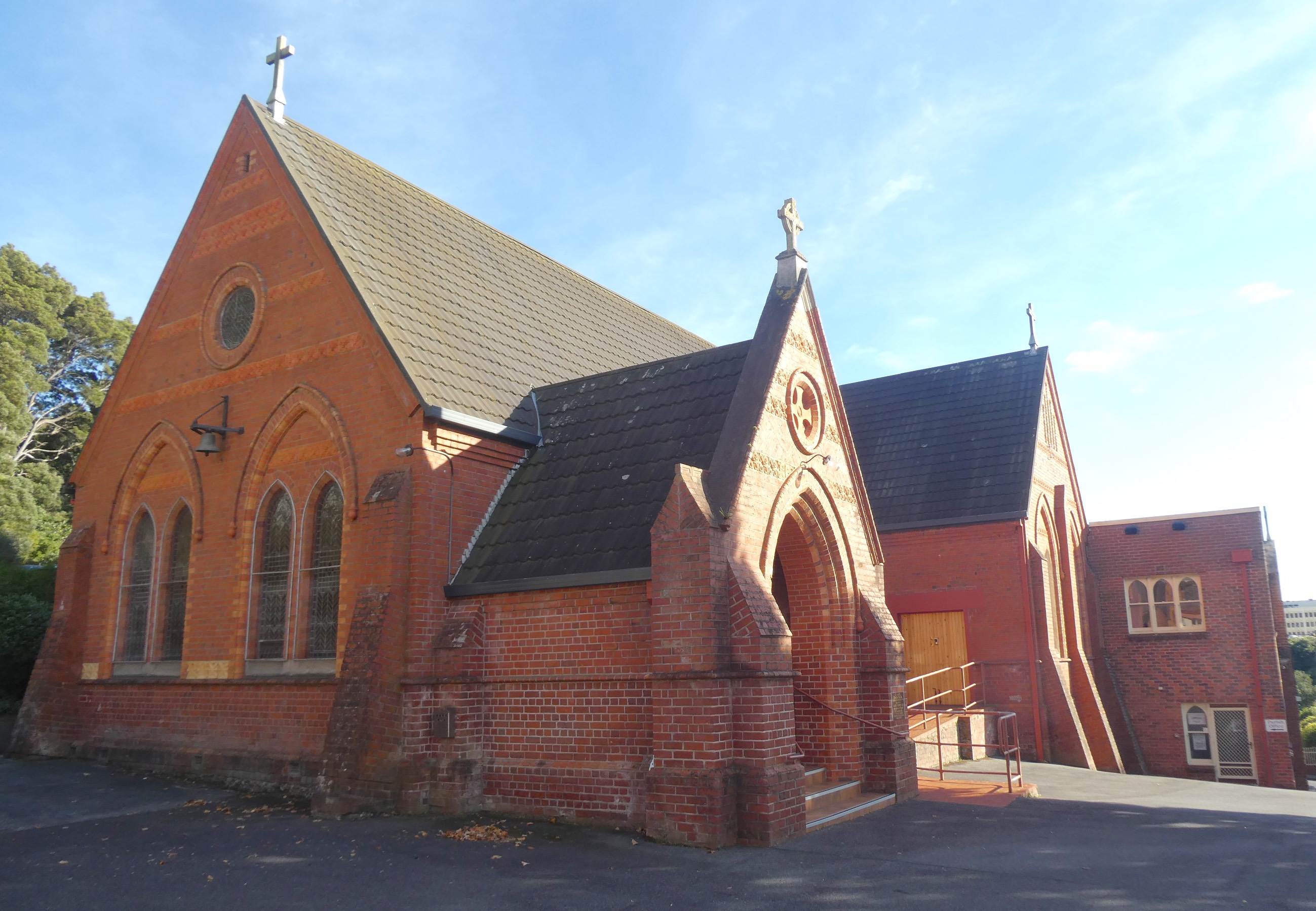
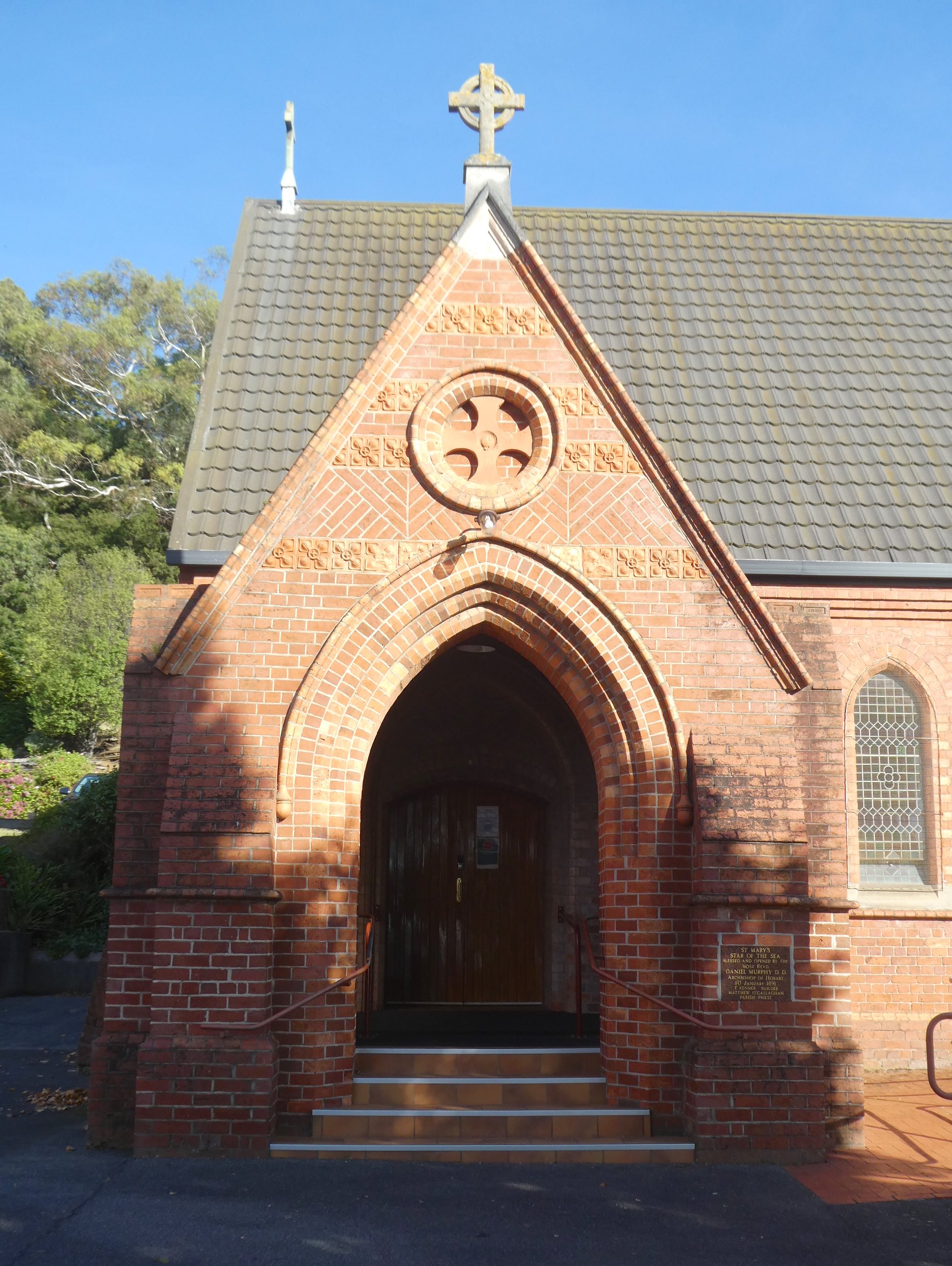
The red bricks were manufactured locally in Burnie while specially moulded bricks and terracotta tiles with a stylised flower design came from Launceston. The finest quality sandstone from Ross quarry in Tasmania’s midlands was used for the window frames.

The use of black bricks amongst the red ones to create geometric patterns, known as structural polychromy, was one of the features of High Victorian Gothic buildings.
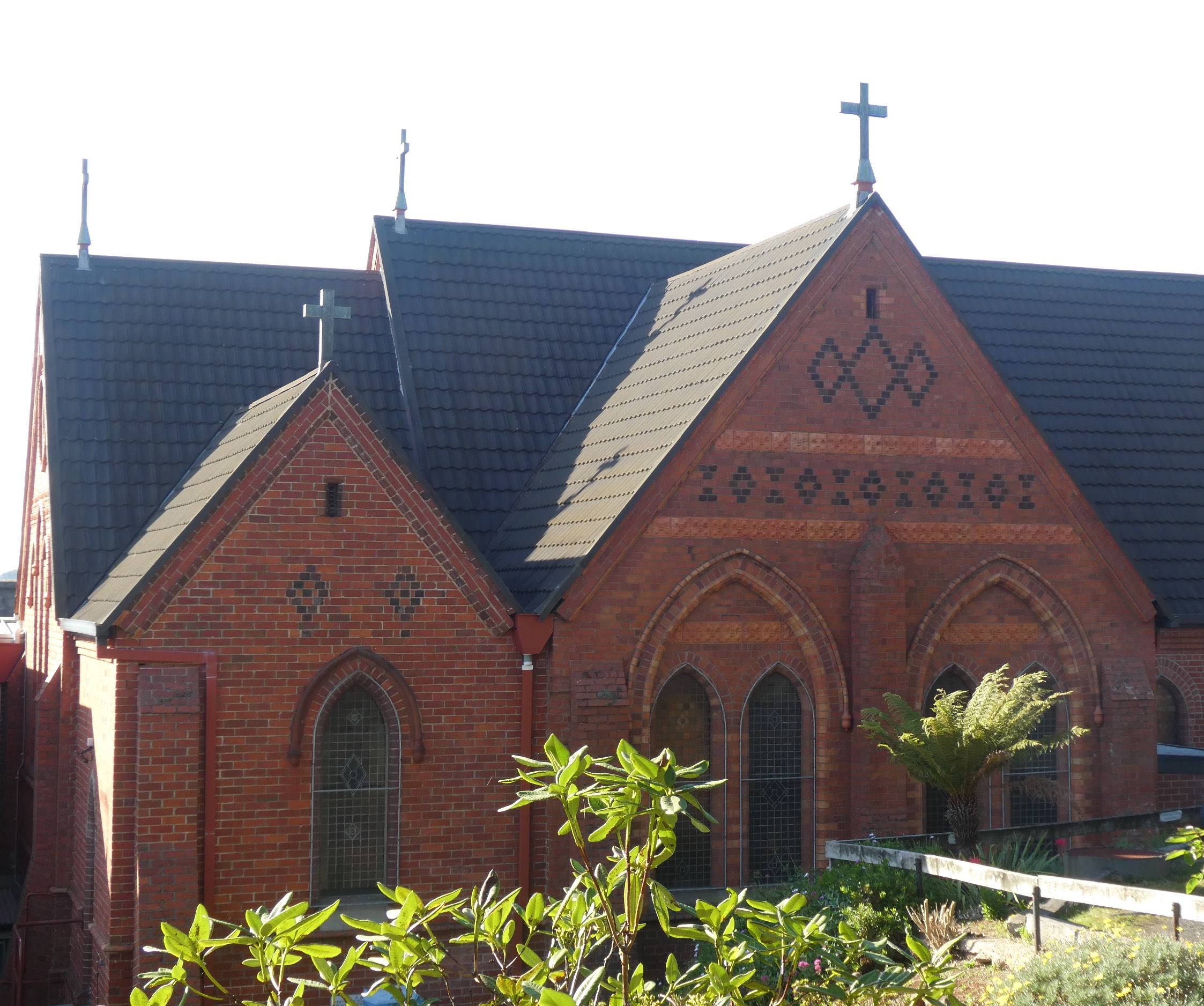
The Welsh slates on the pitched roof have stood the test of time.
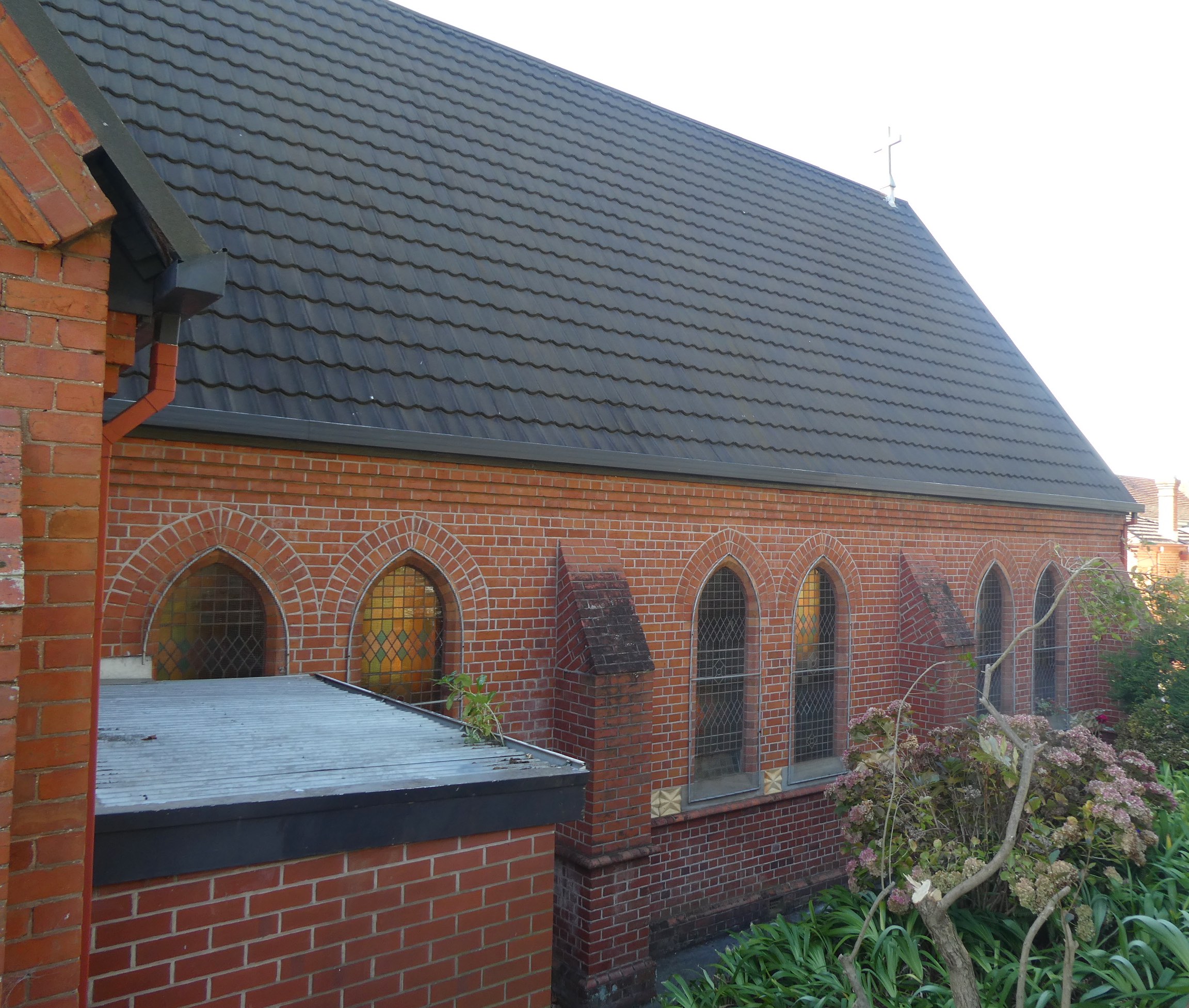
The interior is welcoming and warm with red brick walls and a pine lined roof.

I made my way to the chancel

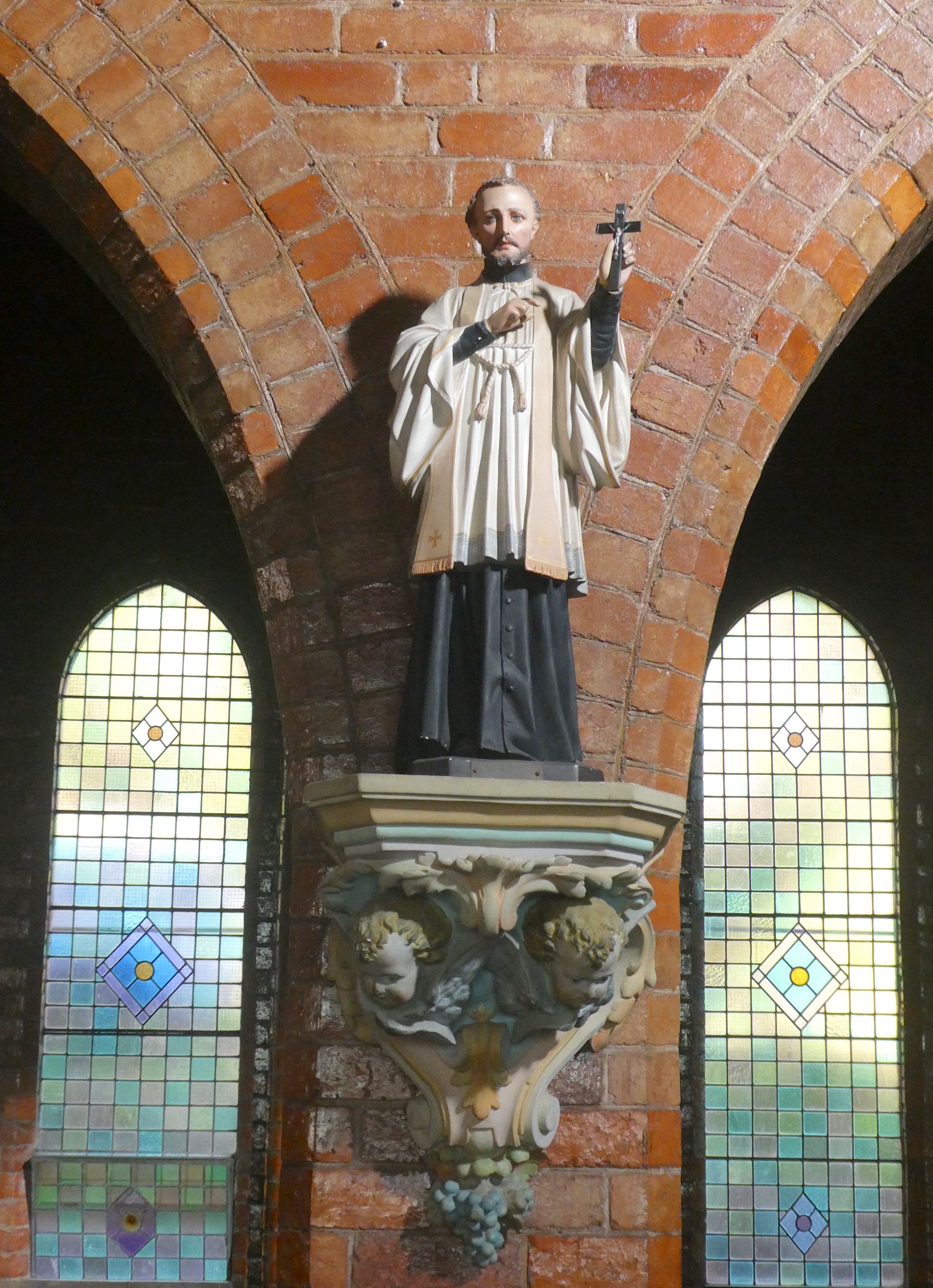
where a trinity of colourful stained glass windows depict the Annunciation, the Sacred Heart appearing to St. Margaret Mary Alacoque and the Nativity.
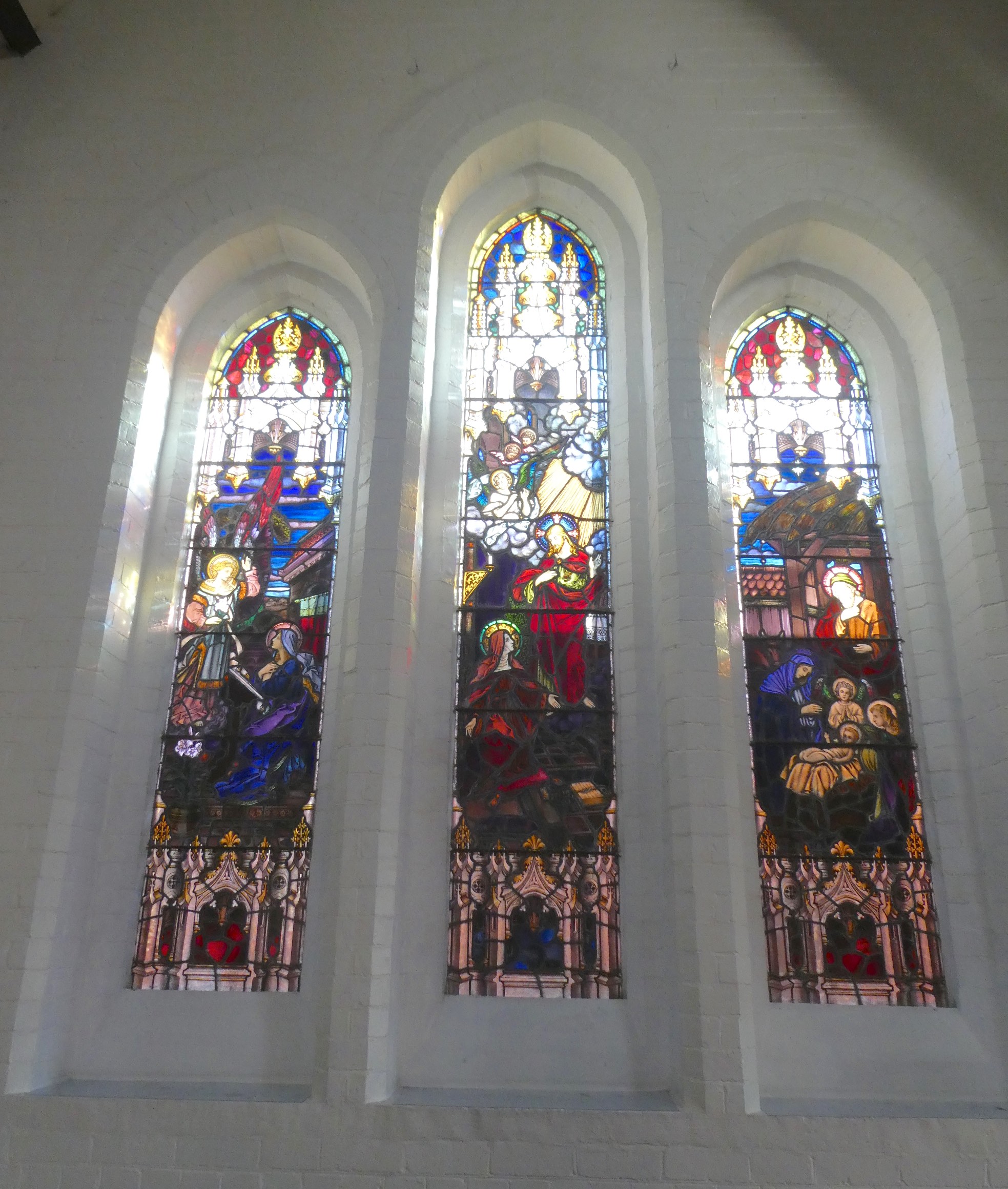
All the windows are of stained glass, the bold geometric patterns throughout the nave were designed by North himself.

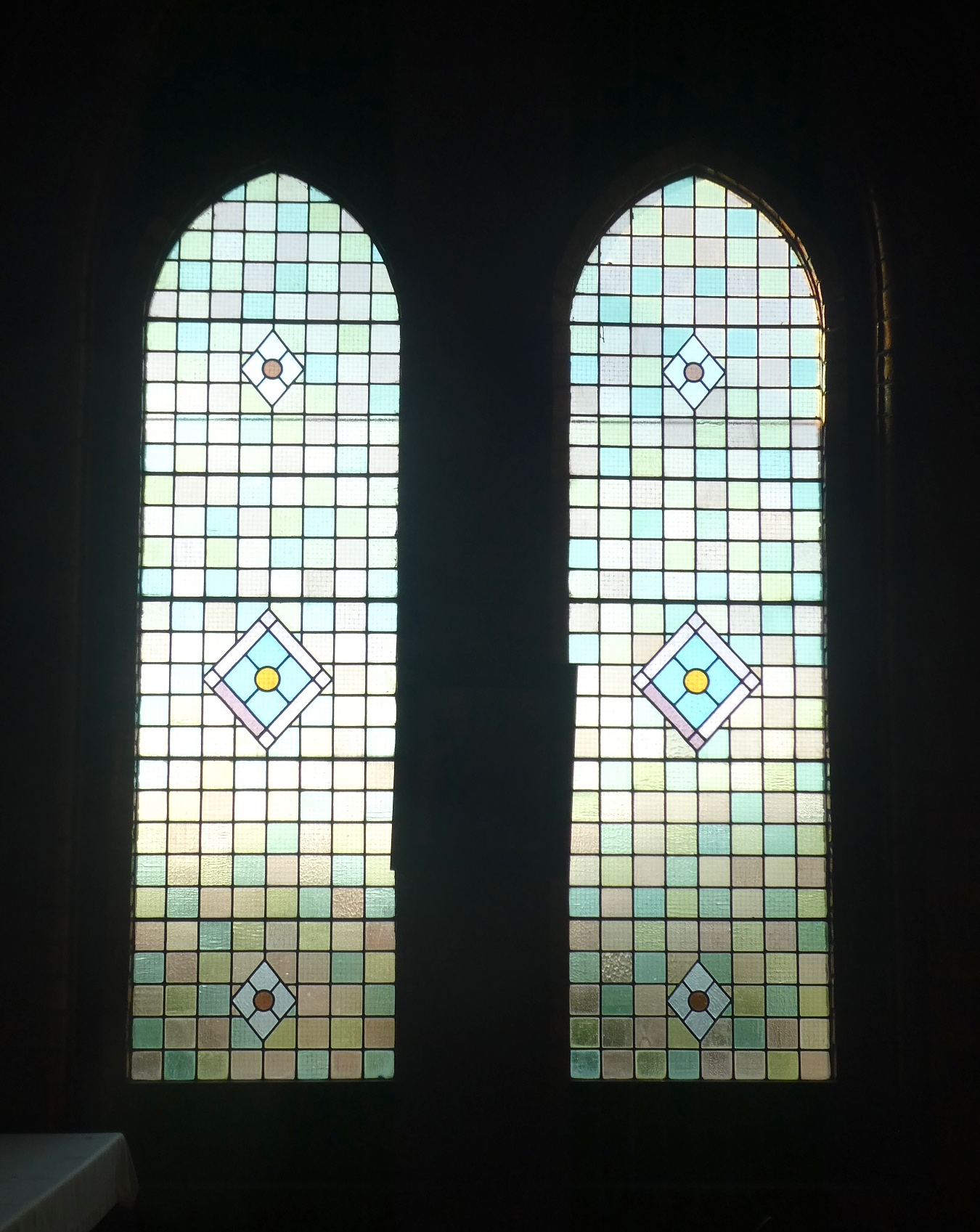
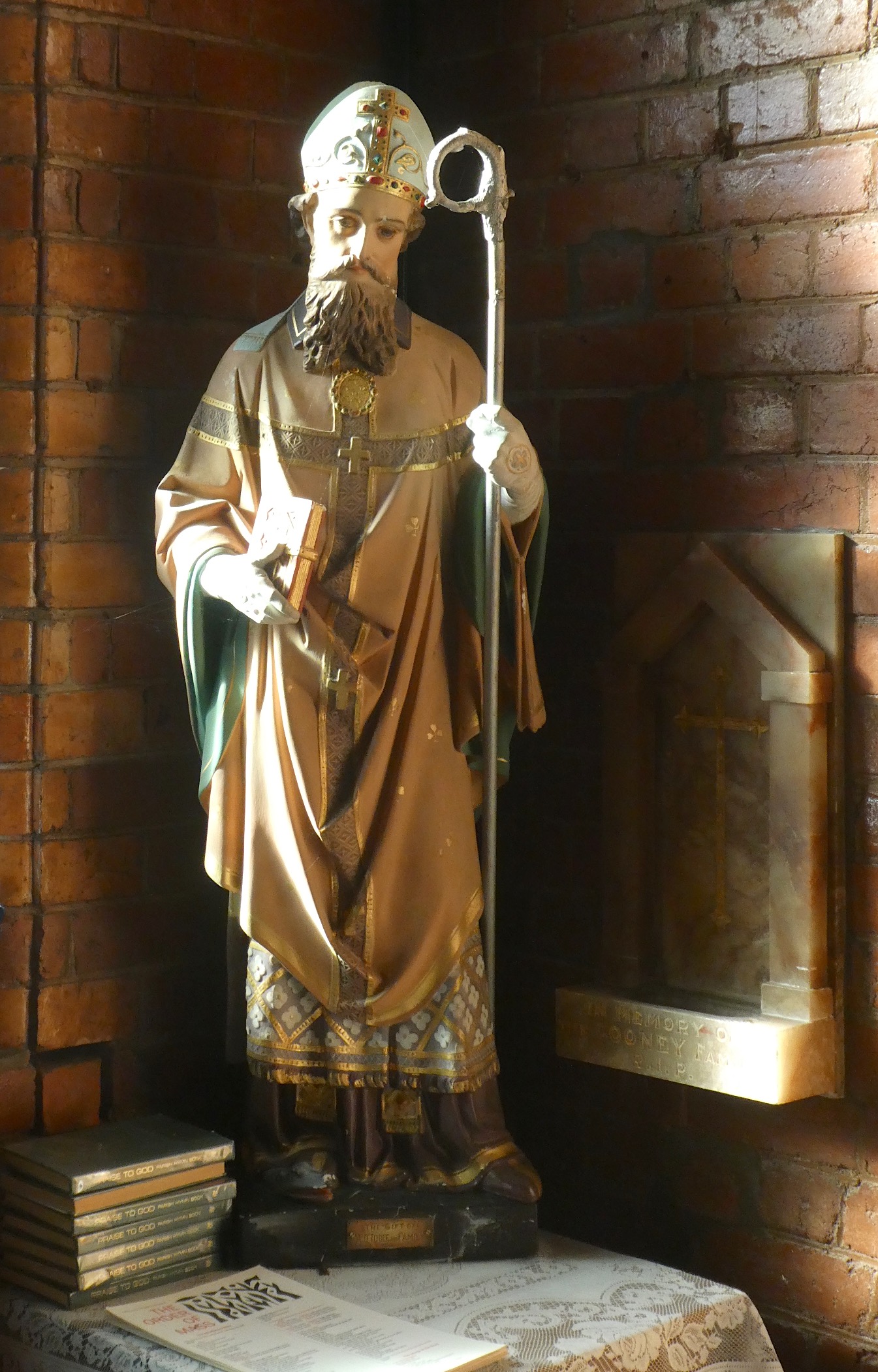
A small side chapel in the east transept beatifically captured the morning sun

while the votive candles in the west transept awaited the congregation for Holy Thursday.

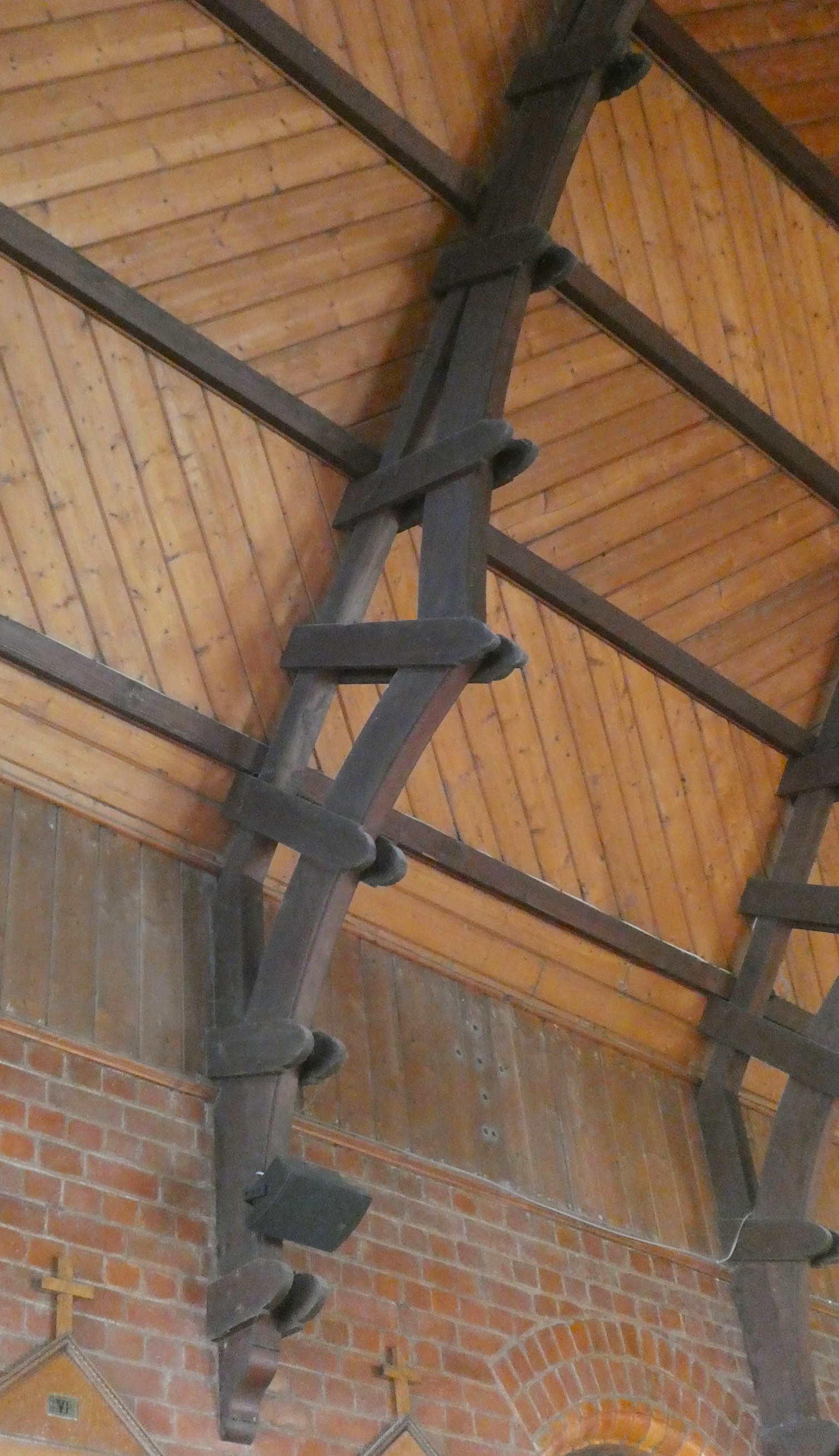
The ceiling is a work of art, the spiky elaborate roof trusses are another example of High Victorian Gothic style.

The porch is adorned with memorials of many people associated with the church. St. Mary’s by the Sea was originally a small wooden church on the corner of Cattley Street and Marine Terrace in town. When Irishman Father Matthew O’Callaghan became parish priest, he was instrumental in selling that property and purchasing the land on which the new church was built. He was transferred to Queenstown in 1897 and died two years later. His remains were returned to Burnie for burial in the parish he had served for twenty five years.
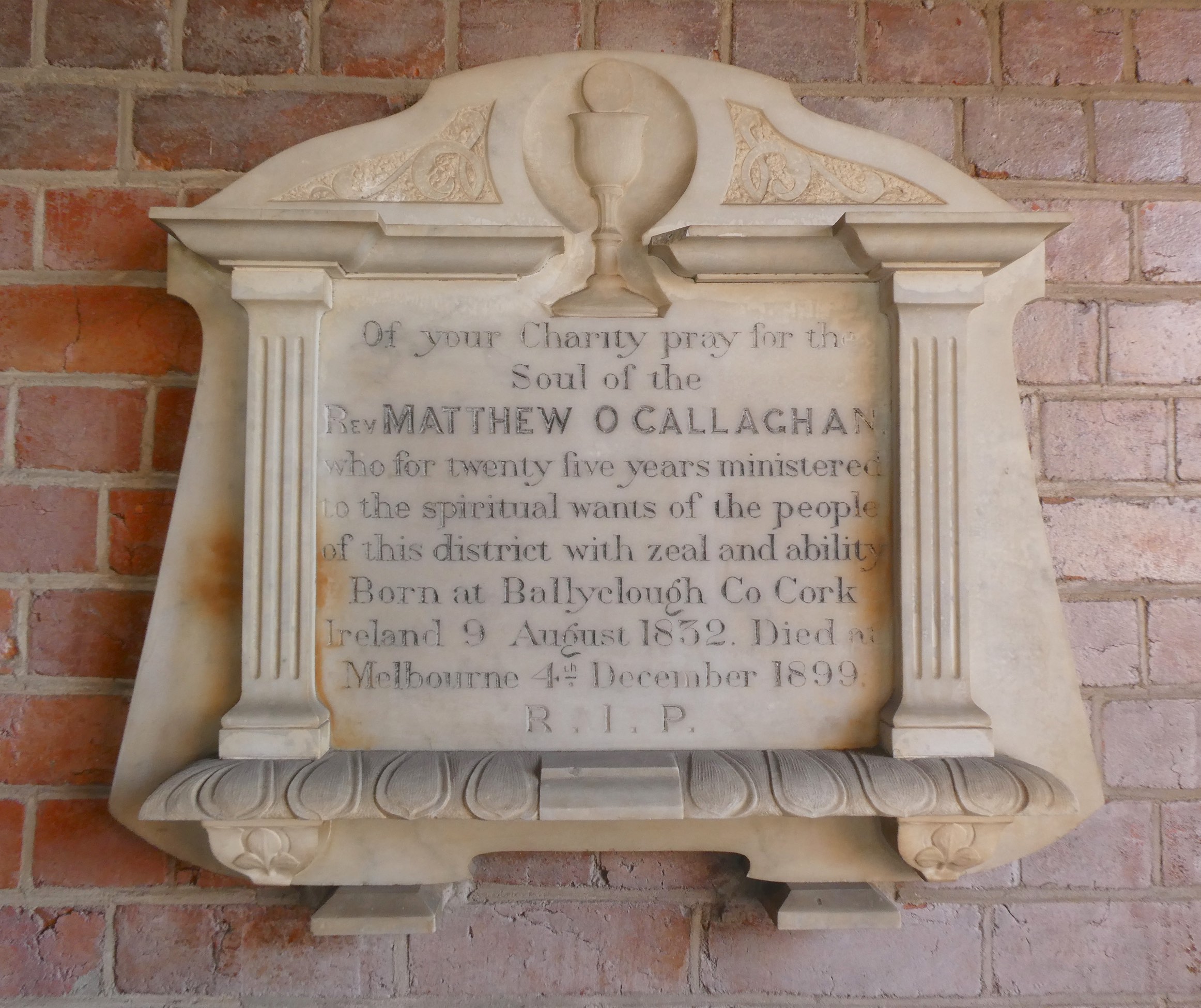
The memorials to the Dunphy and Cooney families have piqued my interest. I have found they are buried in the Wivenhoe cemetery a short drive from our house, I shall investigate further.

Another Irishman, Father Patrick Hayes, was appointed to the parish in 1889 and was responsible for building a Catholic school in 1912 and adding a presbytery in 1928. He retired in 1947 and, passing away in 1954, was also buried at Wivenhoe.

A historic plaque was discovered by current parish priest, Father John Girdauskas, beneath the Star of the Sea church, commemorating the opening of St. Anne’s Catholic church and primary school in 1961.

The gardens on the two acre site have been established and are tended by volunteers.

A tidy section by the steps from the car park is dedicated to Father Terry McCosker, whose arrival in 1988 was sadly cut short due to illness.

The steeply sloping land behind the church has been landscaped with care and many hours of hard work have resulted in some very impressive retaining walls.

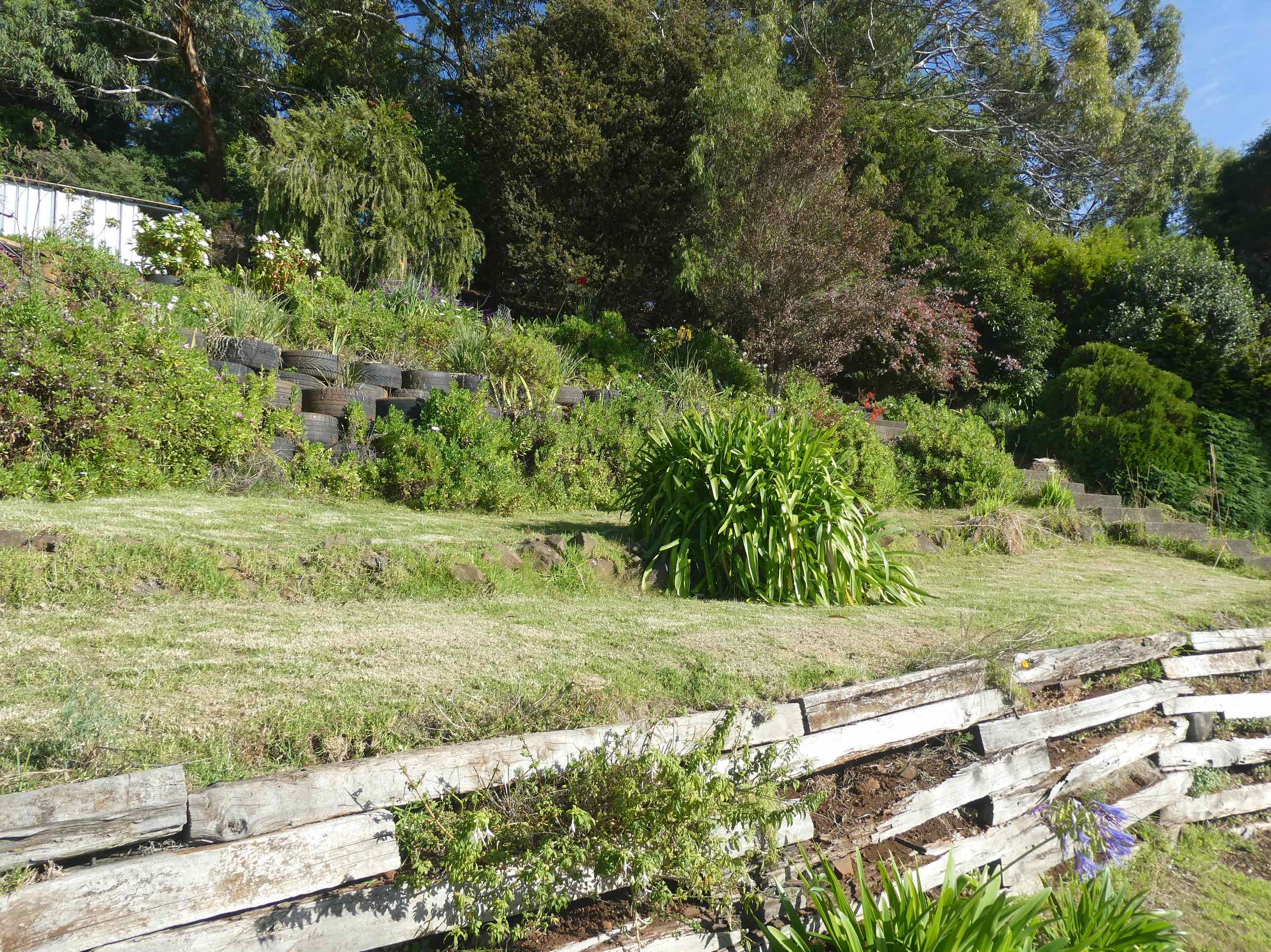
The path continues from the more formal gardens to a natural reserve, dedicated to the Fraser family.

St. Mary’s Star of the Sea has escaped the threat of removal twice. Firstly with the relocation of the Burnie Highway in 1979 and again just before Fr Girdauskas took over when the Marist priests intended building a replacement church near Marist College. The church is now heritage listed, as it should be.

Hamilton Gardens – Fantasy

Having explored the Hamilton Gardens Paradise Collection, we moved on to the Fantasy Collection where imagination and fantasy are integral to the garden design. Three of these are found along paths leading from Time Court. Bronze characters from Alice in Wonderland are assembled atop a plinth, a plaque quotes: “If you don’t know where you are going, any road will take you there. Lewis Carroll.”

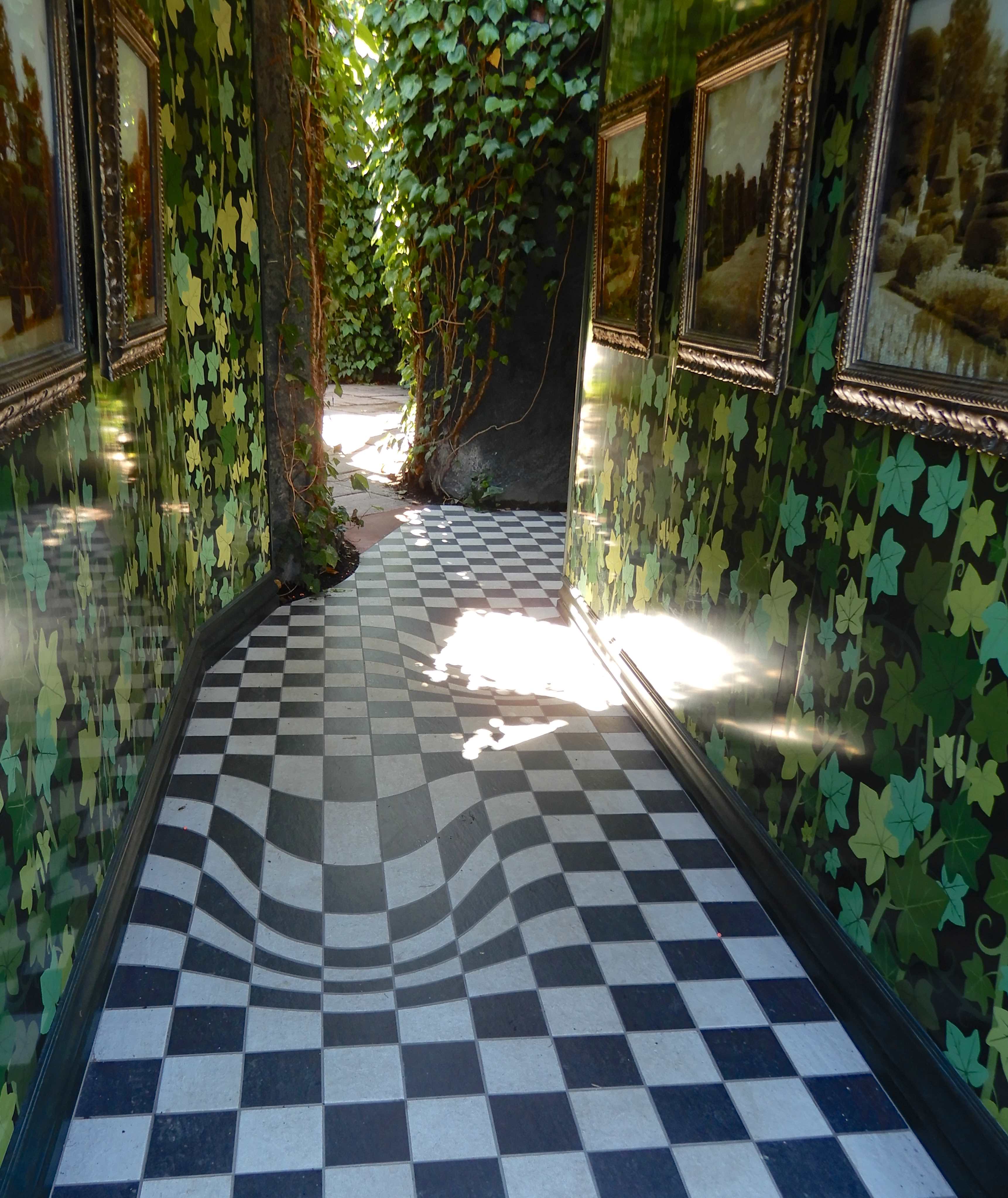
We entered the Surrealist Garden along a disconcerting black & white tiled passageway that led to a fireplace with nothing on the mantlepiece except a pair of egg shaped ornaments.

Surrealist art came to the fore in the 1920s and 30s when artists and writers became fascinated with the mysterious world of dreams and the subconscious mind. In garden design, this was illustrated through distortion of scale, strange forms of topiary & sculptures and elements behaving in an unexpected manner.

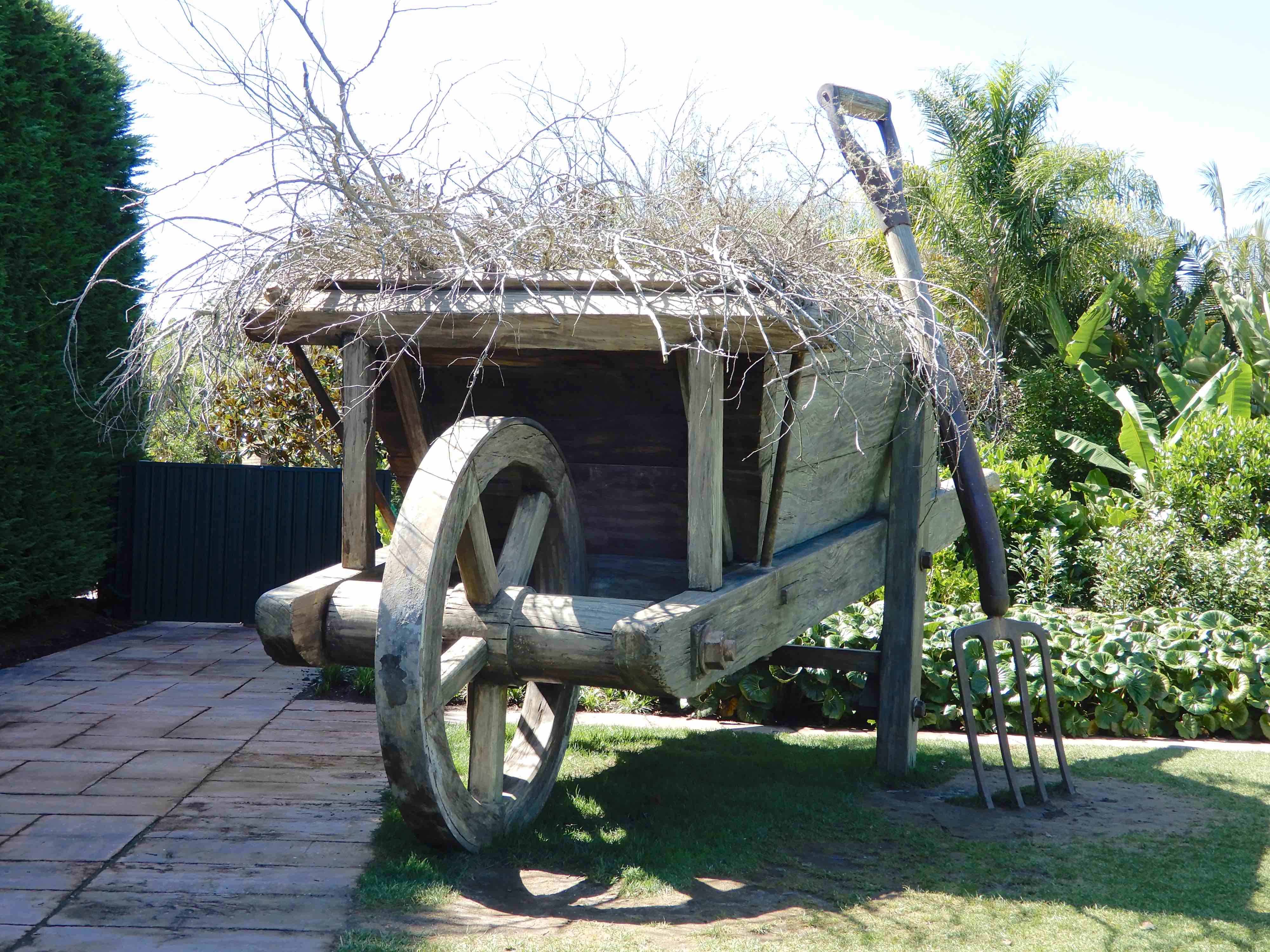
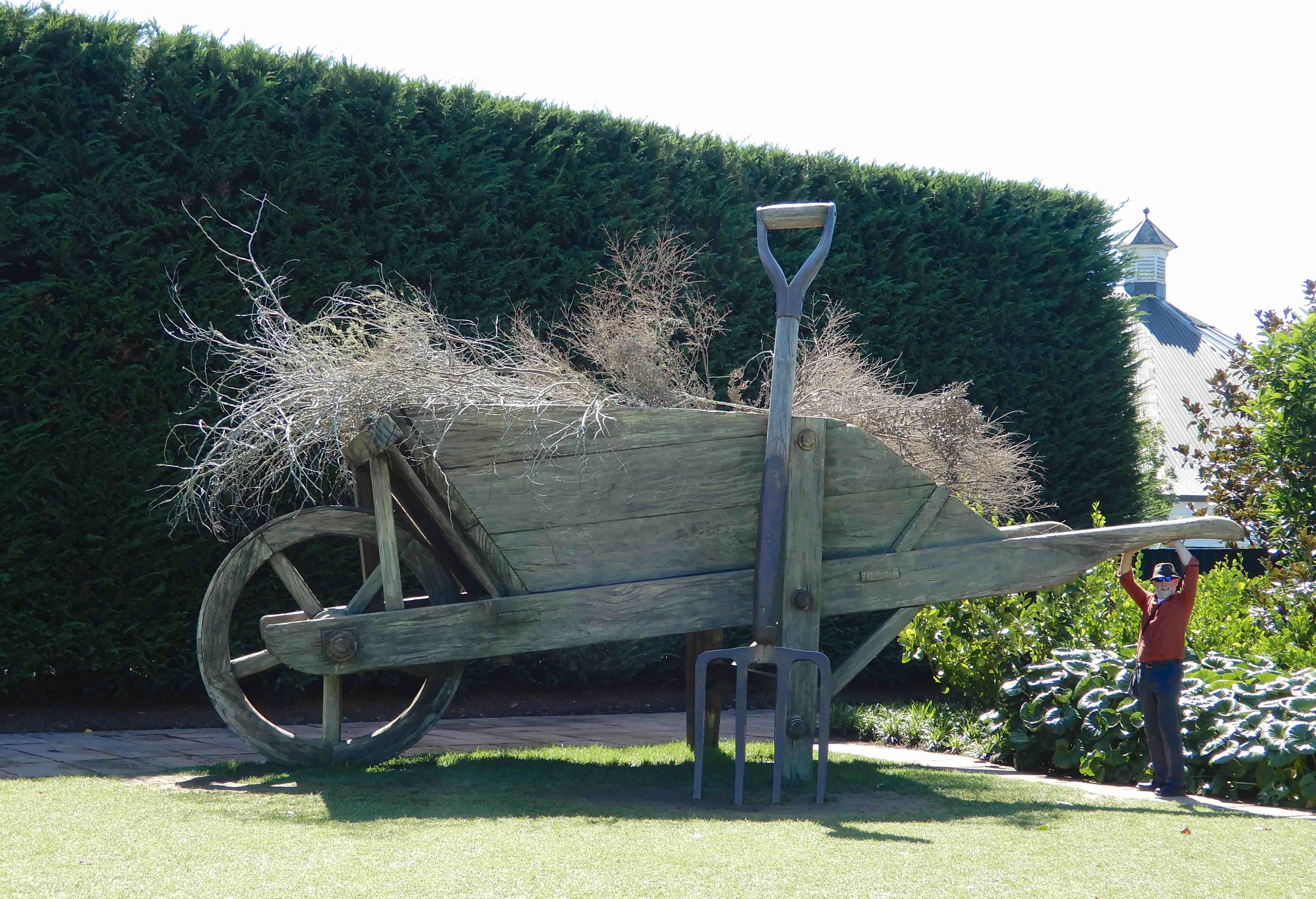
Everything in this garden is five times the normal scale

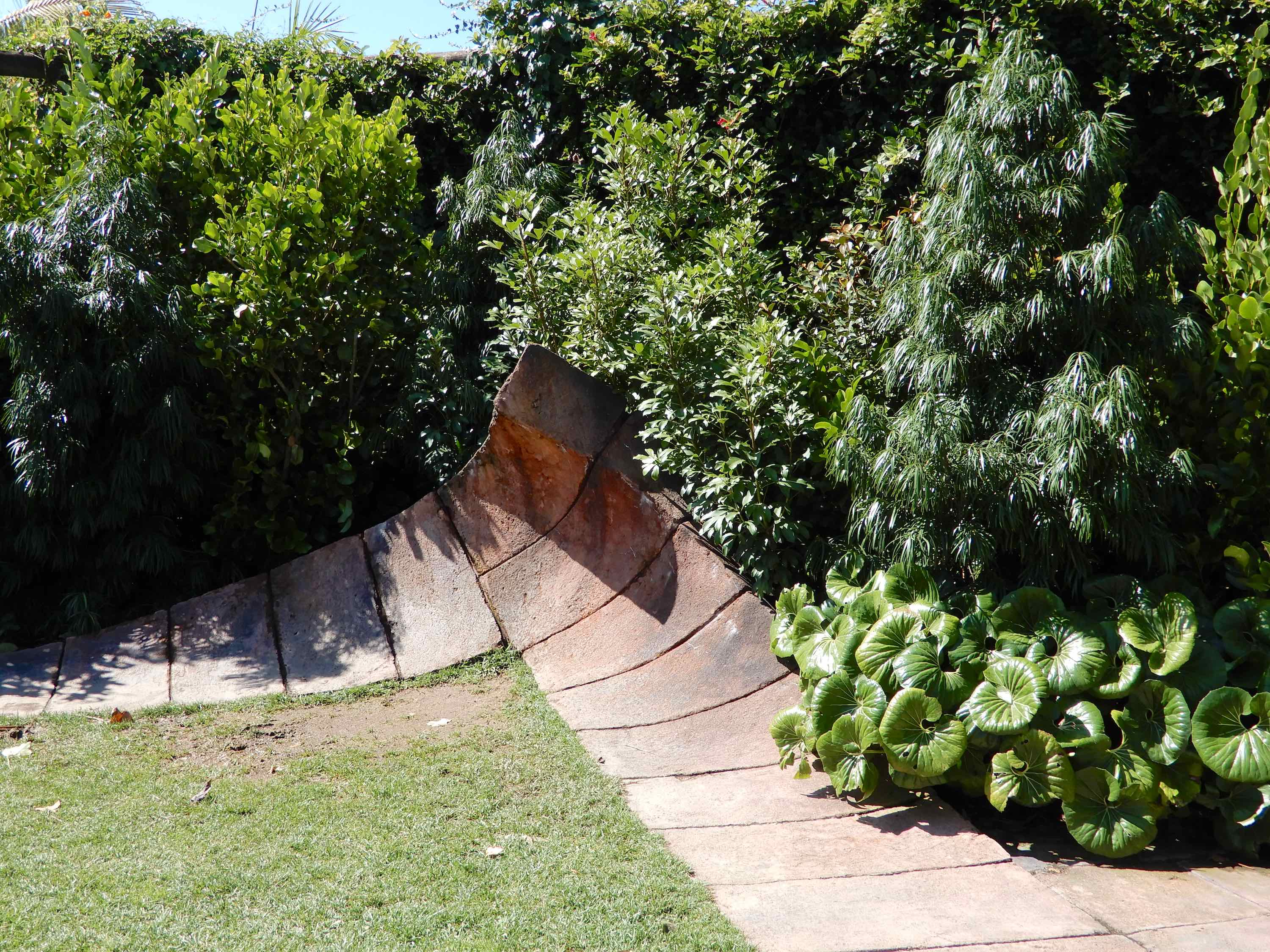
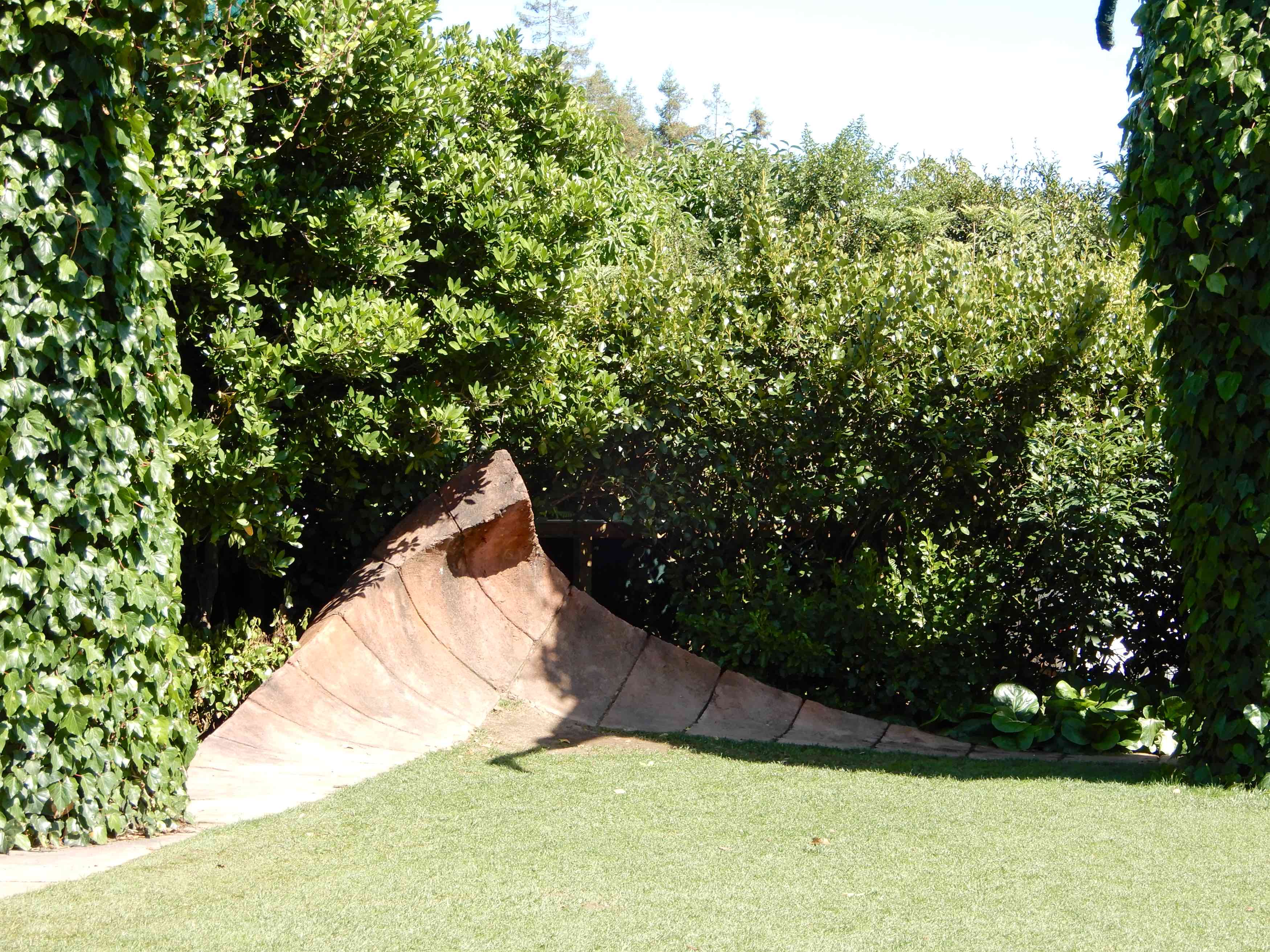
and the lawn edging curves up at the corners like a sheet of paper.

Instead of a dozen white roses, a dozen white noses are dotted throughout the thick foliage bordering the lawn.

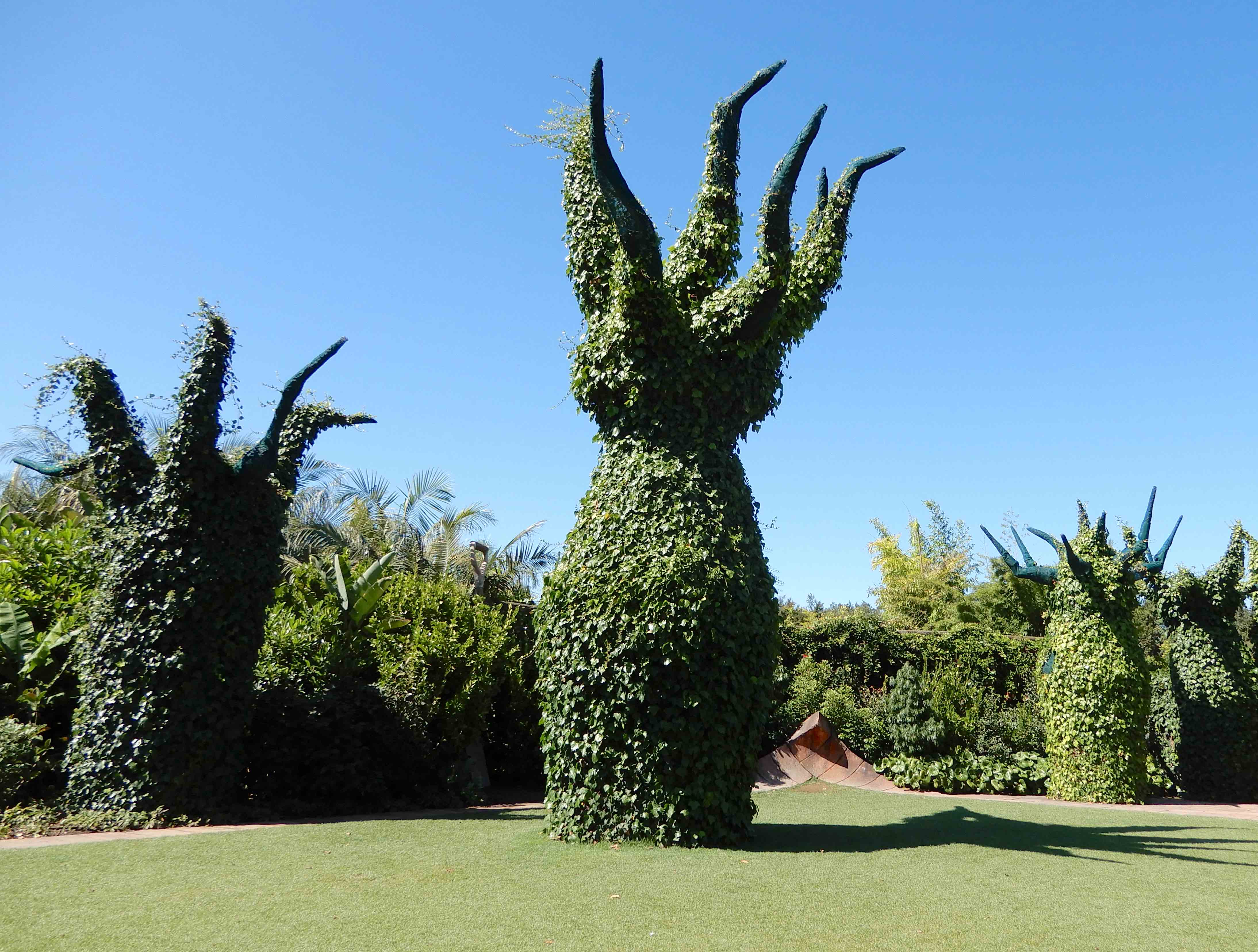
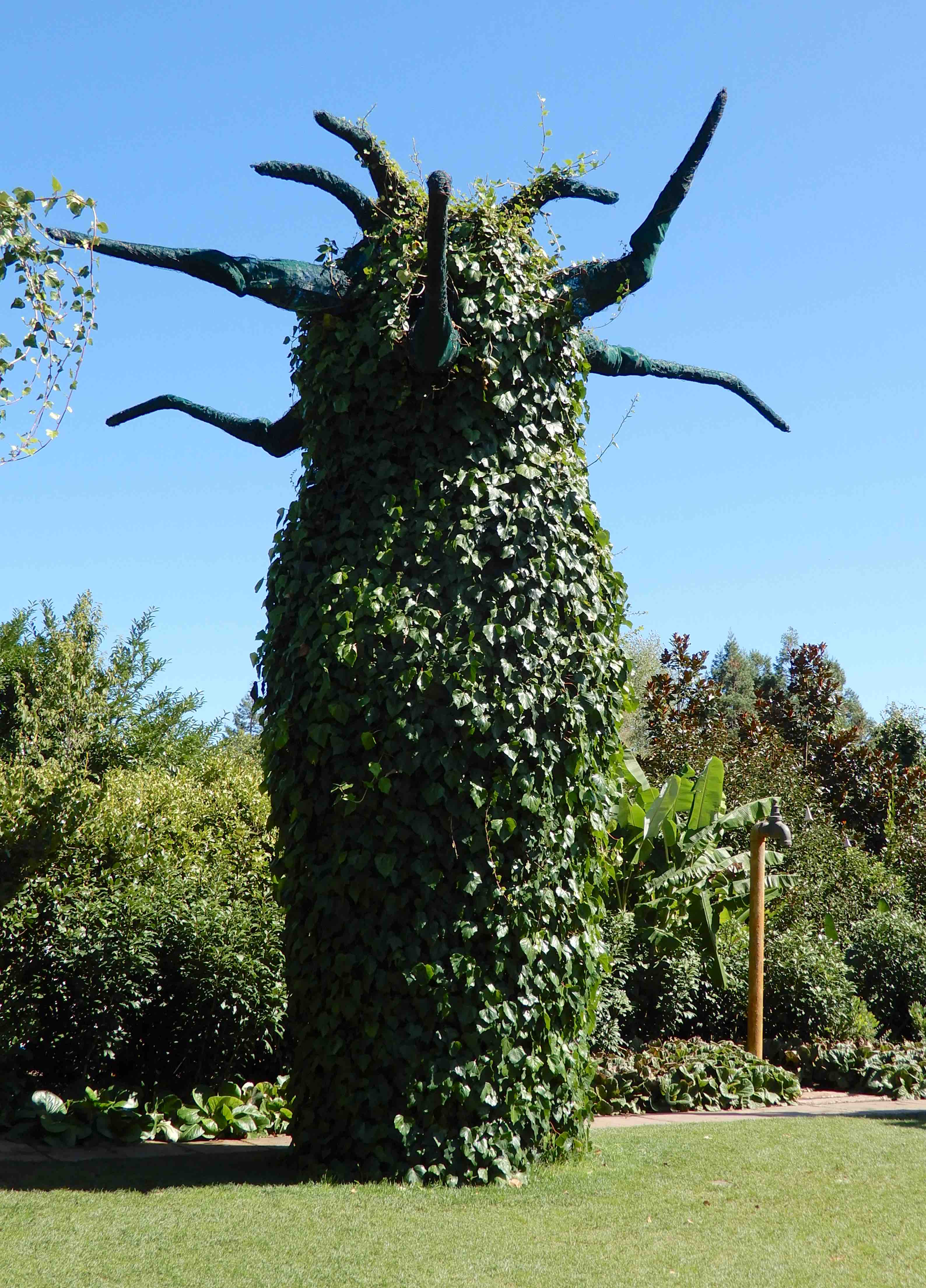
I thought I was seeing thing when I saw the ‘branches’ of these trees moving. The ivy covered shapes, known as ‘trons’, appear slightly sinister as their hydraulically controlled arms move when least expected.

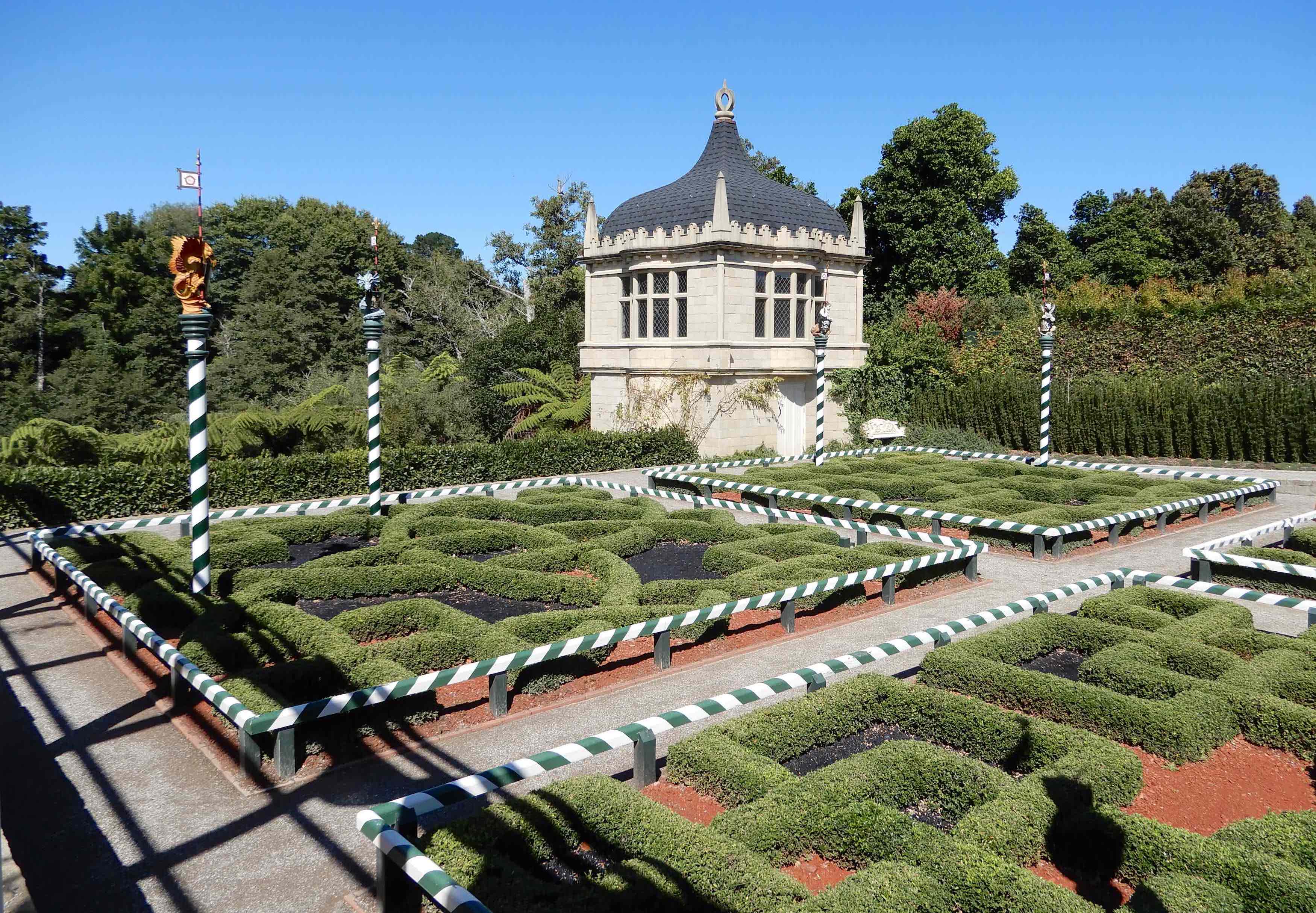
The Tudor Garden reflects the fascination 16th century English aristocracy had with geometric patterns and symbolism. A stone pavilion, based on the one at Montacute House in Somerset, overlooks intricate knot gardens that were traditionally outdoor settings for fantasy plays or ‘masques’.

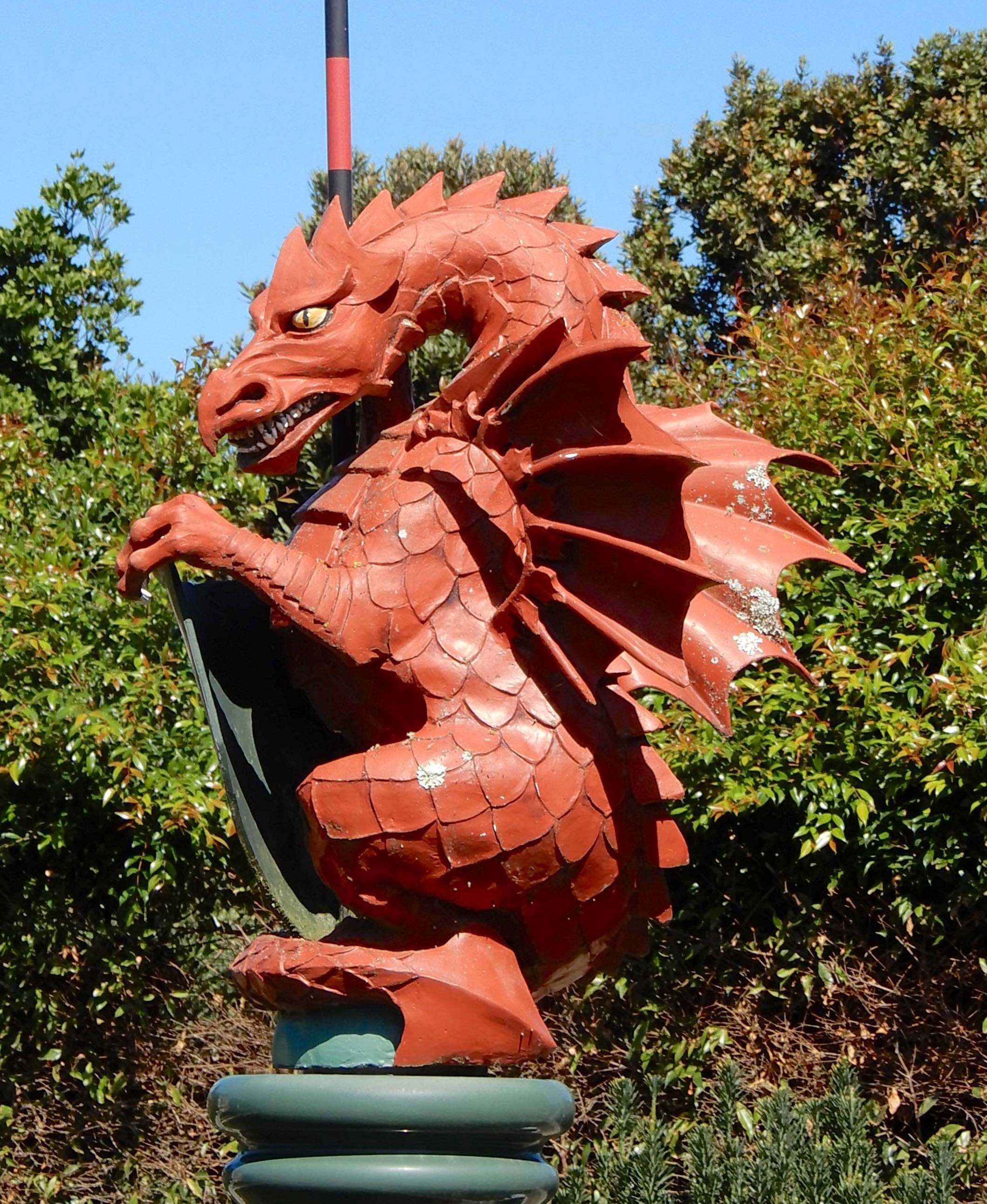
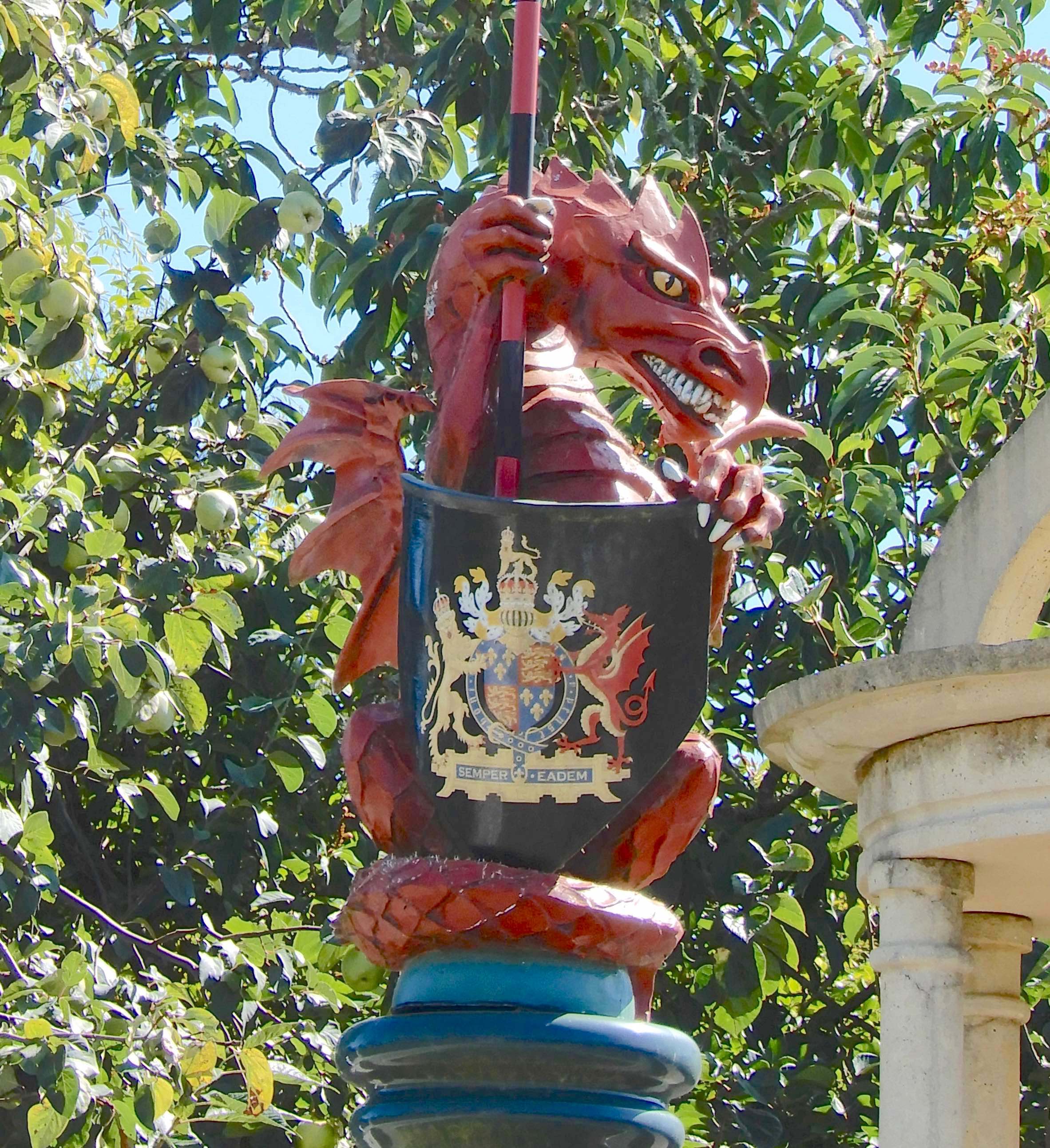
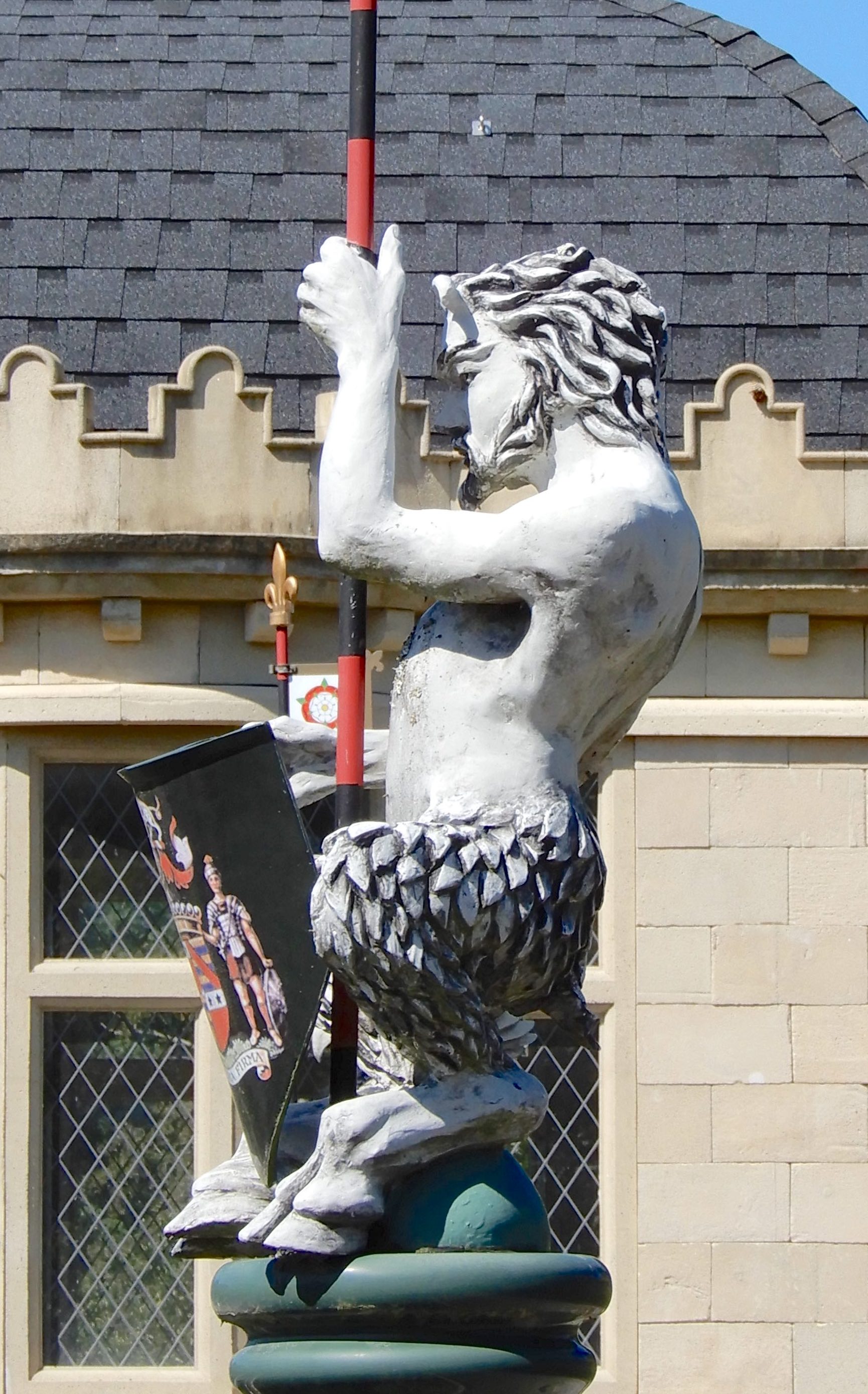
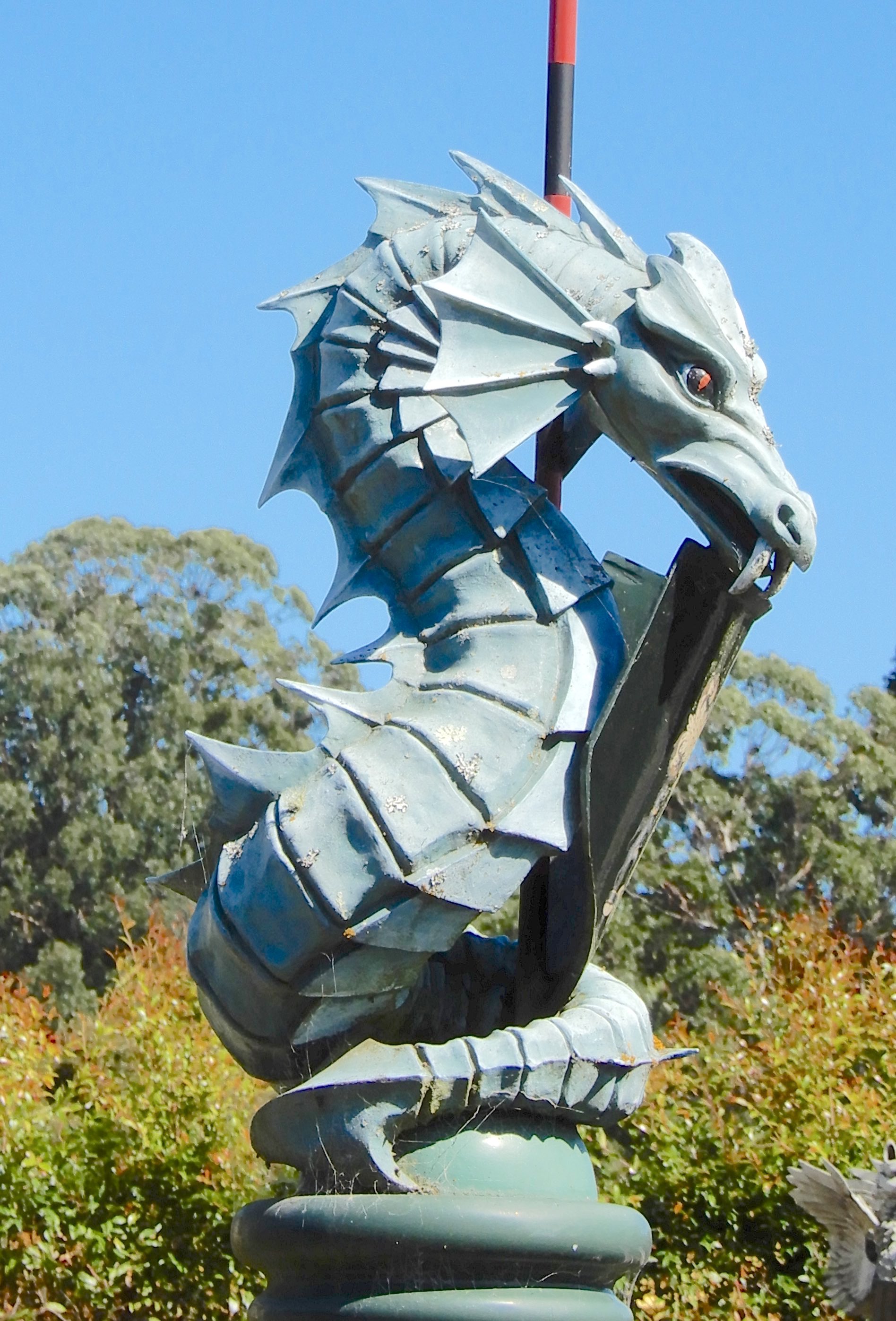
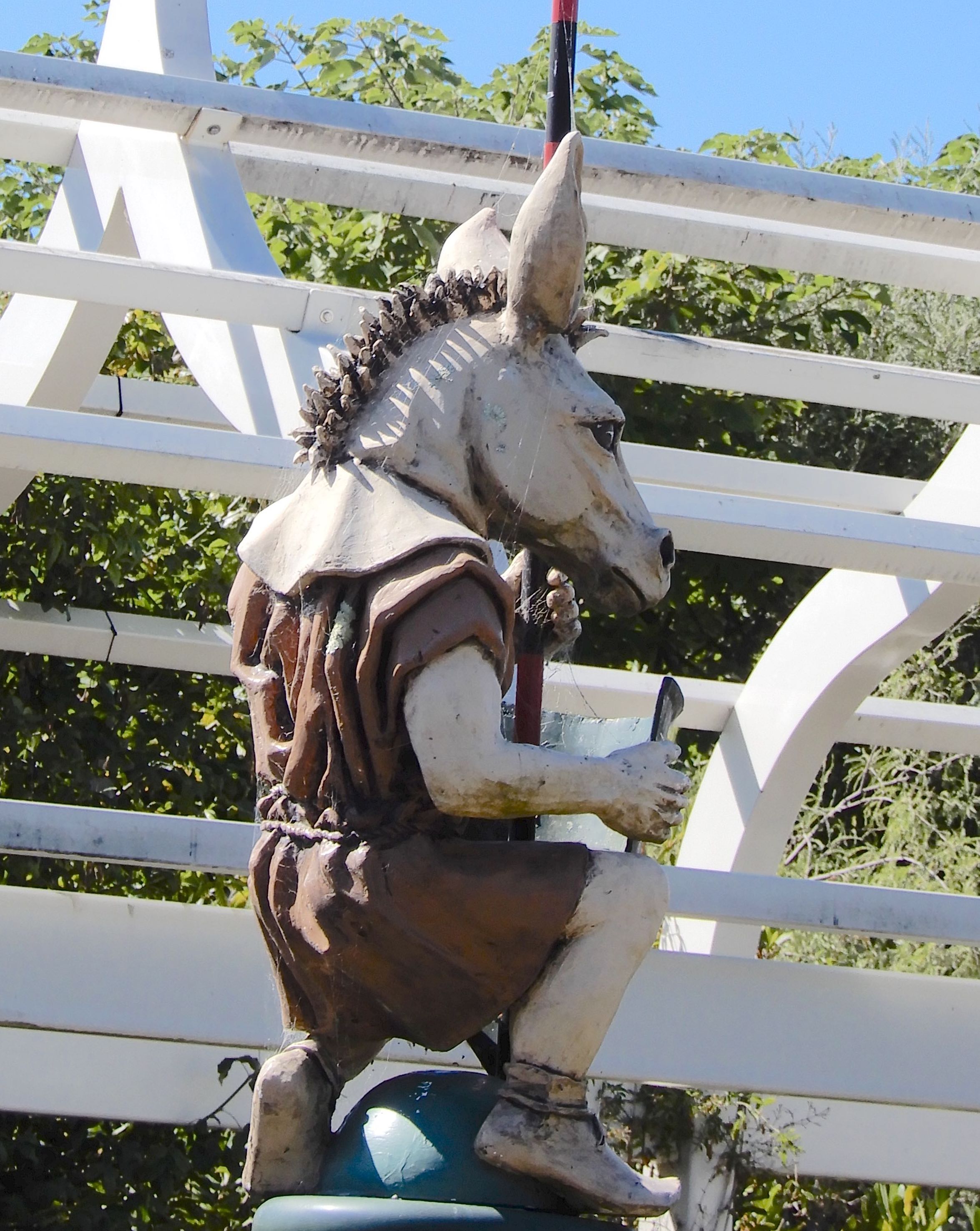
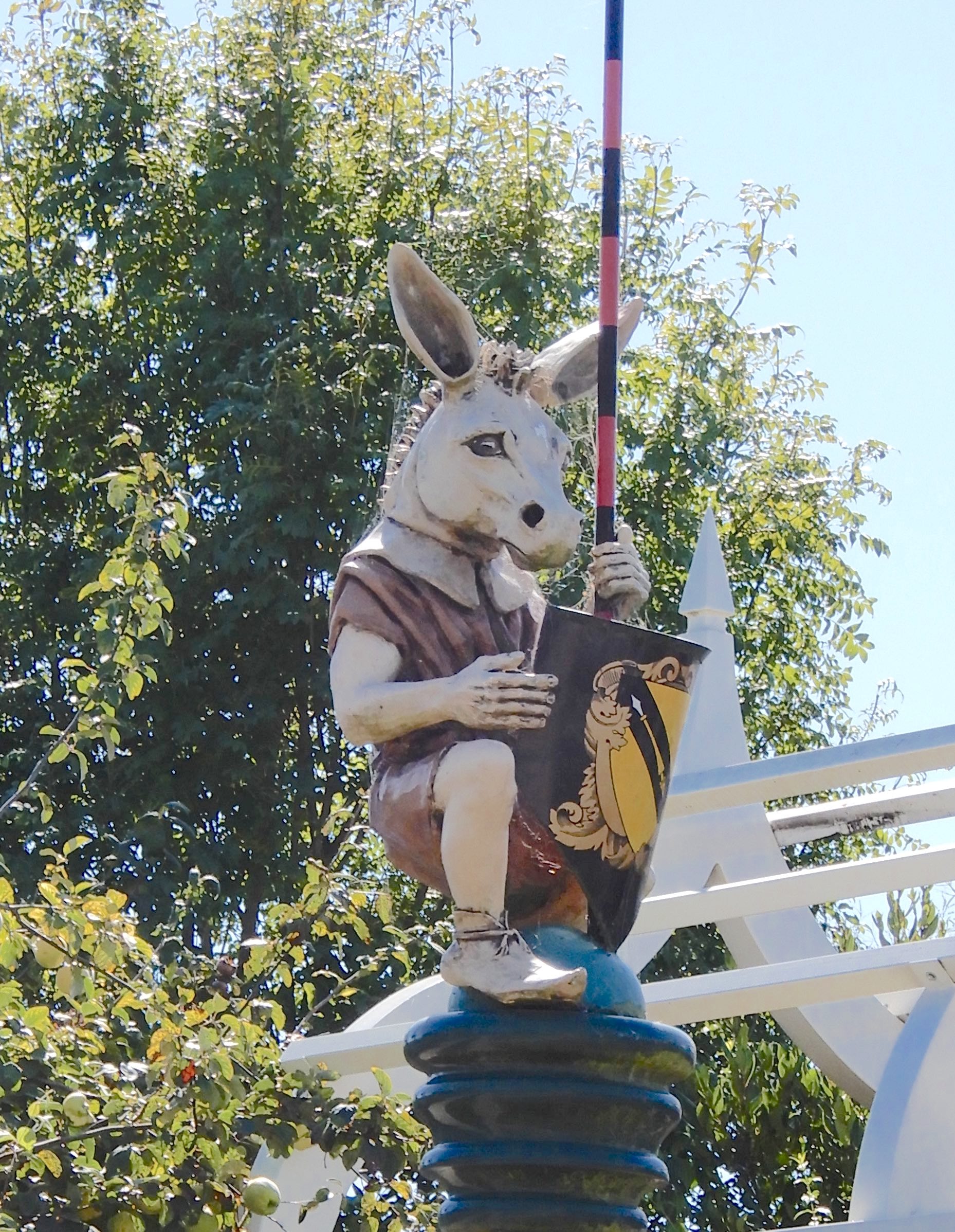
Mythical beasts on green and white striped poles each hold a flag of the Tudor Rose as well as a sculptural crest of some of the notorious personalities of the day. Although some of the shields can’t be seen from the angle of the photo, royalty are represented by the unicorn (Mary, Queen of Scots), the griffin (King Henry VIII) and the dragon (Queen Elizabeth I).

Lord Chancellors of the aforementioned royalty make an appearance with the Centaur (Sir Thomas More) and Satyr (Sir Francis Bacon).

Two favourites of Queen Elizabeth I, both described as a ‘privateer’, are upheld by the sea serpent (Sir Walter Raleigh) and the Phoenix (Sir Francis Drake). The most endearing is the lovable Bottom from Midsummer Night’s Dream holding the shield of Sir William Shakespeare.
Chinese and Japanese imports flowed into Europe in the 18th century and created a fashion craze that became known as ‘Chinoiserie’. Garden design became an expression of the Western fantasy of Oriental art. This Chinoiserie Garden is quite simple. Once through the Bottle Gate and along the path to the Perfume Garden,

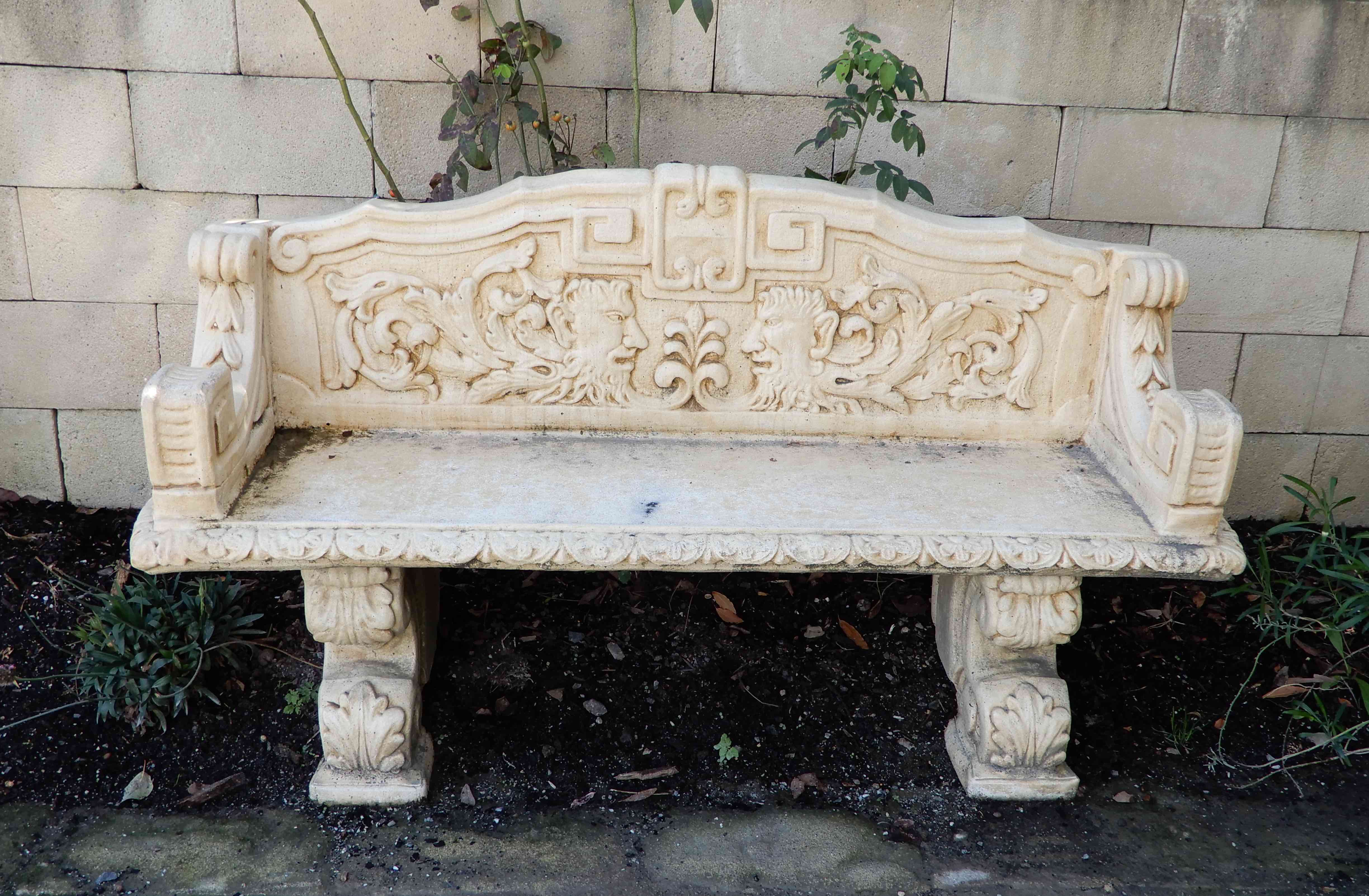
there are Chinoiserie seats and a Chinese Pavilion overlooking a sweeping lawn.

The pavilion is modelled on the ‘Chinese House’ at Stowe Landscape Gardens in England which was built in 1738. Like the original, the roof is copper and the colourful decoration gives it a theatrical touch.

Planting in the Tropical Garden has been designed so that the hardier plants offer protection to those more susceptible to Waikato winters. Exotic plants such as bromeliads and orchids sprinkle colour amongst the lush greenery and a trickling stream adds to the tranquil tropical atmosphere.

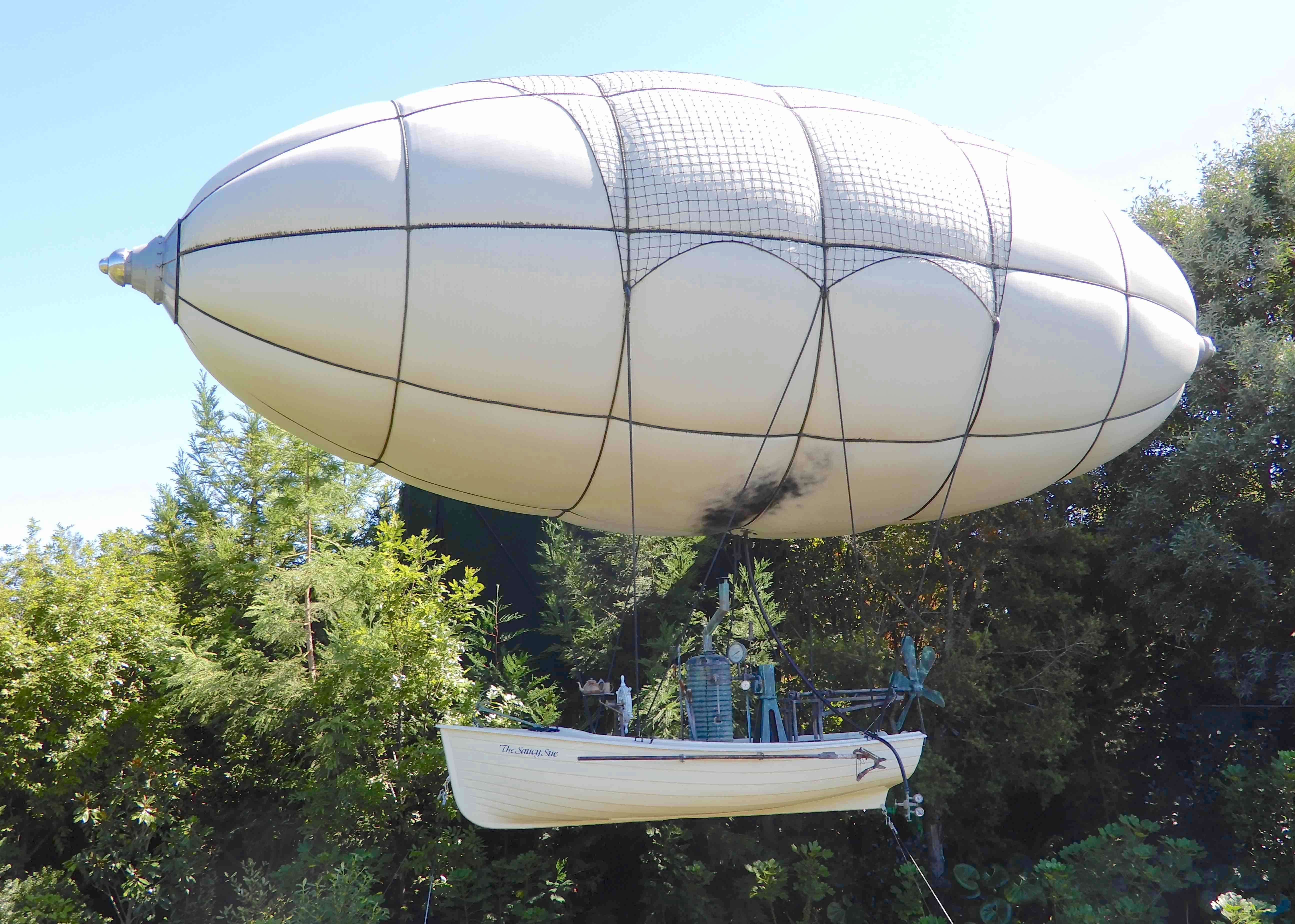
The next three Fantasy gardens led from Braithwaite Court where a Huddleston airship, full of gardening gadgets, is tethered. The airship is more than ornamental, it glides through the night delivering plants and pruning hard-to-reach hedges.

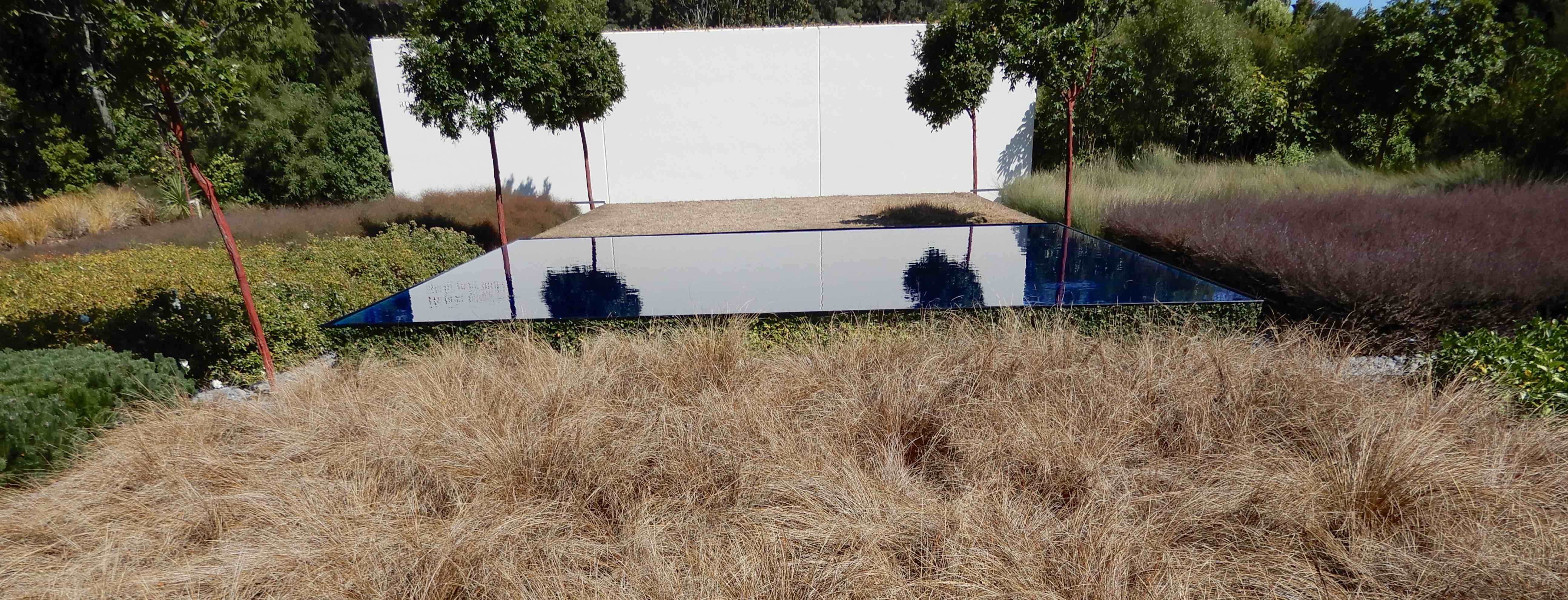
Essentially a form of outdoor conceptual art, the Concept Garden has been inspired by the square boxes of a legend on a map. Nine types of New Zealand landscape are symbolised in the blocks; pasture is represented by the grass, native bush by Muehlenbeckia astonii, urban areas by White Carpet roses, horticultural by citrus trees, tussock grassland by Carex buchananii, coniferous forest by Pinus mugo, scrubland by Leptospermum scoparium, wetland by Apodasmia and water bodies by the central pool.

Two Māori whakataukī, or proverbs, appear in the garden. He peke tangata, apa he peke titoki, is inscribed on the white wall, meaning ‘the human family lives on while the branch of the titoki falls and decays’. Perhaps a suggestion that as the population grows, it is at the expense of natural environments. The other whakataukī is inscribed on a steel pipe, which will gradually rust away; the interpretation of this message is, ‘but in the end, nature is going to win’.

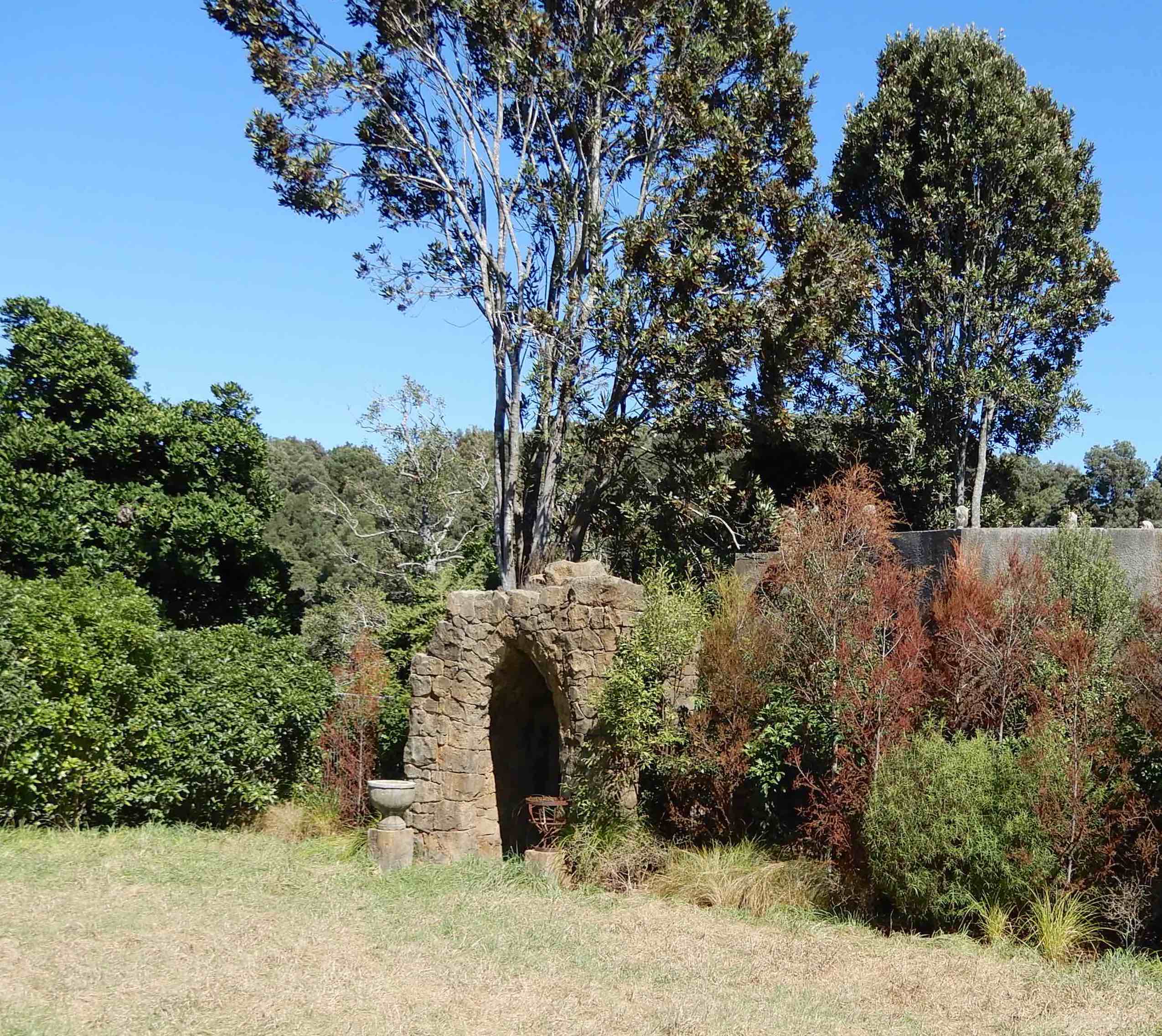
A change in attitude toward the formality of garden design came about with the Picturesque Garden movement in England during the 18th century. Gardens retained a natural look, some deliberately wild and overgrown, and often had a sequence of features representing a fantasy story or classical legend. The Picturesque Garden at Hamilton makes reference to the story of The Magic Flute, written by Mozart in 1791, along with Masonic symbolism found in the story. We entered through a cave guarded by a pair of sphinxes

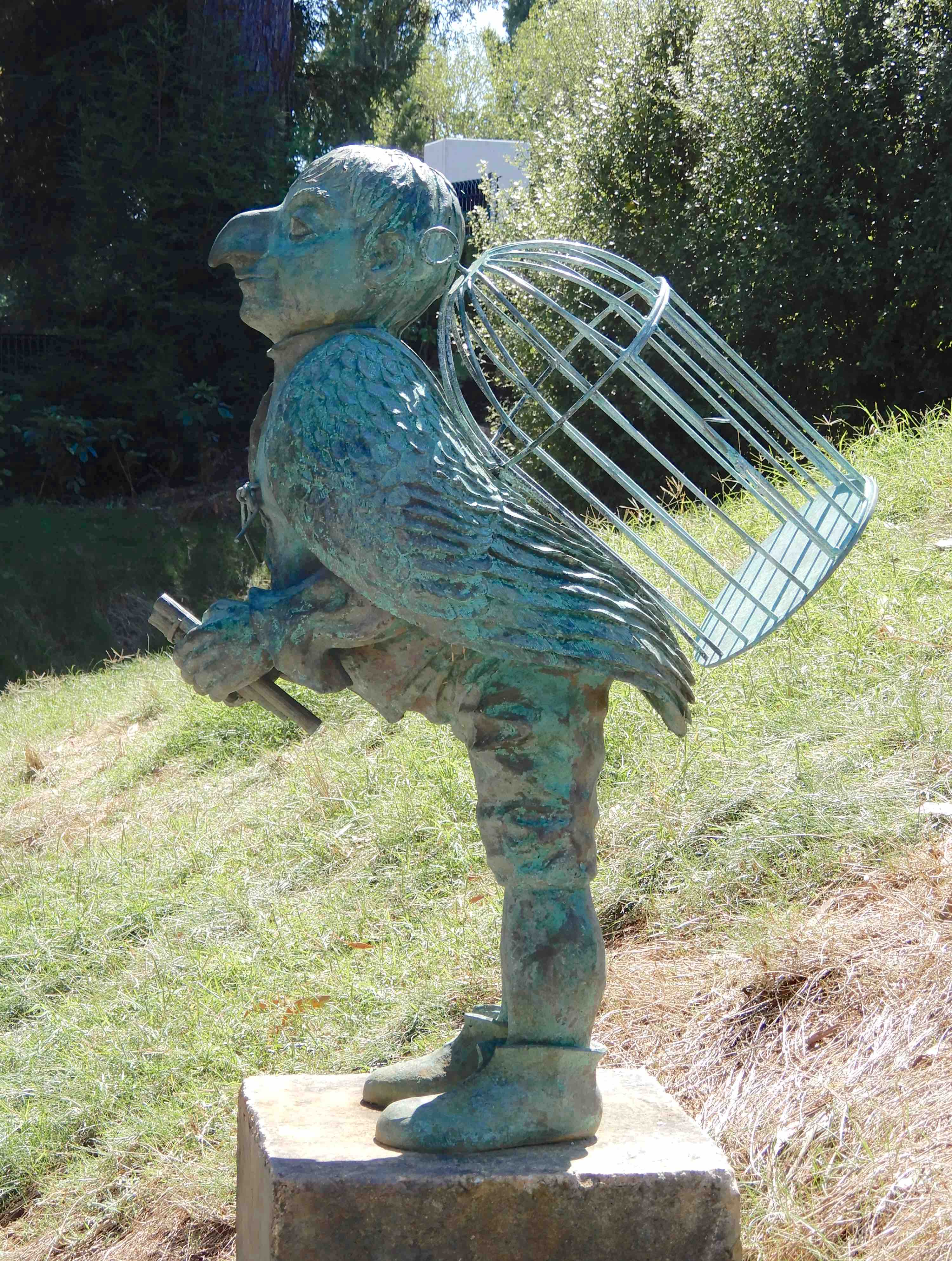
and passed the figure of Papageno

before reaching the Woodland Temple of the Queen of the Night.

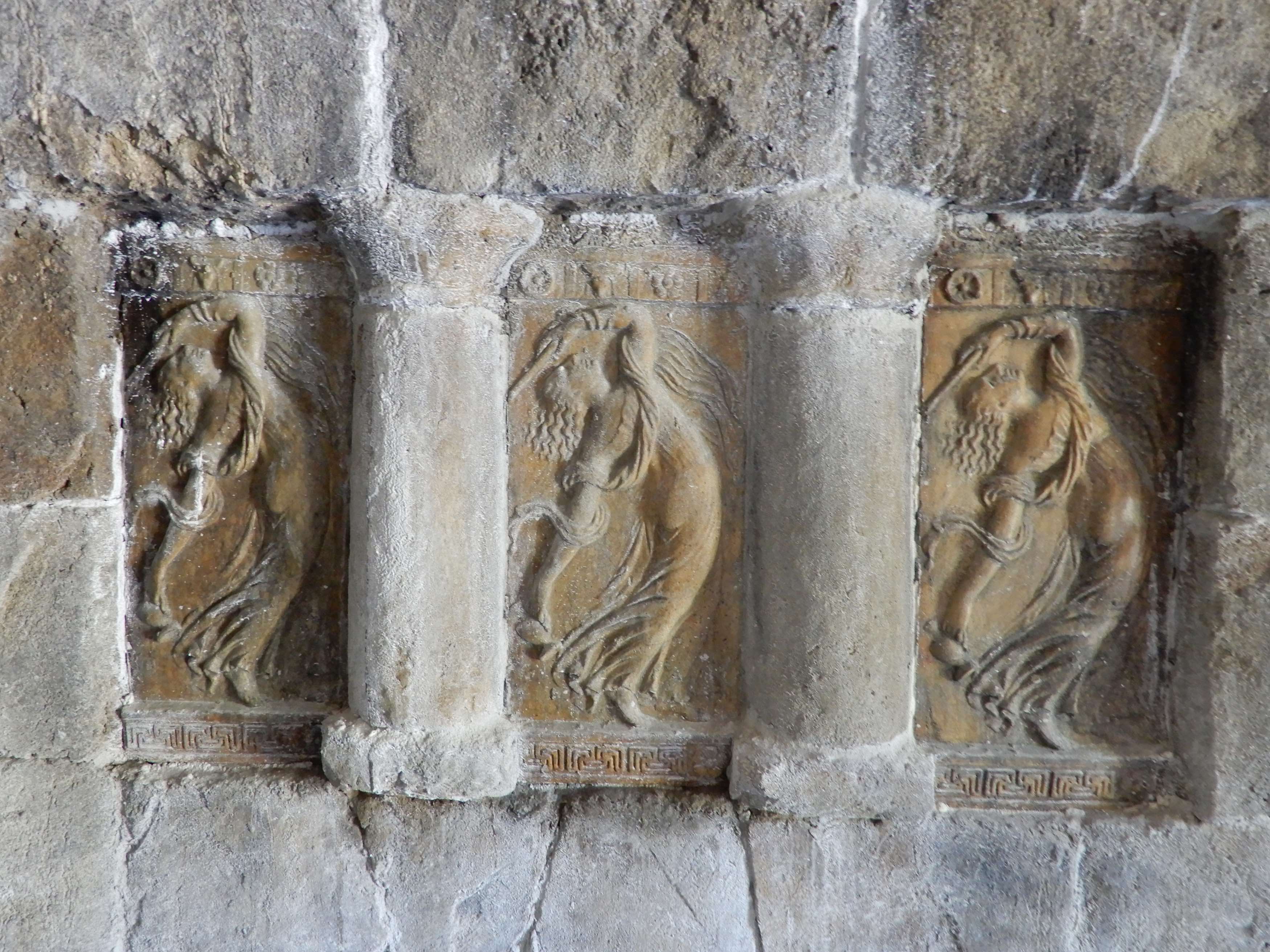
The number three is significant to the Freemasons, as evinced by the three guardian angels, three portals to enter the temple and, through the dark passage, three temptresses represented in relief sculpture on the wall.

A table of food and wine awaited in a meadow

and the entrance to the cave where Tamino faced his last test is flanked by a brazier and bowl, symbolising fire and water. Opening a door at the end of the path, we wondered what could possibly top that experience.

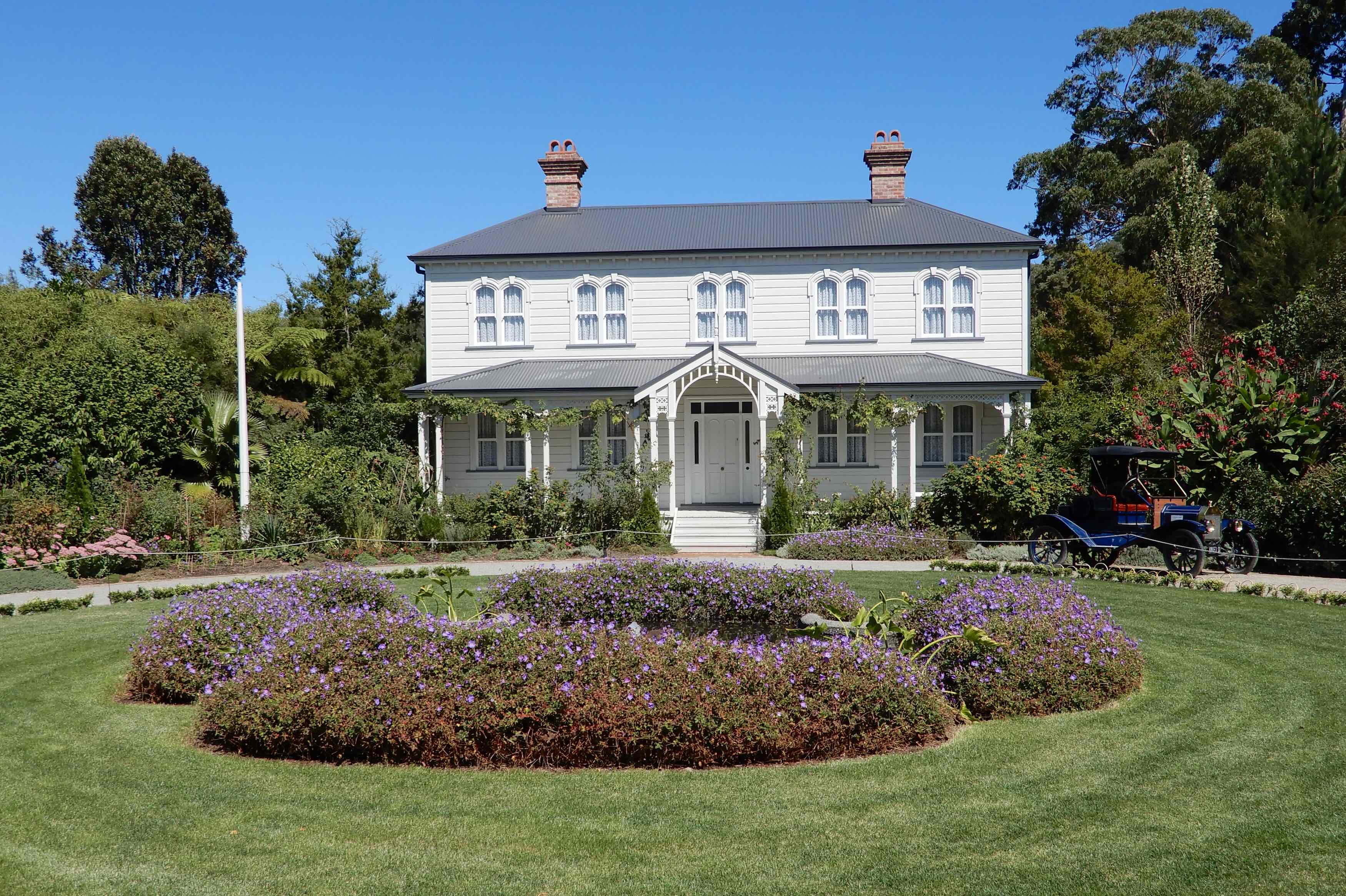
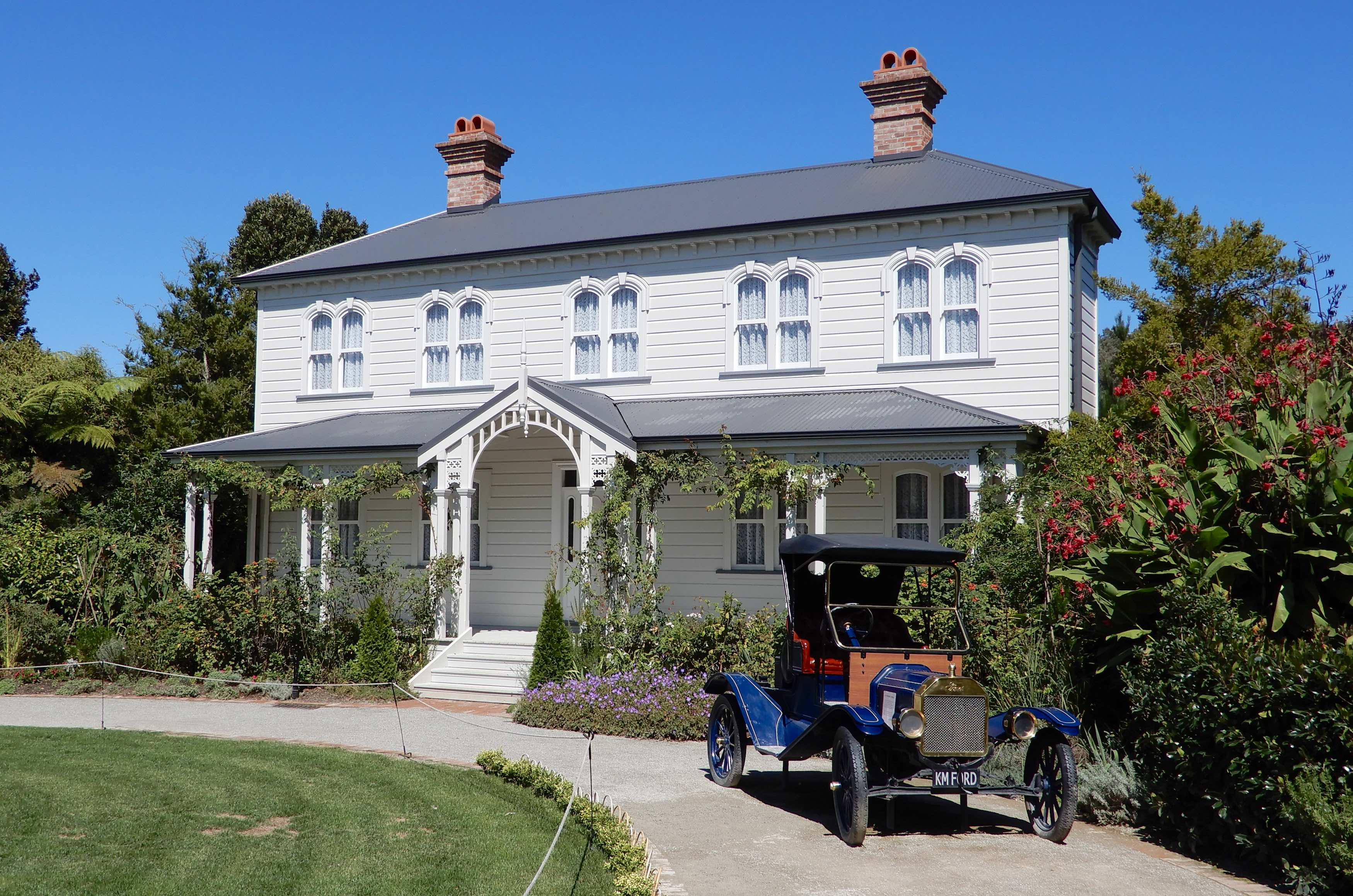
We weren’t disappointed. One of the foremost pioneers in modern literature, New Zealand born Katherine Mansfield wrote her short story, The Garden Party in 1922. Inspired by an event that took place in Wellington in 1907, the architecture, food and design detail of the Edwardian period has been recreated in the Mansfield Garden. Circular gravel driveways with a pond or fountain in the centre were a common theme

and the Model T Ford was a status symbol of the time.

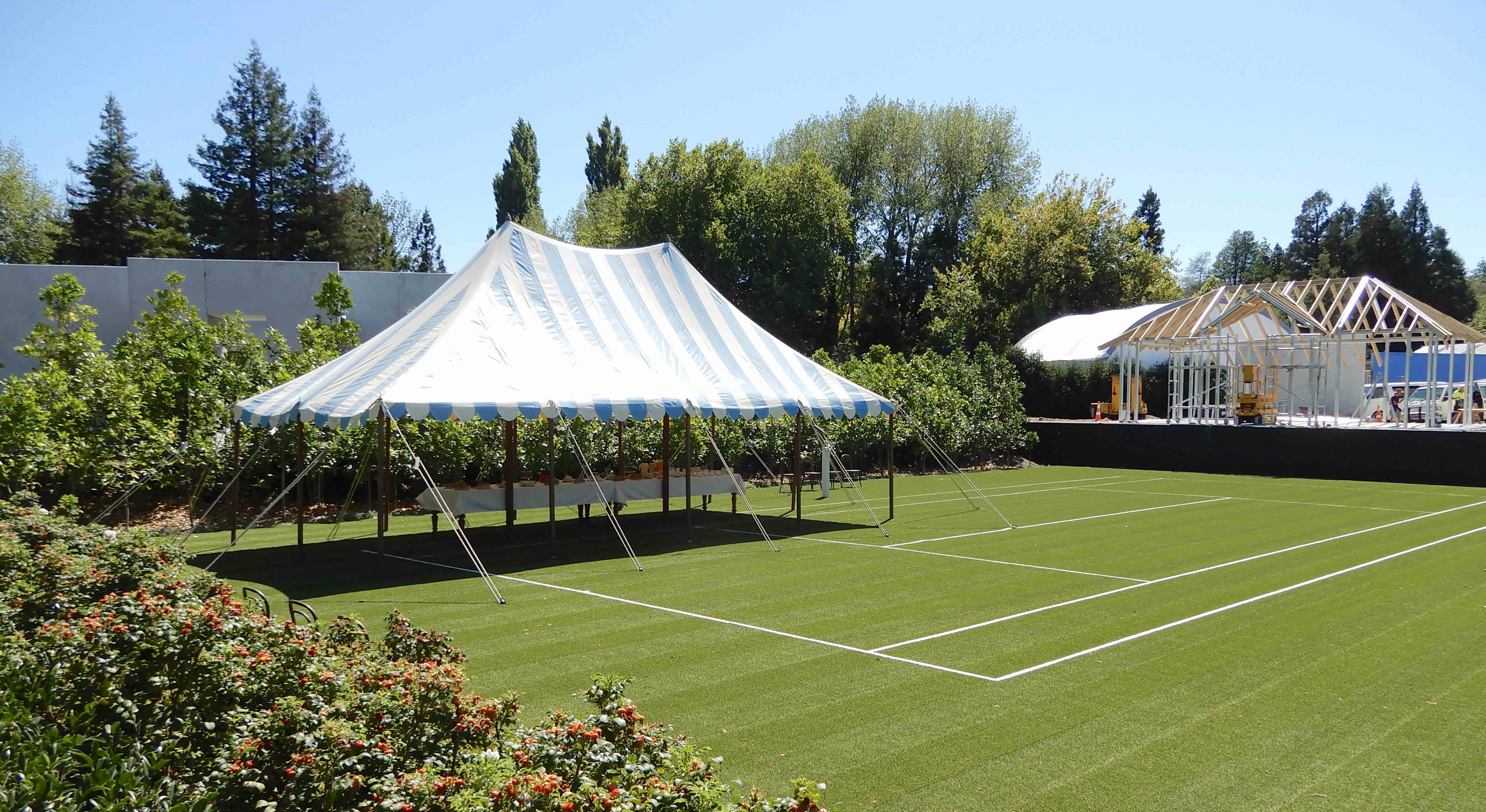
The lawn tennis court is the setting of the party

and workmen erected a marquee against the karaka hedge, specifically mentioned in the story, on the far side of the court.

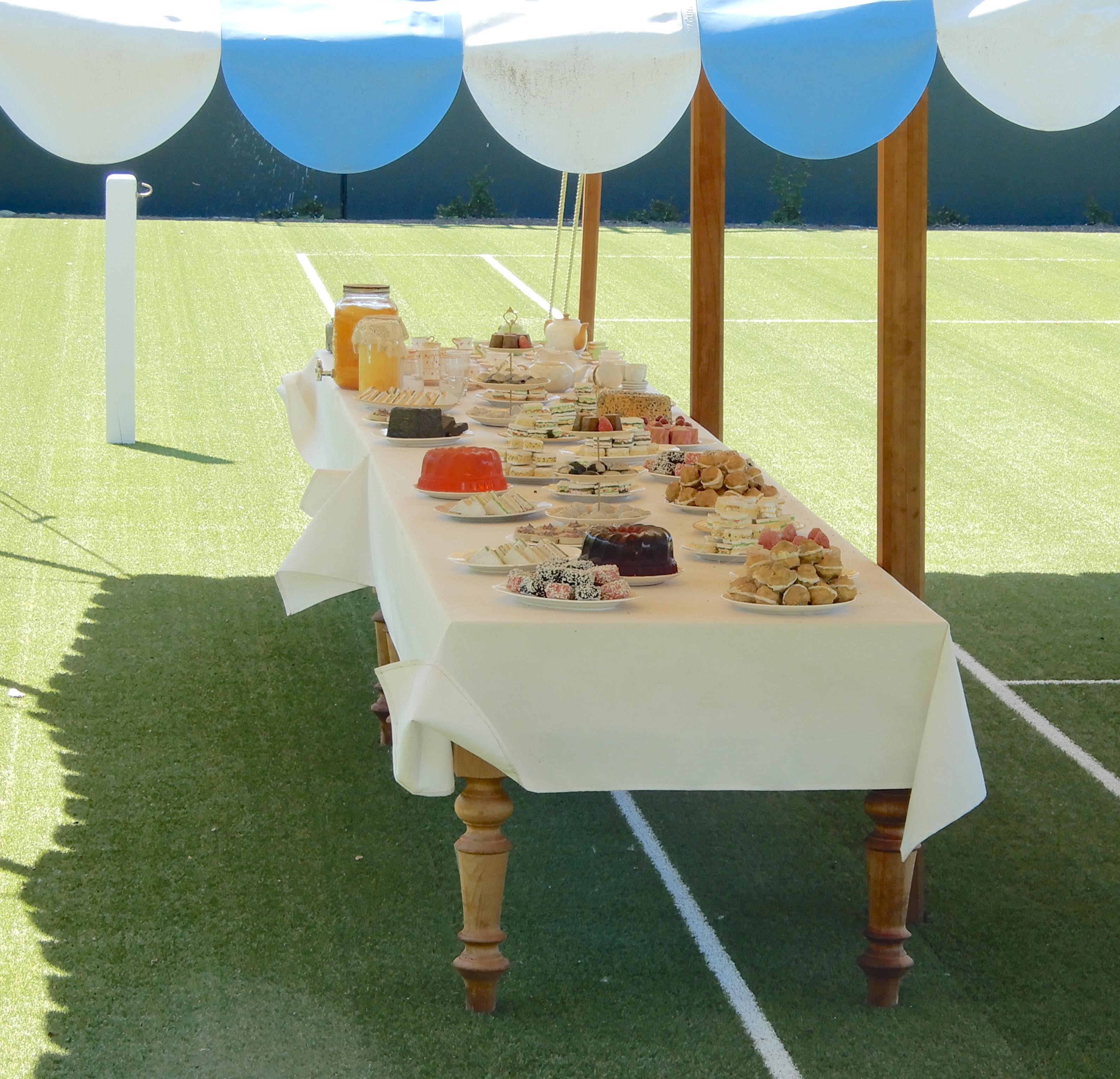
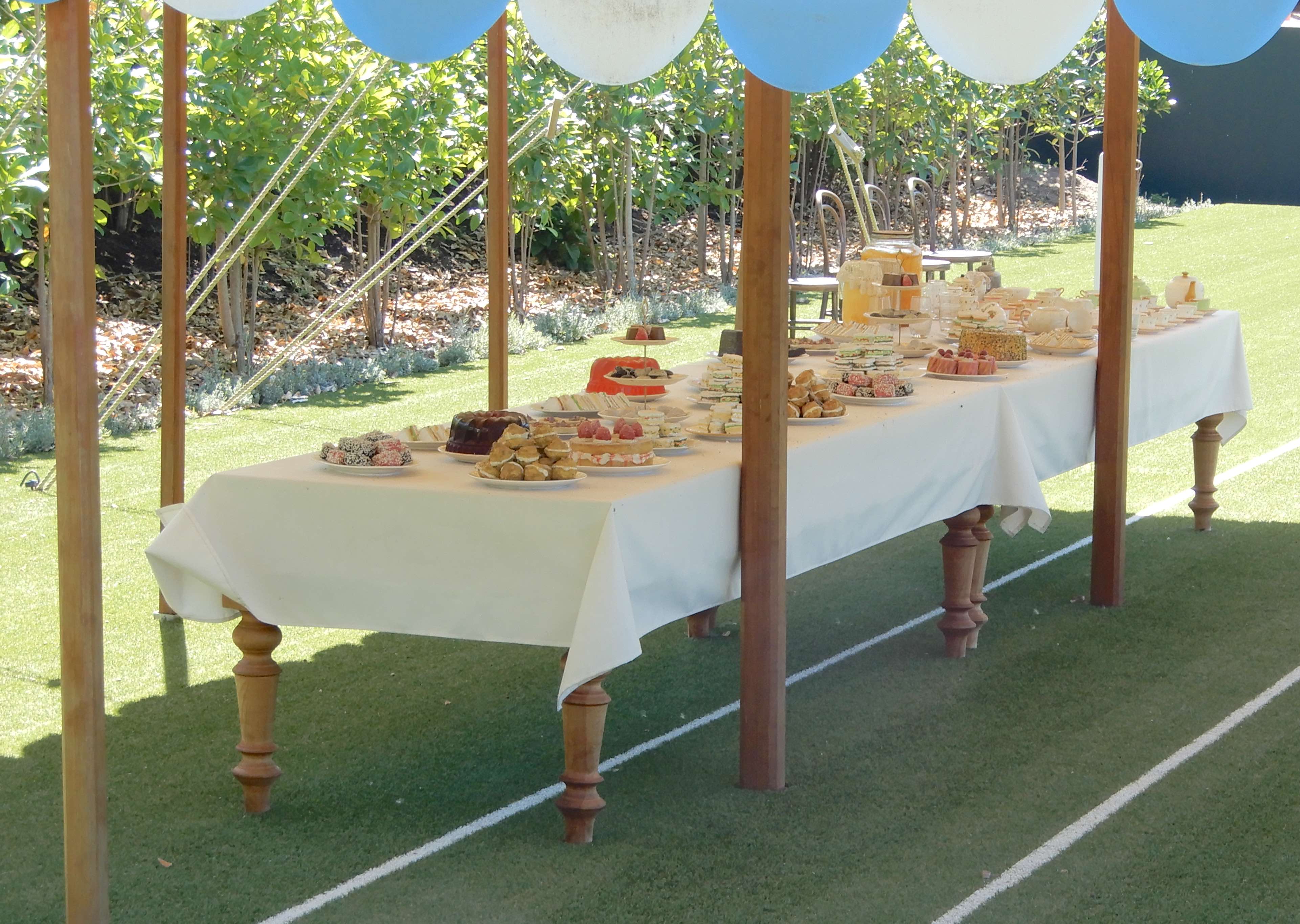
The banquet table is laden with mouth-watering fare. Fifteen kinds of sandwiches with the crusts cut off are suggested in the story, although only two were specified; cream cheese with lemon curd and egg & olive. ‘Godber’s famous cream puffs’ were also on the menu, a nod to James Godber, a very successful baker, confectioner and caterer in Wellington at the turn of the century. The delectable spread is actually made from concrete and resin to withstand the elements.

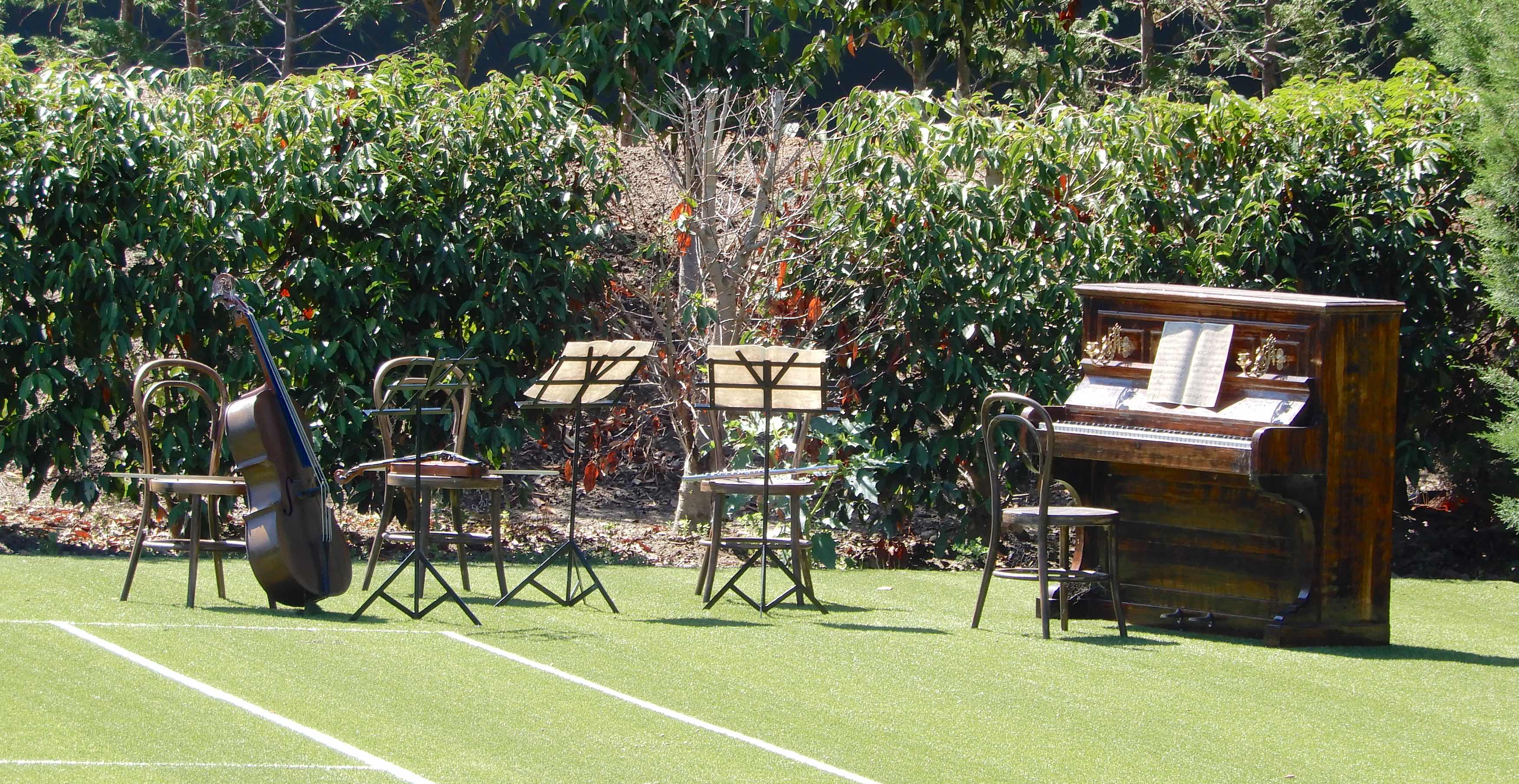
Yet another detail from the story is the placement of the ‘very small band’ in another corner of the tennis court.

Having read Katherine Mansfield’s short stories since our trip, this fantasy garden lacked nothing. Sadly, she died with tuberculosis in 1923 at the age of 34.

Saturnia

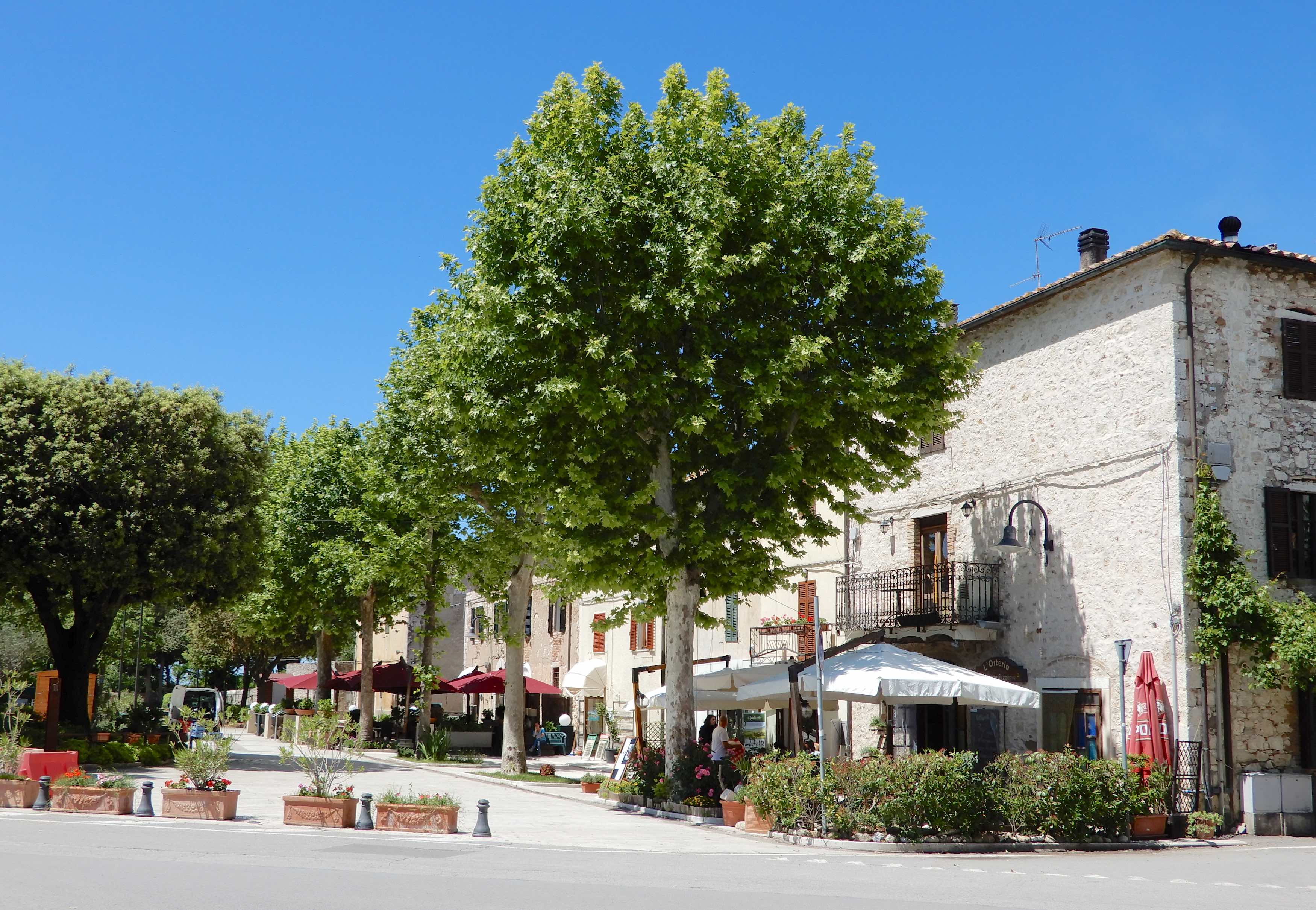
We had worked up an appetite lounging around in the healing waters of Cascate del Mulino and so, smelling slightly sulphurous, advanced to the nearby town of Saturnia. Despite dating back to the Etruscans in 800BC, there was a feeling of openness and modernity.

There is a reason for this. In 1300AD, it became the hideout of outlaws and was razed to the ground by the Sienese. Forgotten for hundreds of years, it was rediscovered in the late 19th century, the land around the spring was drained, the spa was built and the town breathed new life. While the boys relaxed with a coffee,

we girls wandered the streets, exploring shops

and local sights,

some of which were quite unexpected.

The Church of Santa Maria Maddalena dates back to 1188AD but the building we see now is due to a restoration in 1933. If only we had known the 15th century Madonna and Child frescoe by Benvenuto di Giovanni was inside.

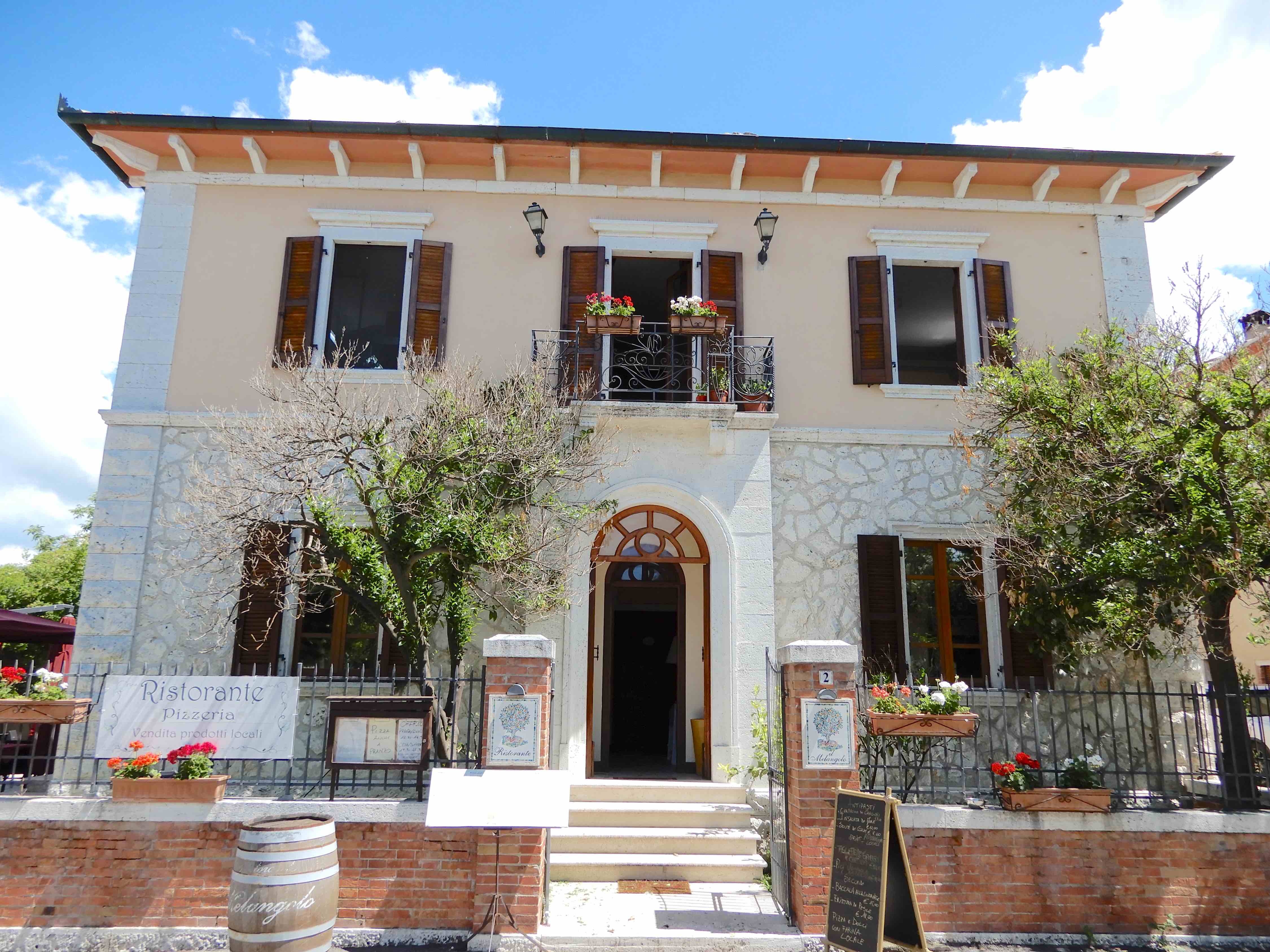
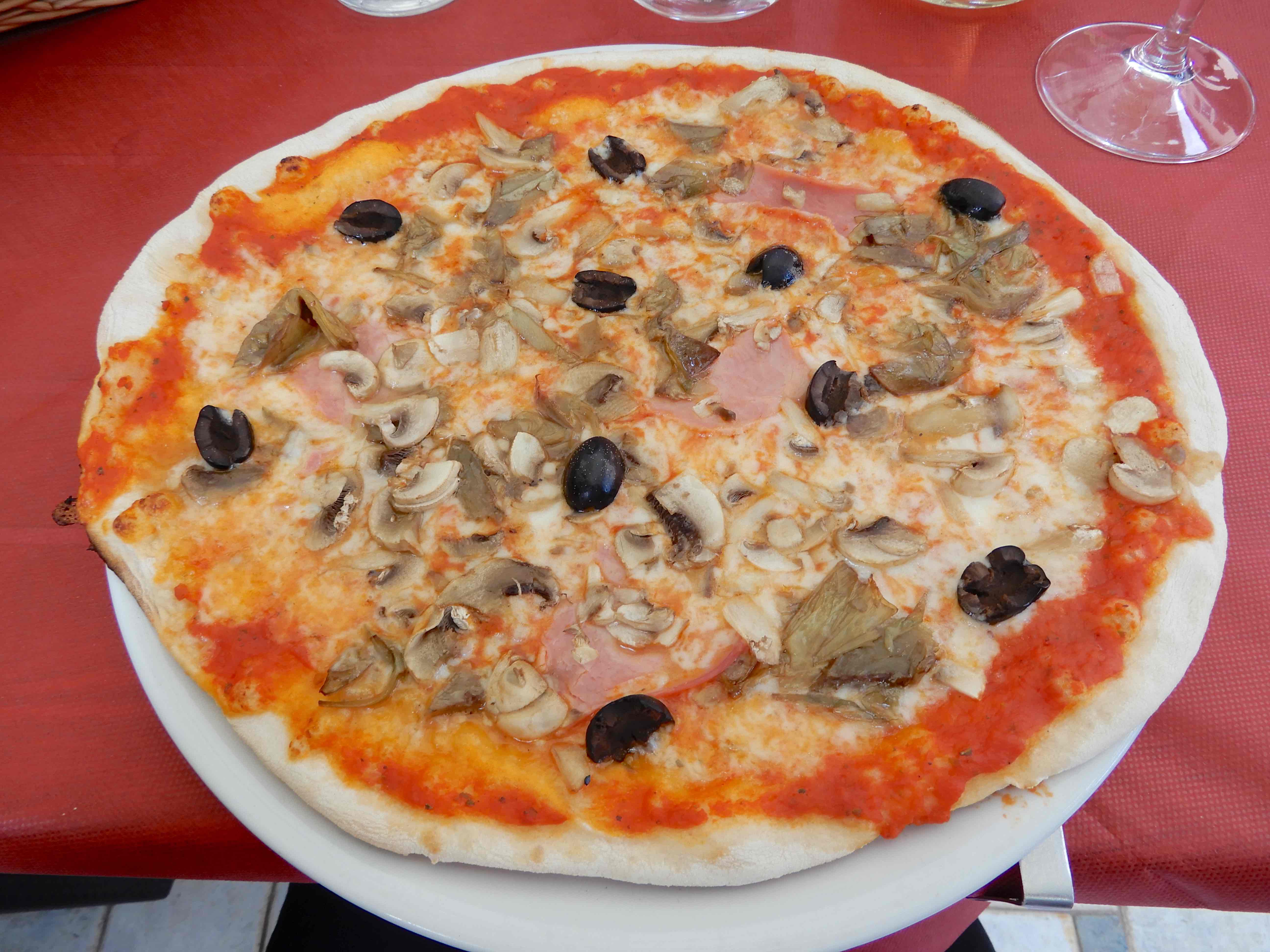
We found a lovely alfresco dining area at Ristorante Il Melangolo, the perfect setting to savour a vino and delicious pizza.

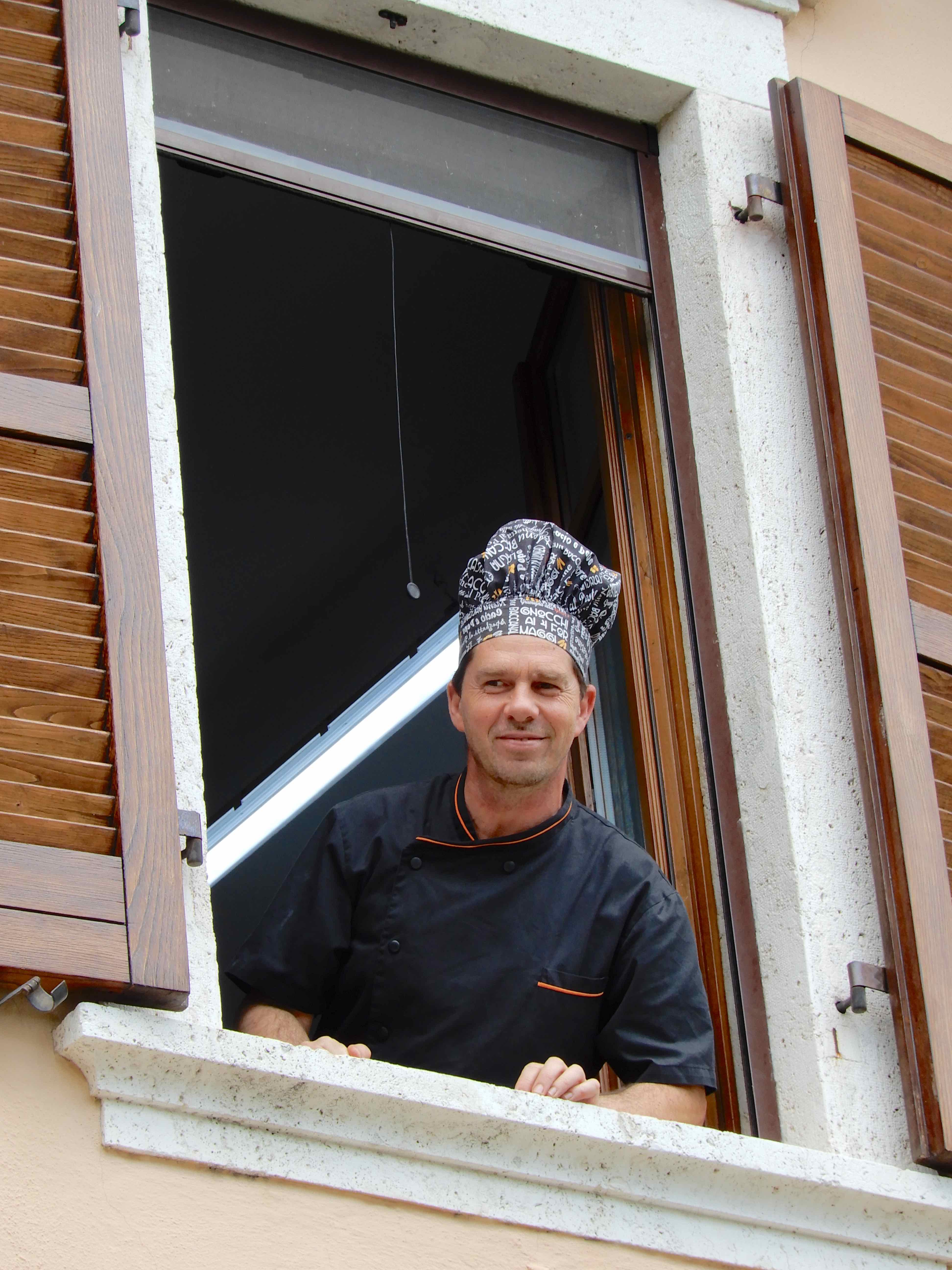
We enjoyed friendly banter with our waiter, Alex and as we left, an ardent “good-bye” reached us from a smiling chef Marco in the top floor window.

We made our way back to the car and, with a last glimpse of the stunning panorama, farewelled Saturnia.

Civita di Bagnoregio

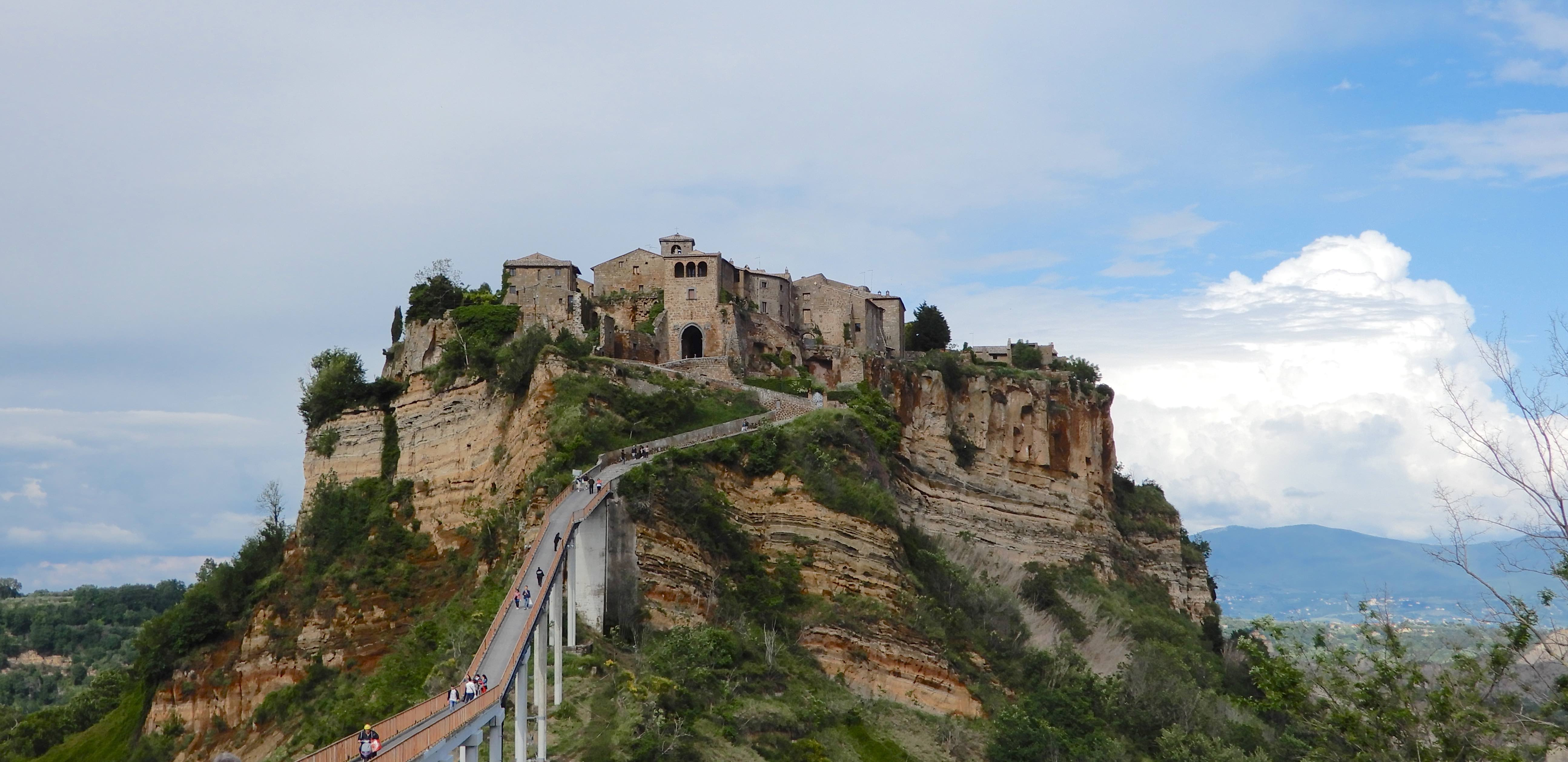
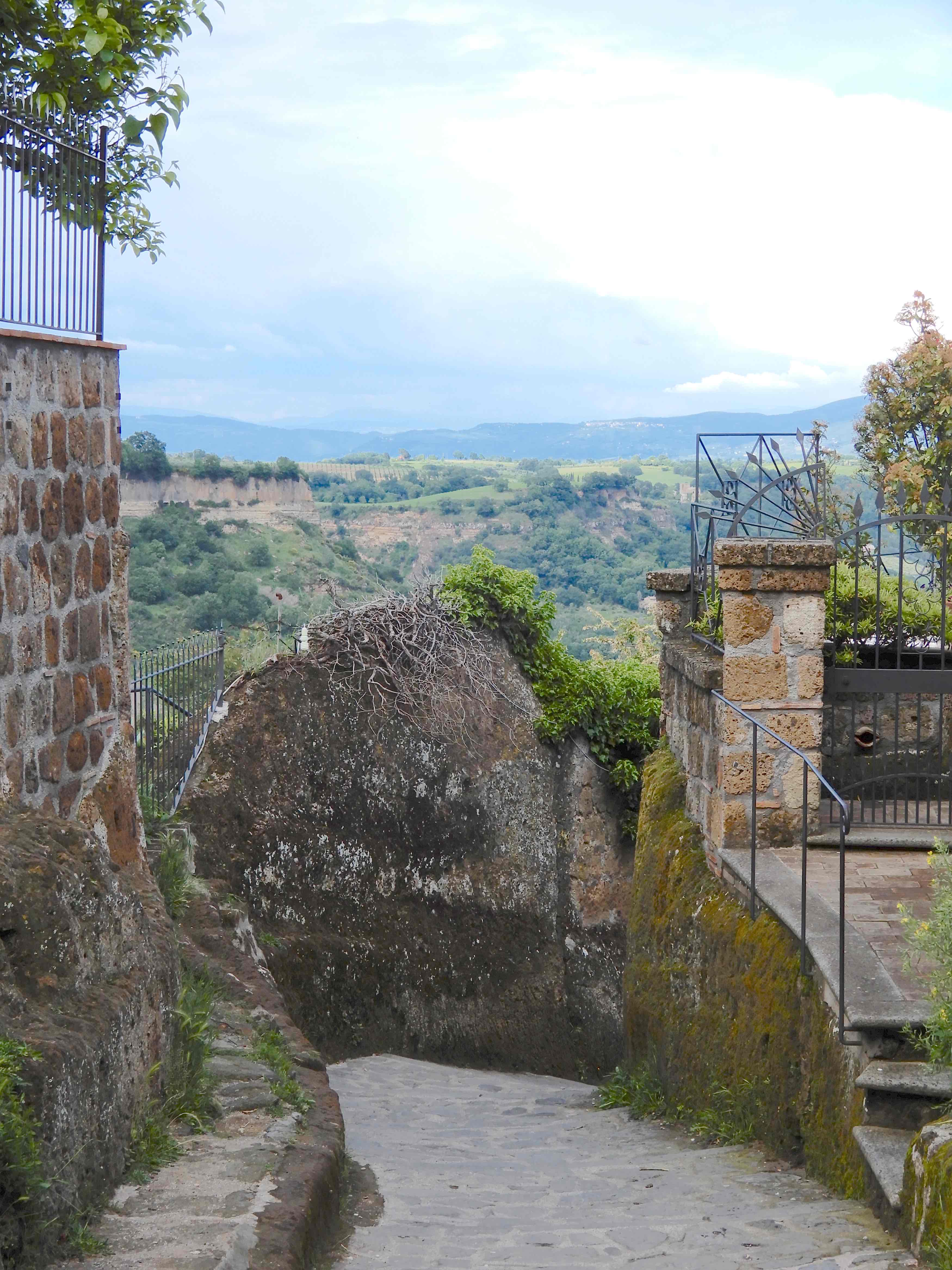
Despite the exhaustion from our adventures at Bomarzo, we couldn’t resist a detour to explore Civita di Bagnoregio. The two towns of Civita and Bagnoregio were once connected but by the 16th century, Civita had begun to disintegrate. The clay base below the tufa subsided and the cliff edges were weakened by the constant removal of stone to build houses. An earthquake in 1695 sealed its fate and the residents moved to Bagnoregio. There is now a permanent population of 12 in Civita, swelling to over 100 in the summer months, not to mention thousands of tourists. There is only one way into the town, across a long, steep footbridge.

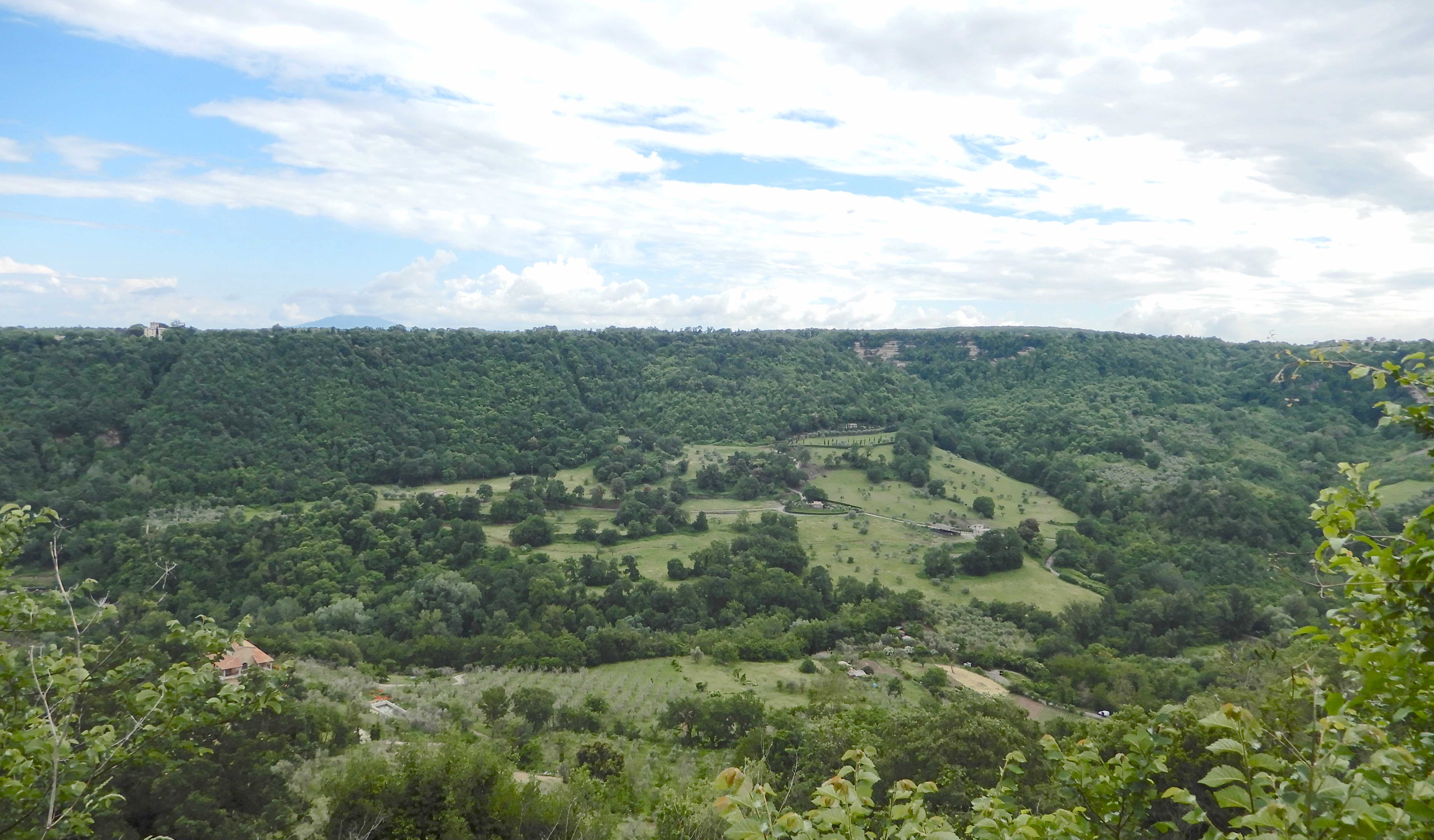
We parked the car in Bagnoregio and boarded a shuttle bus, the driver uninterested in collecting our €1 fare. A white-knuckle ride brought us to the start of the walkway with magnificent views across the valley.

As we climbed, the vista opened up to the mountains beyond.

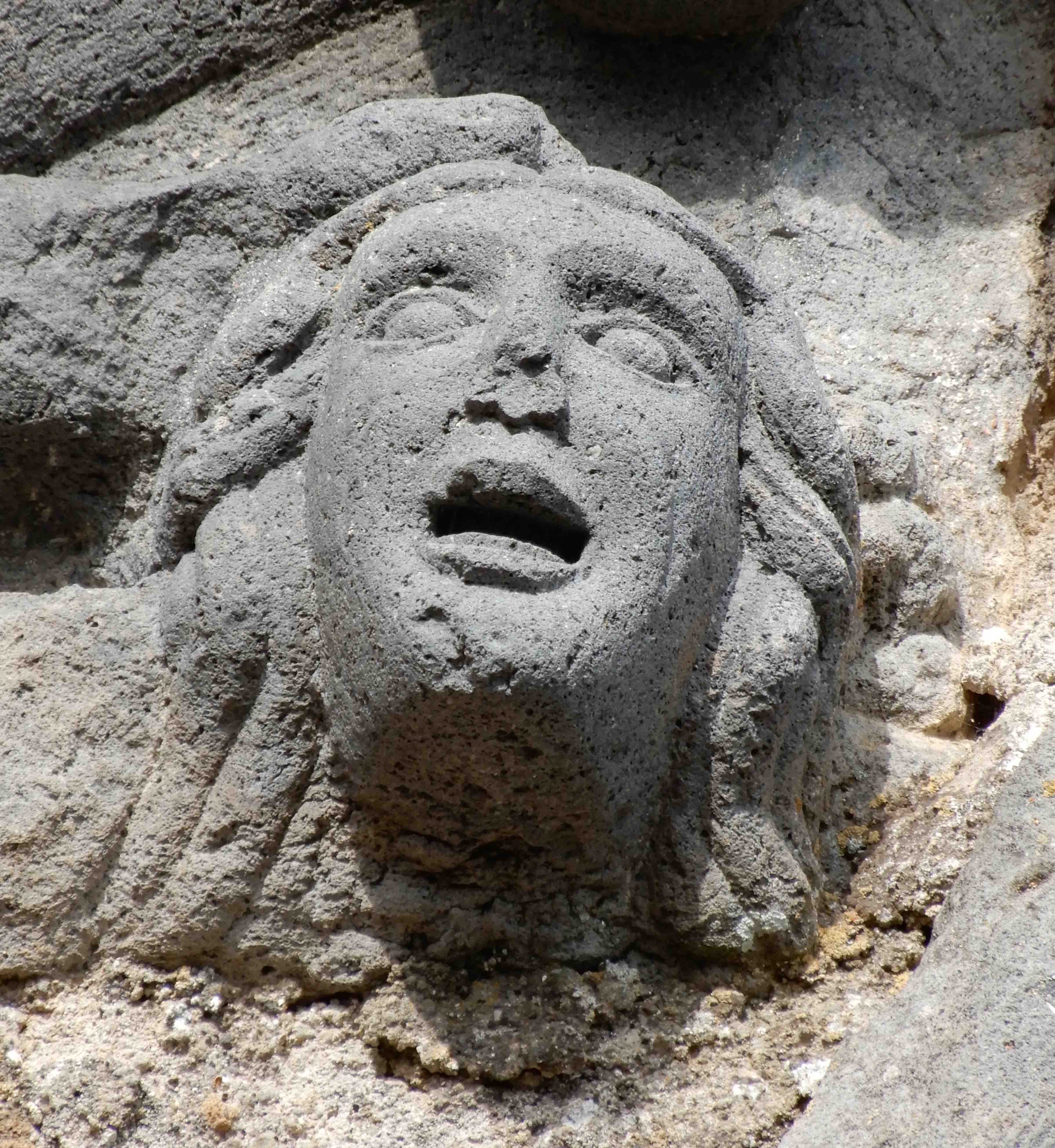
At the end of the bridge, we entered the town through the Porta Santa Maria, a stone doorway cut by the Etruscans 2500 years ago. Redecorated in the 12th century, the lions holding a human head are medieval symbols of the church.

The effort was definitely worth it, this magical place seemed frozen in time.

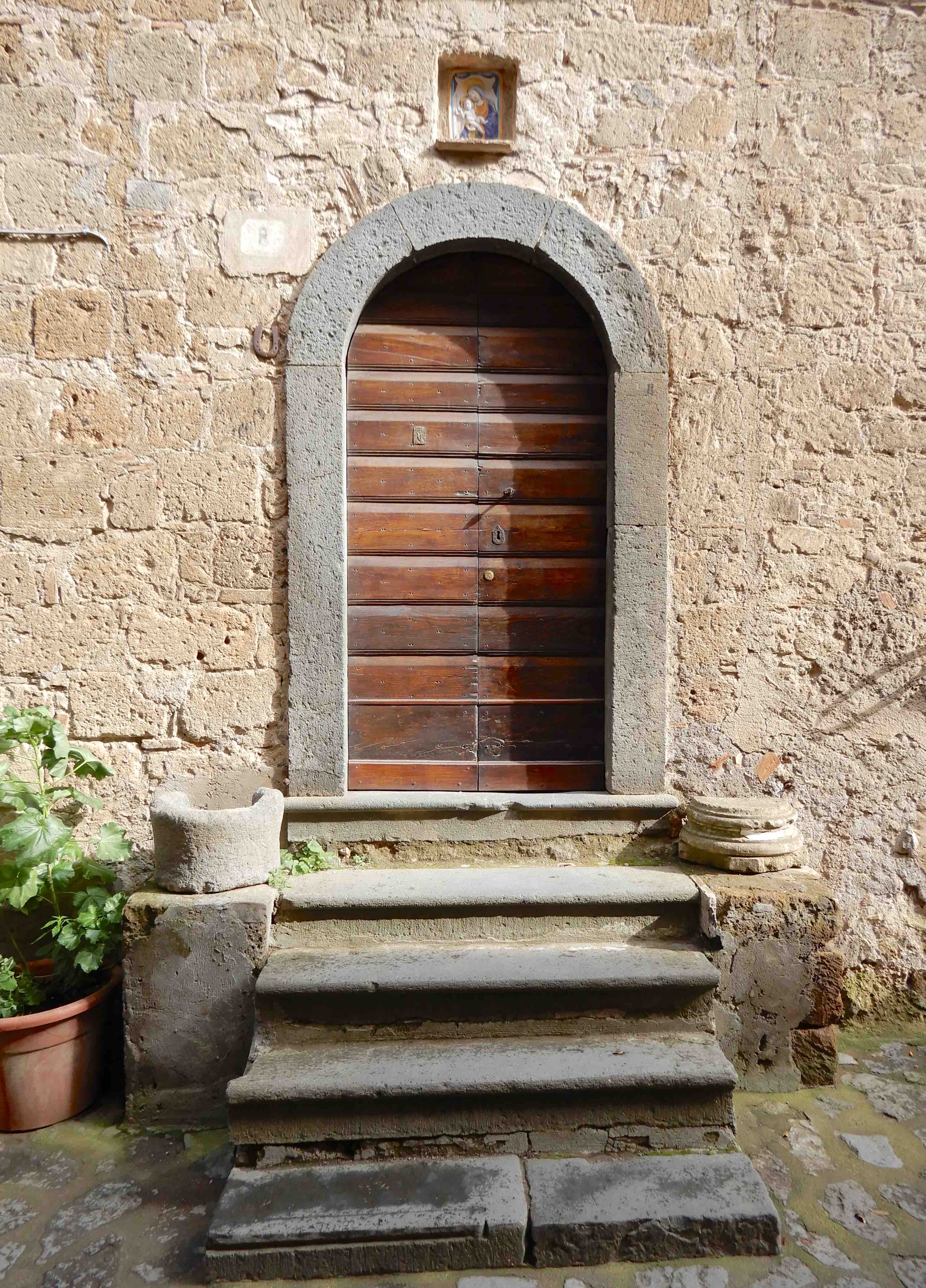
We wandered through streets unchanged since medieval times, the decorative door of the old palazzo and window above it has nothing but sky beyond. The rest of the building has long tumbled off the edge of the cliff.

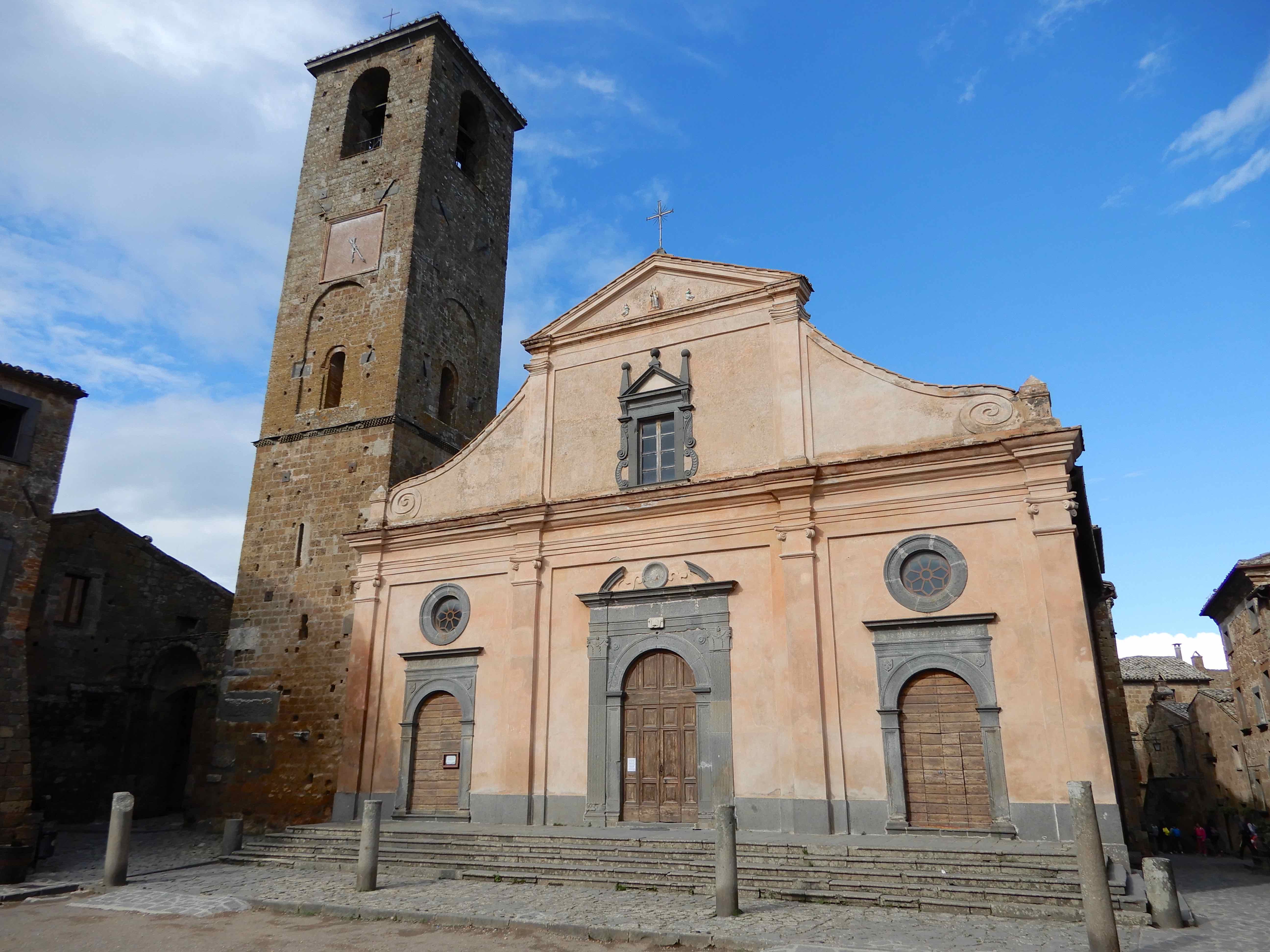
The main square, Piazza San Donato, takes the name of the 5th century Romanesque church dedicated to Saint Donato of Arezzo, a 4th century martyr. The only church in town, it was the cathedral of Bagnoregio until 1699 when damage from the previous earthquake rendered it unsafe.

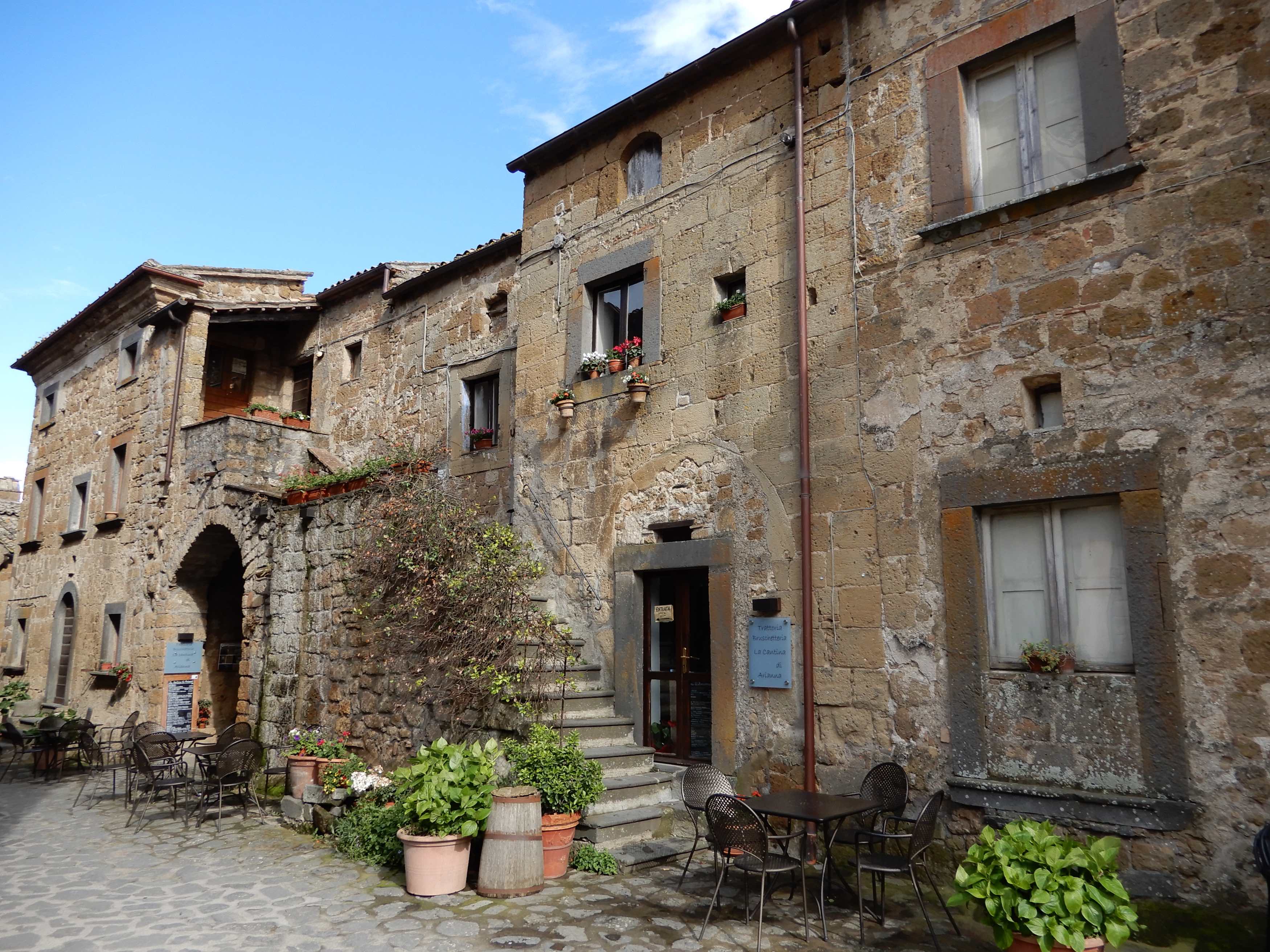
There was no shortage of eating establishments in the piazza, though the dinner crowds had yet to emerge.

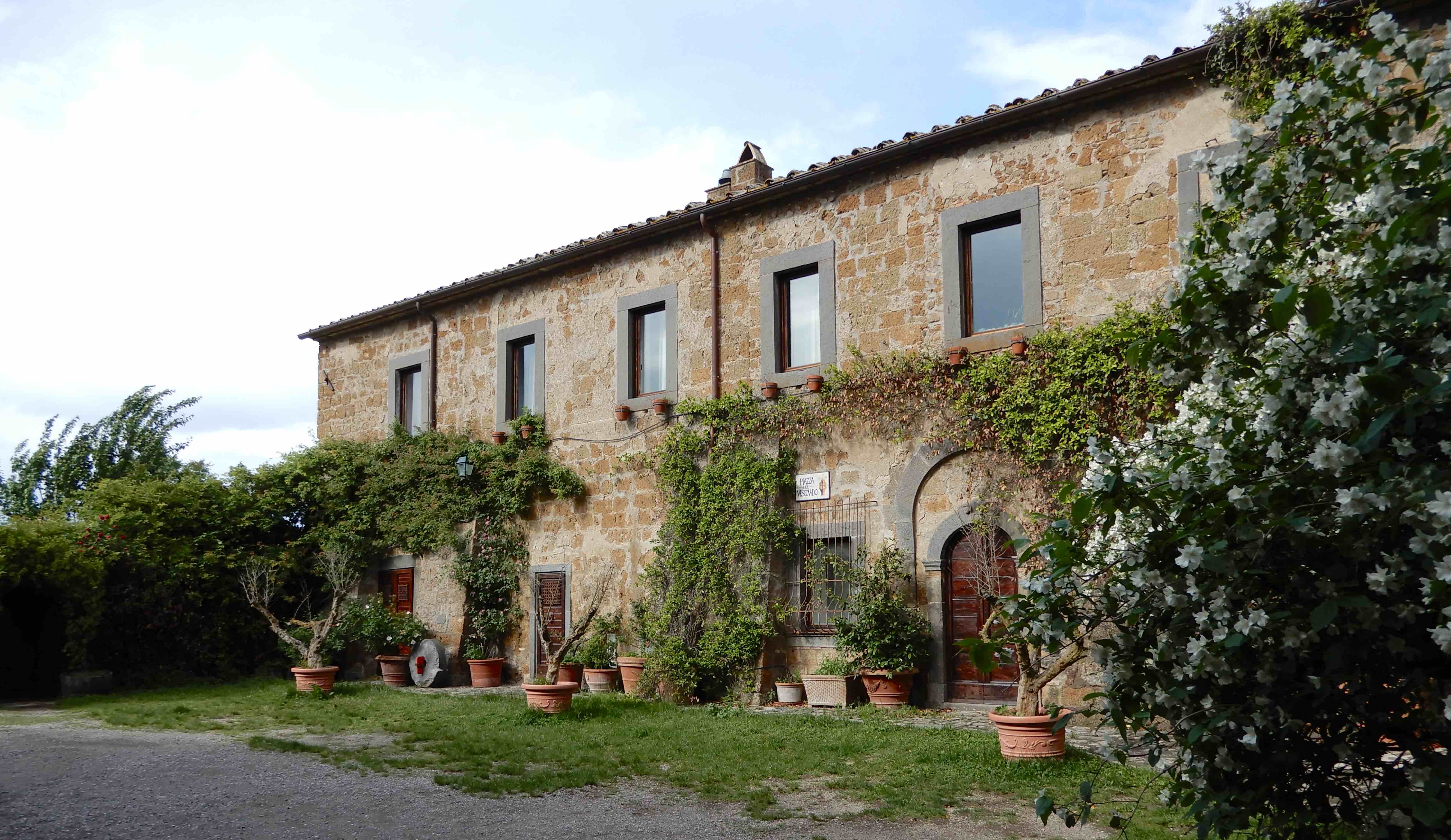
A double archway leads to the Piazza del Vescovado, the seat of the ancient bishop’s palace.

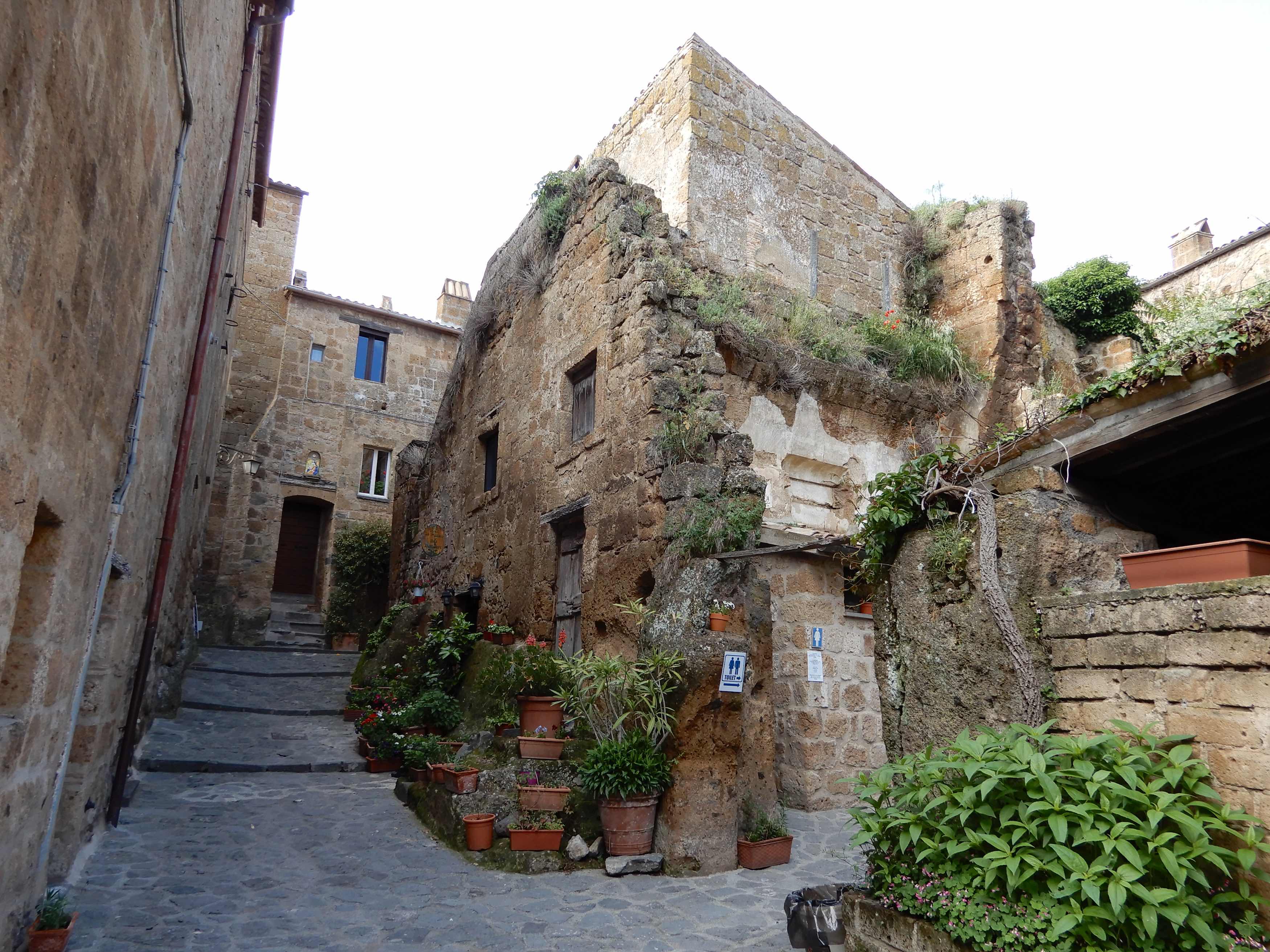
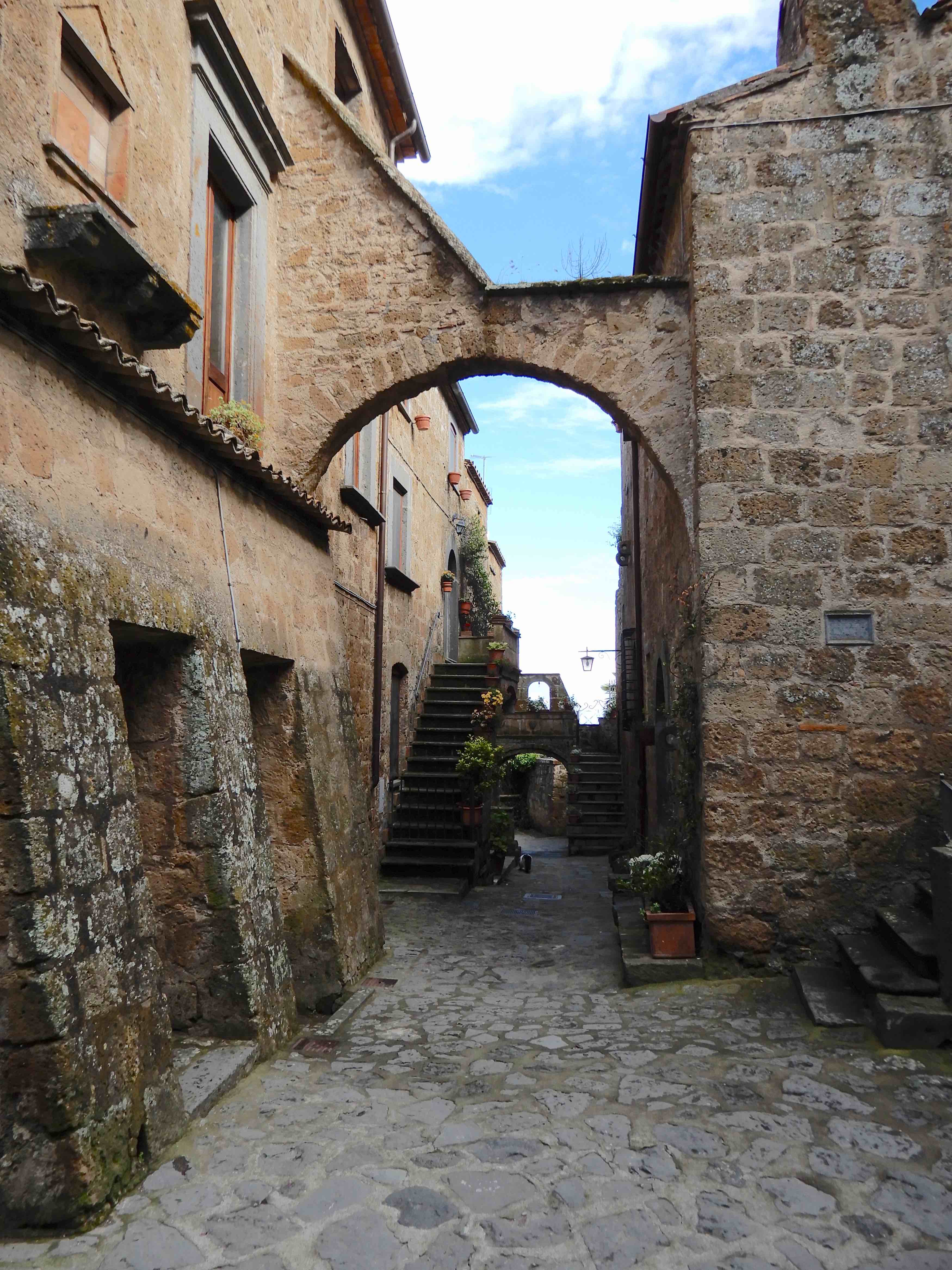
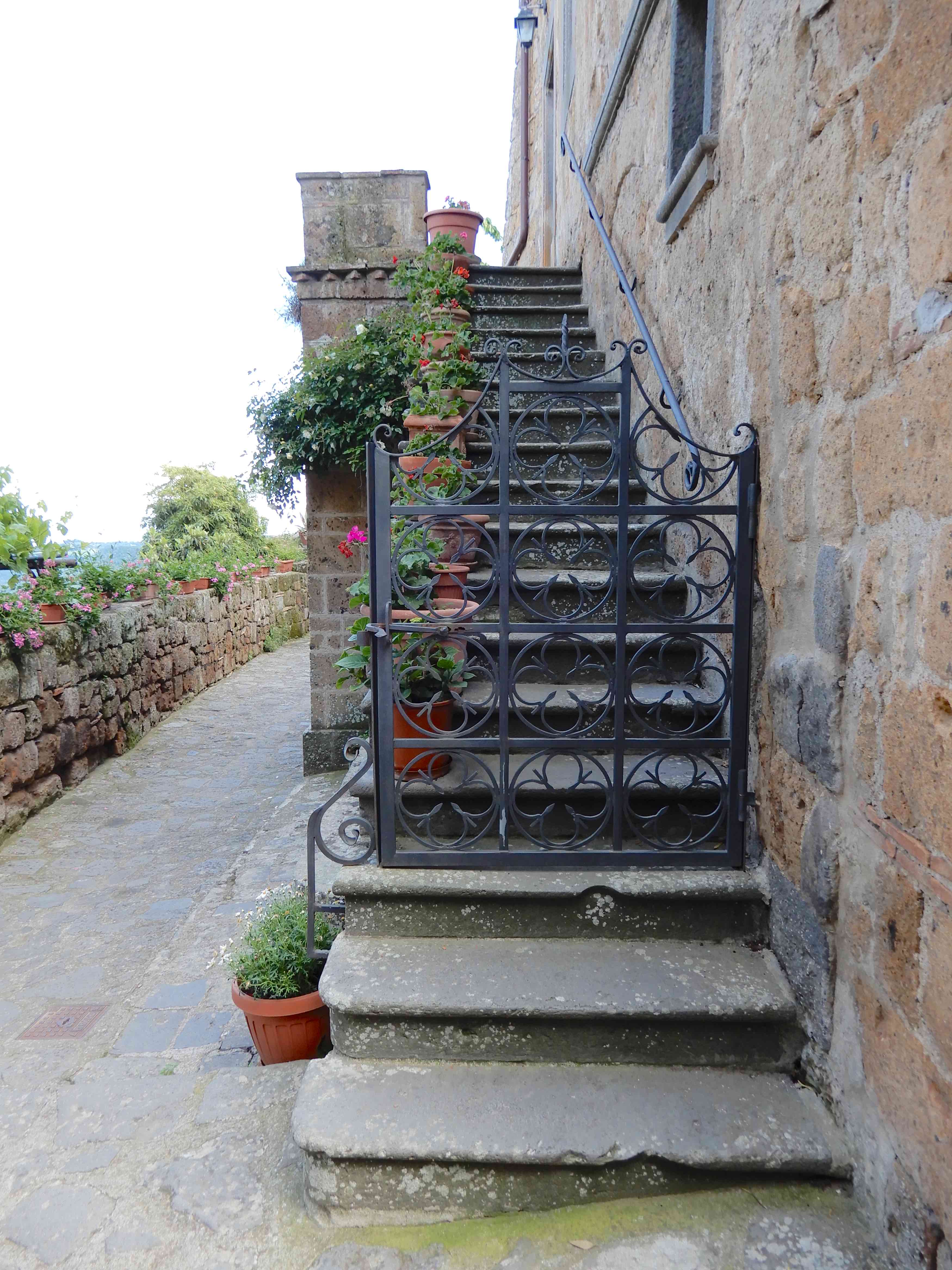
We ambled along the cobblestones, fascinated by the architecture and intricacy of alleyways, arches and stairs.

At the end of the village, a road leads to nowhere

and an interesting set of steps descend into the tufa below.

The return journey was easier on the legs,

though we were tempted to hitch a ride.

The erosion on the surrounding hillsides hinted at the future of this beautiful landscape.

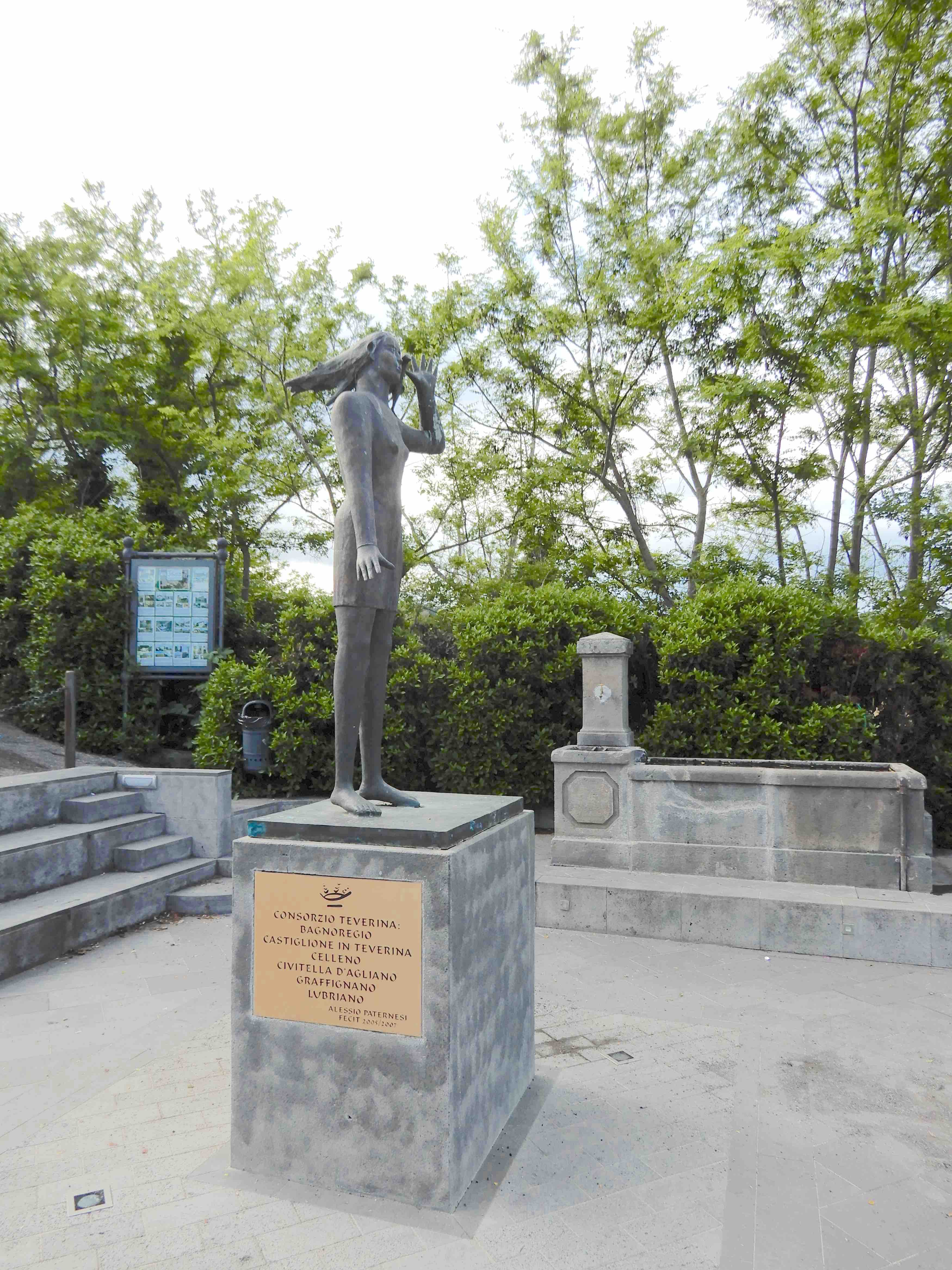
We waited for the bus in a lovely square with a bronze monument dedicated to Bonaventura Tecchi, a writer born in Bagnoregio in 1896.

From here, ‘the dying town’ of Civita shone radiantly in the evening sun.

piccioni Italiani

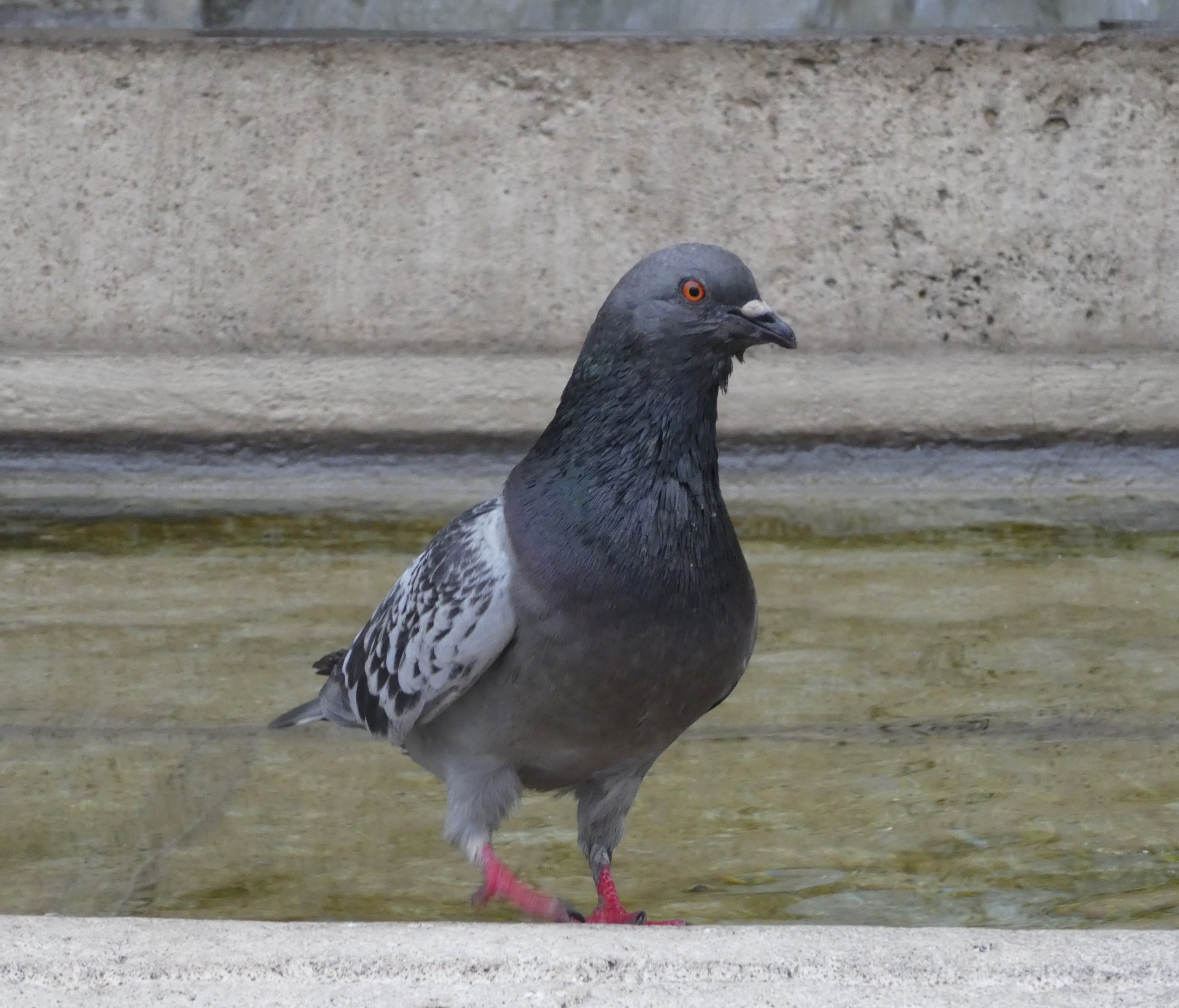
The mention of pigeons in Italy usually conjures images of tourists in Venice being smothered by masses of the unruly birds, left with hair dishevelled, clothing akimbo and the odd splattering of egesta. The feeding of pigeons in Piazza San Marco was legally banned in 2008 with a penalty up to €700 to discourage the practice. While we saw the occasional pigeon on our travels, they were very discreet and didn’t exhibit any manic flock behaviour. A paddle in the waters of Fontana dell’Acqua Felice cooled the feet on a warm day in Rome.

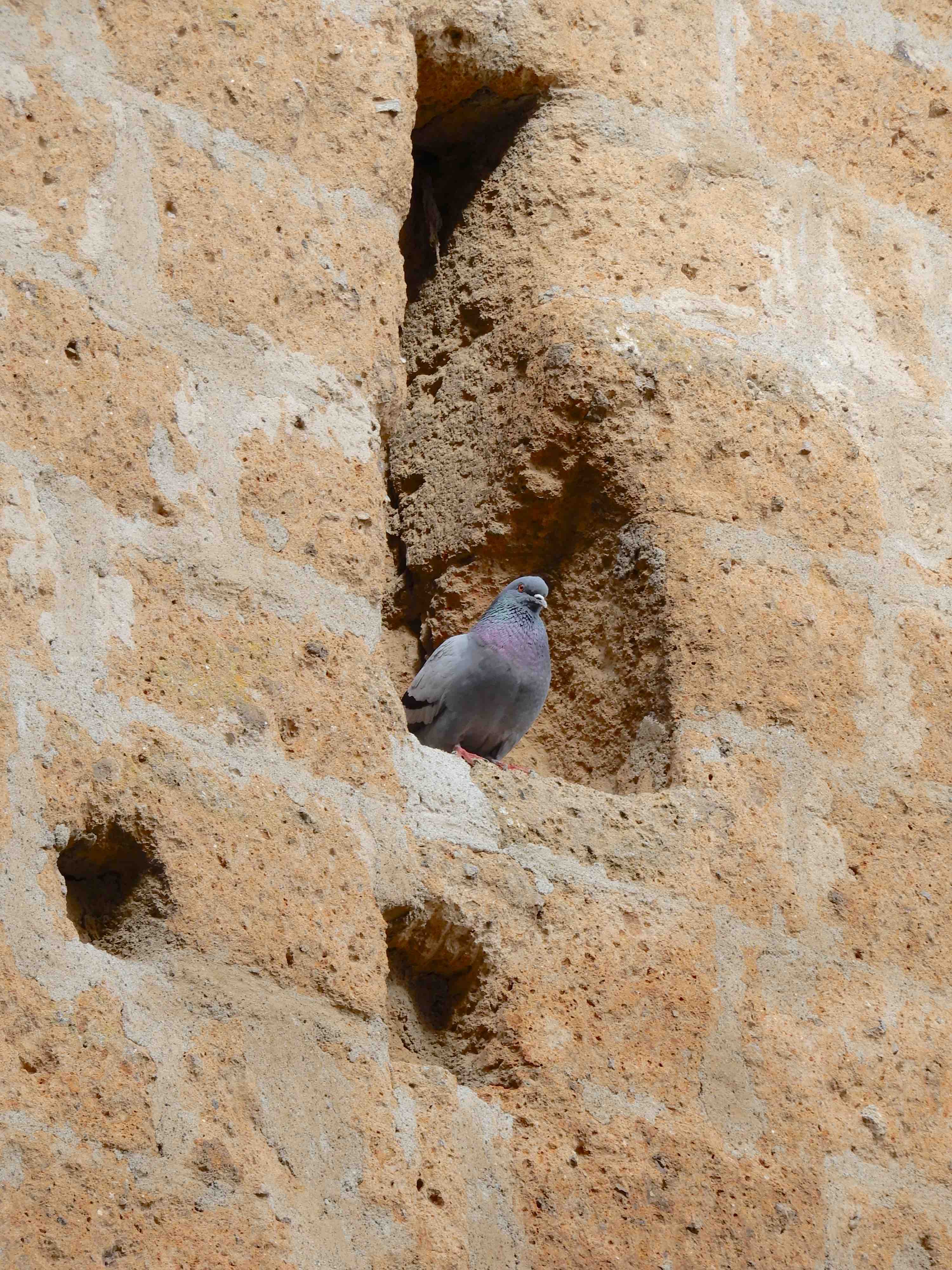
The ancient stonework of the Colosseum now serves as a comfortable columbarium. The word is from the Greek for pigeon or dove and describes the niches in walls designed for roosting and breeding.

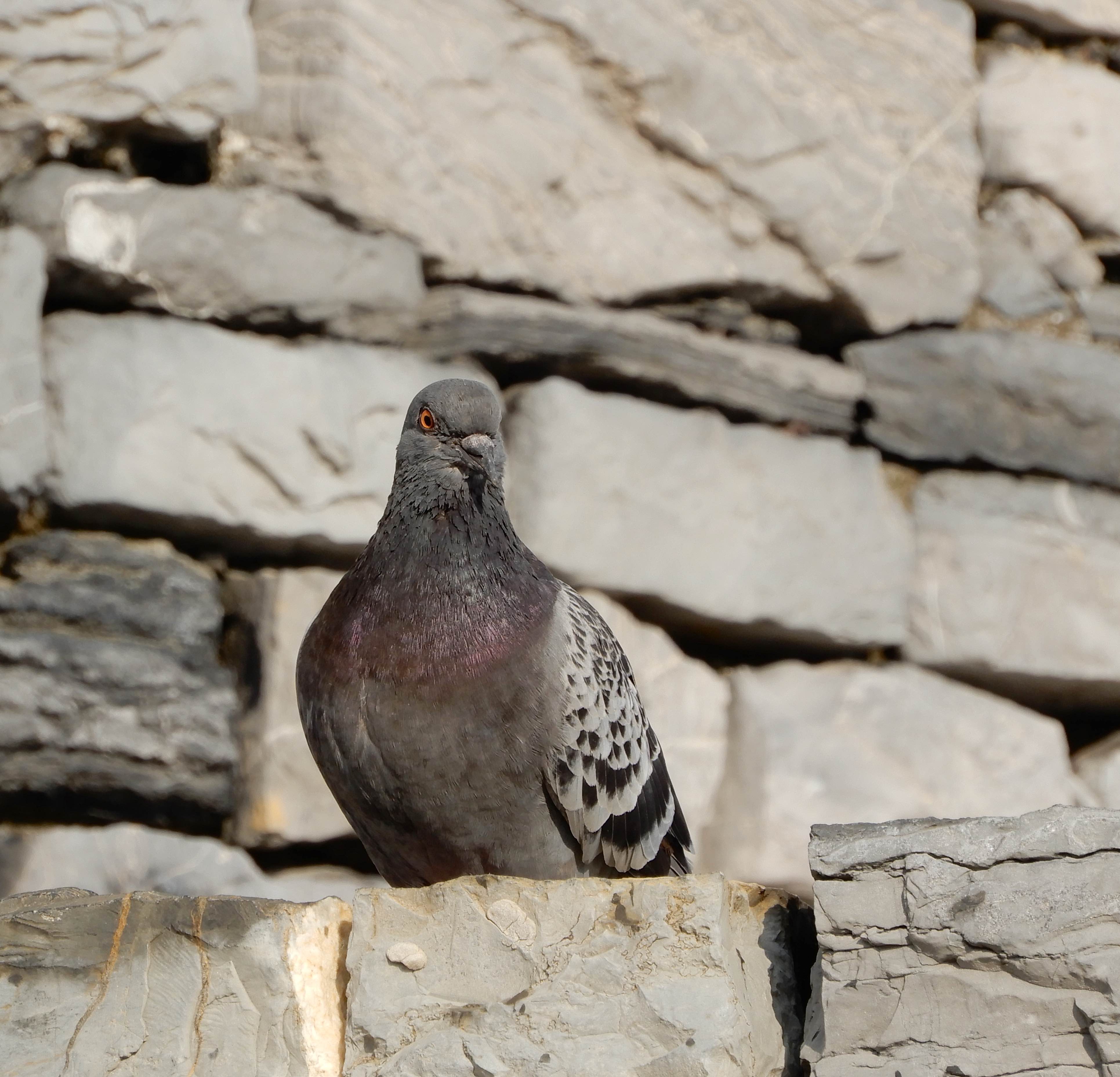
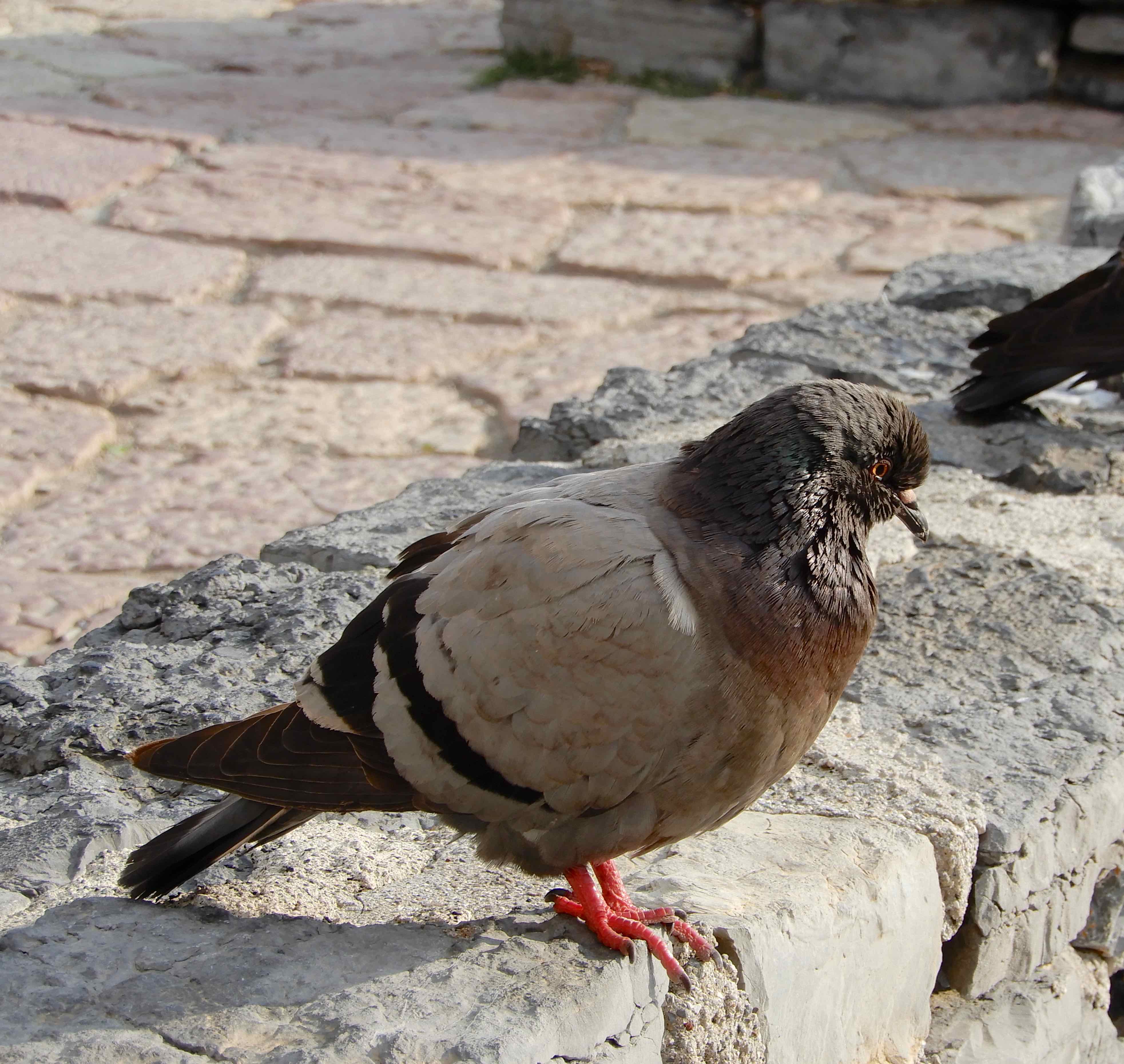
The merging of local and imported breeds over the centuries has led to an array of colours and markings. There aren’t many places better to enjoy the morning sun than the walls of Chiesa di San Pietro at Porto Venere.

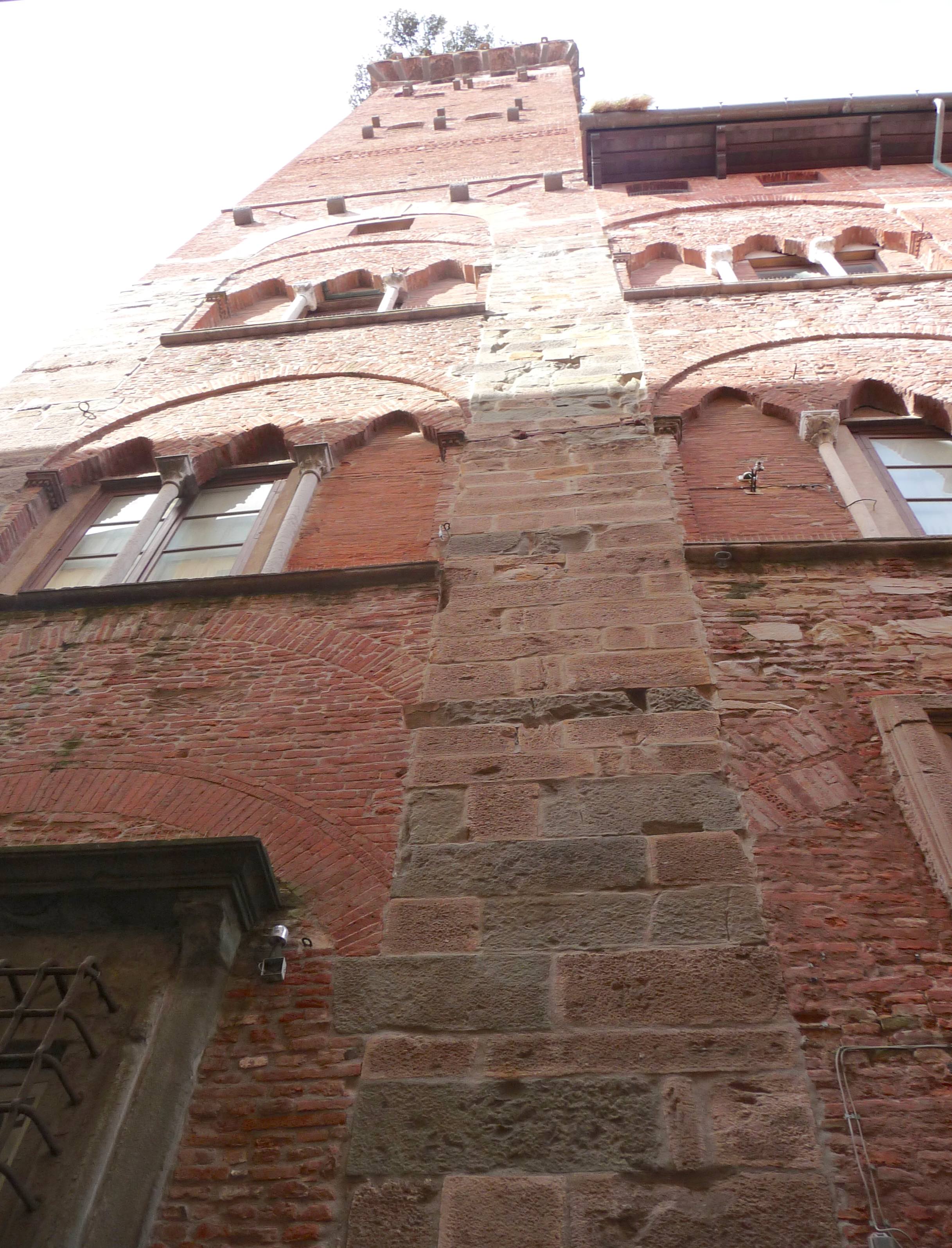
Pigeons have long been maligned as bearers of disease, possibly due to their indiscreet toilet habits and their link to the infection, psittacosis, which causes a pneumonia type illness in humans. Along with that, it seems they were responsible for the closure of five rooms in the Uffizi Gallery in April 2016. An infestation of ticks was discovered by a security guard and the rooms, displaying 15th century Italian paintings, were closed for two days to undergo pest control. The outbreak was blamed on the pigeons that perch on the Uffizi’s windows. No such problem in the Torre Guinigi at Lucca, there is plenty of aeration and fabulous views.

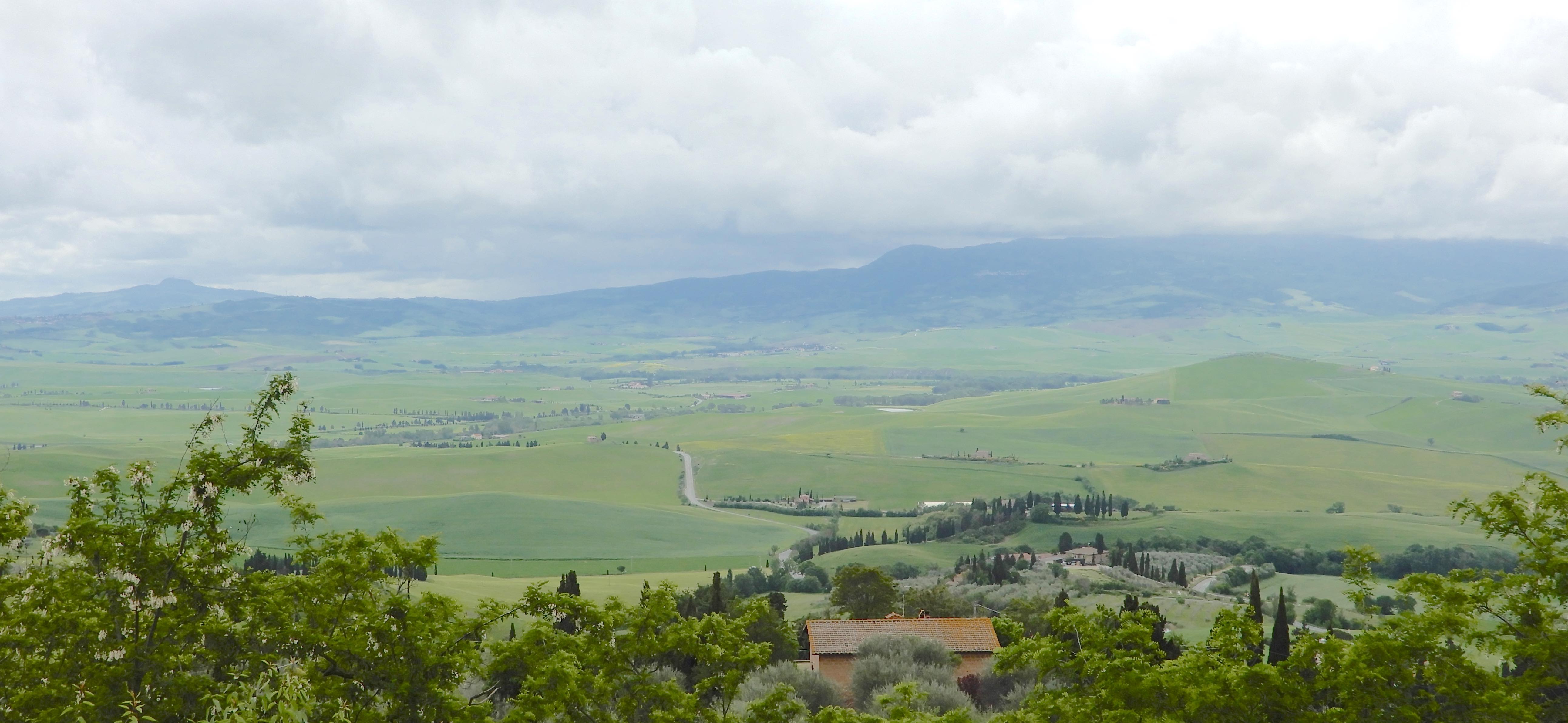
Pigeons obviously have a head for heights, what bird doesn’t? They can fly at altitudes of 6,000 feet or more with speeds up to 90 mph and can travel 700 miles in a single day. Some are happy to just find a quiet perch and admire the fabulous vista in Pienza.

One of the most intelligent birds on the planet, the pigeon can apparently recognise itself in a mirror as well as all 26 letters of the alphabet. Sounds like interesting research, some do look more inquisitive than others.

The belltower of Chiesa di San Donato in Bagnoregio provides a perfect niche from which to observe the wanderings of tourists in the piazza.

Pigeons have been used as messengers for centuries, the earliest reference dating back to 2500 BC. They have been credited with saving tens of thousands of lives in both World Wars with their efficient, reliable service. It wasn’t until 2006 that the last service, used by the police force in Orrisa, India, was disbanded. Presumably, the Orsini family relied on the birds to keep in touch at their palazzo in Pitigliano.

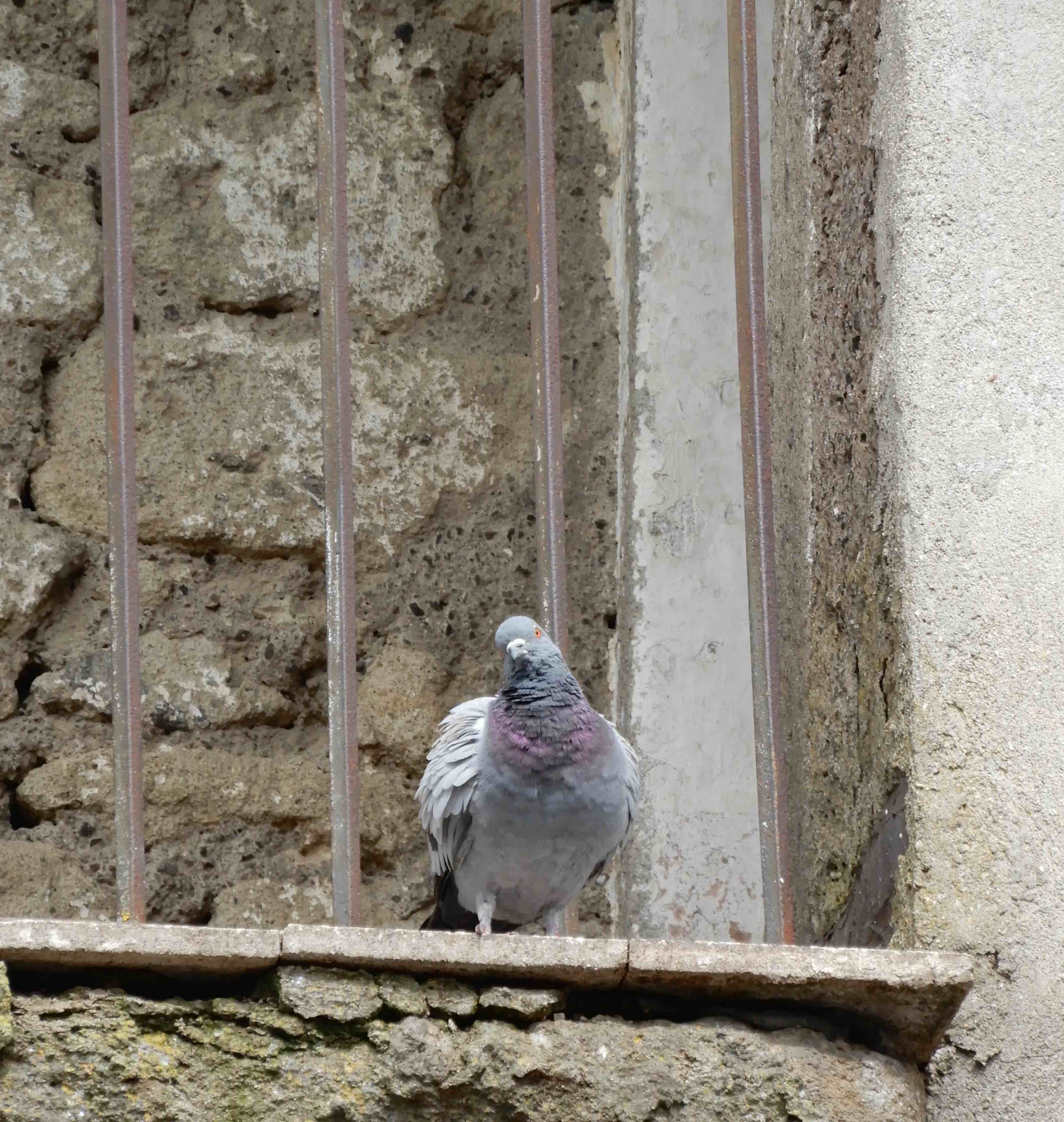
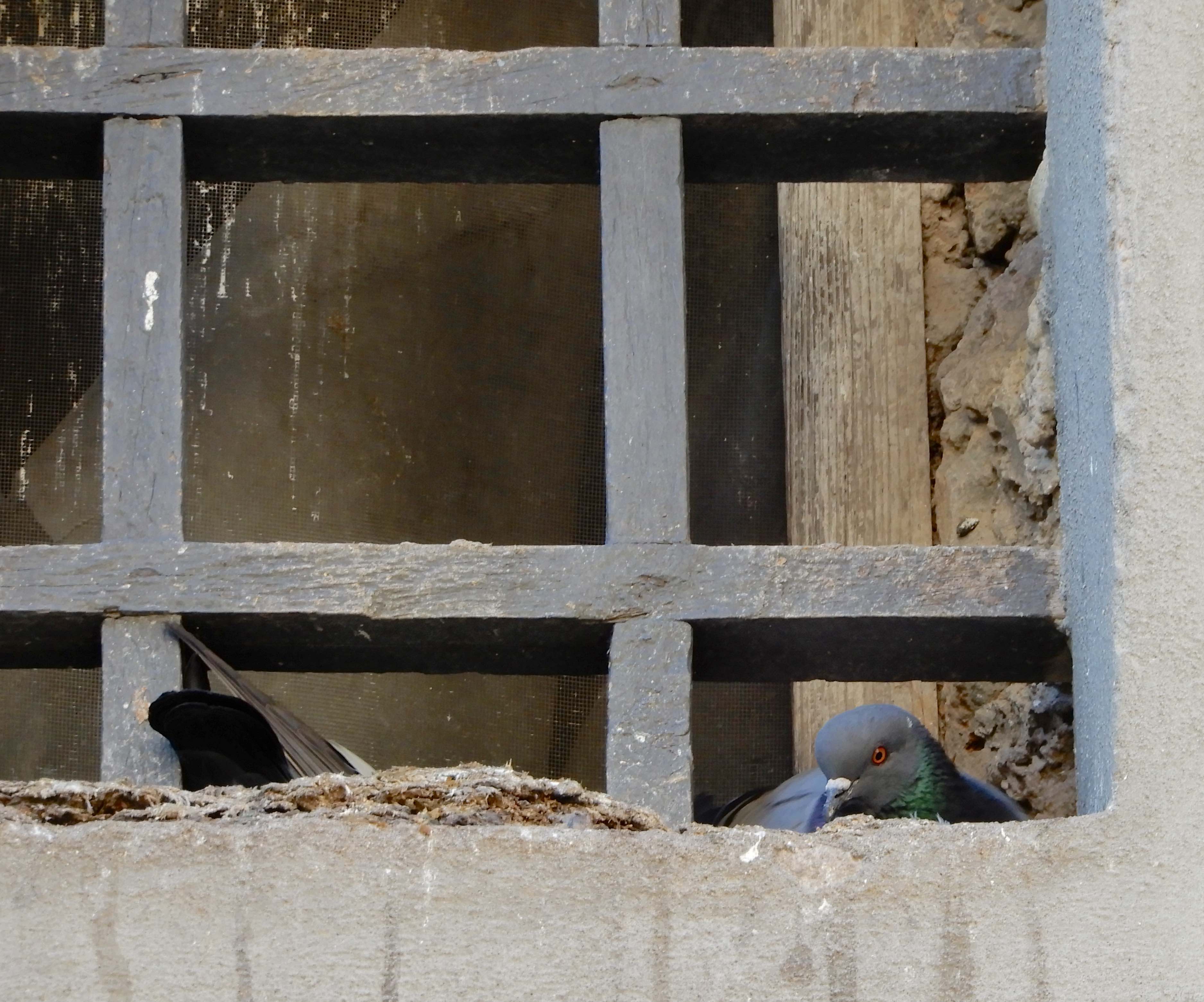
As well as breeding for food, sport and as messengers, pigeons were found to have another valuable resource. In the 16th century, their excrement was found to contain saltpetre, a substance used in the manufacture of gunpowder and fertiliser. It seemed to be in plentiful supply on the window ledges of Acquapendente.

The first mention of domesticated pigeons being used for food was in Egypt in 3000 BC and it is not unusual to find a piccione dish on menus throughout Tuscany. In January 2016, Italian celebrity chef, Carlo Cracco, caused controversy when he cooked a pigeon with turnips on Masterchef Italia. The president of the Italian Institute for the Protection of Animal and the Environment reported him to the police for encouraging people to cook wild animals. He overlooked the fact that pigeons are farmed for food and the law protecting pigeons only applies to wild ones. Of all the pigeons we encountered in Italy, this was by far my favourite.