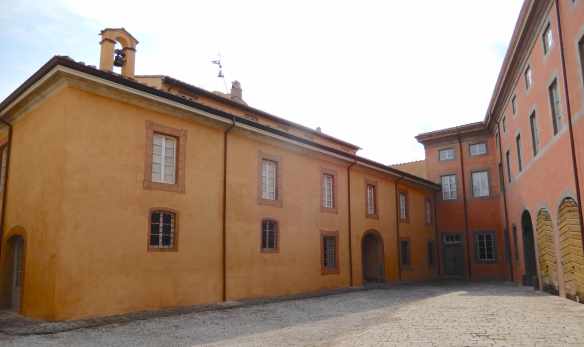
Parco Villa Reale

When we first visited Italy in 2014, I spent a blissful morning exploring the former estate of Napoleon’s sister, while Michael was busy building his guitar. A year later, Villa Reale di Marlia was sold and has undergone extensive restoration work. I returned with Michael this year to see the transformation. Elisa Bonaparte Baciocchi purchased the 16th century villa, along with some neighbouring properties, in 1806. The reflection of the villa can be seen clearly in the pristine waters of the lake.

1.Villa Reale di Marlia2.Lago

I thought the villa was beautiful when I first saw her but she has been rejuvenated to perfection.

3.Villa Reale4.Villa Reale

The 18th century Chapel of St. Francis Xavier, protector of missionaries and tourists, has received some special treatment, too.

The statues and stonework in the Italian Garden are looking decidedly brighter

and the water now spouts from the mouths of the masks (although they don’t look too happy about it).

The mosaic work in Pan’s Grotto is much brighter than I remember but the gargoyles are just as disturbing.

The water in the Spanish garden is certainly cleaner, the fountains helping with the circulation in the main pool.

The blooms are as lovely as last time.

The scattered statues are enjoying their revival

and the rear gates have clearly been attended to.

Arno and Serchio look like new men as they relax at the end of the 17th century fish pond in the Lemon Garden.

The statues and fountain in the atrium of the Green Theatre sparkle in the sunlight

48.Fontana Teatro di Verzura

while Columbine, Pantaloon and Punchinello patiently await their audience.

50.Teatro di Verzura

The most spectacular reformation is that of the Clock House.

53.Palazzina dell' Orologio54.Palazzina dell' Orologio

The stables, kitchens and servants’ quarters around the back have been given a stunning facelift.

58.Palazzina dell' Orologio

Once again, the statues and fountains of the Water Theatre have been refreshed

and the grotto fountain springs new life.

I recall Villa del Vescovo was a magnificent building with intriguing courtyards and fabulous views across the park.

69.Villa del Vescovo

It is currently under renovation, no doubt the same attention to  detail will continue.

73.Villa del Voscovo

I guess we will have to return when it is finished. To learn more of the park and the restorations, visit the website https://www.parcovillareale.it/

stormy skies

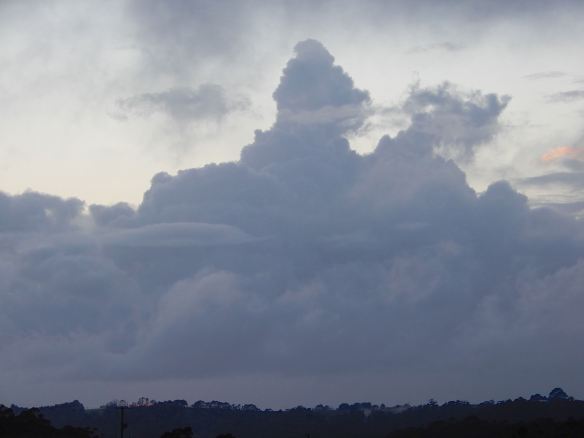
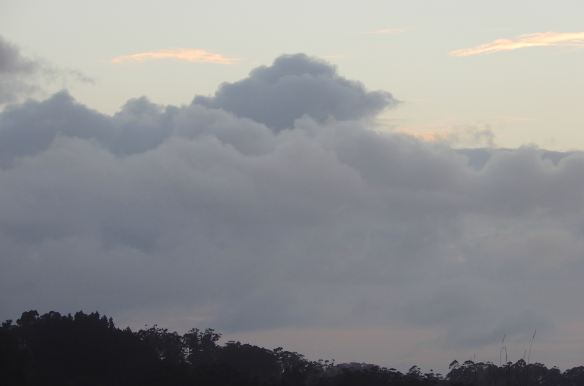
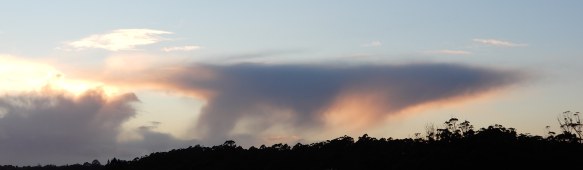
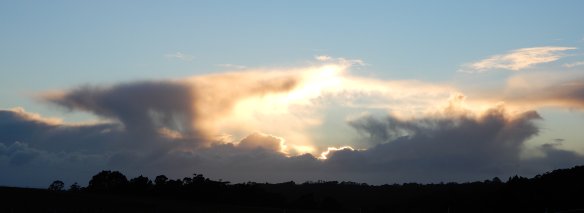
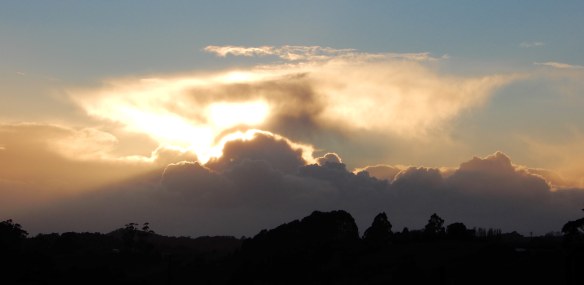
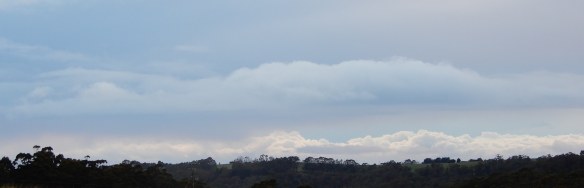
I have to admit to being a little distracted on my drives to work of late. We have had some atrocious weather – rain, high winds, storms – the upside being the spectacular early morning cloud formations.

1.storm clouds2.storm clouds3.storm clouds4.storm clouds5.storm clouds6.storm clouds7.storm clouds

My journey has been interrupted with frequent pauses to capture the ever changing skyscape.

8.storm clouds9.storm clouds10.storm clouds11.storm clouds12.stormy skies13.stormy skies

Sometimes, the sky resembles the ocean.

14.sky looks like ocean

The drive home brings a different set of surprises.

15.rainbow

Giant’s Causeway

The Giant’s Causeway was discovered by the Bishop of Derry in 1692 and much debate ensued as to the origin of this amazing phenomenon.

1.Giant's Causeway

One theory was that it was created by an Irish giant called Finn MacCool who was challenged to a fight by the Scottish giant Benandonner. Finn built the causeway across the North Channel to meet his foe but he chickened out when he saw the size of the Scot. Instead, he disguised himself as his own son. Benandonner took fright at the thought of just how big his rival must be and retreated to Scotland, destroying the causeway as he went. The mystery was solved in 1771 when French geologist, Nicolas Desmarest, announced the structure was the result of volcanic activity around 60 million years ago. Almost 40,000 basalt columns were created as the molten lava cooled, forming a pavement from the cliff to the sea.

2.Giant's Causeway

Most of the columns are hexagonal,

3.Giant's Causeway

the tallest being around 12 metres high.

4.Giant's Causeway5.Giant's Causeway

Some of the formations have been named after objects they resemble. In the distance are the Chimney Stacks and about two thirds along the cliff to the right, the Organ Pipes.

6.Chimney Stacks

There was a lot more to see along the Giant’s Causeway Walk but unfortunately, it was too late in the day to tackle that. I was happy just to be standing in this spectacular location,

7.Giant's Causeway

Michael was a little more adventurous.

8.Giant's Causeway

dewdrop diamonds

Walking in the forest on a crisp, cold morning after a heavy frost is like strolling through nature’s jewellery store. The sun, low in the sky, turns simple dew drops into glittering diamonds.

1.dewdrops2.dewdrops3.dewdrops4.dewdrops5.dewdrops6.dewdrops

Even those stems bereft of foliage held onto the occasional glistening droplet.

7.dewdrop8.dewdrops9.dewdrops10.Prickly Moses

I was like a child in a sweet shop, I couldn’t get enough of this amazing beauty.

11.dewdrops12.dewdrops13.dewdrop

The gems would disappear as the sun climbed, but for now I was content to experience another of nature’s treats.

14.dewdrop


Causeway Coast

The coast of Northern Ireland has some of the most spectacular scenery in the world. The present coast road was engineered in the 1830s and is now known as the Causeway Coastal Route, 190km hugging the Atlantic Coast from Belfast to Londonderry. Amidst the geology and greenery, there was the unexpected. Just before we reached Ballygally, a very happy bear appeared out of nowhere. The origin of the polar bear persona is unknown but every year, the locals touch up the paint and ensure his smile never fades.

1.Bear Rock

The village of Ballygally nestles along the shore of Ballygally Bay.

2.Ballygally

At the head of the bay, Ballygally Castle has an interesting history. Built in 1625 by Scotsman James Shaw, it would have been surrounded by four walls and withstood several incursions during the 1642 rebellion. It remained in the Shaw family into the 1800s and then passed through a few different families. In the 1950s, an entrepreneur bought, refurbished and opened the castle as a hotel and further development in 1966 created the hotel as it is now. Reputed to be one of the most haunted places in Ulster, there are a number of resident ghosts. The most active is Lady Isobel Shaw who had been starved and locked in her room by her husband. Tragically, she fell to her death from the window. She now has a habit of knocking on the doors of the rooms and disappearing.

3.Ballygally

The rest of the houses around the bay look very peaceful and undisturbed.

4.Ballygally5.Ballygally

Looking out to sea, The Maidens are visible 9km offshore. The two lighthouses date back to 1829, the lighthouse keepers and their families lived for a year at a time on these islets. The isolation was no obstacle to romance; in the 1830s, the assistant keeper of one lighthouse fell in love with the daughter of the keeper of the other. He often visited by boat until the families had a falling out and her father forbade them to meet. They found a solution, they eloped to Carrickfergus. No longer inhabited, the West Maiden was abandoned in 1903 and the East Maiden was automated in 1977.

6.The Maidens

The Mull of Kintyre broke the horizon, only 10km from the coast of County Antrim.

7.Mull of Kintyre from Glenarm

It was a pleasure to drive the coastal road surrounded by mountains to the left and ocean to the right. This fence line reminded me of Michael’s engineering feats when we lived in the Adelaide Hills.

8.Ballycastle

The next town was Ballycastle,

9.Ballycastle

the sunlight through the clouds illuminated the clifftops of Fairhead.

10.Fair Head

Rising 196 metres above the bay, Ballycastle’s headland formed as a result of volcanic activity 60 million years ago. The upper half of the cliff is composed of gigantic columns of dolerite up to 12 metres in diameter.

11.Fair Head

Further up the coast, rocky islands are scattered throughout the waters of Larrybane Bay.

12.Larrybane Bay

The dolerite cliffs of Sheep Island were magnificent.

13.Sheep Island, Larrybane Bay copy

Remnants of old machinery remain on Stackaboy Island from the days when dolerite was carried on overhead lines to the island and then loaded onto steamboats for the trip to Scotland.

14.Stackaboy Island, Larrybane Bay

I had mentally prepared myself for the heart-stopping walk across the rope bridge at Carrick-a-Rede, not realising it was another icon that closed down for the winter season. First erected by salmon fishermen in 1755, the 20 metre long bridge is suspended 30 metres above the sea. The waters around Carrick Island were teeming with salmon migrating to the North Atlantic and the fishermen would walk the bridge in all weather and return with their catch. Whether due to changing migratory patterns or over-fishing of the area, there are now very few salmon left and the tradition ended in 2002. Carrick Island is the first bump from the headland (it looks attached from this angle).

15.Carrick Island, Larrybane Bay

These photos may look familiar to anyone who watches Game of Thrones, much of the filming took place along the Causeway Coast.