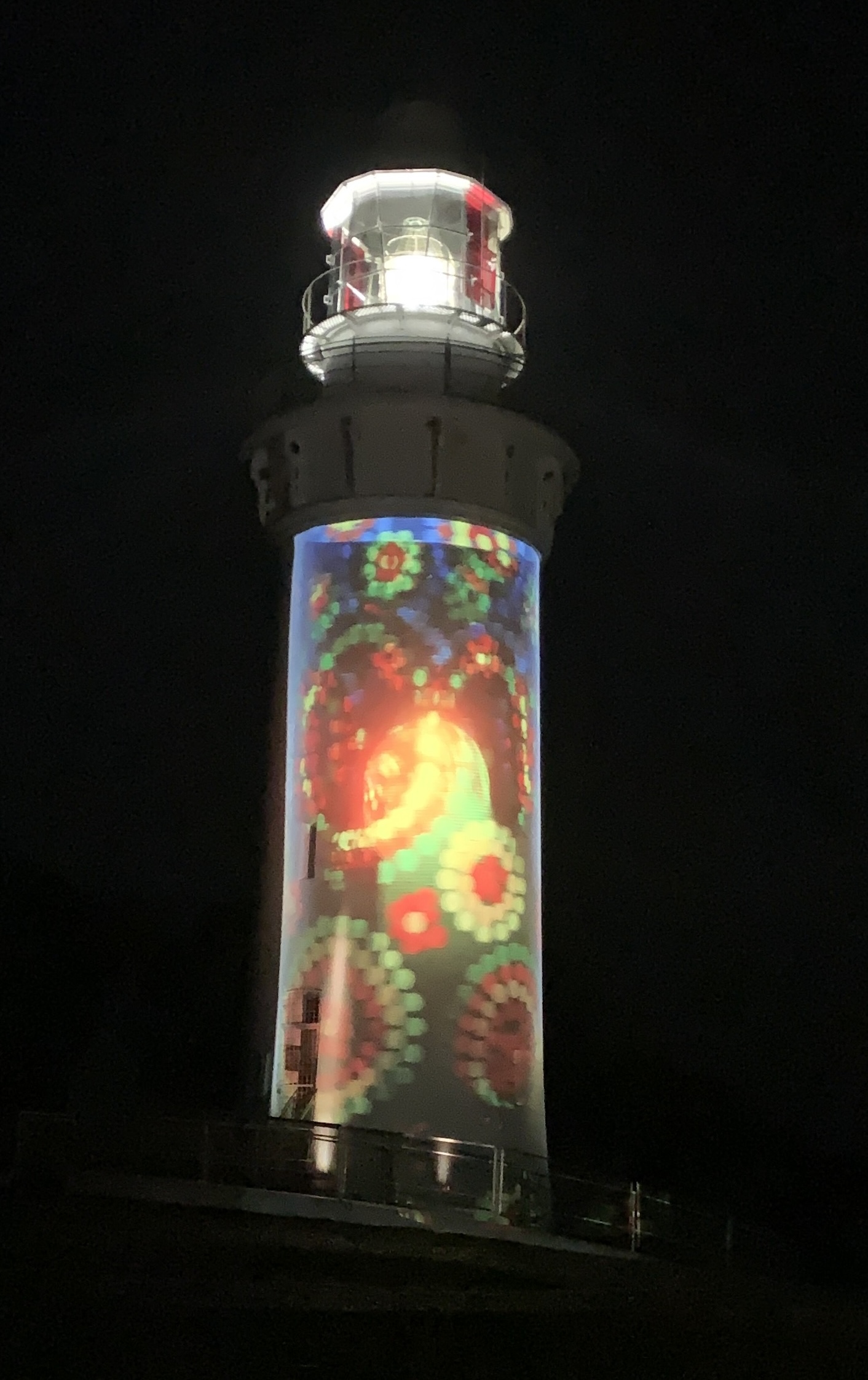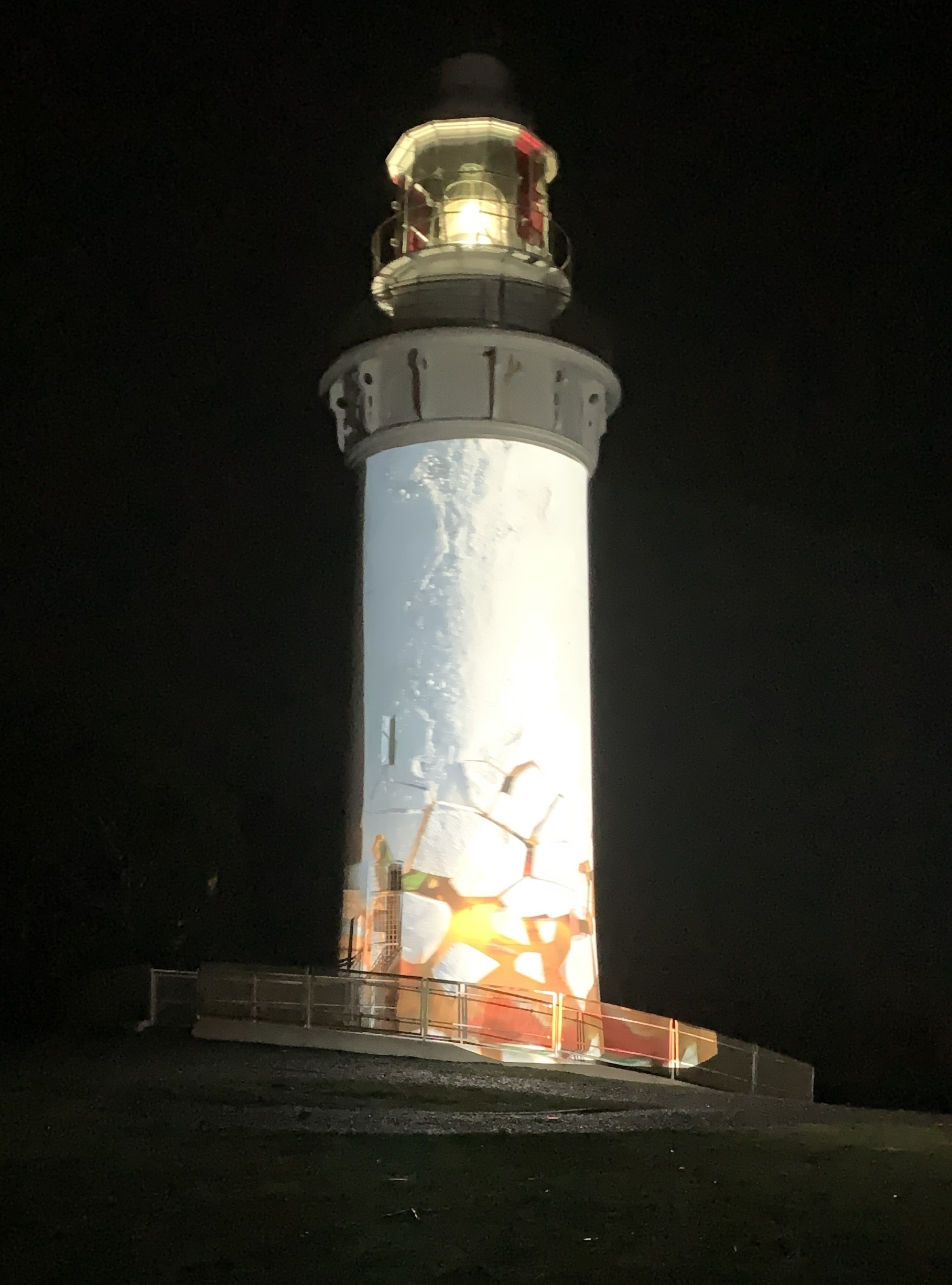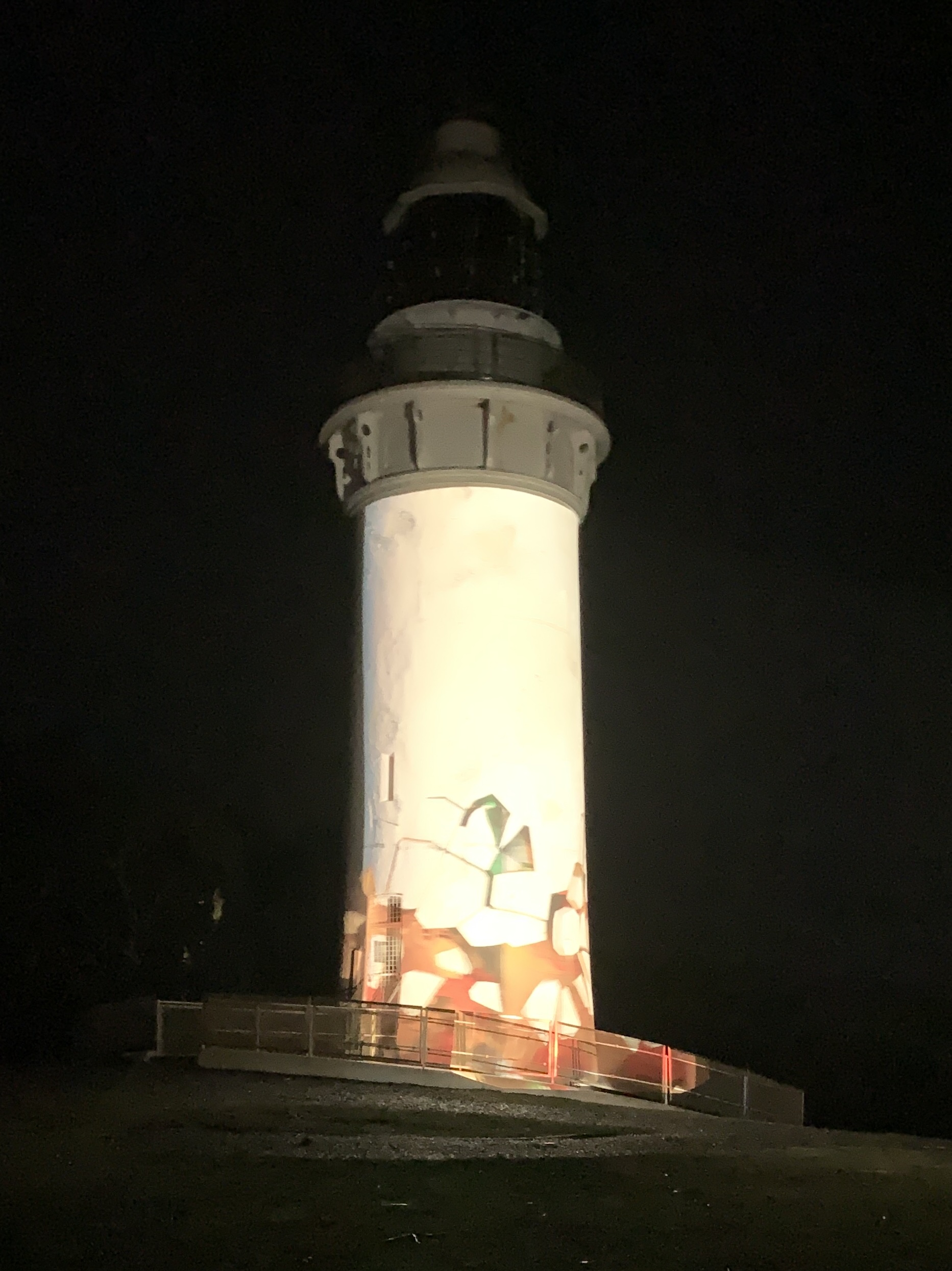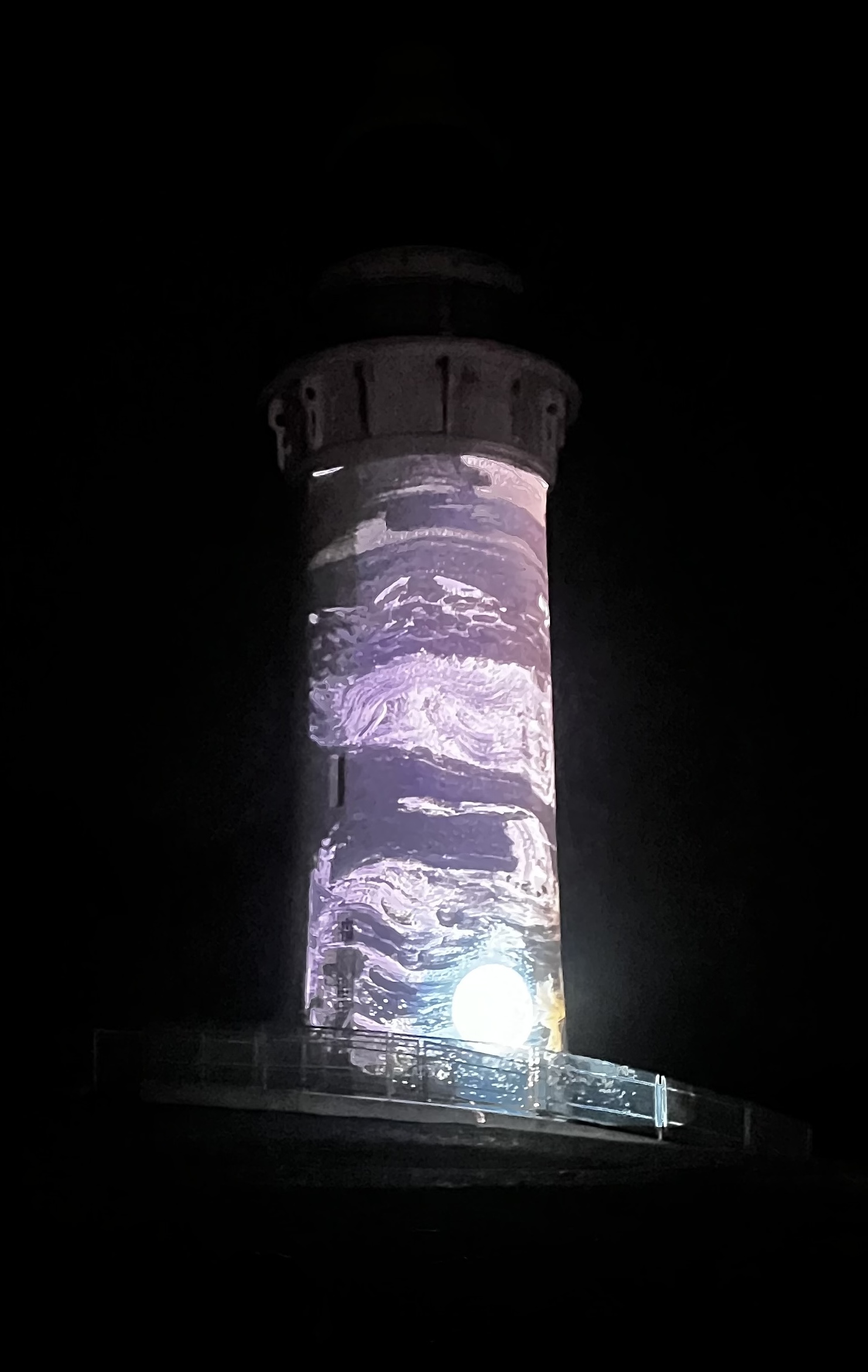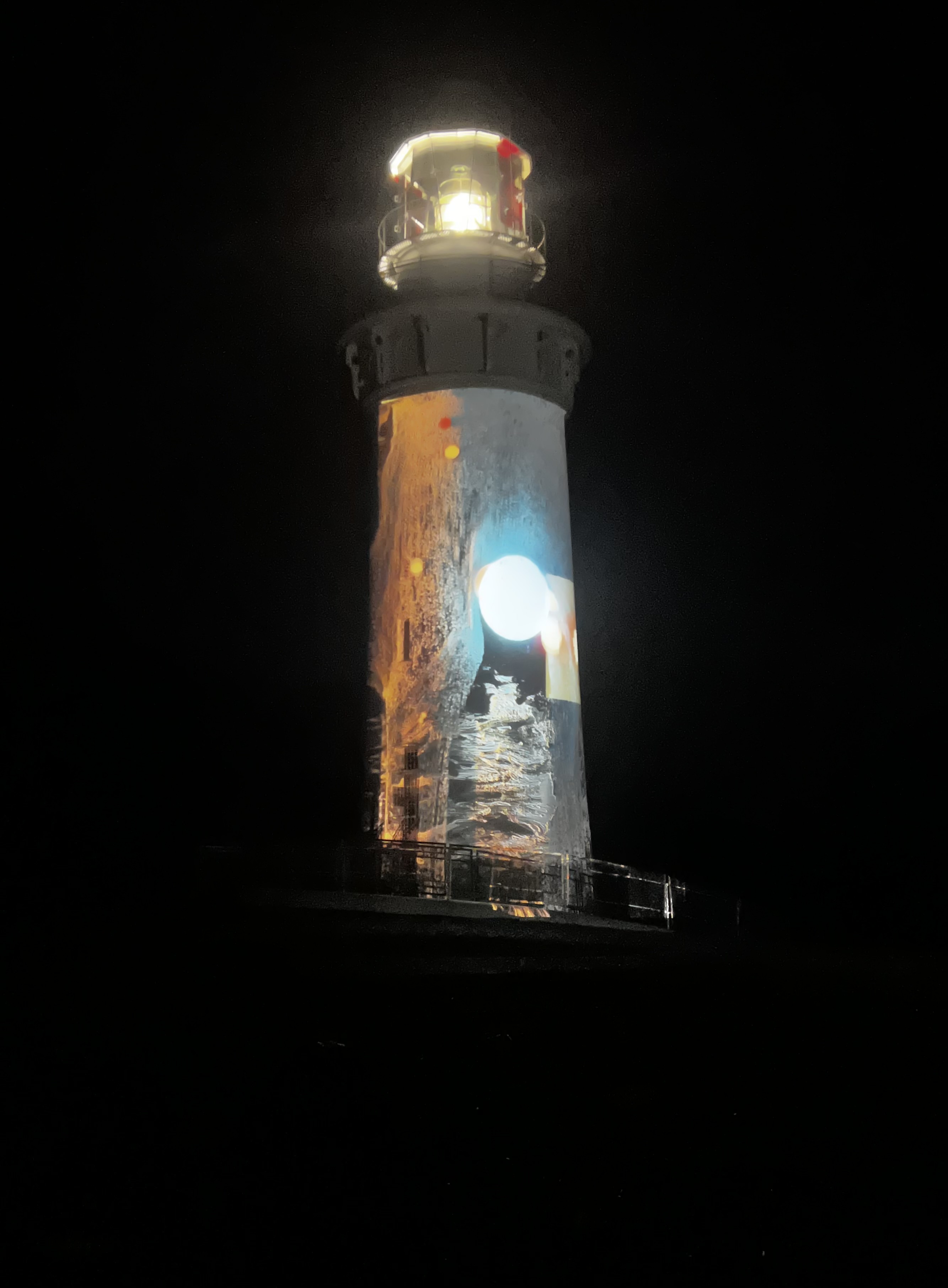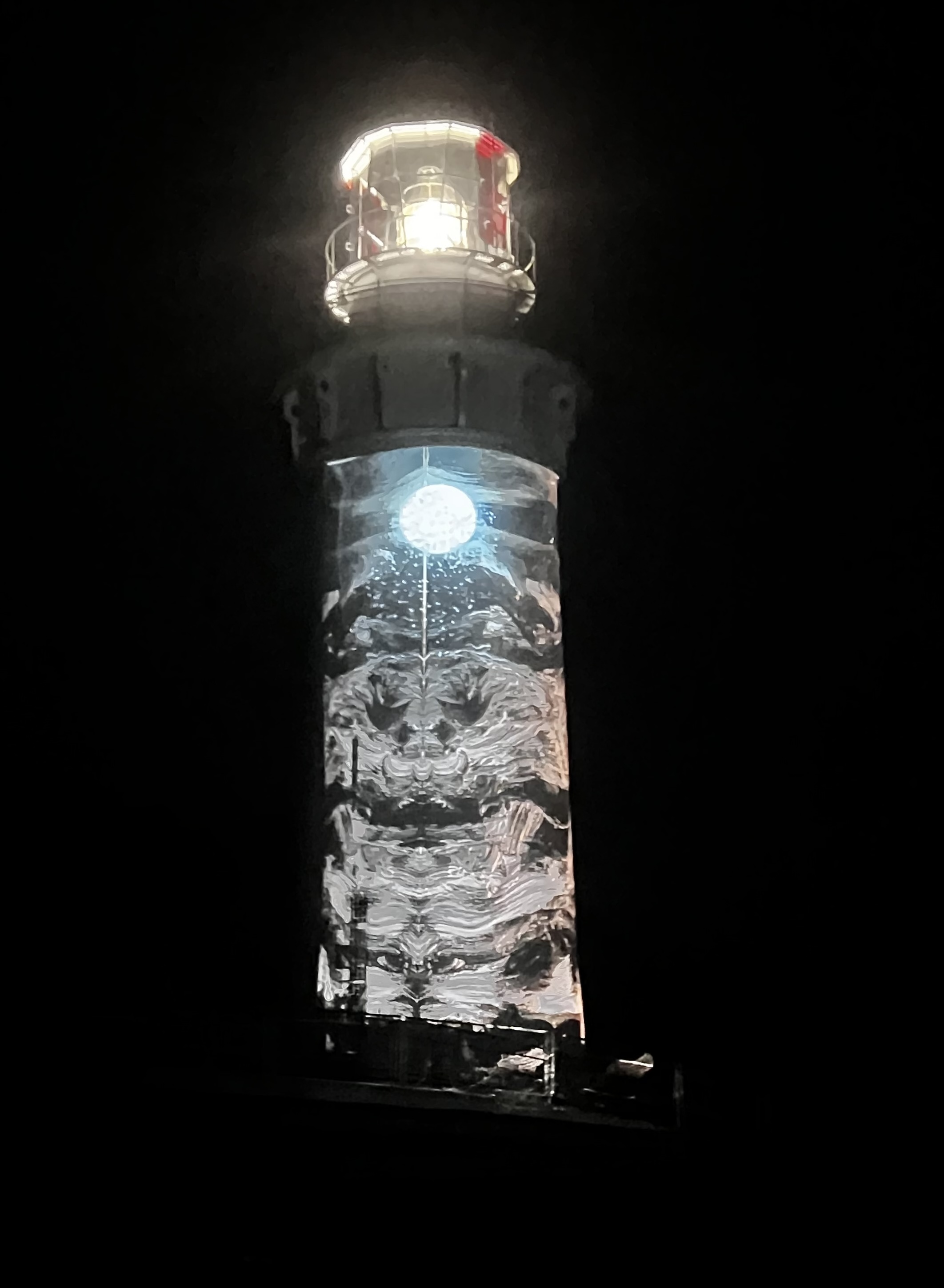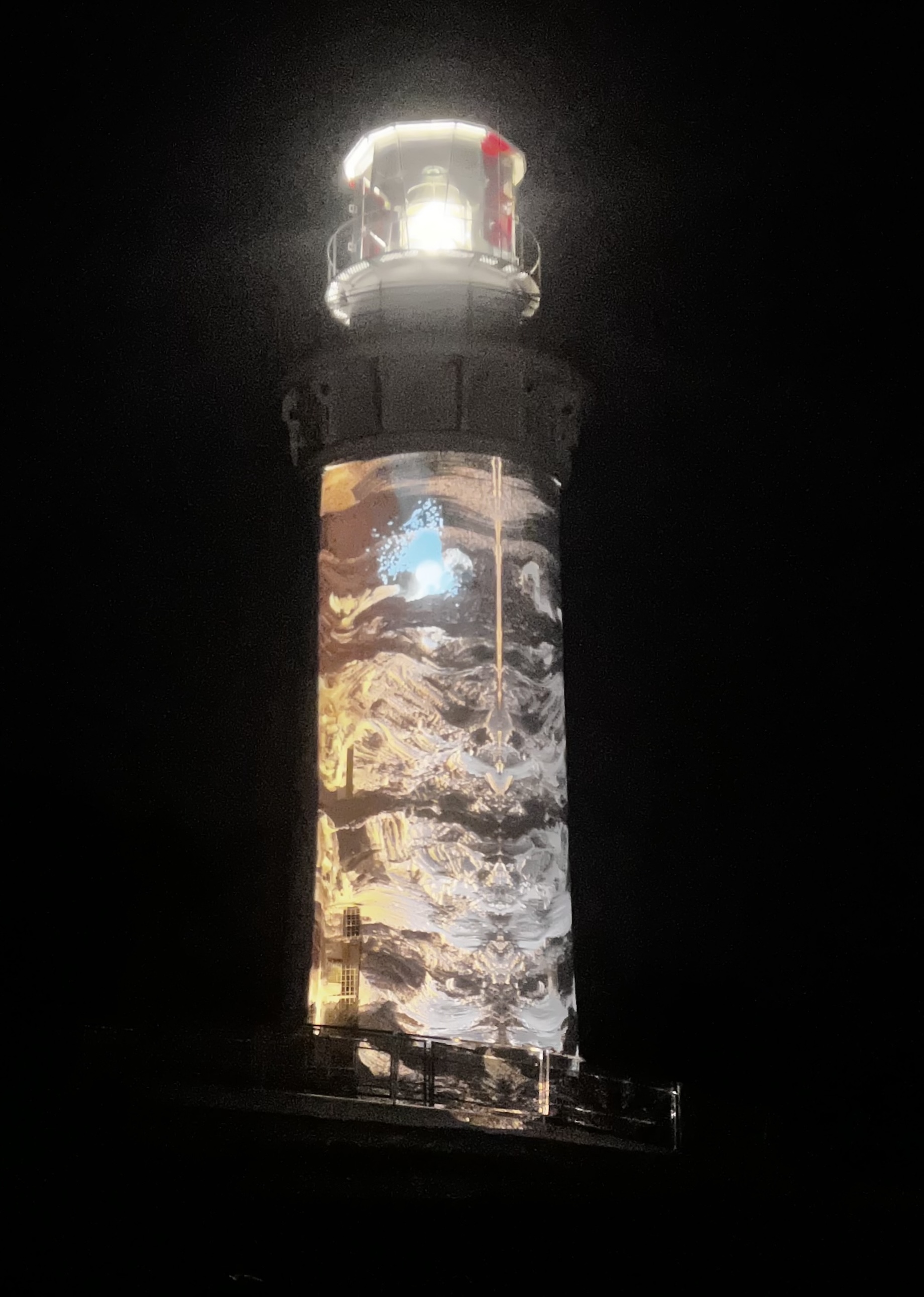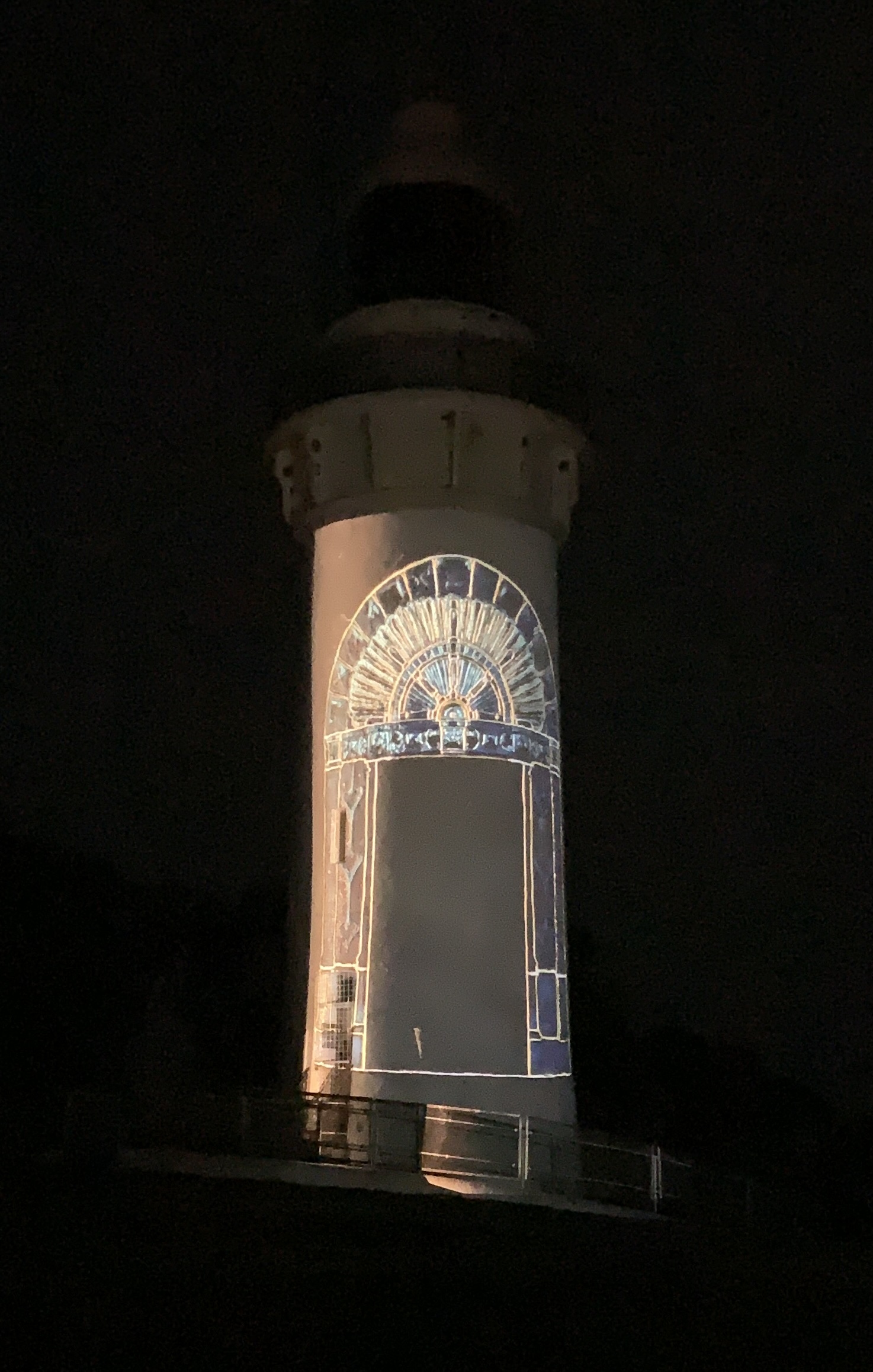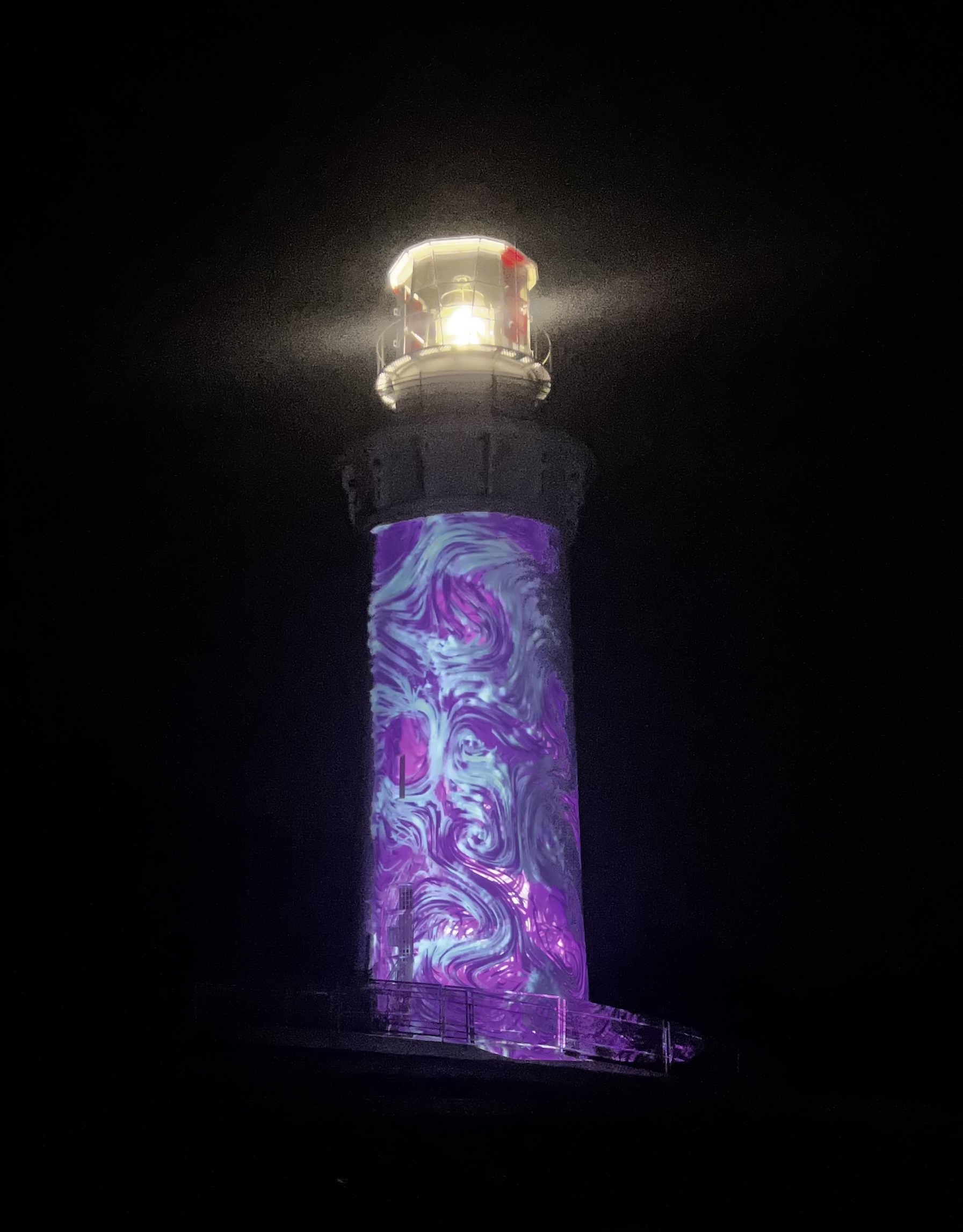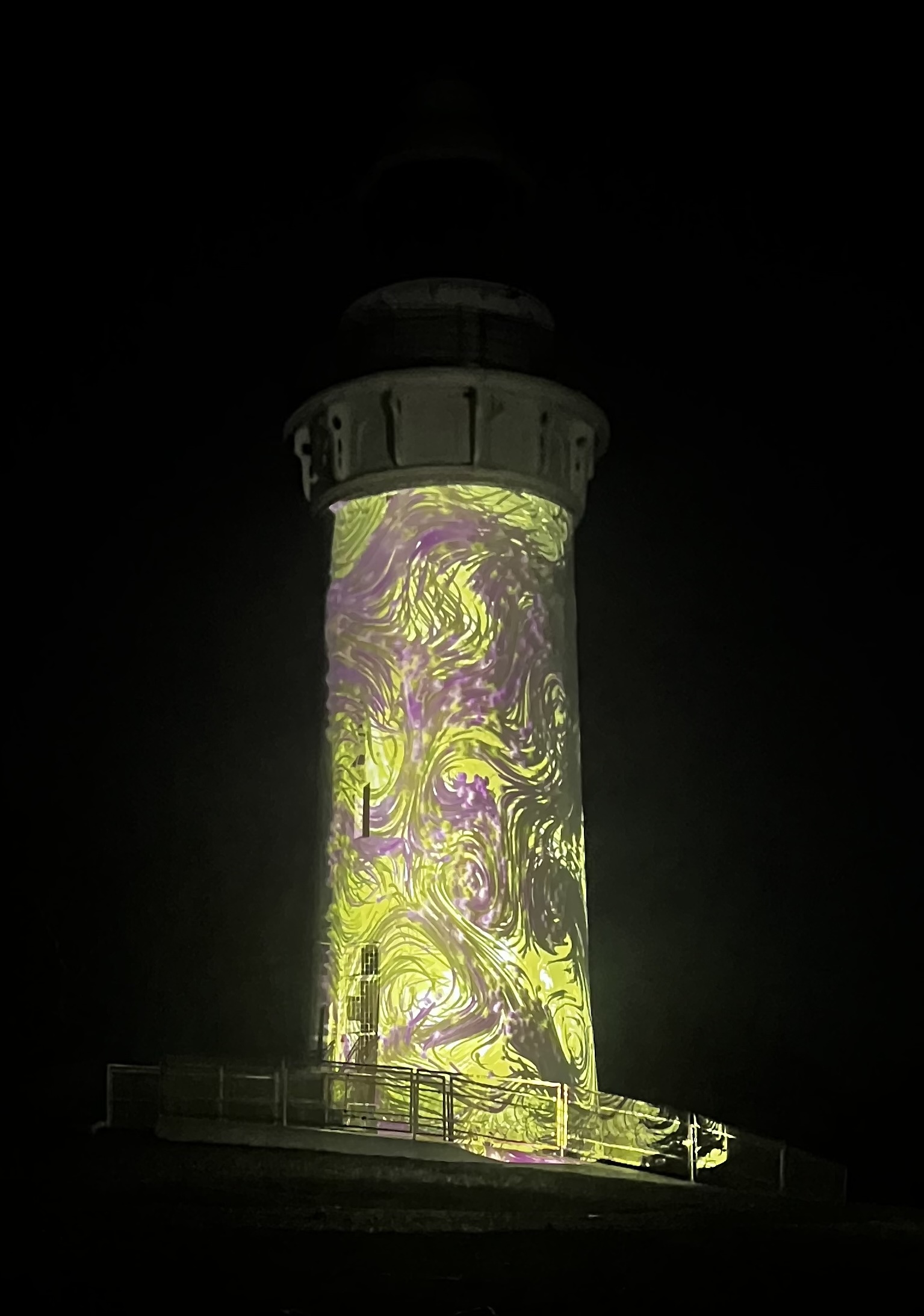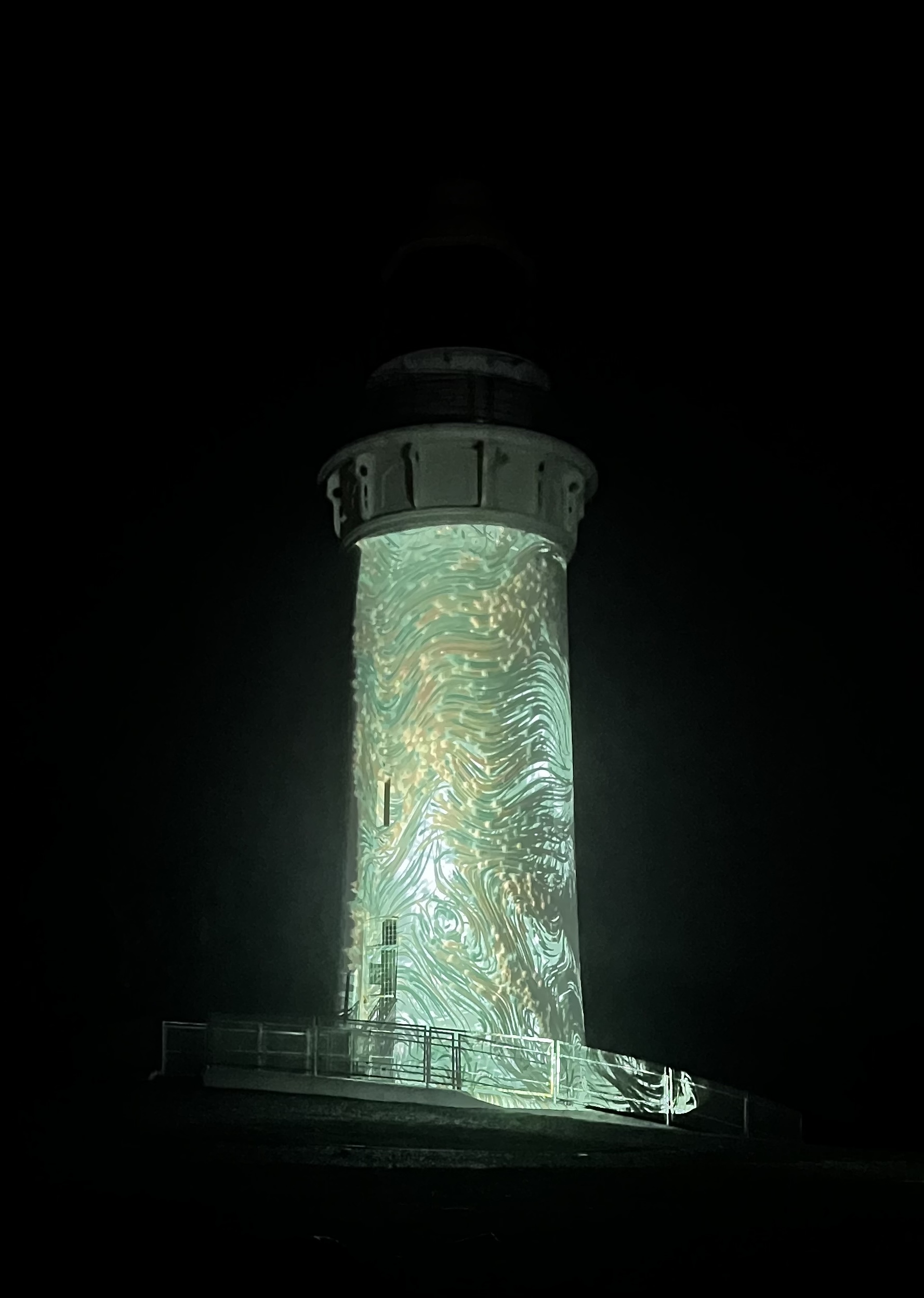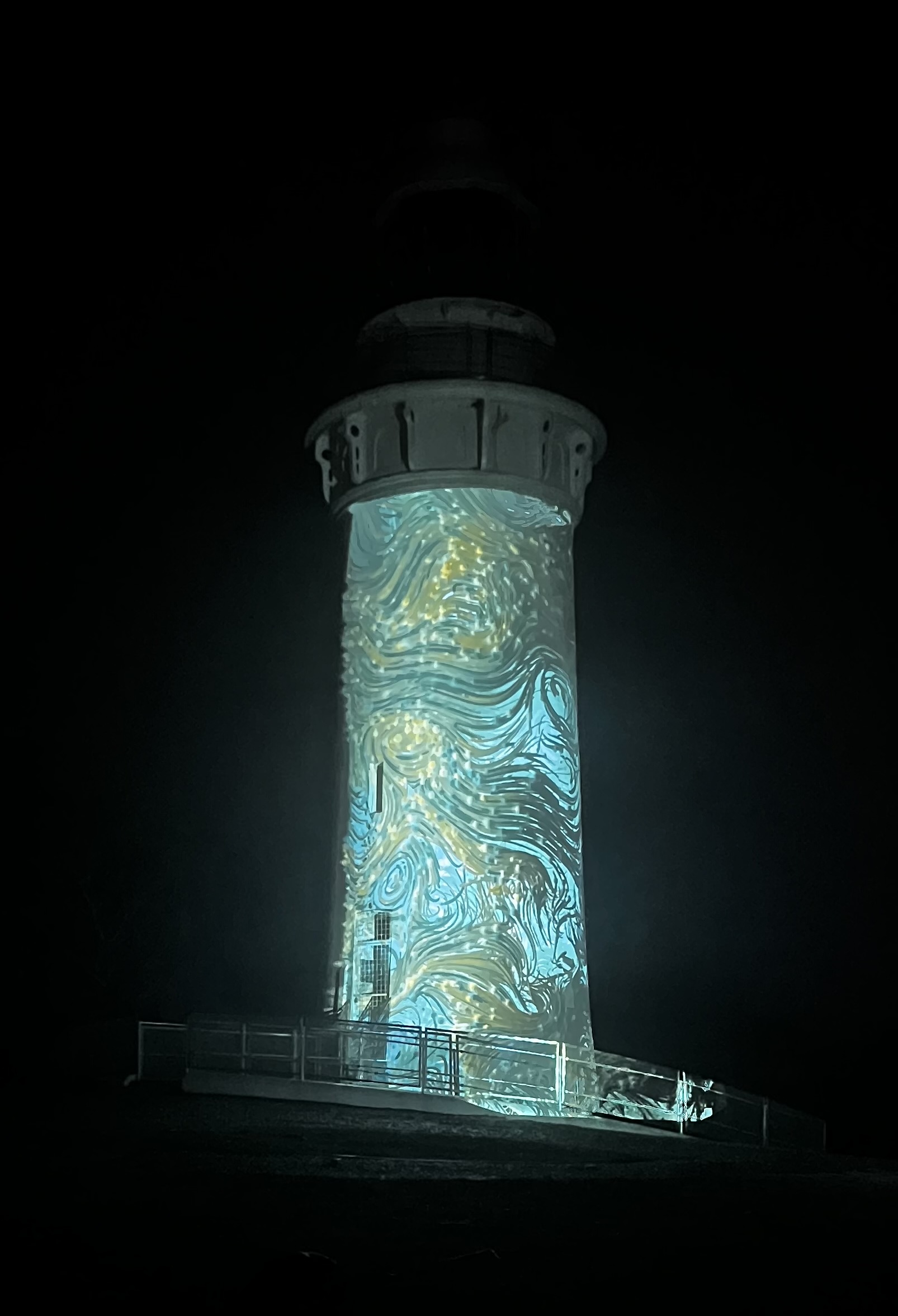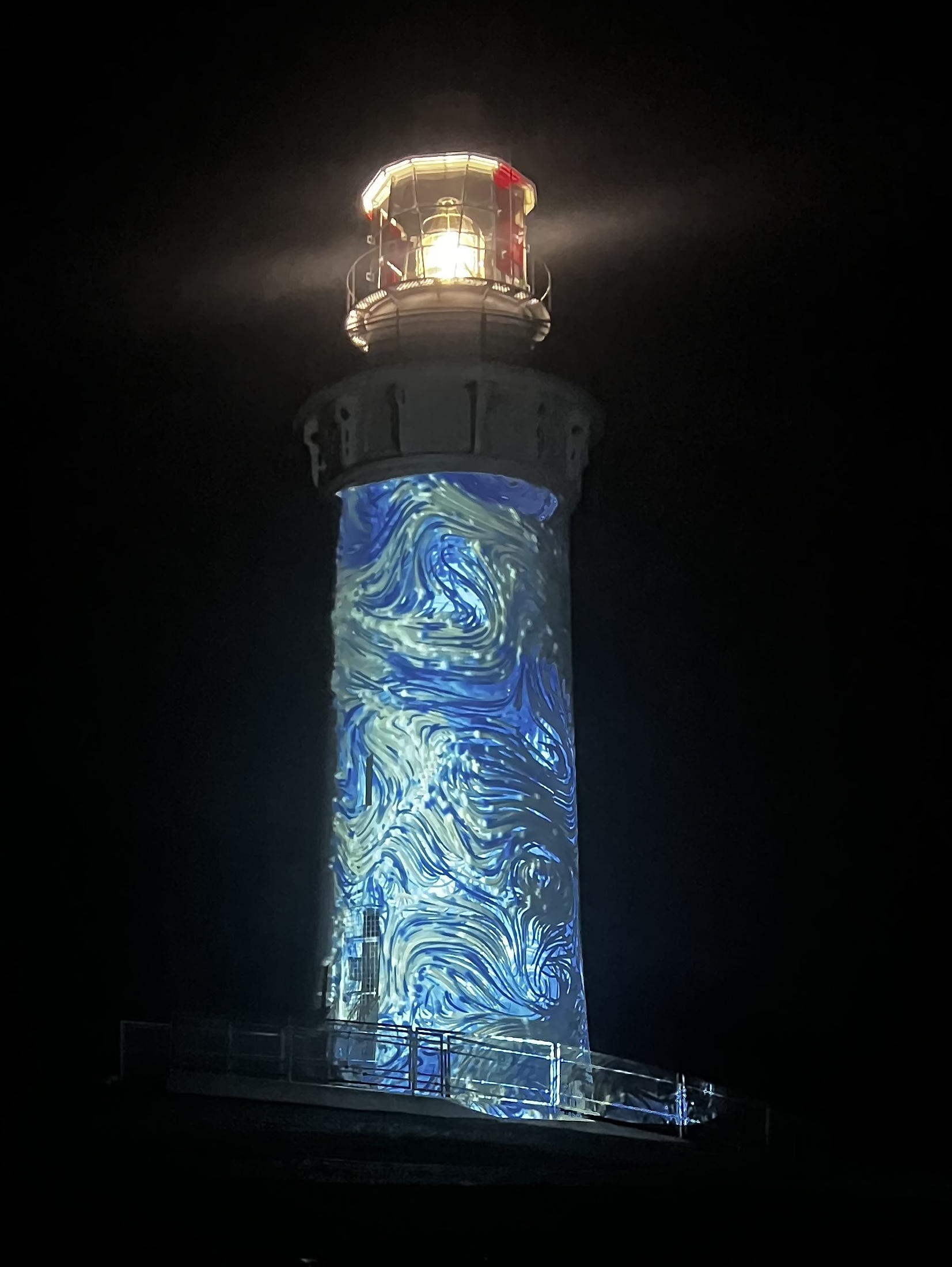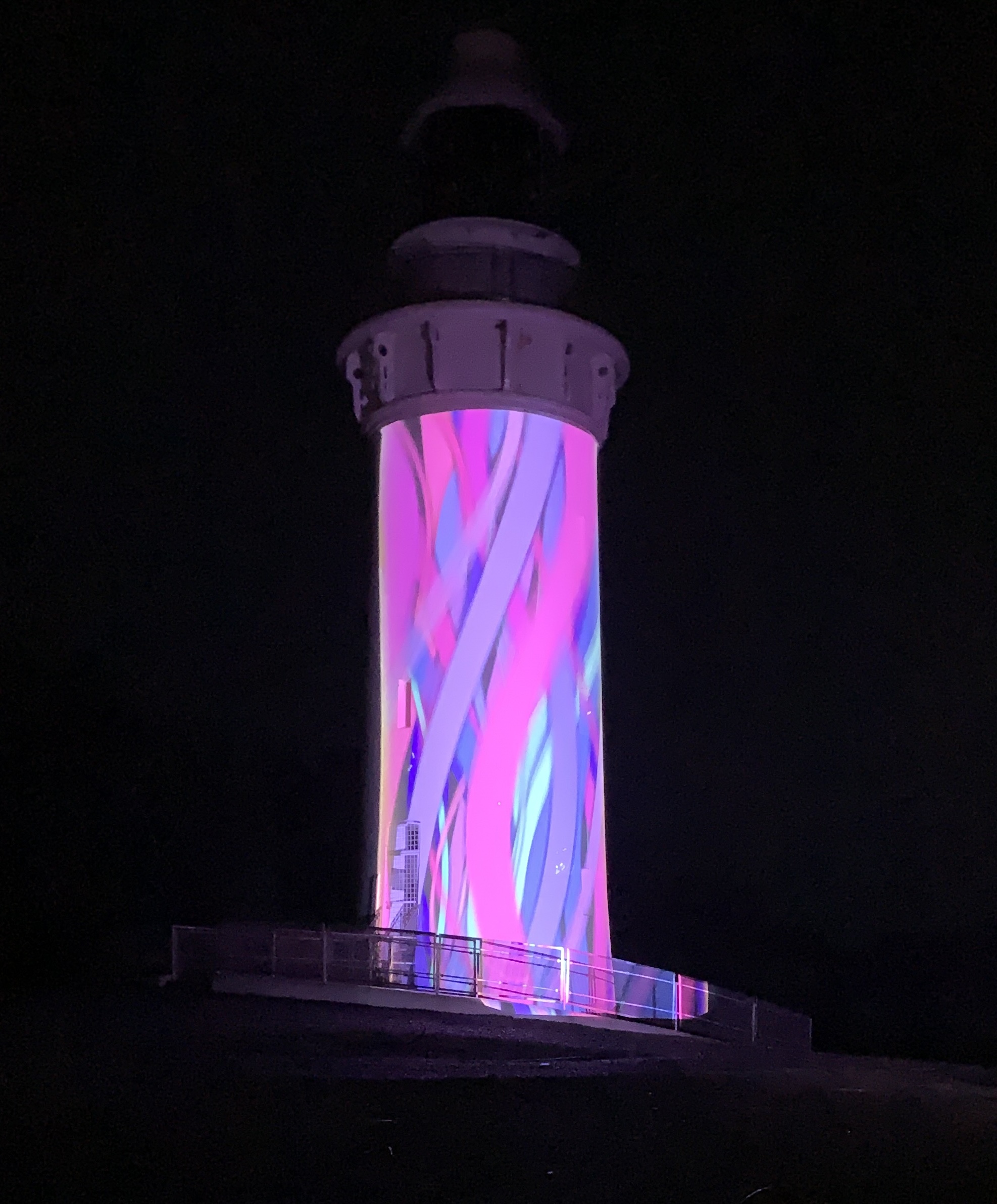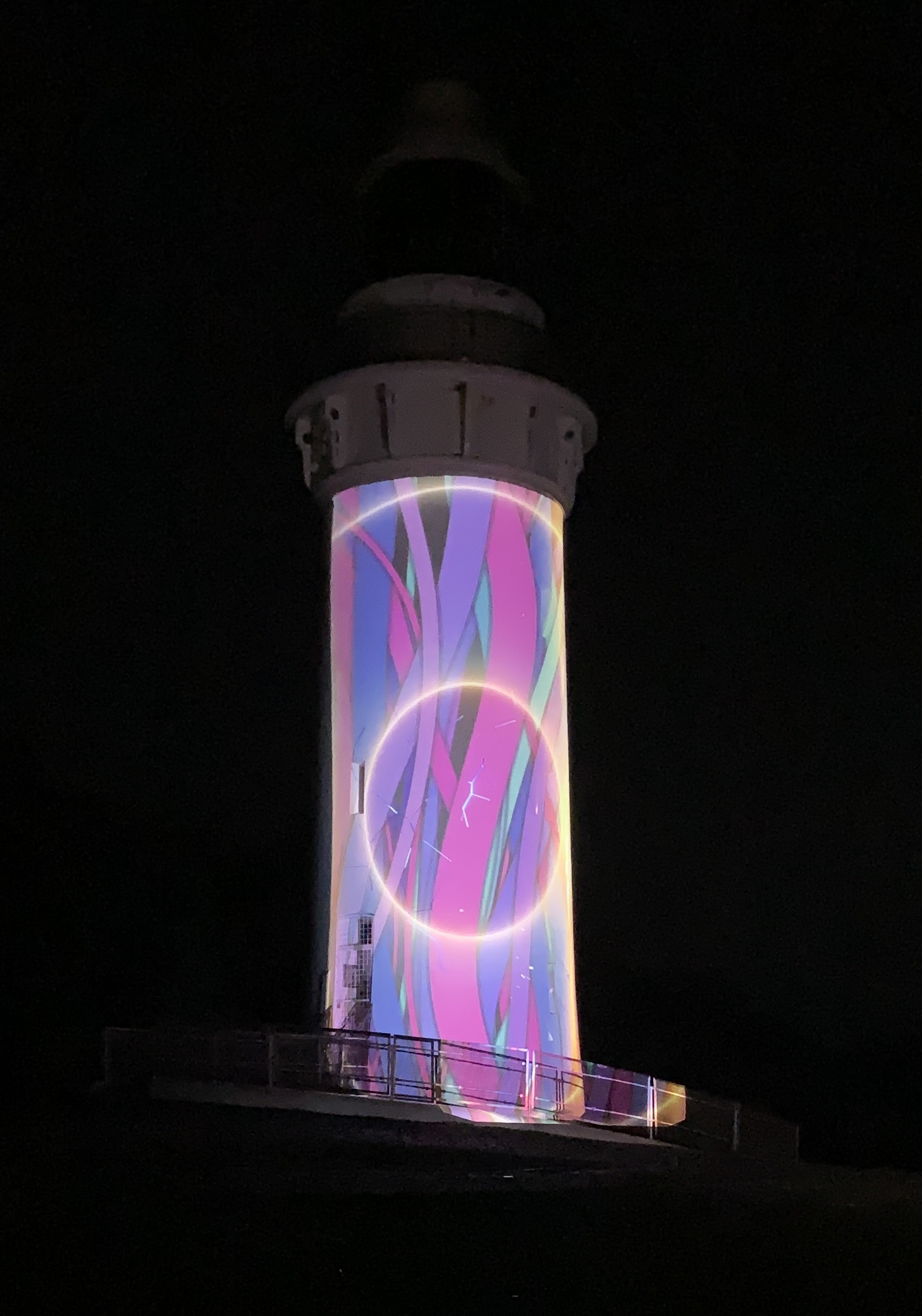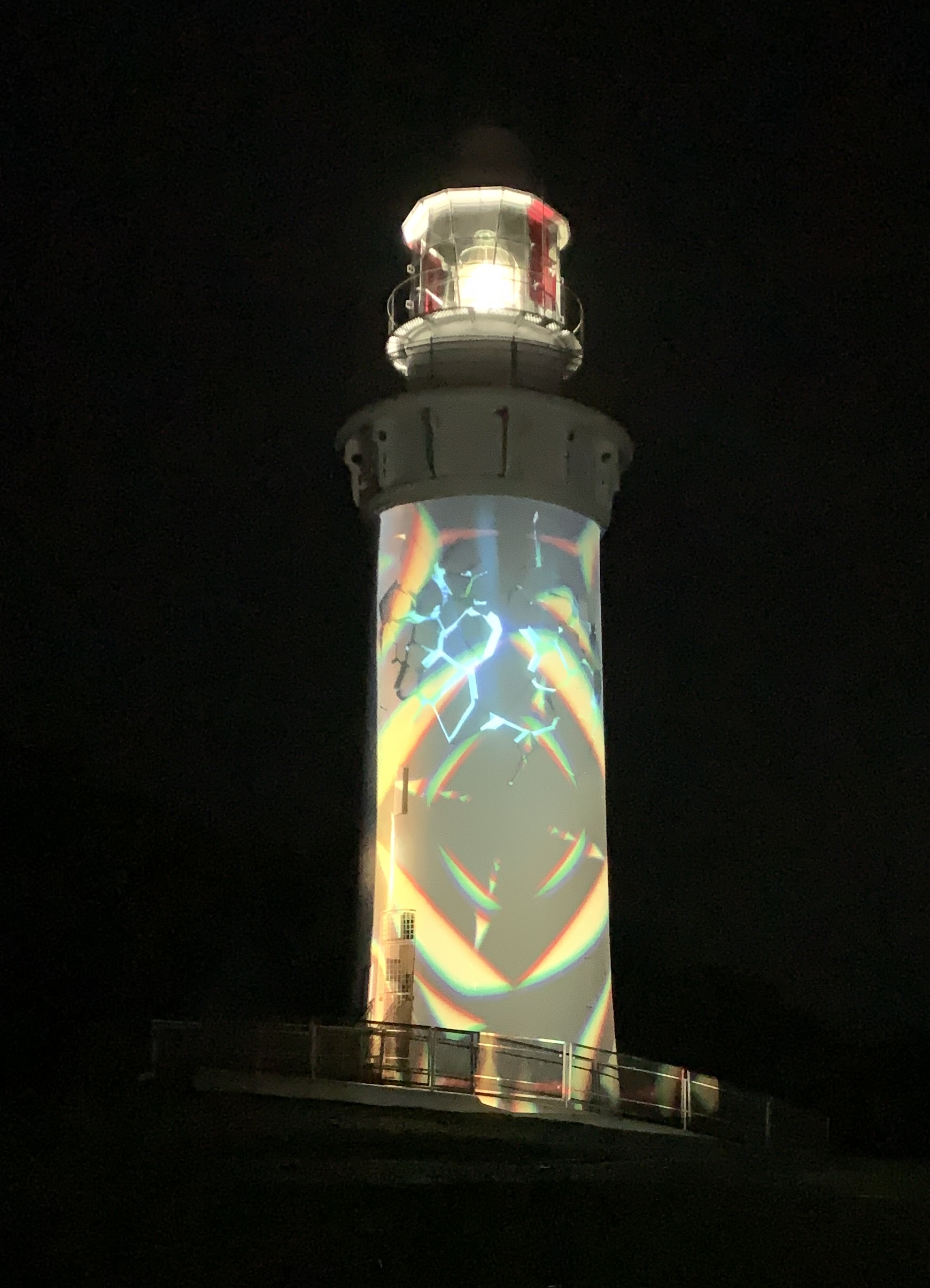
Atop Table Cape, an extinct volcano rising 180 metres above the ocean in northwest Tasmania, is a heritage listed lighthouse. Each weekend evening throughout the month of July, the structure becomes the centrepiece for a stunning visual and auditory light experience.
Moonlight Stories is one of a series of events, collectively known as Permission to Trespass, presented during our Tasmanian winter. Other events, offering exclusive access to private properties in the stunning Wynyard and Table Cape areas, include long table feasts, creative workshops and secret whisky tastings. As the volunteer contingent for one Saturday show, we arrived before dark to arrange a few hay bales with blankets for seating and prepared the headsets to hand out to the anticipated crowds. With three shows of ten minutes duration and twenty minutes between shows, there was no time to rest. Fortunately, we were able to enjoy the final session of the evening.
Inner Light is the work of Tasmanian artist, Alex Moss, who encourages discovery and challenges perceptions through projected light, sound design and interactive elements. We took a few photos, though they don’t really convey the true spectacle of the visual revelation on the 25 metre high tower, and of course, the narration is absent. At times, the wall of the lighthouse appeared to crack and fall away, revealing colourful images beneath. (Click on the images to see enlarged version).
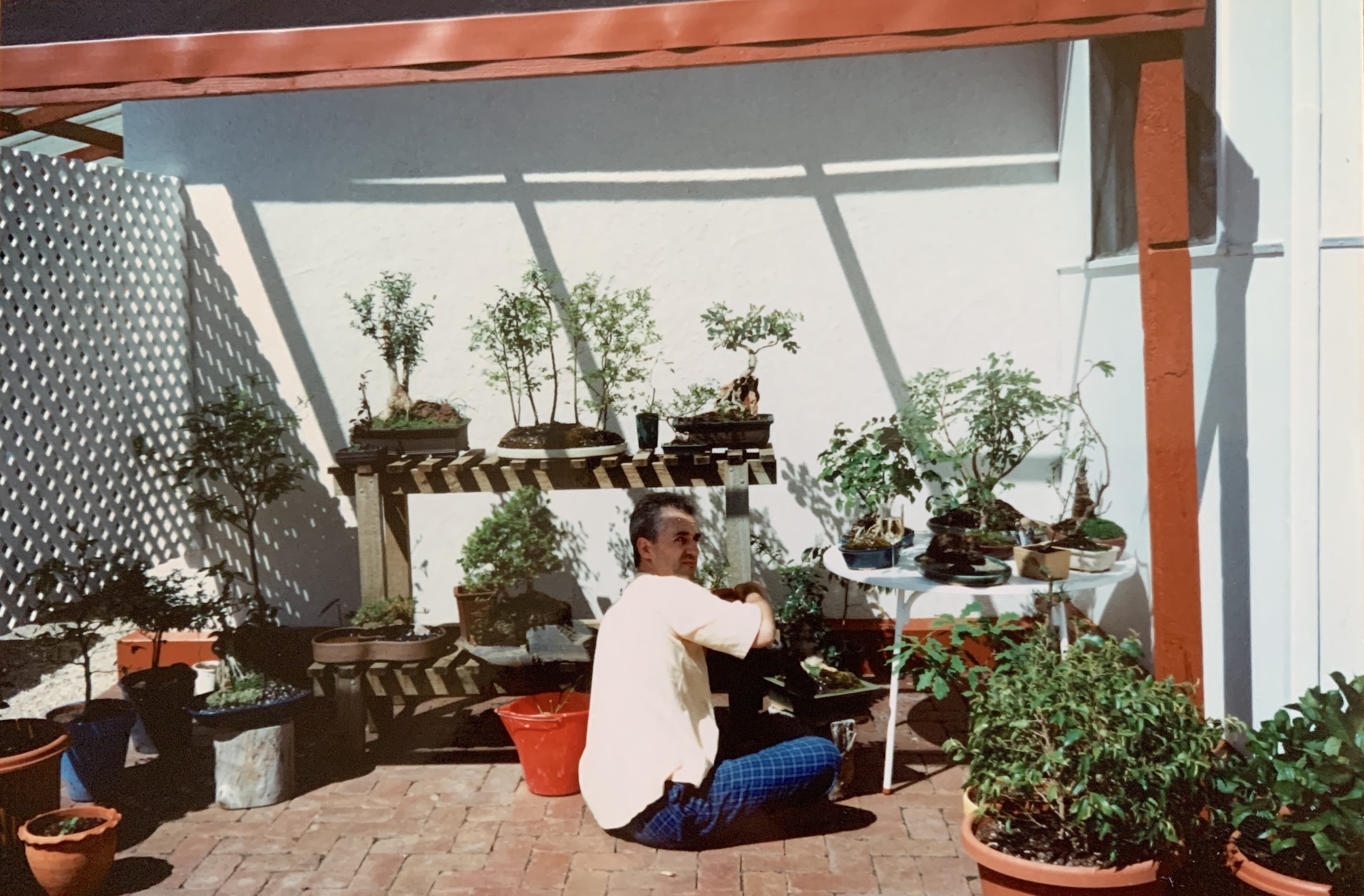
Michael developed a fascination with all things Japanese in his mid twenties and so began his interest in the art of bonsai. When we met, fifteen years later, he came as a package deal and his beloved bonsai found a home in a sunny spot under the pergola of our suburban backyard.
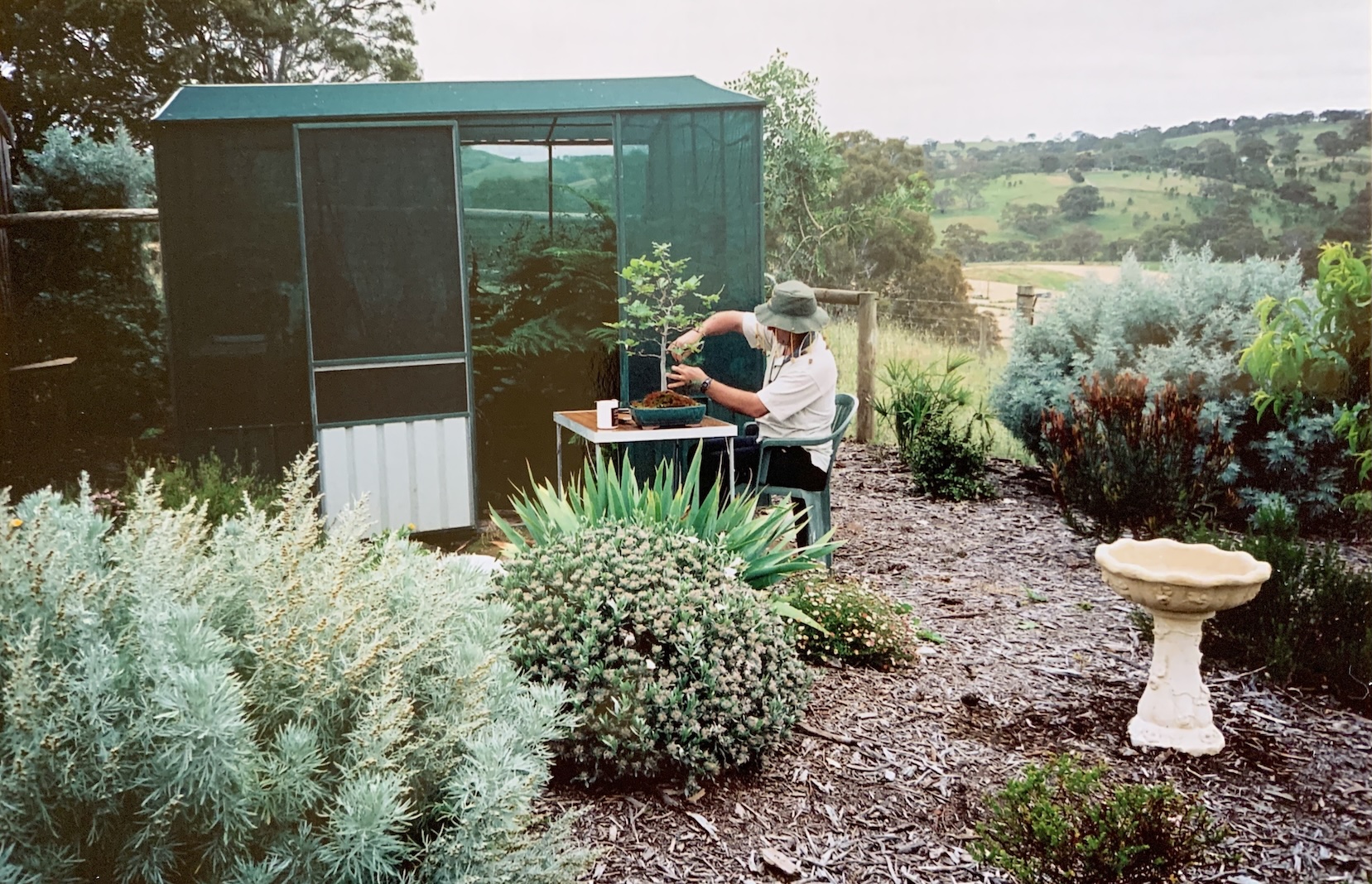
Five years on, we moved to a property in the Adelaide Hills and one of the first items we added to the garden was a shade house to protect the bonsai from unpredictable weather. (It did become airborne in one particular storm but, fortunately, no bonsai were harmed. We then concreted the corner posts into the ground.)
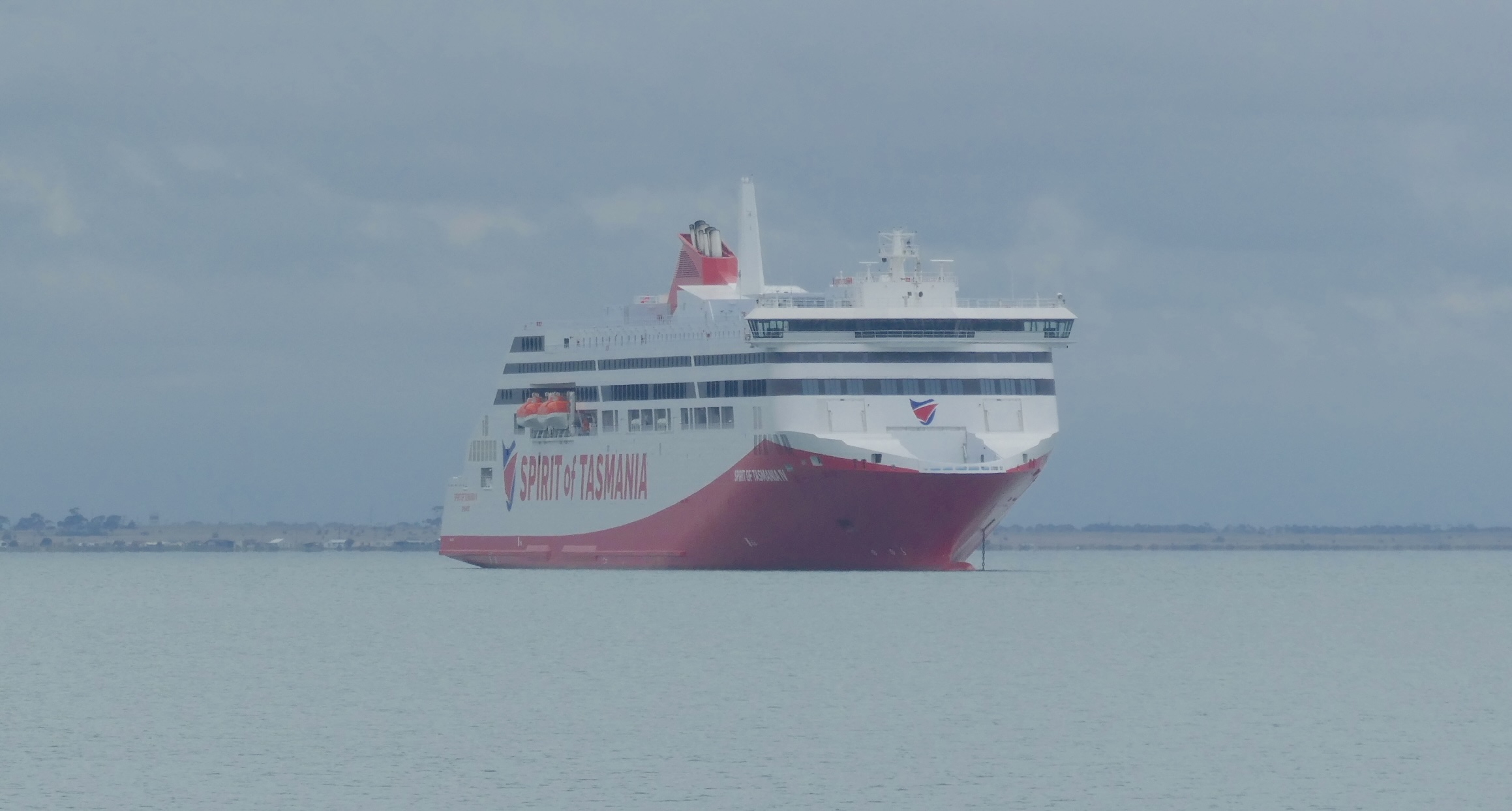
Fast forward another seven years and we made the bold decision to relocate to Tasmania. By this stage, there were over forty bonsai to consider in varying stages of evolution. There were strict biosecurity rules for entry into Tasmania, any potted plants had to be fumigated by a registered authority and sealed until arrival across the creek. Sadly, all but four were sold or given away and the remaining plants travelled with us on the Spirit of Tasmania to their new abode. More specimens have been procured and nurtured since our arrival but they have been somewhat “out of sight” in various spots around the garden.
After years of planning and procrastinating, the new bonsai stand was finally created last winter.
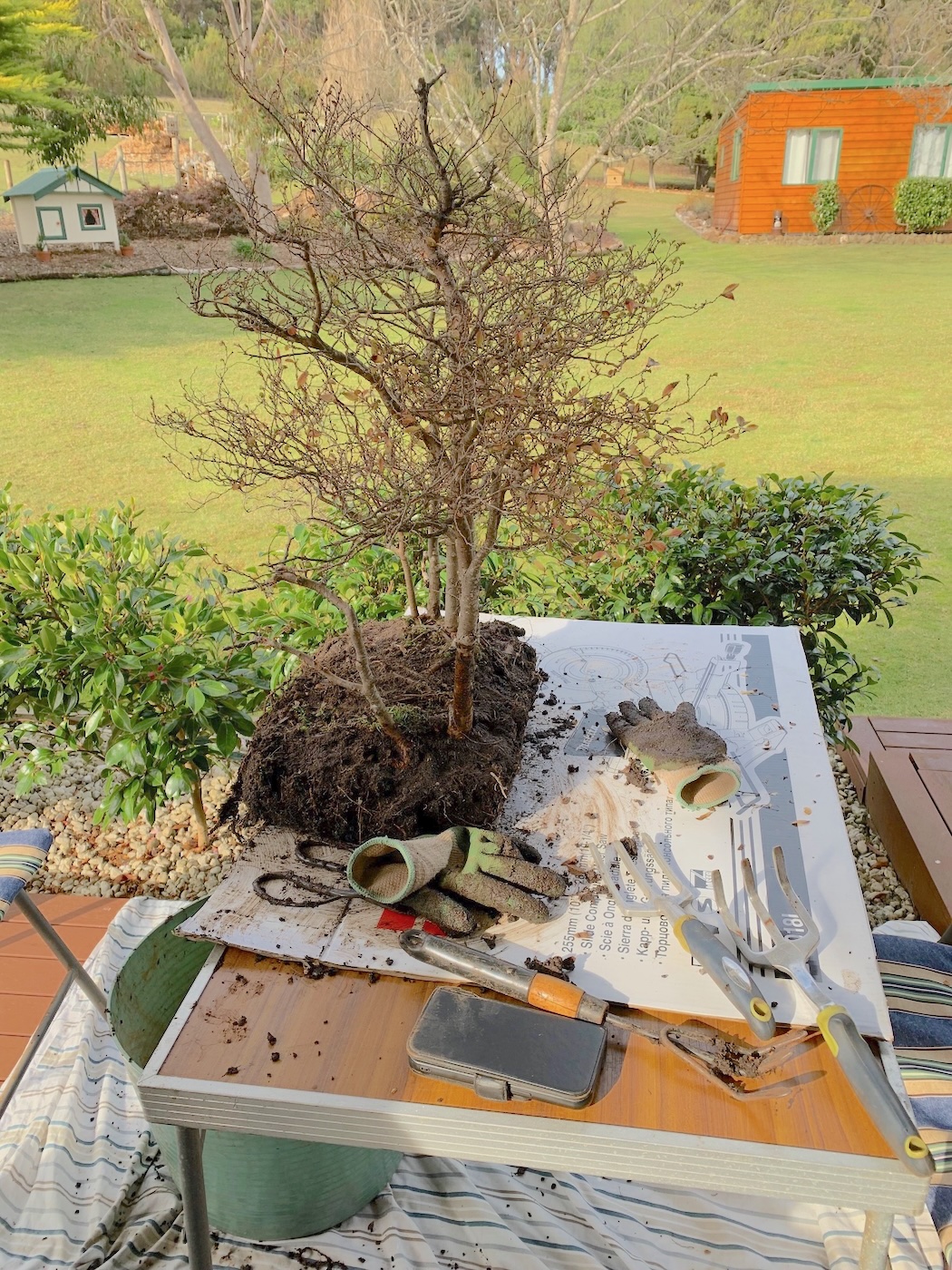
The little trees received some long overdue attention with pruning, root trimming and re-potting.
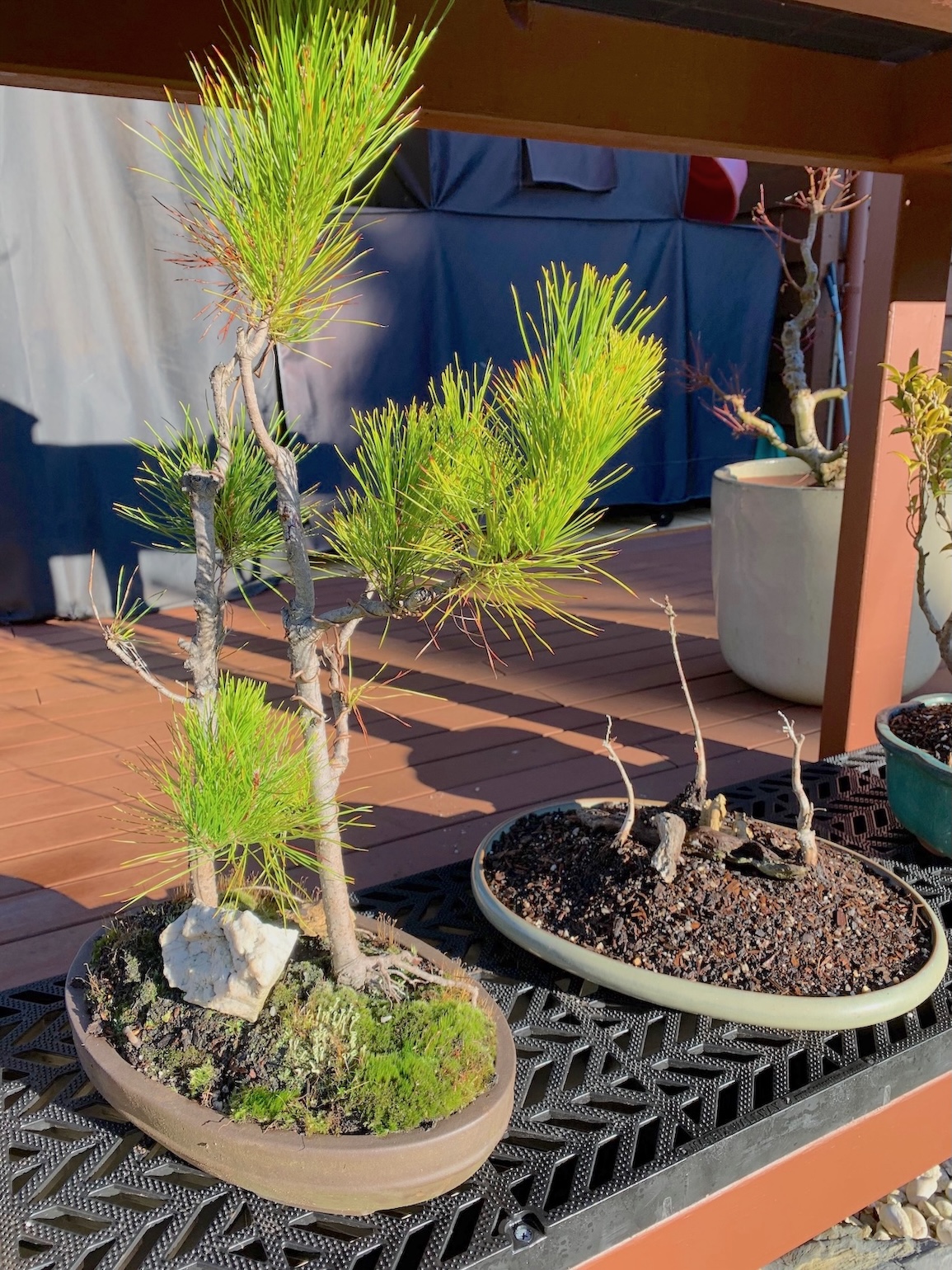
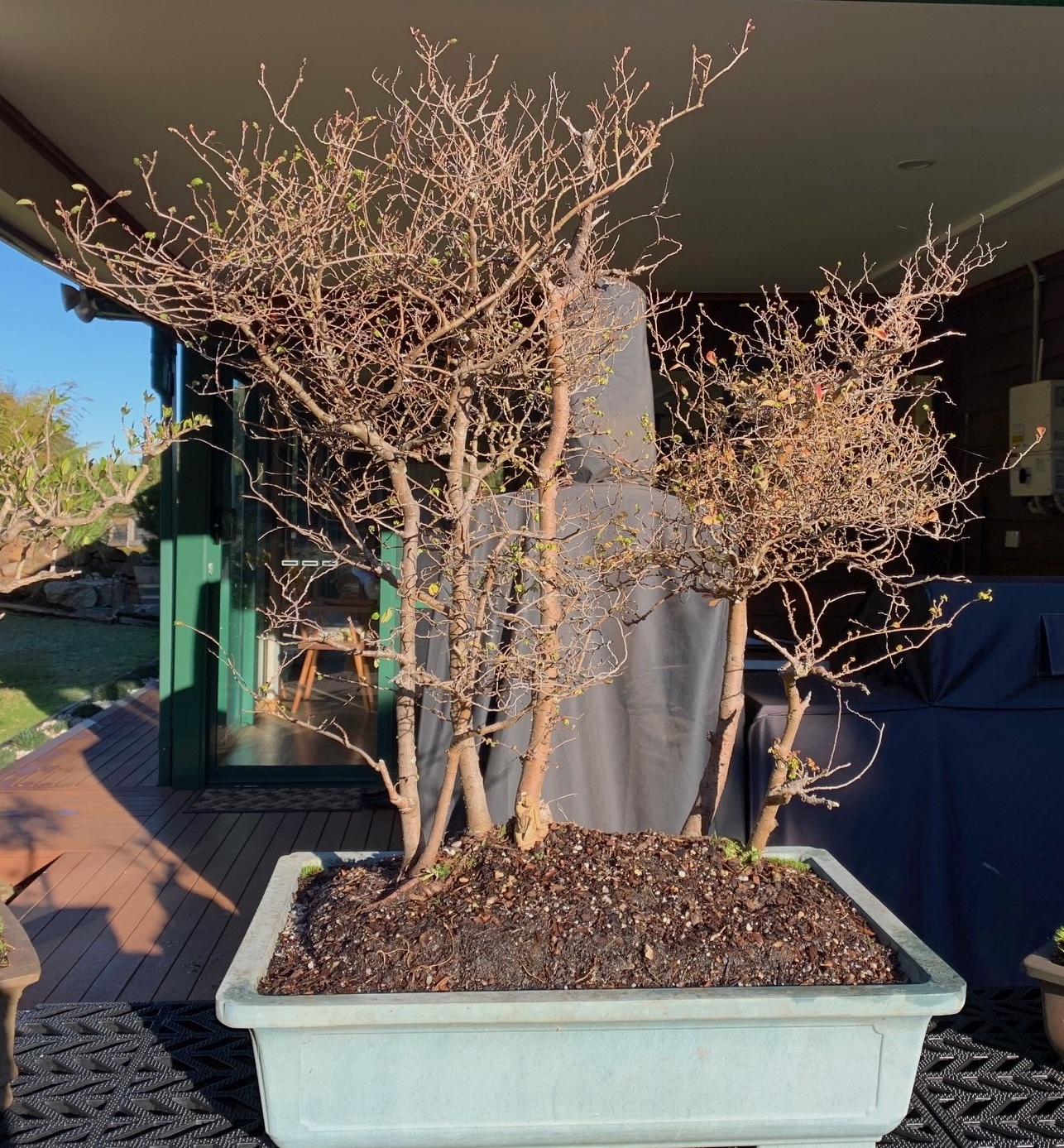
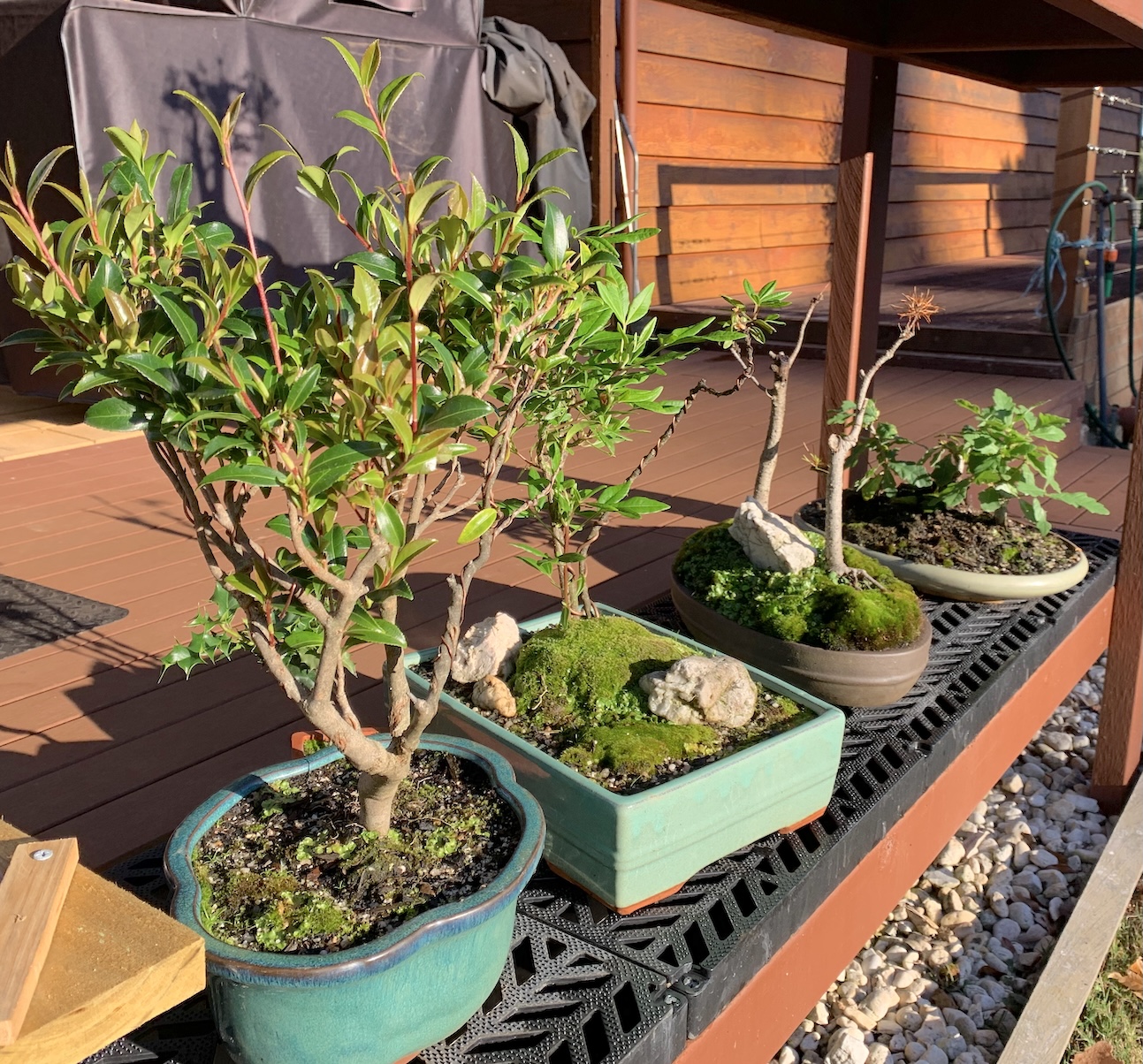
Let me introduce you to the collection. The radiata pine was given to Michael by someone who no longer wanted to continue with bonsai, and the three sticks on the right are English oaks that had self-seeded on a friends property at Table Cape.
Spring brought verdancy to the oaks but, regrettably, the radiata failed to thrive.
The origin of this liquidambar is uncertain (meaning forgotten) but, despite resembling a twig in winter, it perked up once the warmer weather arrived.
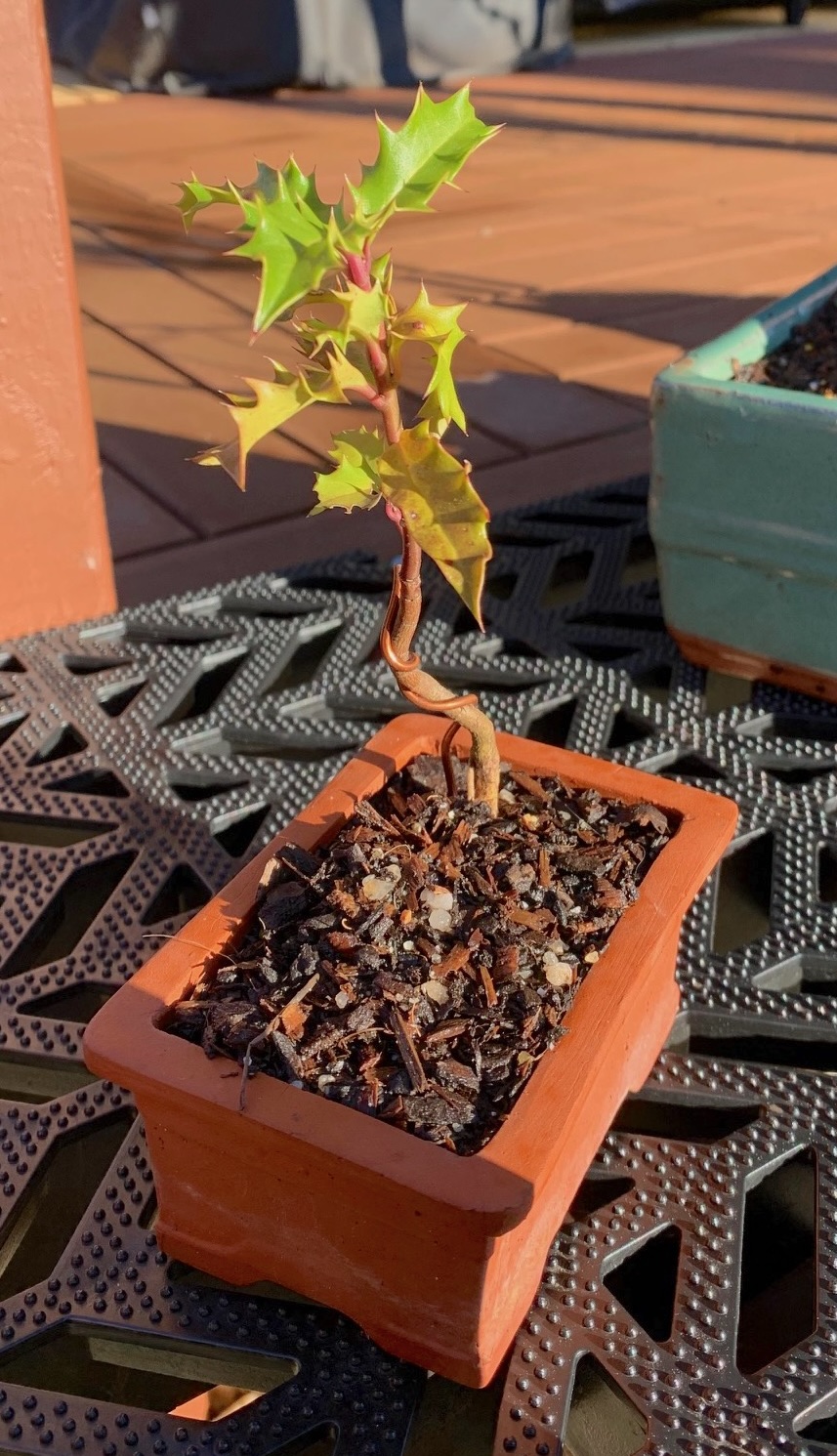
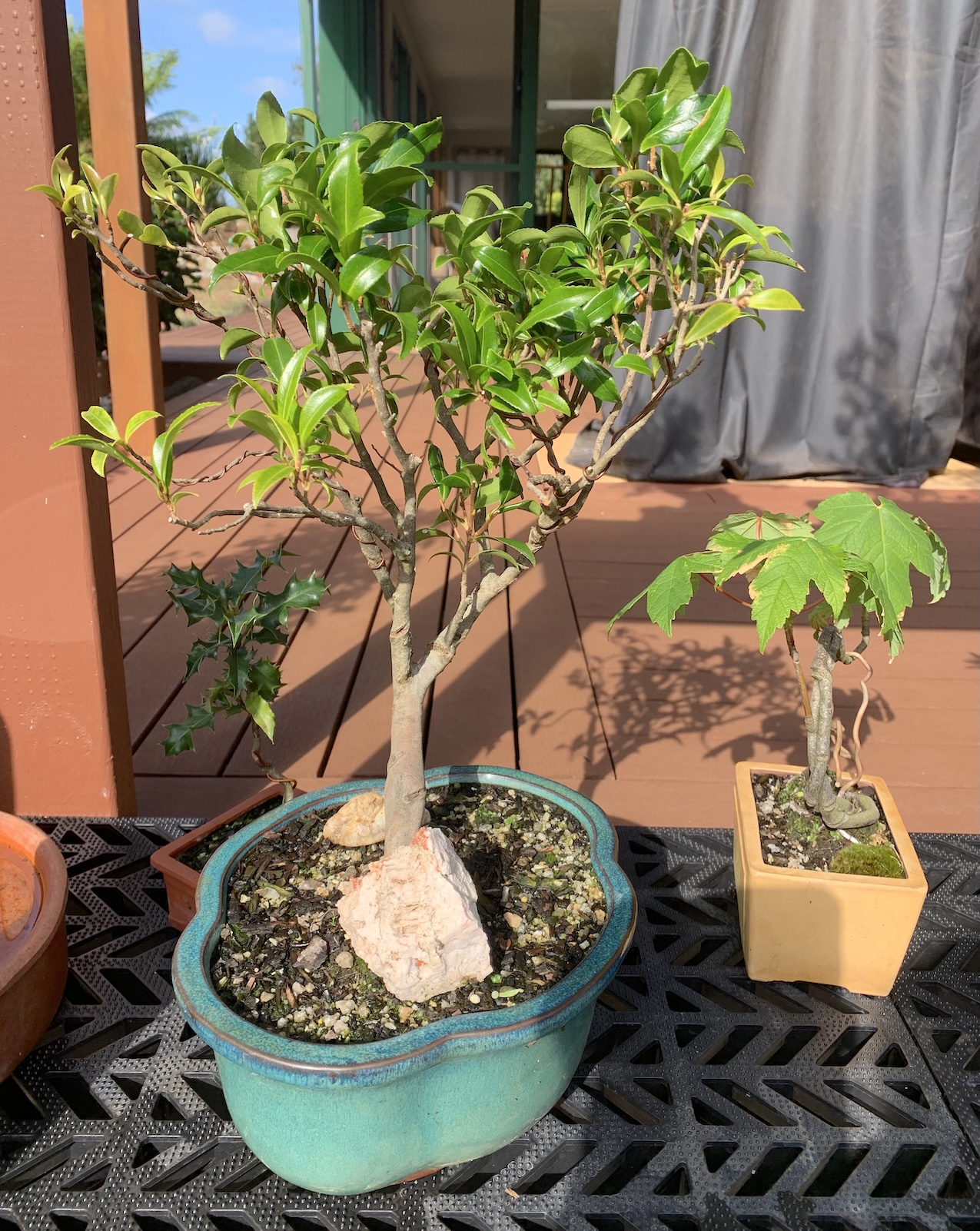
We have a huge holly tree in the garden from which we occasionally find young saplings, the perfect source to experiment with bonsai. So far, this one is a success.
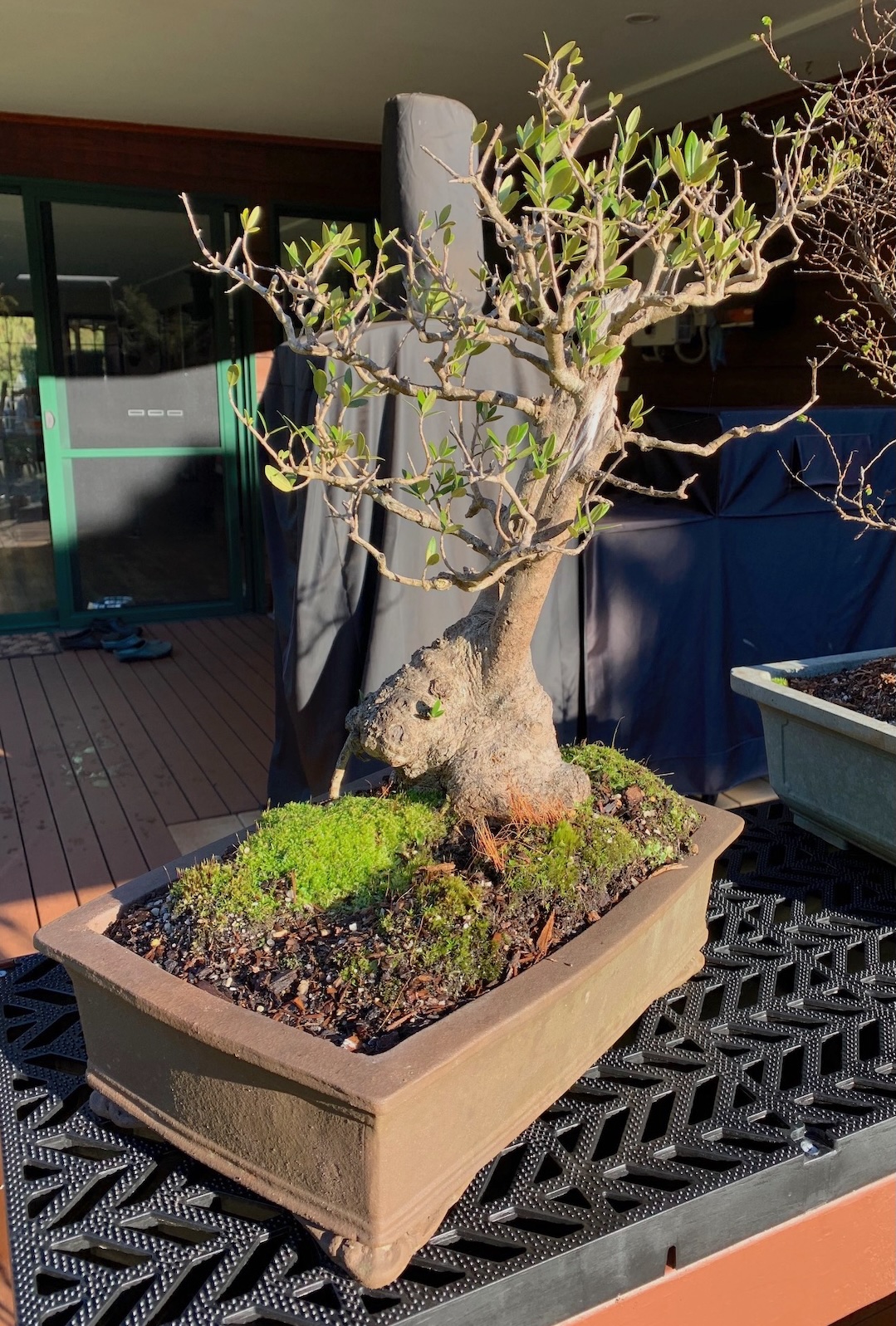
I bought Michael this olive as a gift nearly thirty years ago. He re-trained it and it is one of the chosen few who came from South Australia with us.
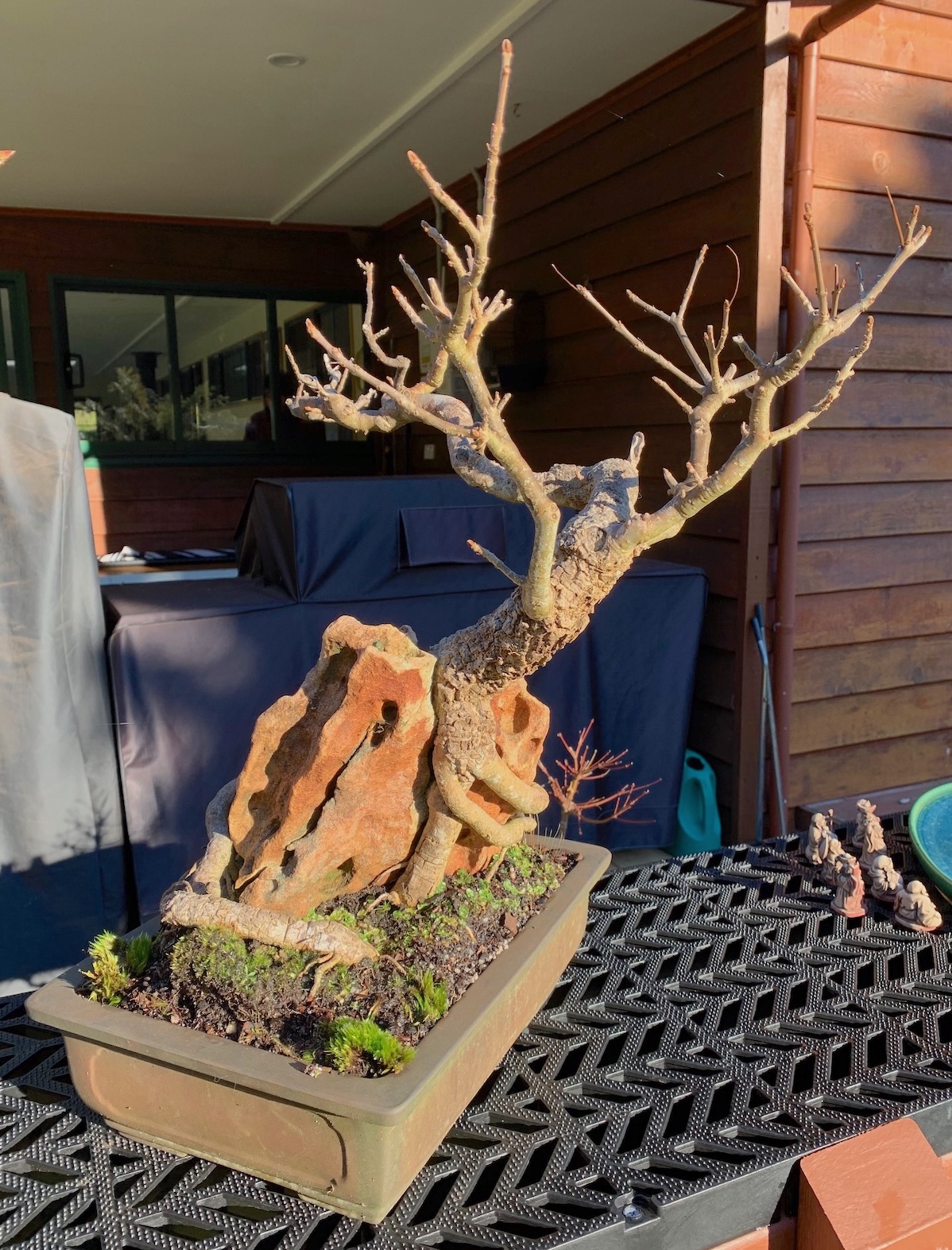
The ash tree is quite spectacular. Liberated from between two pavers on a suburban footpath in the mid 80s, Michael trained the roots around a rock before planting in a deep pot. The roots were then gradually exposed and this is the result.
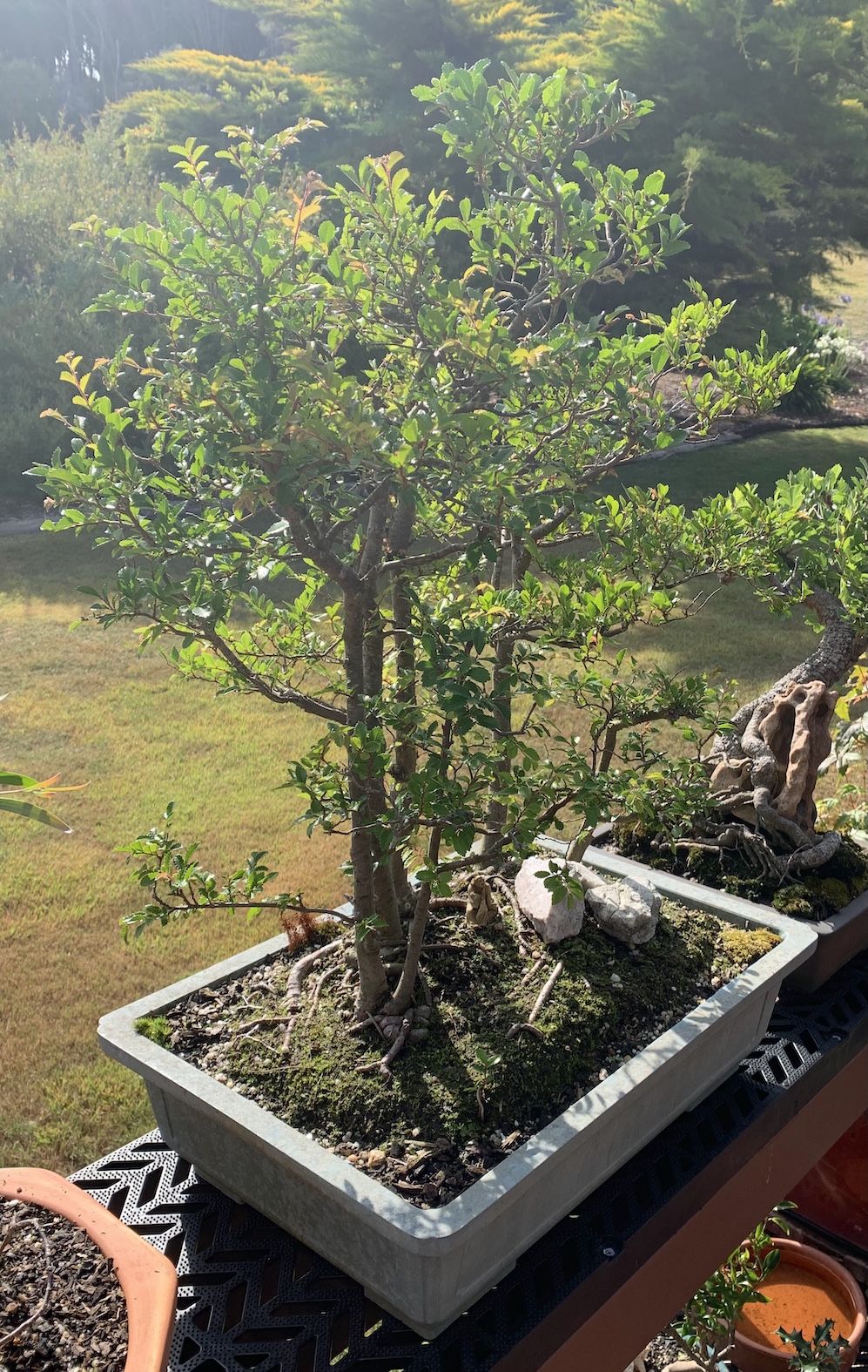
The oldest exhibit in the collection is a copse of English elms. One of the original seven died in transport to Tasmania but there are two new saplings growing in the grove and one will be nurtured to reinstate the preferred uneven number.
The dwarf camellia has done well and produced a beautiful pink flower last year.
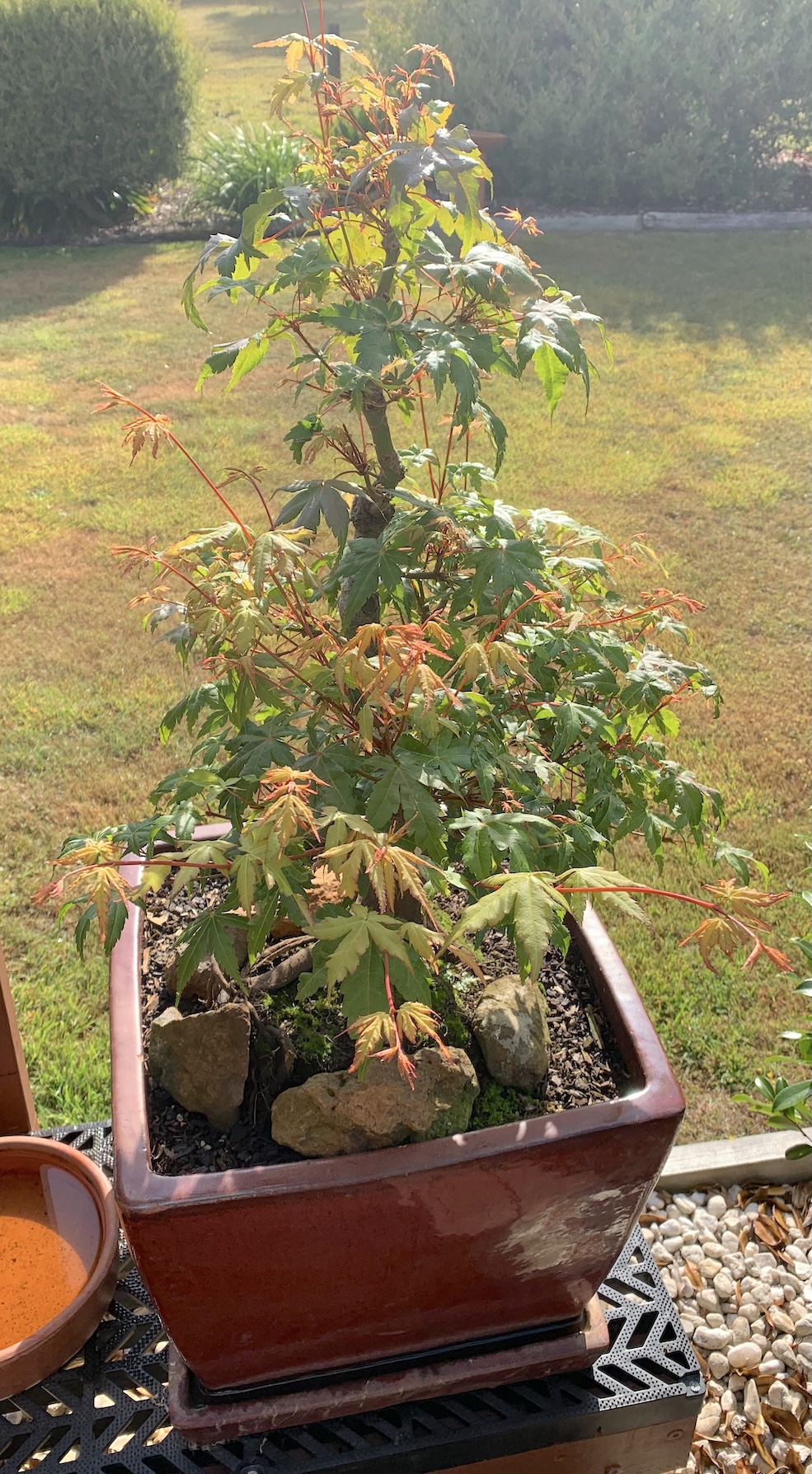
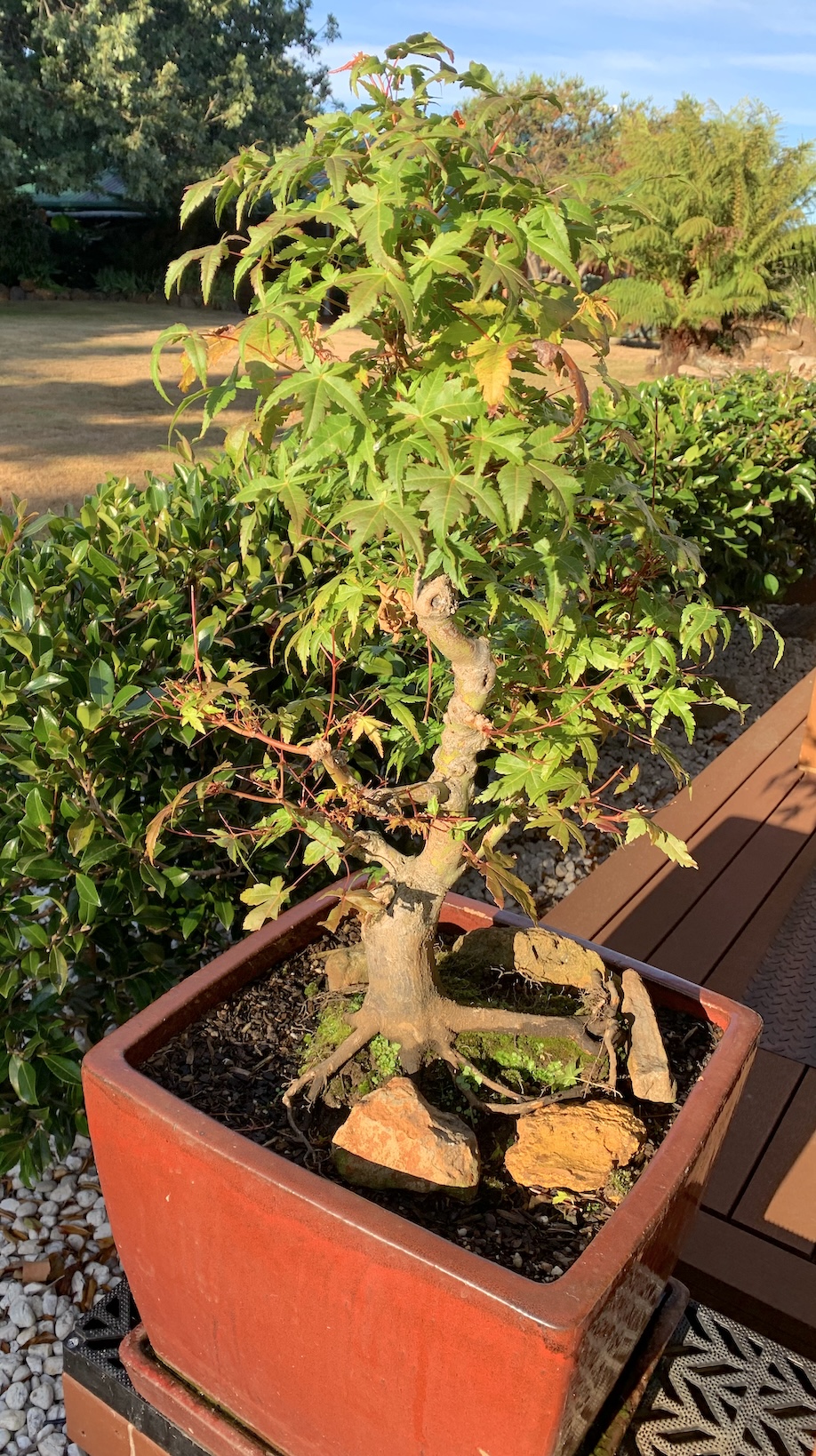
Perhaps the hardiest of them all is the Japanese maple. Firstly created as a bonsai, it was then planted in the garden to enable it to reach its full potential. That wasn’t to be when the neighbours horses reached over the fence and ate most of it. Reclaiming it into a pot seemed the kindest thing to do, now we just need to find a way to stop the nocturnal wildlife having a nibble.
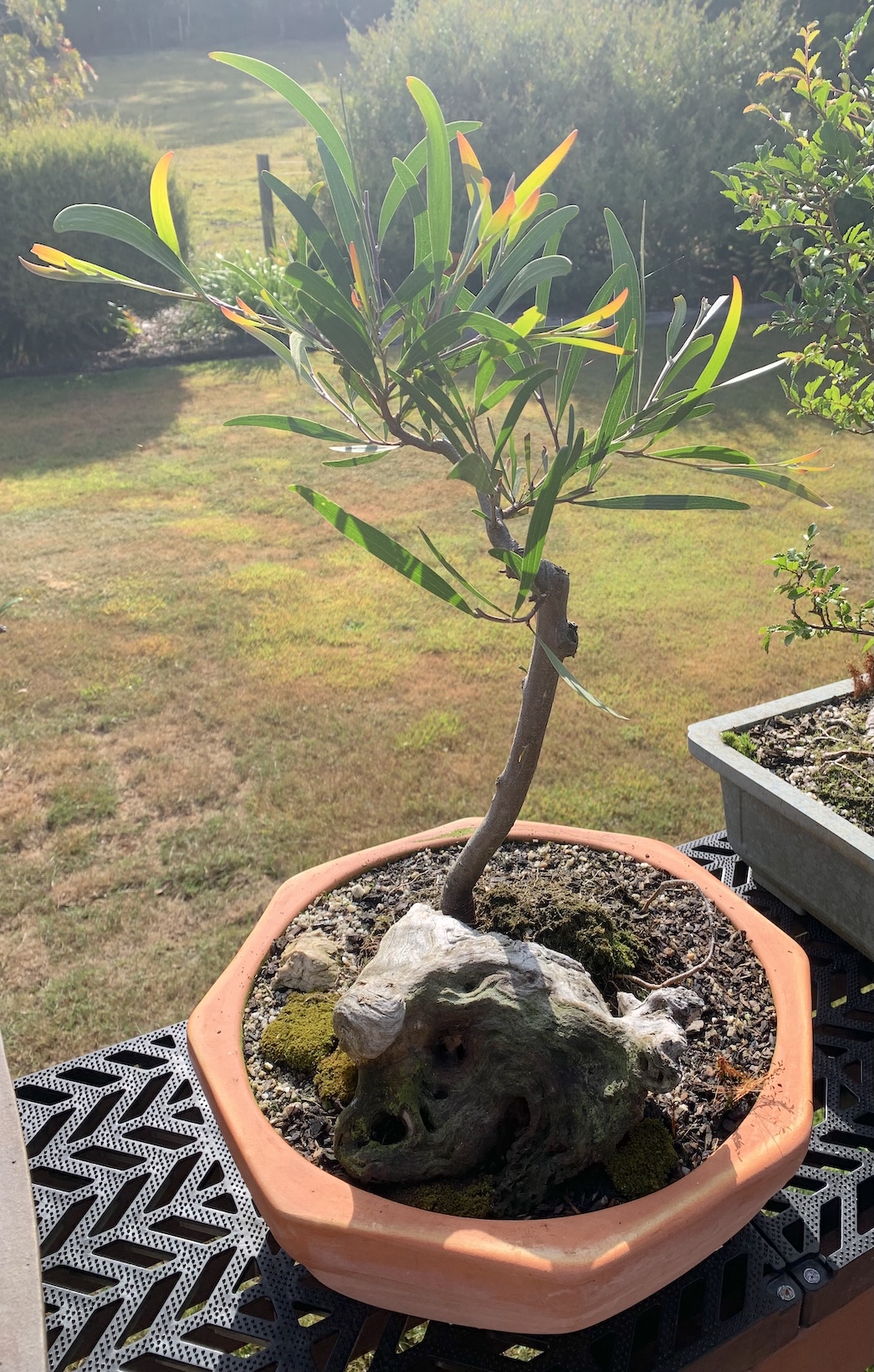
The Australian blackwood was gifted at the same time as the radiata but has fared considerably better. Several root suckers have emerged and will hopefully result in a miniature blackwood forest.
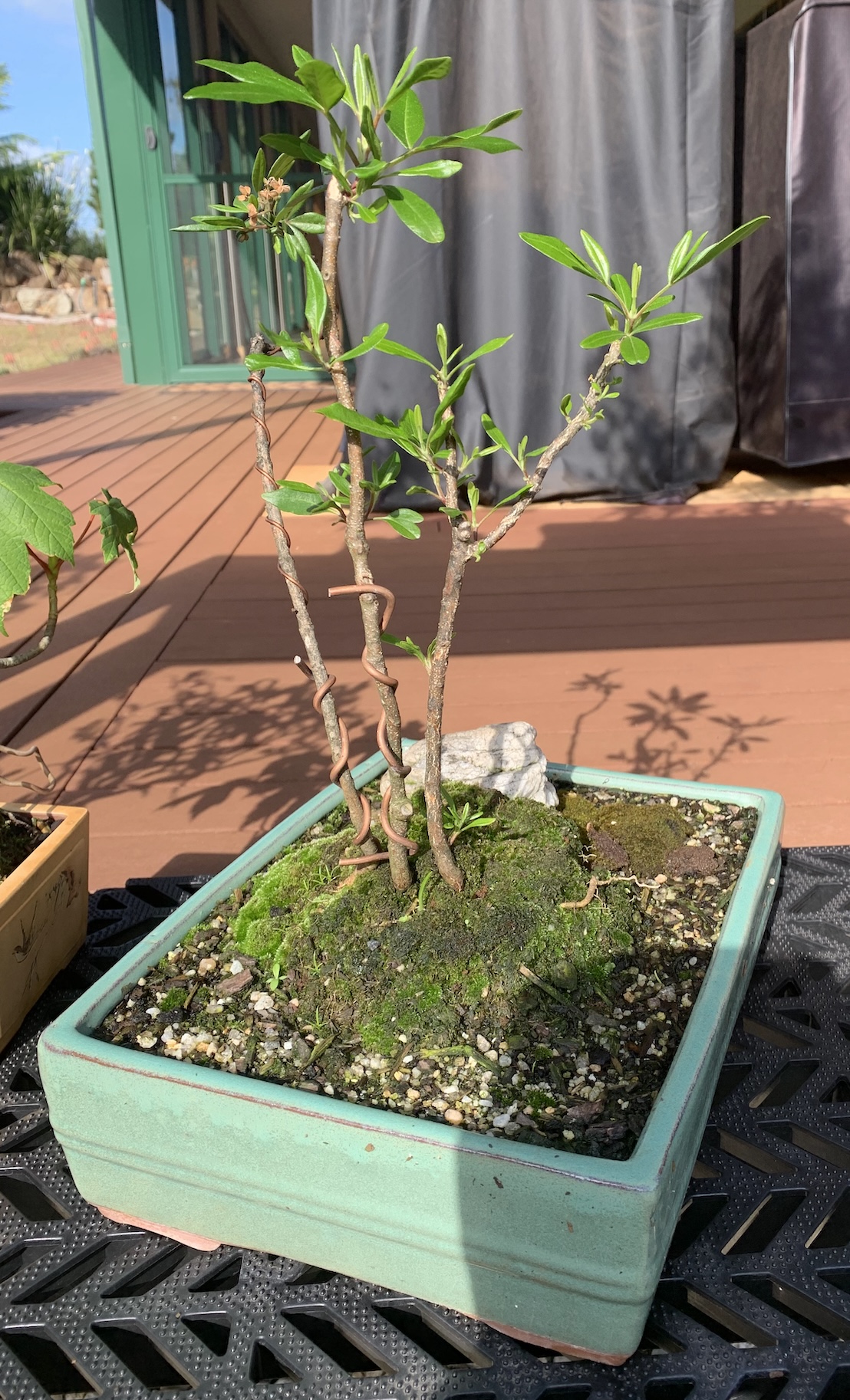
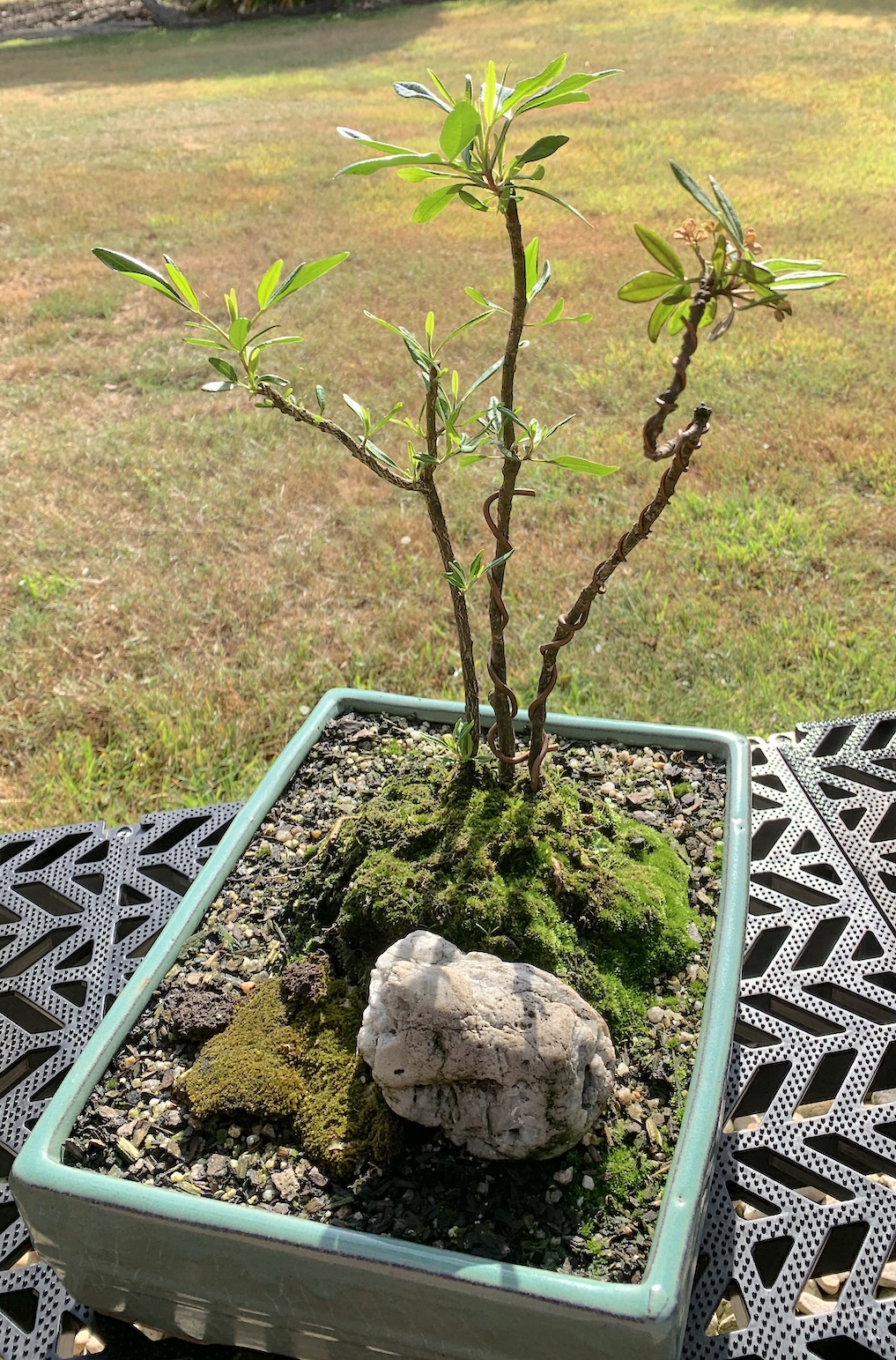
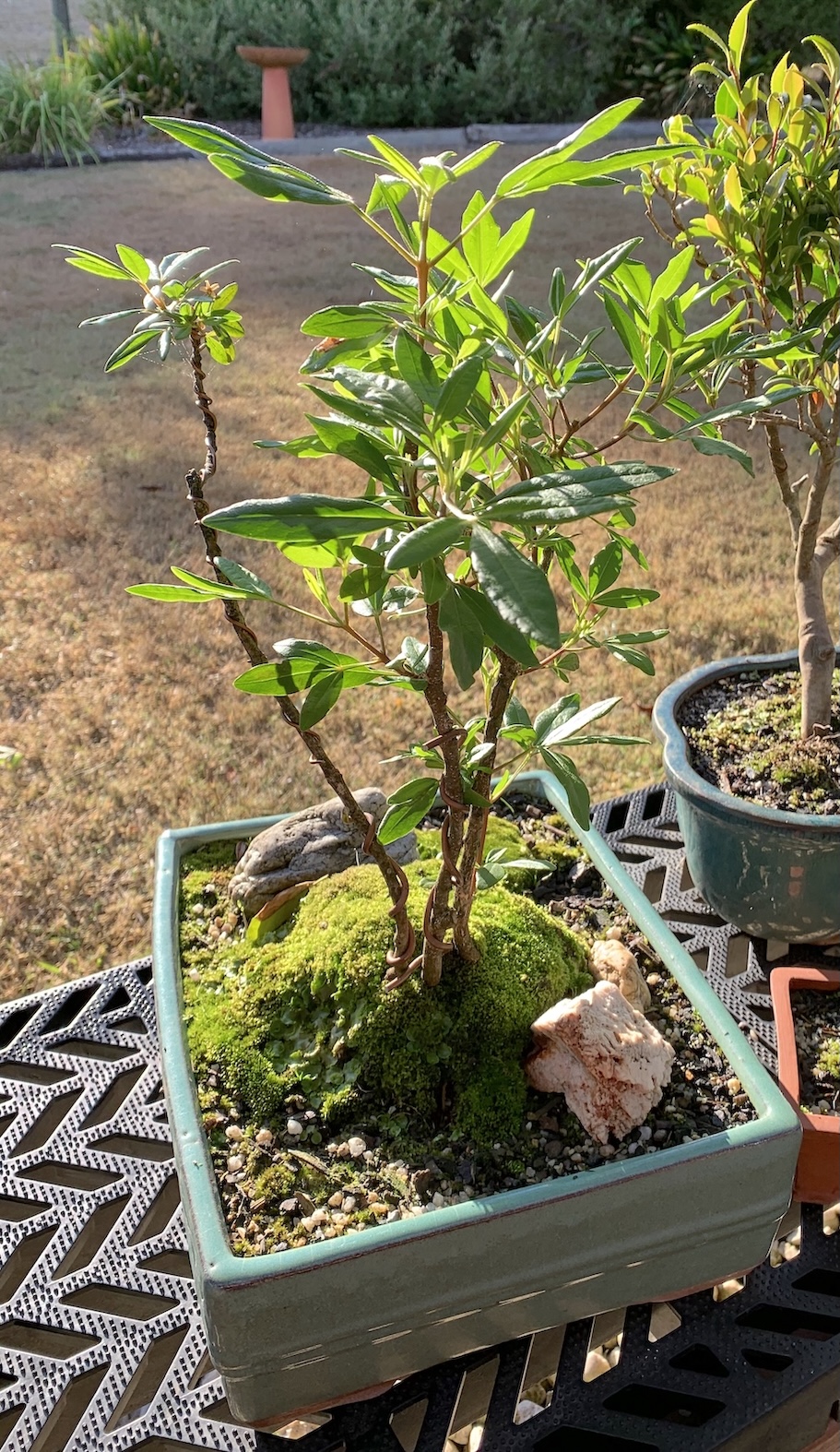
Dogwood trees are prolific in our forest and Michael took these three from the path to see if they could become bonsai. I’d say it was a successful experiment.
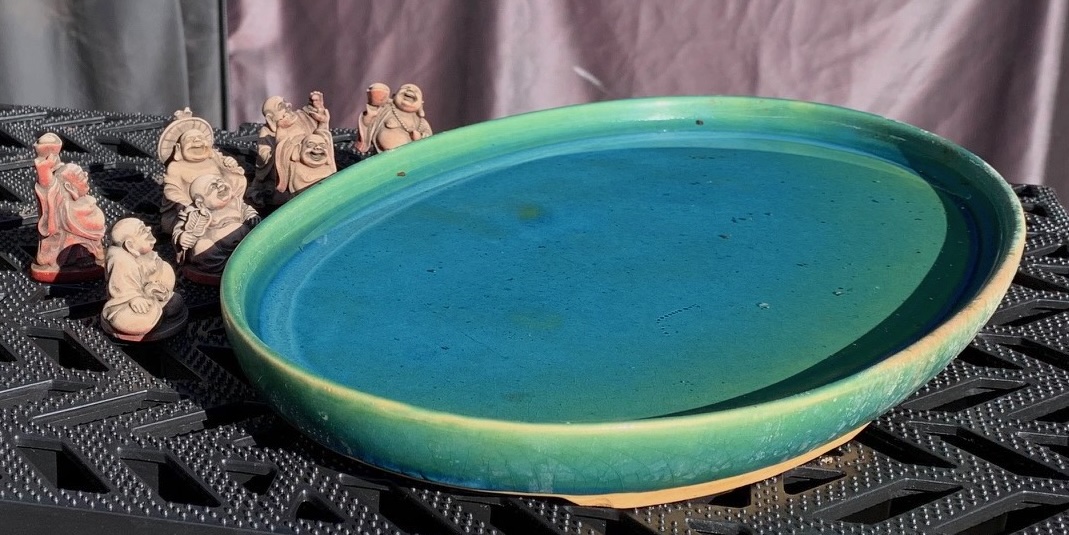
With the Japanese Buddhas enjoying themselves at the watering hole,
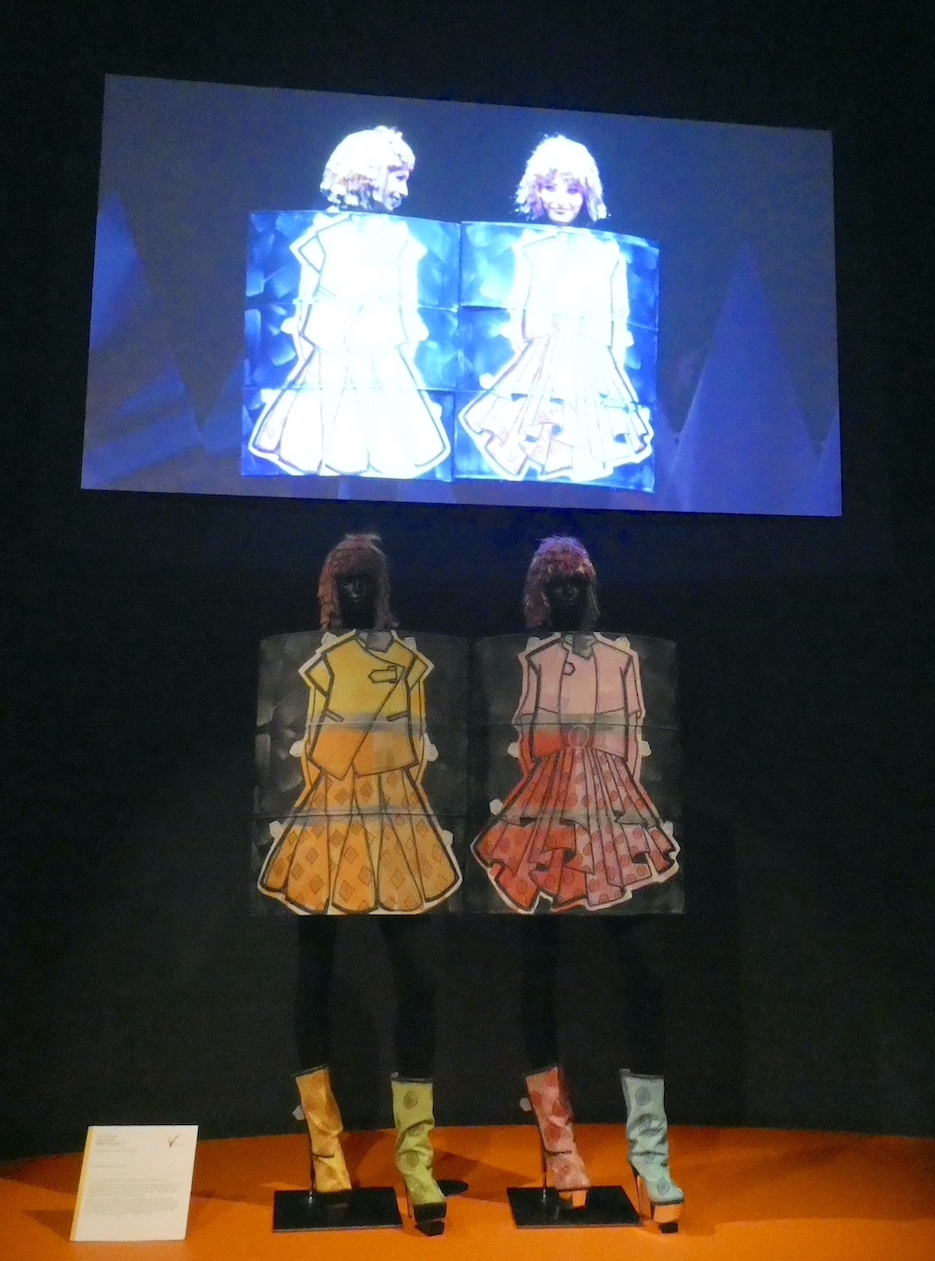
Continuing our circuit of the World of WearableArt Museum, we entered the Transform Section. Designers were challenged to create a work that changes in form, nature and appearance. I only captured two of the five pieces, they don’t translate too well to static visuals. Meg Latham (NZ) was inspired by the paper dress-up dolls she played with as a child. Using polyethylene, canvas and acrylic paint for her version of Dress Up Dolls, the models change costumes as if turning pages of a book.
Tara Morelos, Ahmad Mollahassani and Nelia Justo (Australia) have employed electronics, along with acrylic, cardboard and fabric for their homage to Japanese artist Yayoi Kusama. They describe Infini-D as, ‘a meditation on geometry, dimensionality and cinematic post-modern gothic’.
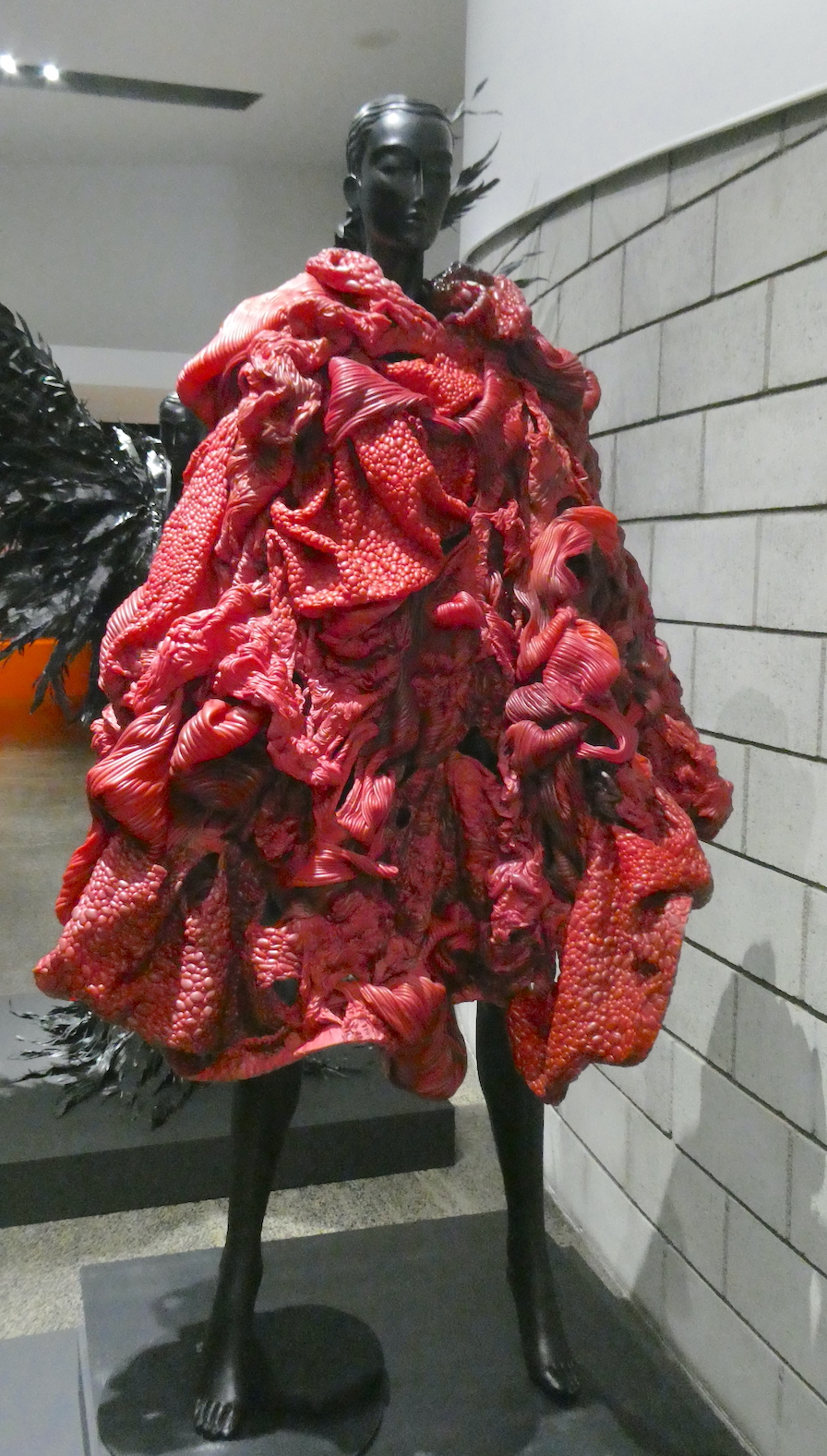
The Aotearoa Section draws on the deep sense of place New Zealanders have and celebrates who they are as people and what makes them proud. Ocean beauty comes to life with Sacha Mail’s (NZ) Fatal Attraction. 30,421 hand-dyed cable ties and foam remind us to protect it before it turns to plastic pollution.
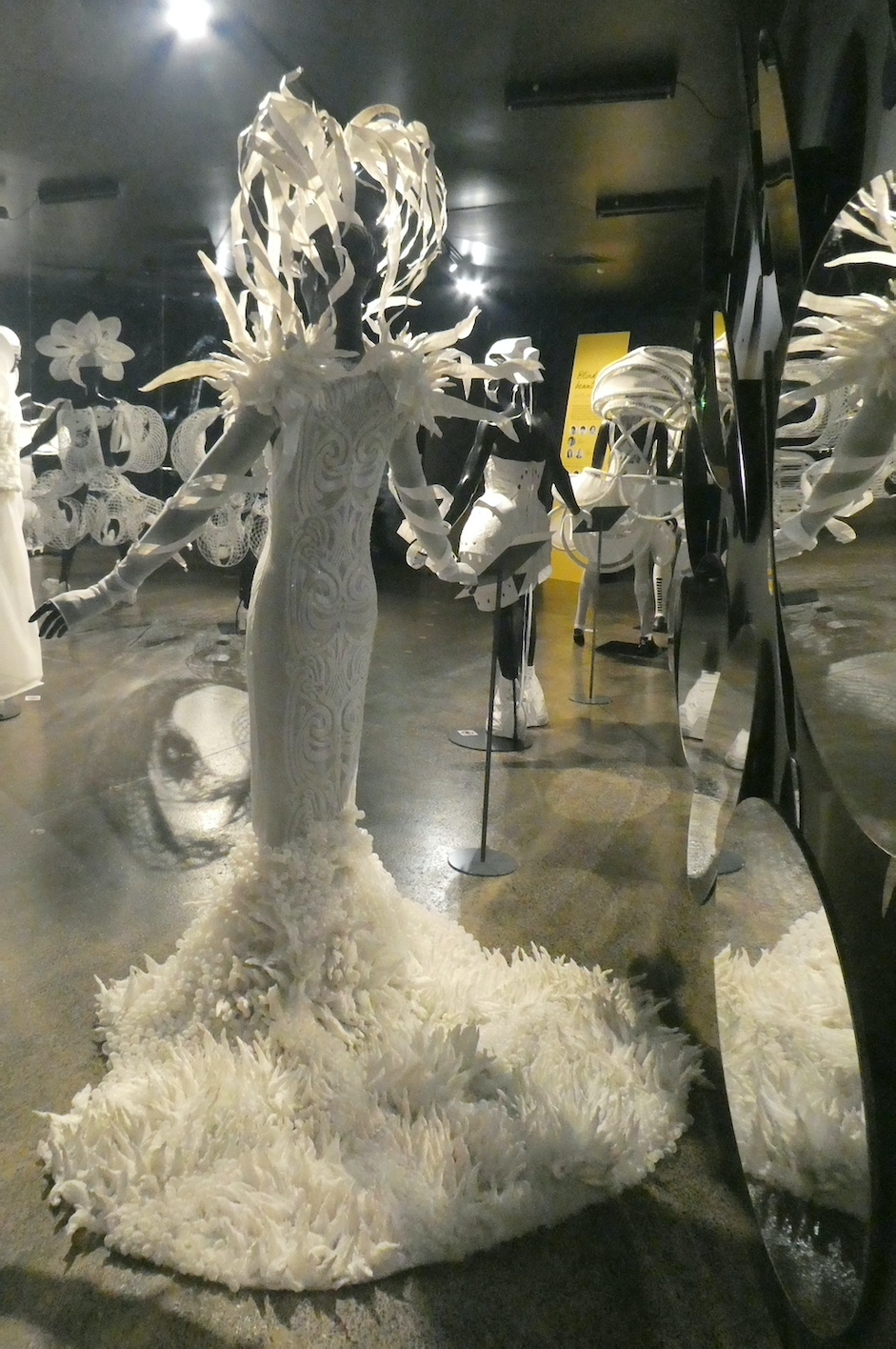
Dylan Mulder (NZ) combined 100% merino wool and 3D-printed jewellery to merge Artificial Intelligence and Māori design. He claims the garment, Natural Progression, intuitively designed itself.
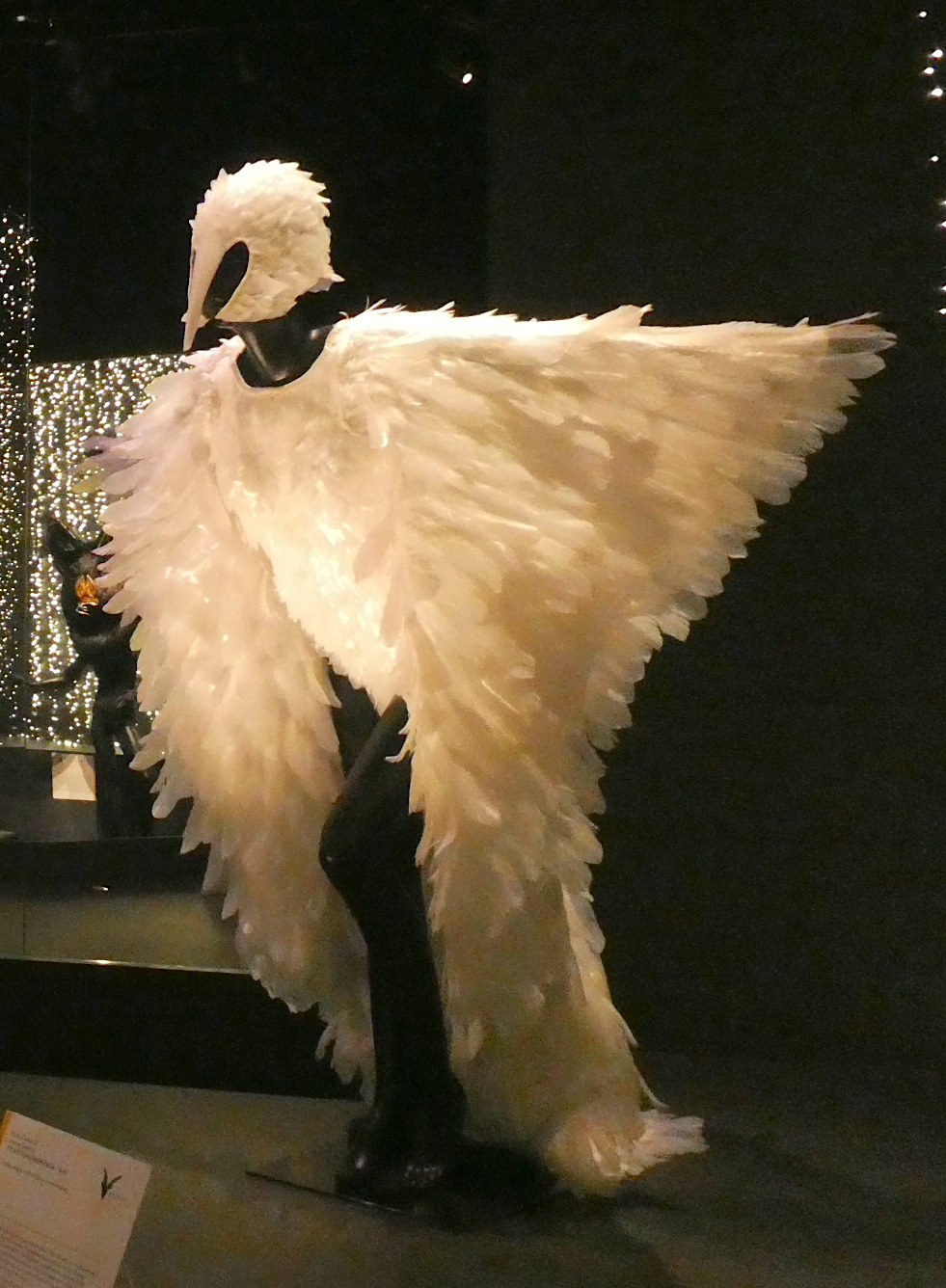
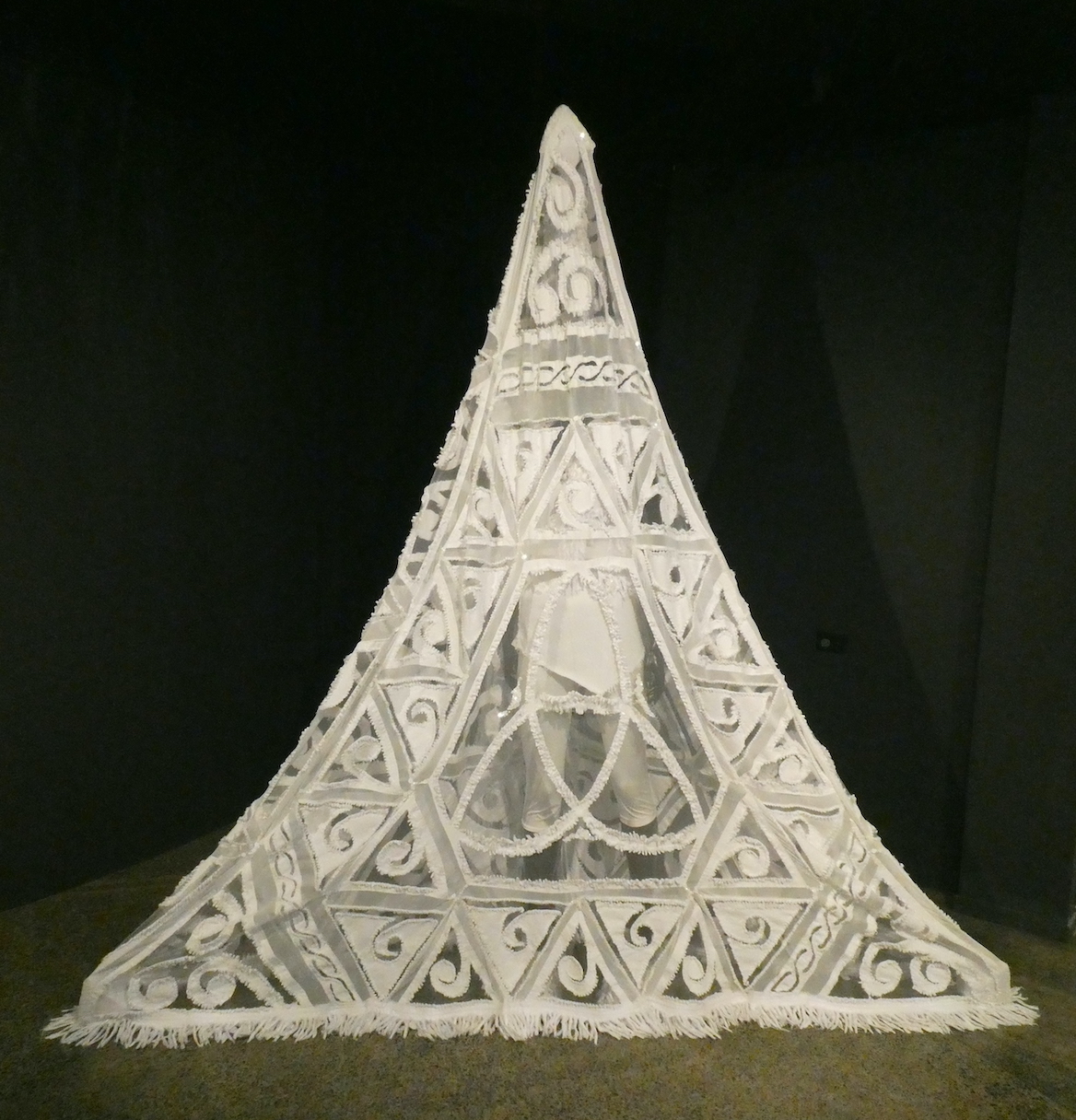
Te Kotuku Rerenga Tahi is a Māori whakatauki or proverb, which means ‘a white heron’s flight is seen but once’ and is indicates a very special and rare event. Jenny Sutton (NZ) used paper, plastic milk bottles and weed matting to depict the lovely spirit-like bird.
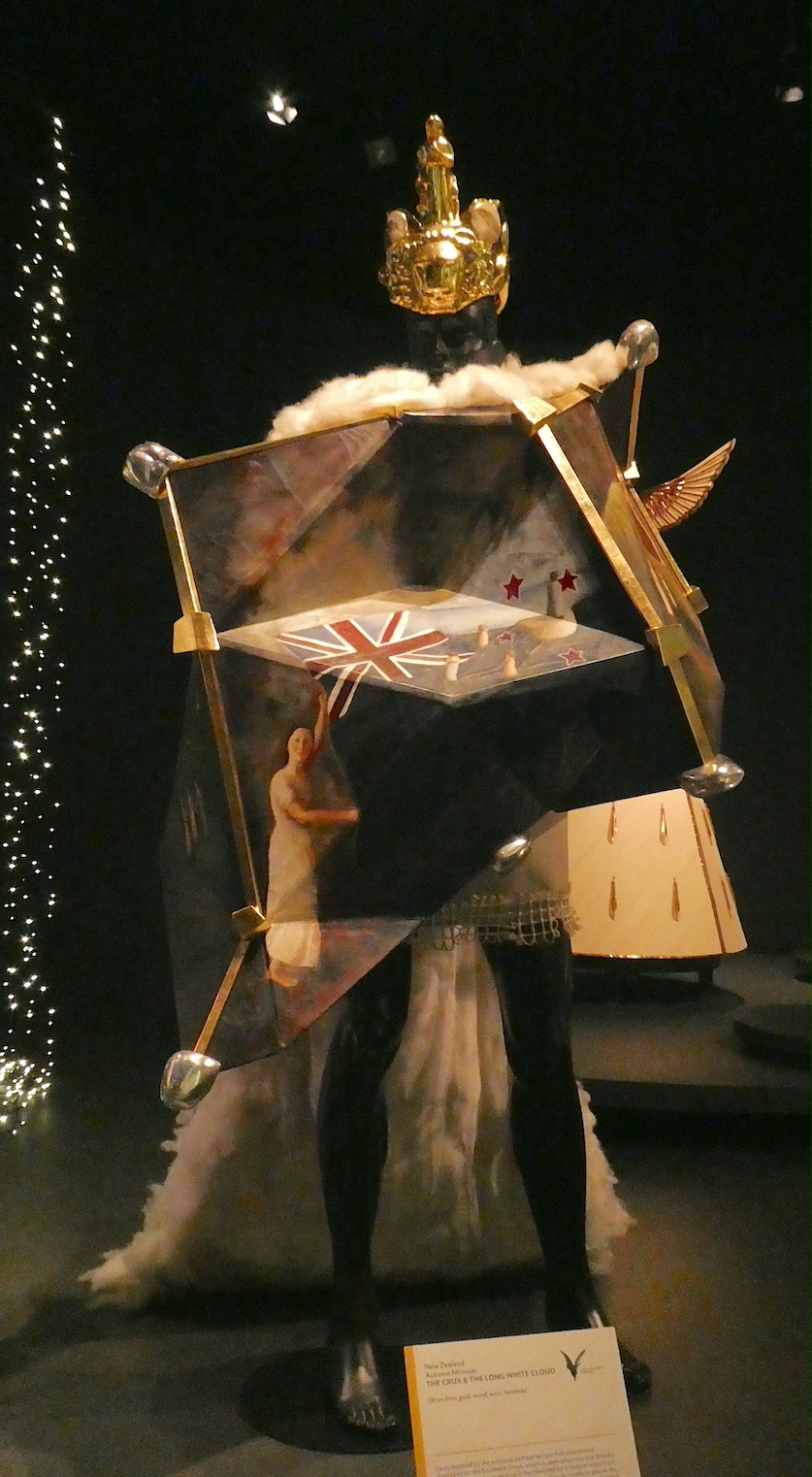
The Crux and the Long WhiteCloud marries the Southern Cross in the heavens with the anthem of New Zealand. Autumn Minnear (NZ) chose gold, wood, wool and harakeke (flax) to complement the oil on linen images.
Stephanie Cossens (NZ) has honoured the New Zealand lesser short-tailed bat, Pekapeka-Tou-Poto, using ceramics, faux fur, Dacron and aluminium.
Fabric, plastic and elastic have amalgamated to form Erica Gray’s (Australia) Echinoderm, a monochromatic representation of the colourful sea creatures.
The title says it all, Our History? It’s Complicated… Lynne Dunphy (NZ) worked with woollen blankets, calico, silk and brass to share the message that there is more to Aotearoa than blankets and guns.
Lisa Vanin’s (NZ) depiction of Kaitiaki, a Māori term for a guardian or protector of the environment, is an understated combination of bamboo and copper.
An interesting conglomeration of tulle, rattan, shells and modelling clay make up the intricacies of Shelley Scott’s (NZ) JAFA (Just Another Fabulous Aucklander).
The colour white (yes, I know, there is some controversy as to whether it is actually a colour) is often associated with peace, light, love and purity. In some parts of the world it can represent death and mourning. The White Section incorporates the entire spectrum of emotions in spectacular fashion.
Renee Louie (NZ) has shaped PVC pipe, fabric and nylon string to create Symbiosis, her message that, ‘Alone they are great but they are even better together.’
Intricately woven aluminium wire and white wire make up Dreamcatcher, a fairy of the night by Tsao Chien-Yi and Lu Pei-Hsin (Taiwan).
‘The incarnation of an ethereal soul, protected by many different, textured layers’, describes Integumentum. Marine Arnoul (France) used 3D-mesh, spandex, foam and 3D-printed glasses to achieve the image.
A sterile white armour attempts to fight disease, but it is flawed. Hanna Smith (Australia) shaped Faulty Armour from Tyvek, cork and surgical masks.
This gorgeous garment by Galina Mihaleva (Singapore) is fabricated from polyester, plastic and sequins. Losing Touch? represents the uncertainties facing nature.
On a similar theme, Erica Gray (Australia) has used plastic and fabric for Face Coral, reflecting the underwater species stripped of vibrancy and colour.
Although many of the pieces on display are stretching the concept of ‘wearable’, I feel this would be particularly challenging. Ruth Arkless (NZ) has used cotton, tulle, mesh and sequins to create Cultural Peak, expressing the strength of the country’s heritage, casting large shadows and reaching new heights.
Taking ‘wearable’ to the extreme, the Bizarre Bra Section showcases some outrageous examples that have been entered in the competition over the years.
Paying homage to a typical Kiwi breakfast, Fried Eggs made from rubber adorn toast formed with painted sponges. Kelsey Roderick and Rhys Richards (NZ) cleverly added straps constructed from cutlery.
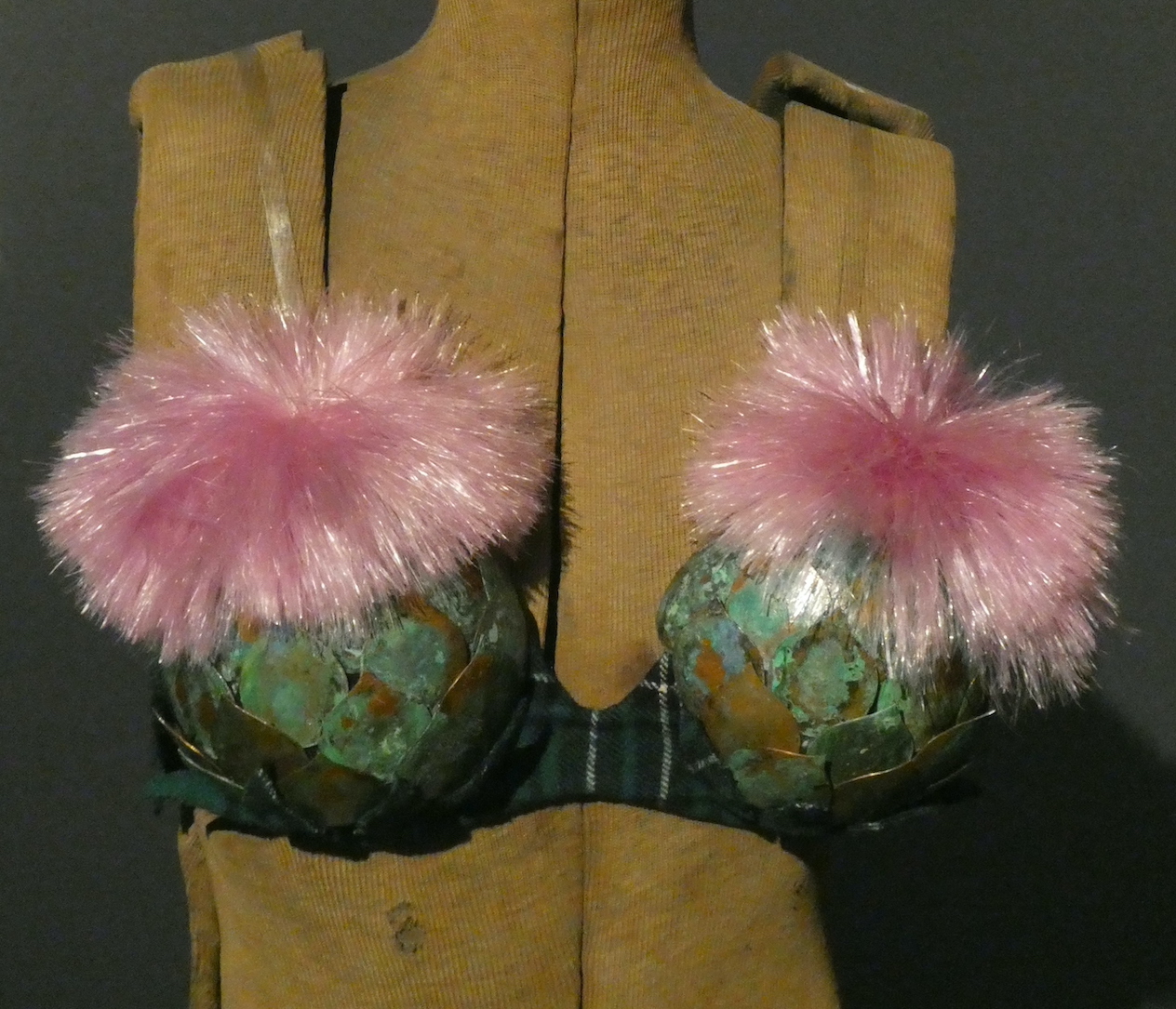
The oldest recorded ‘National Flower’, the Scottish thistle, inspired Lyndal Linton’s (NZ) EdinBra.
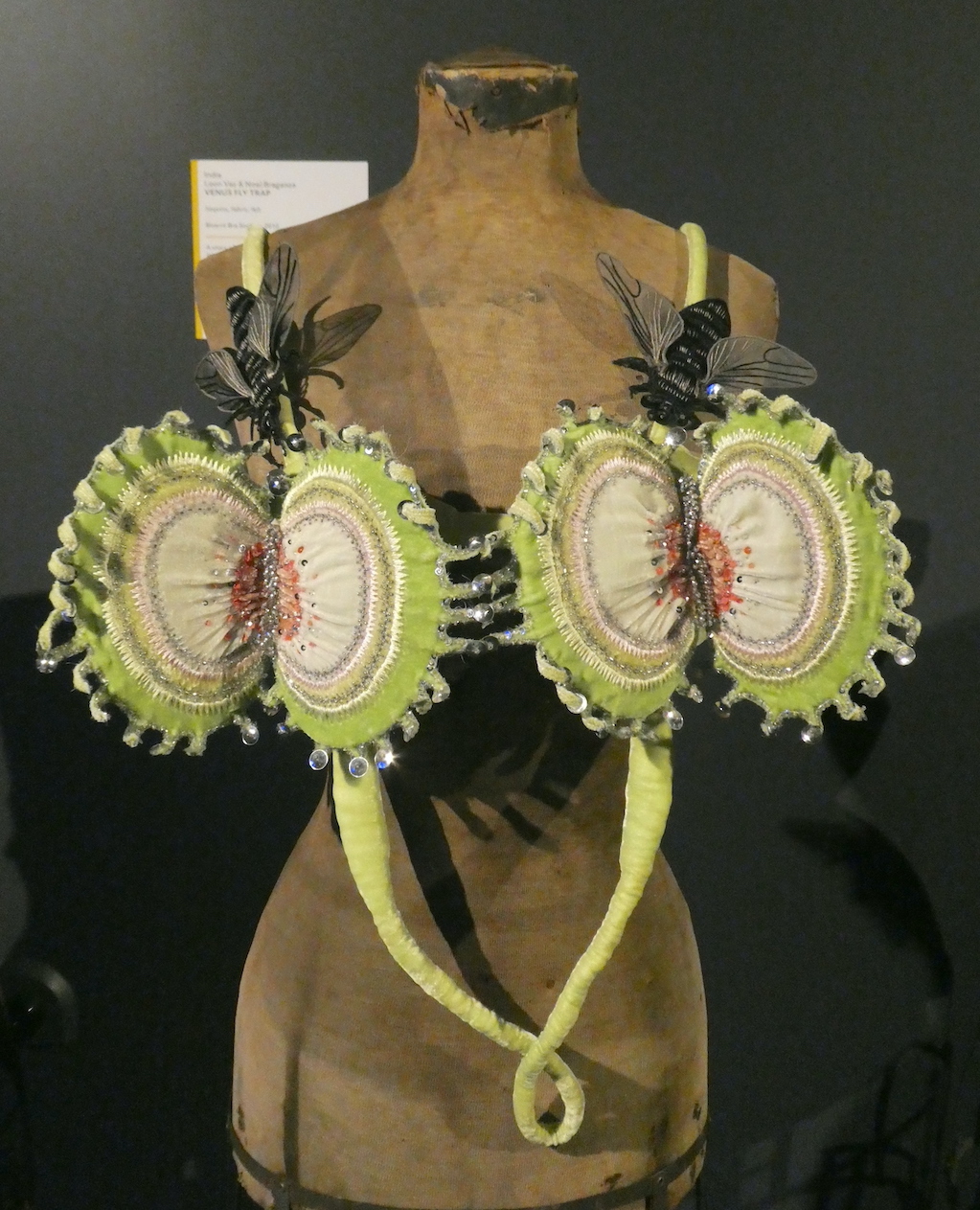
A less sedate, carnivorous tropical plant motivated Leon Vaz and Noel Braganza (India) for their colourful Venus Fly Trap.
Alexa Cach, Miodrag Guberinic and Corey Gomes (USA) combined hand-painted Cicadas, brass leaves, Italian leather, faceted crystals, epoxy and wire for their golden Renewal entry.
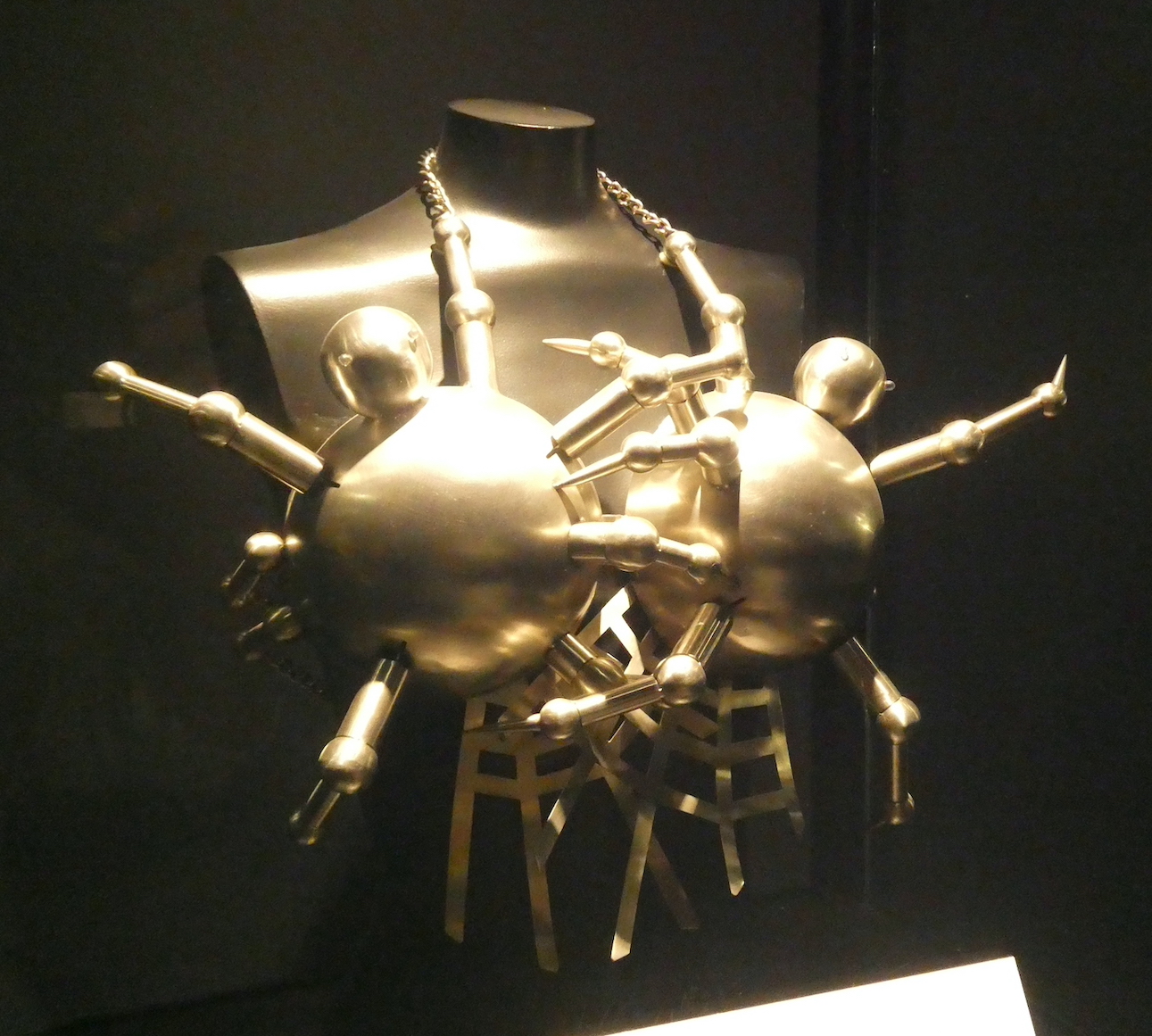
Stainless steel was the material of choice for the arachnoid creation, Miss Muffet, by Bikramjit Bhowmick and Sangeeta Patra (India).
Mark Crocker (NZ) found a use for teapots, bicycle parts, egg cups, kitchen utensils, leather belts, fabric and rivets for his painfully titled Grinder Bra.
Equally uncomfortable is Jantar Mantar by Khadimul Islam (India). I would think those parts made of iron, plastic and reflective sheets would pinch a bit.
Sebastian Denize (NZ) created Re-Decked entirely from recycled skateboards.
I’m not convinced that Tanya Marriott’s A Pair of Spitfires would really take off.
Denise Laurie (NZ) had to learn taxidermy to present Lunar Duo. A tribute to the possum, the unfortunate pair of road kill have been joined together with rubber from a car tyre.
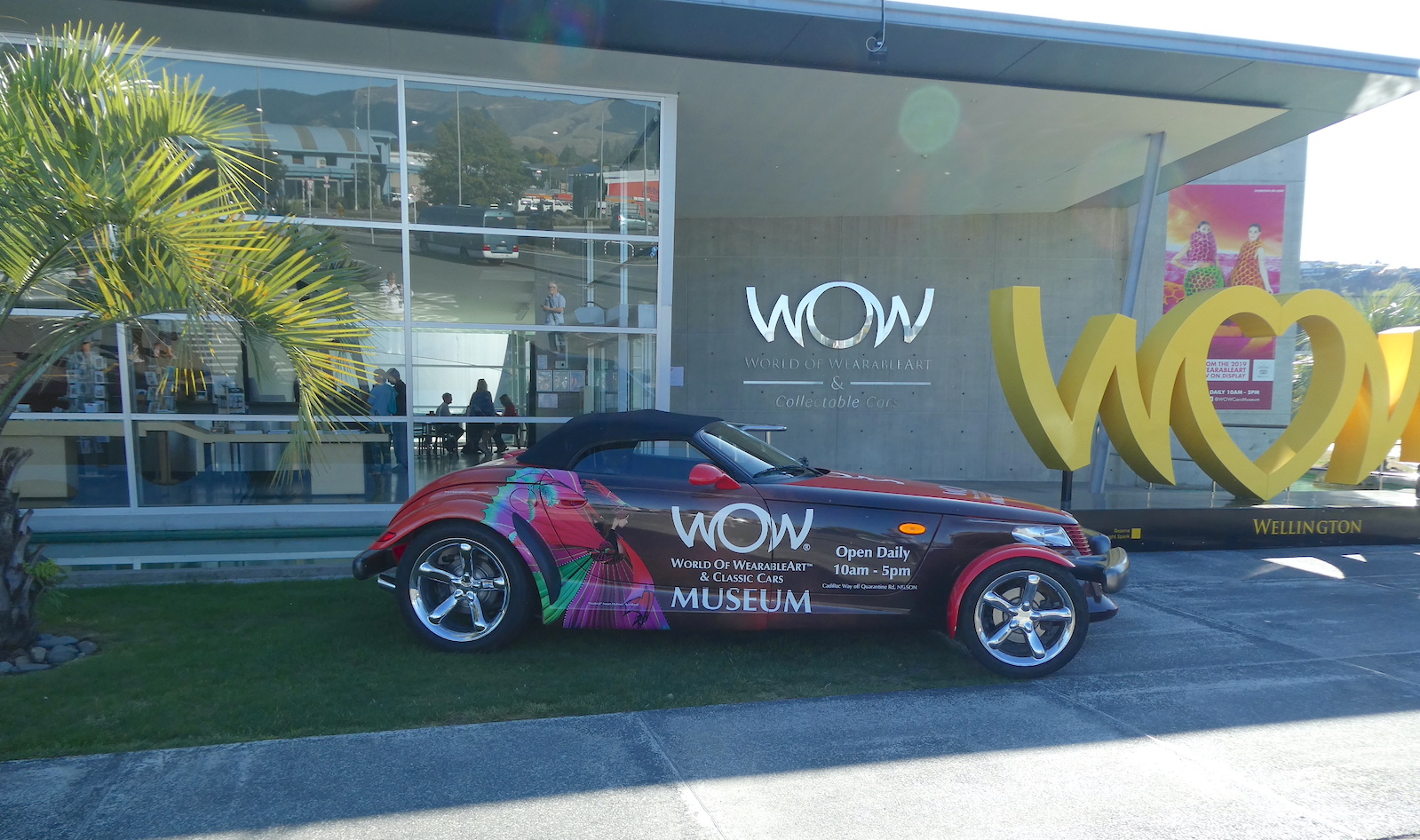
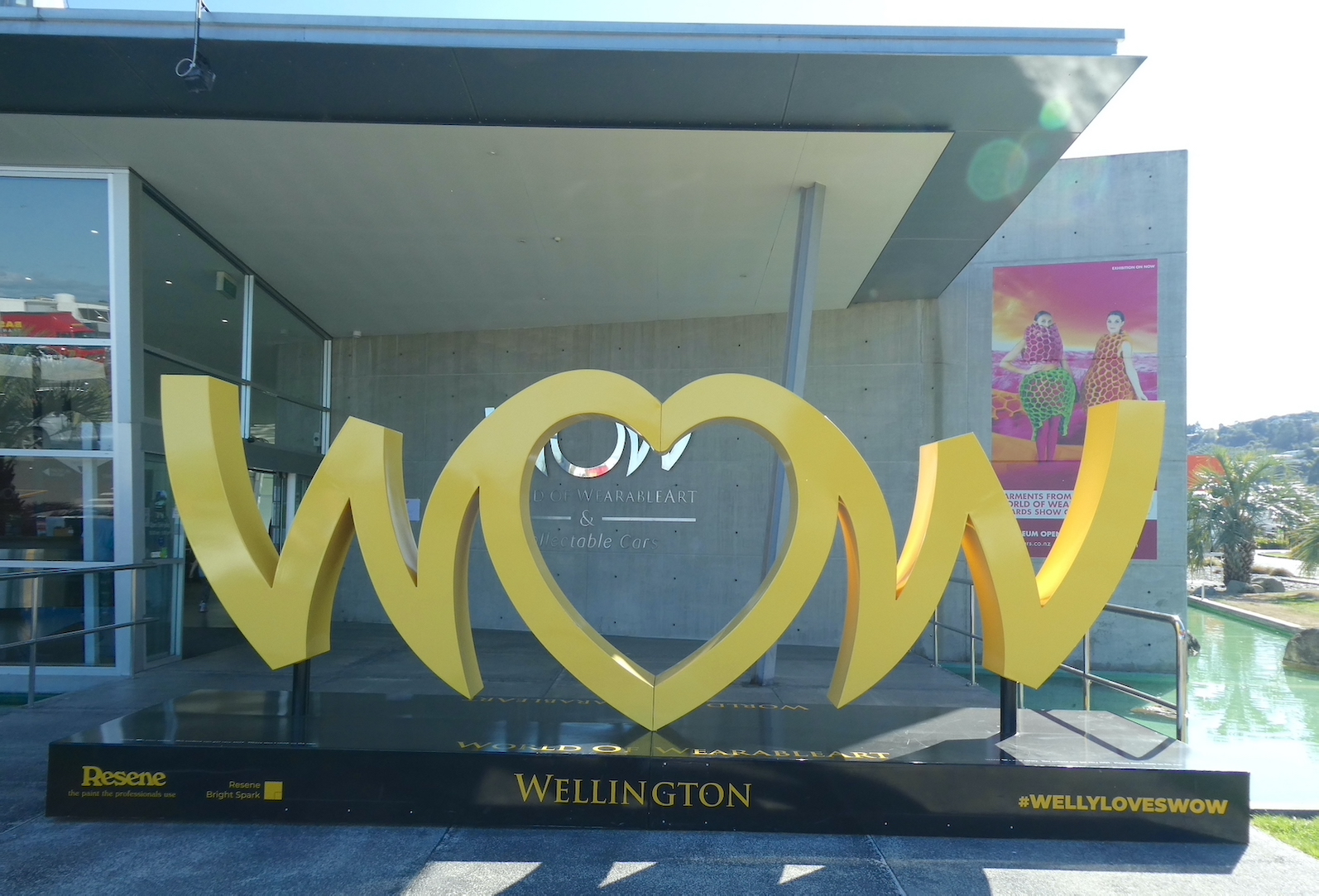
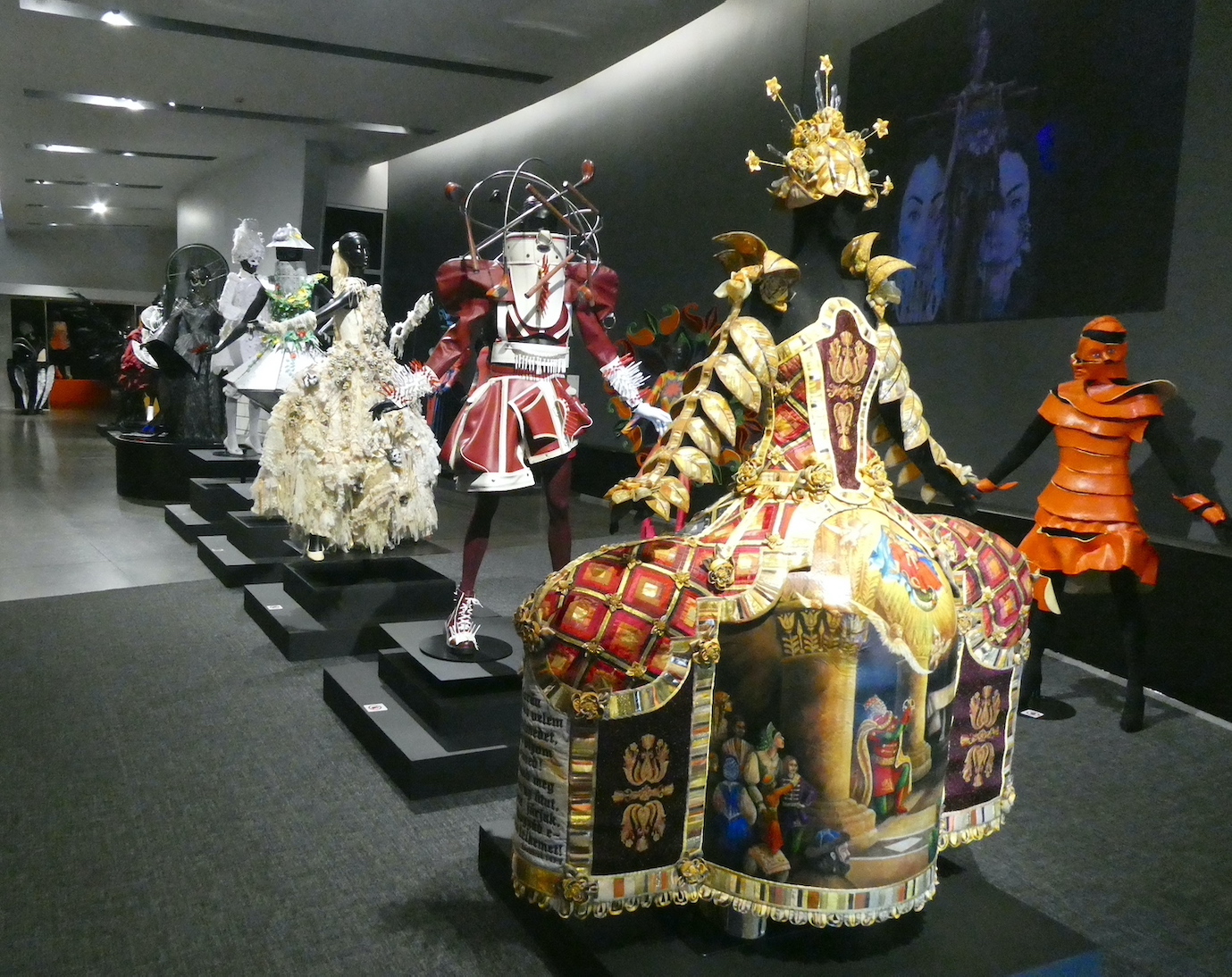
While staying inNelson, we relished the opportunity to visit the World of WearableArt (WOW) museum. Local sculptor, Dame Suzie Moncrieff, instigated the World of WearableArt as a means of promoting a local co-operative art gallery; by taking art off the wall and displaying it on the moving body. Each year, the competition culminates with a spectacular show where the works are brought to life on stage. Since the inaugural show in 1987, the competition now attracts entrants from around the world. The museum dishes up a visual feast of which I will share a tasty portion.
The adventure begins just after the ticket counter, with the vibrant colours of Escaped Pods delivering a promise of things to come. Lynn Christiansen (USA) used felt and fabric for her depiction of Castilleja seed pods that have escaped captivity at the seed bank to live for today.
The displays are separated into different sections with each representing a theme. The Open Section is unique in that it has no thematic boundaries, giving designers complete freedom to create, limited only by their imagination.
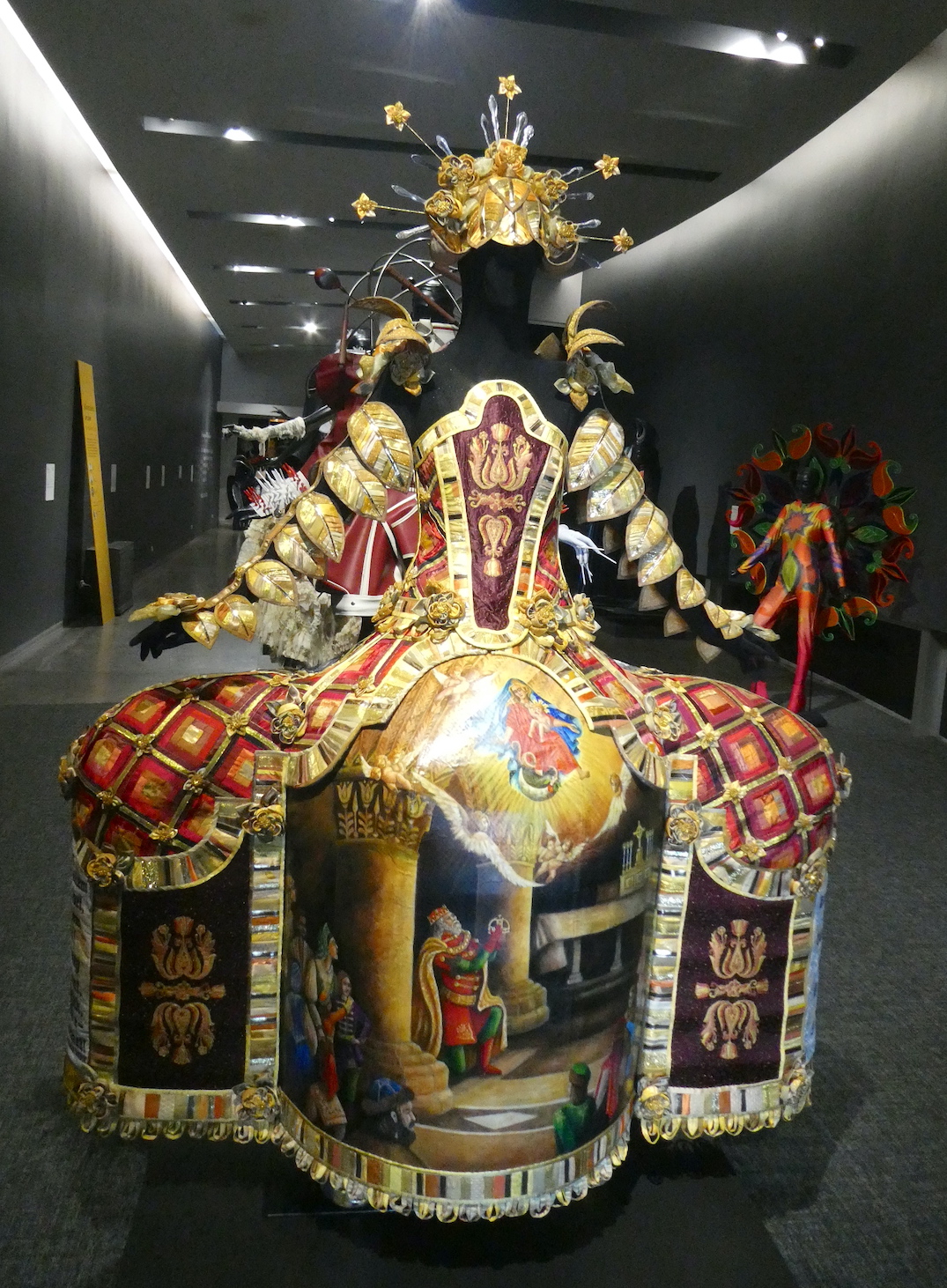
Synthetic scraps, Fimo (a clay developed in the mid-20th century that could be hardened in the oven) and floor insulation were used by Daniella Sasvári and Aaron La Roche (NZ) to create the monarchial Regnum Dei.
Peeling back the layers to reveal the real you, Mary Turner’s (NZ) Appeeling is made from Worbla (a thermoplastic resin), foam, fabric and paint.
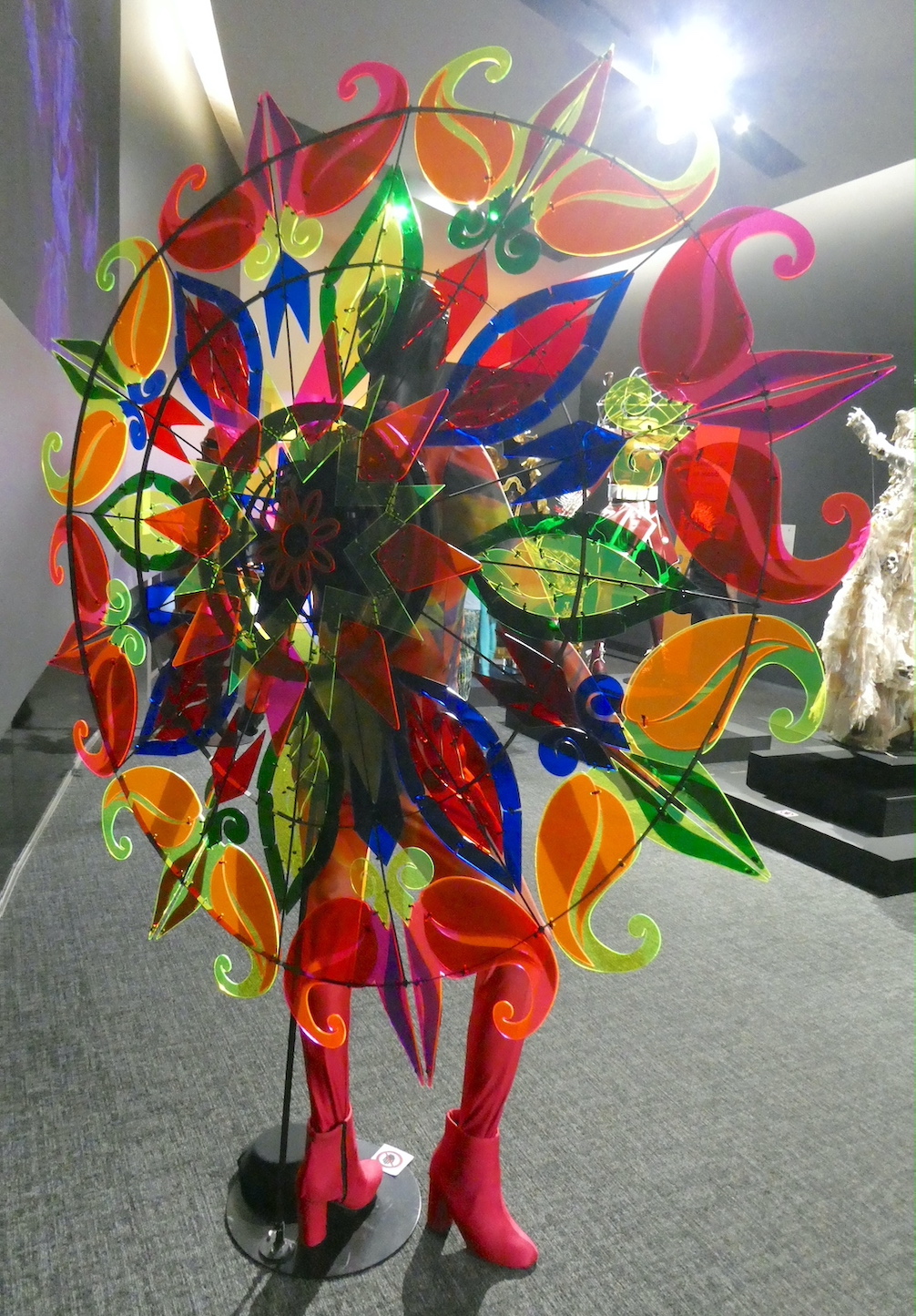
Striking and hypnotic, the changing patterns and colours of Collide-o-Scope were composed from neon acrylic, lycra, aluminium and Worbla by Vicky Robertson (NZ).
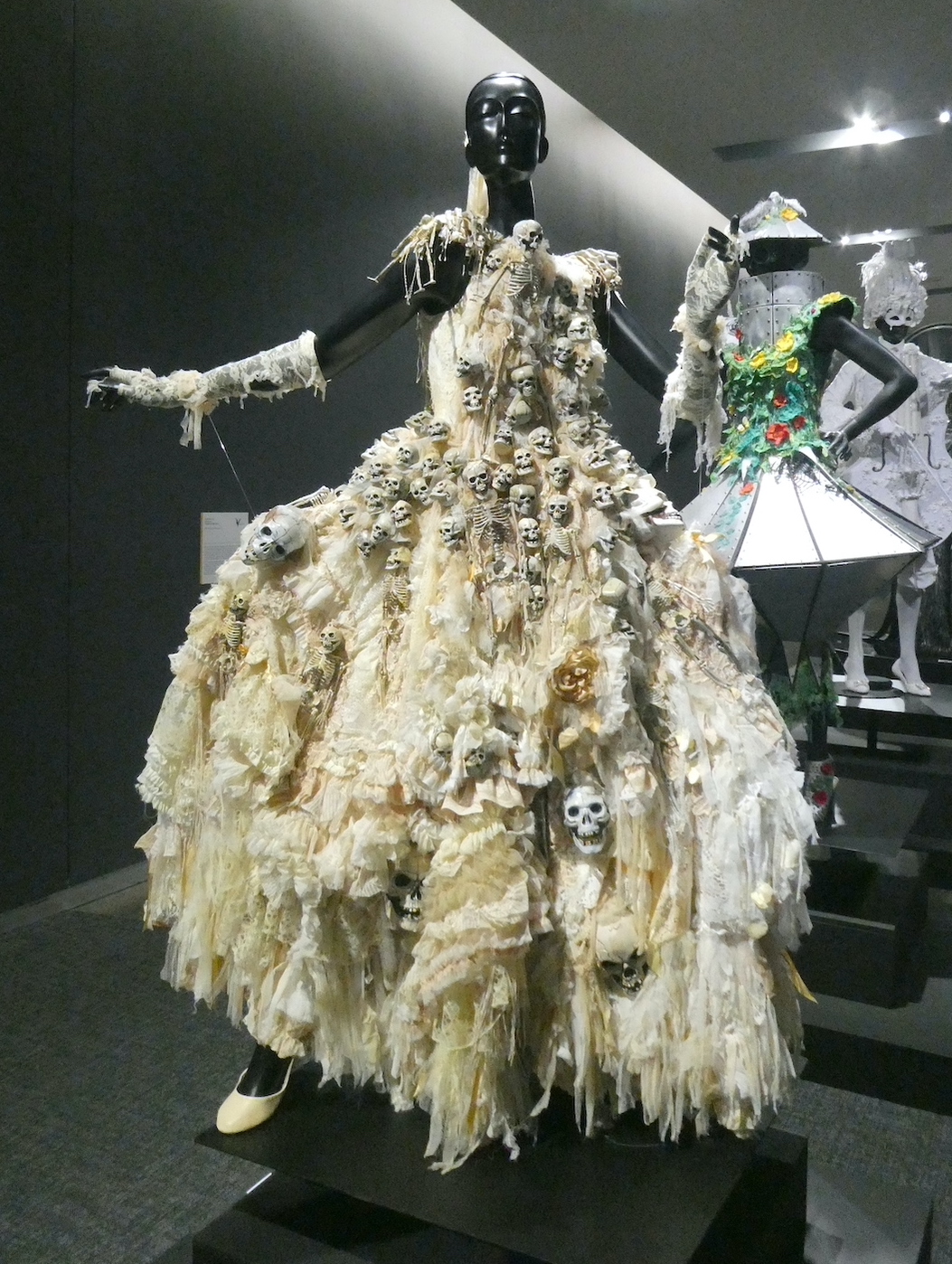
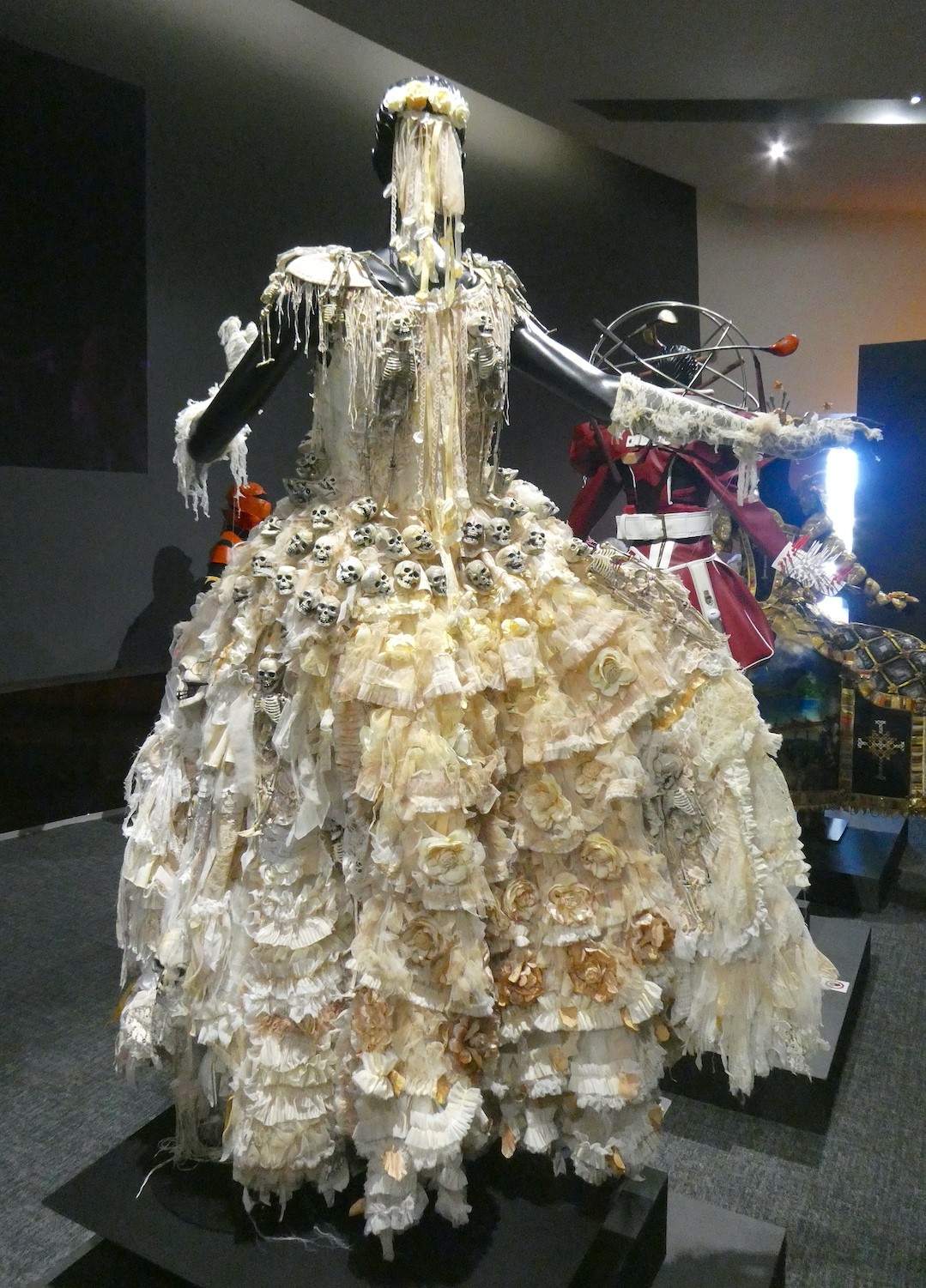
Fabrics, hand-painted skulls and skeletons were used by Sheela Stoneman (NZ) for Memento Mori to illustrate that life is short, death is long, so we need to live life to the fullest while we can.
‘Nature, the hero warrior, transfigures forsaken giants of industry into works of inspiring beauty’. Jill Benson (NZ) used PVC foam board, brass and cotton to construct Derelict Beauty.
Wolfgang Amadeus Mozart was obviously the inspiration for Carolyn Gibson’s (NZ) Rock Me Amadeus. Few materials are more fitting than velvet, leather, pearls and lace for a man who declared that love is the soul of genius.
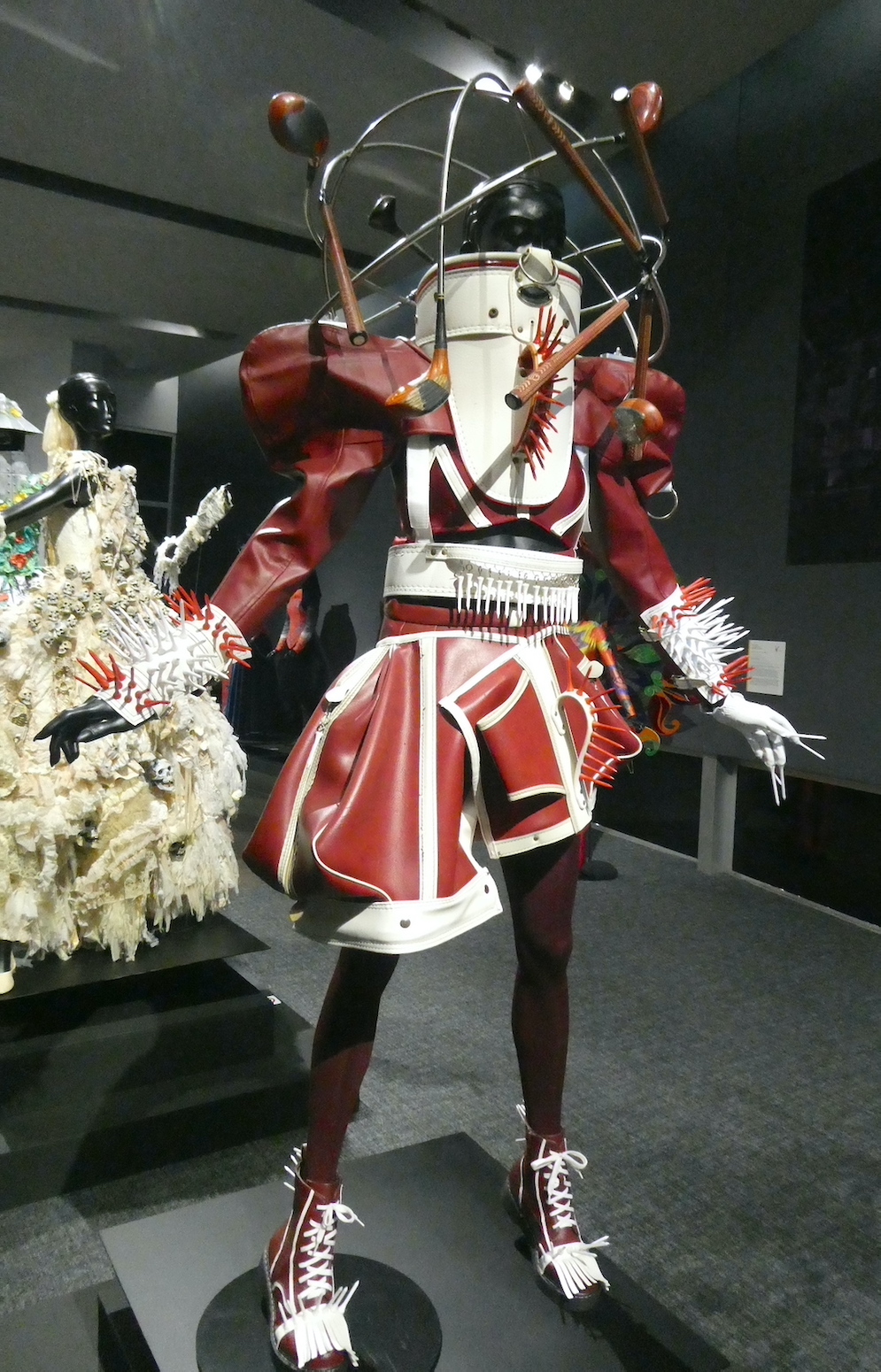
Golf bags, clubs, tees and vinyl were used by Leanne Day (NZ) to relate the overwhelming feeling of having more ideas than time with Engolfed.
The Mythology Section features fantastical designs influenced by dark tales from other dimensions; monsters and creatures, gods and goddesses. Banshee of the Bike Lane shrieks her mourning of the senseless deaths of fallen cyclists. This howling spectre is assembled from bicycle inner tubes, chains, cogs and a wheel by Grace DuVal (USA).
The story of the thread of life – the beginning, middle and end – is told through shape and colour by Tina Hutchison-Thomas (NZ). Velvet, hand-dyed chiffon and embroidery were used to create the garments of The Moirai – the Shape of Us.
Feathers, silk taffeta, paint and crystals combine in the colourful Eden by Ian Bernhard (NZ), a portrayal of a creature of paradise, lost.
Xu Ran’s (China) 3D printed resin, nylon, rope and plastic, Feathers of theRoc, tells the story of giant fish that grow wings and turn into big birds to pursue freedom.
Based on the ancient theory of female hysteria, Louise Byford (UK) has melded latex sheeting, liquid latex and leather to present The Wandering Womb.
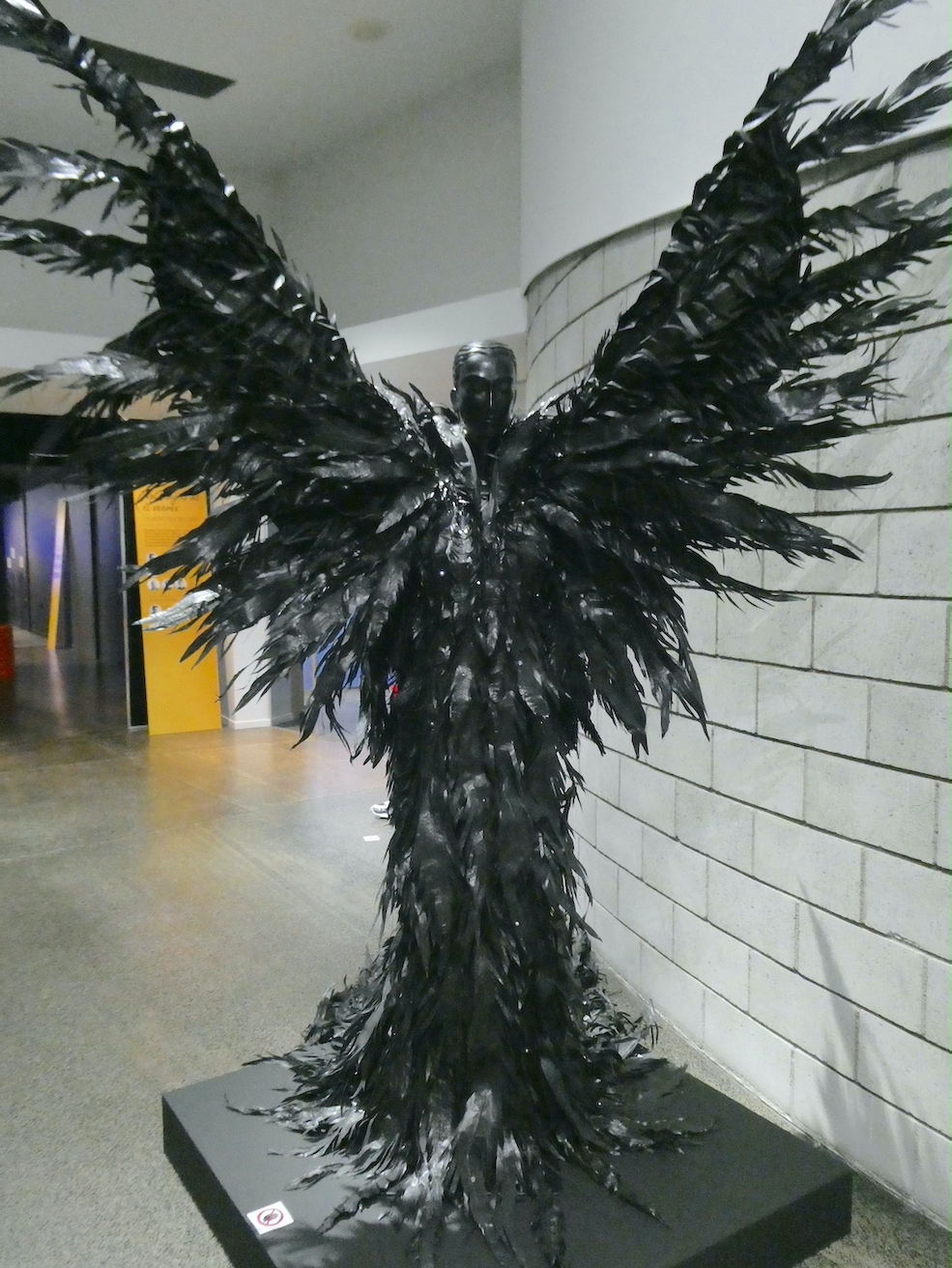
Although Nyx, goddess of the night, has the appearance of a multitude of feathers, it was actually created with plastic bags, metal wire and polyester by Dinh Hai Yen (Singapore).
A fascinating fusion of patent leather, beads and non-woven cloth form the convolutions of Chang-Yi-Wei’s (Taiwan) Soul Guardian, the god who guards the soul.
Wrath of Medusa was inspired by the Greek mythological creature Medusa, as sculpted by Italian artist Bernini. Edyta Jermacz (Poland) opted for vinyl latex, neoprene, jacquard and polypropylene padding for her concept.
Experimental, radical and unorthodox, the Avant-garde Section challenges designers to defy the boundaries of fashion and rebel against the norm.
Buddhist altar cloths and kimono obi lining merge to form Shinka (‘Evolution’ in Japanese). Christopher Davis (NZ) poses the question, ‘in a world of change and rapid evolution, will tradition still remain?’
With the stunning use of steel, silk and silk georgette, Thingamla Adrianne Keishing (India) conceived Oracles of Life, influenced by the aquatic world, especially the rhinopias and coral reefs.
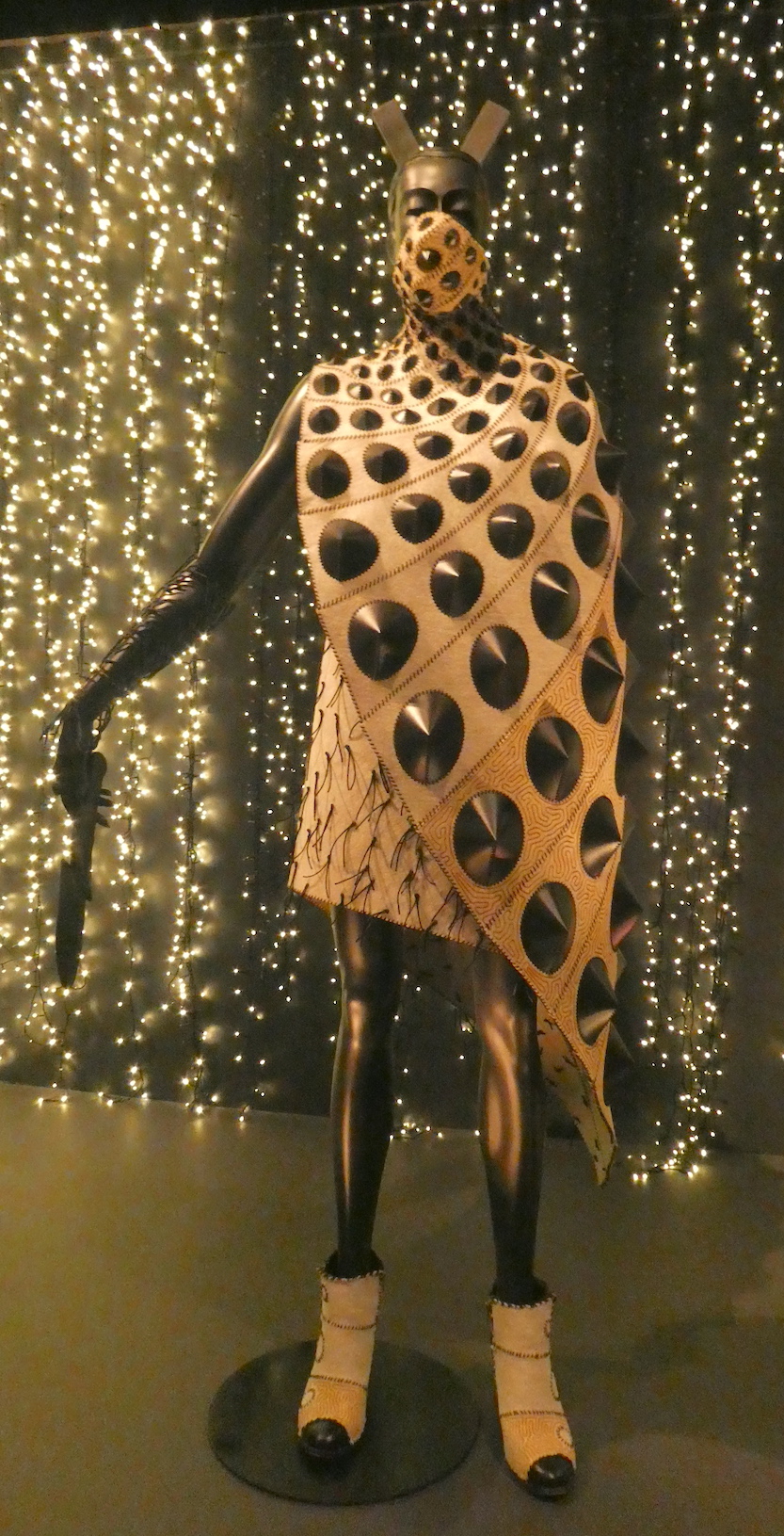
The Lady Warrior embodies the toughest warriors in life – women – in their role of daughter, wife and mother. Rinaldy Yunardi (Indonesia) has brought his vision to life using metal and recycled paper.
Edyta Jermacz (Poland) features once again in this section, using latex, neoprene, fringing and buckles to produce Big Lips, inspired by a range of romantic emotions: desire, obsession, sex, love, intensity.
Silk, foil, foam and wire form the bold concept by Anna von Hartitzsch (UK), Clotho – the Goddess of Fate. According to Greek mythology, the youngest of the three Fates spins the threads of human life.
Baroque style and religion inspired Lam Hoi Man Kinki (Hong Kong) to create Holy Light using non-woven fabric, metal and satin.
Silk satin, taffeta and stone beads adorn Joan, Ian Bernhard’s (NZ) ‘armoured figure in liquid splendour’.
This armour is an interpretation of ‘power dressing’ and the illusory power of the stiletto. Louise Dyhrfort (UK) chose vegetable-tanned leather and plastic heels for Walk All Over Me.
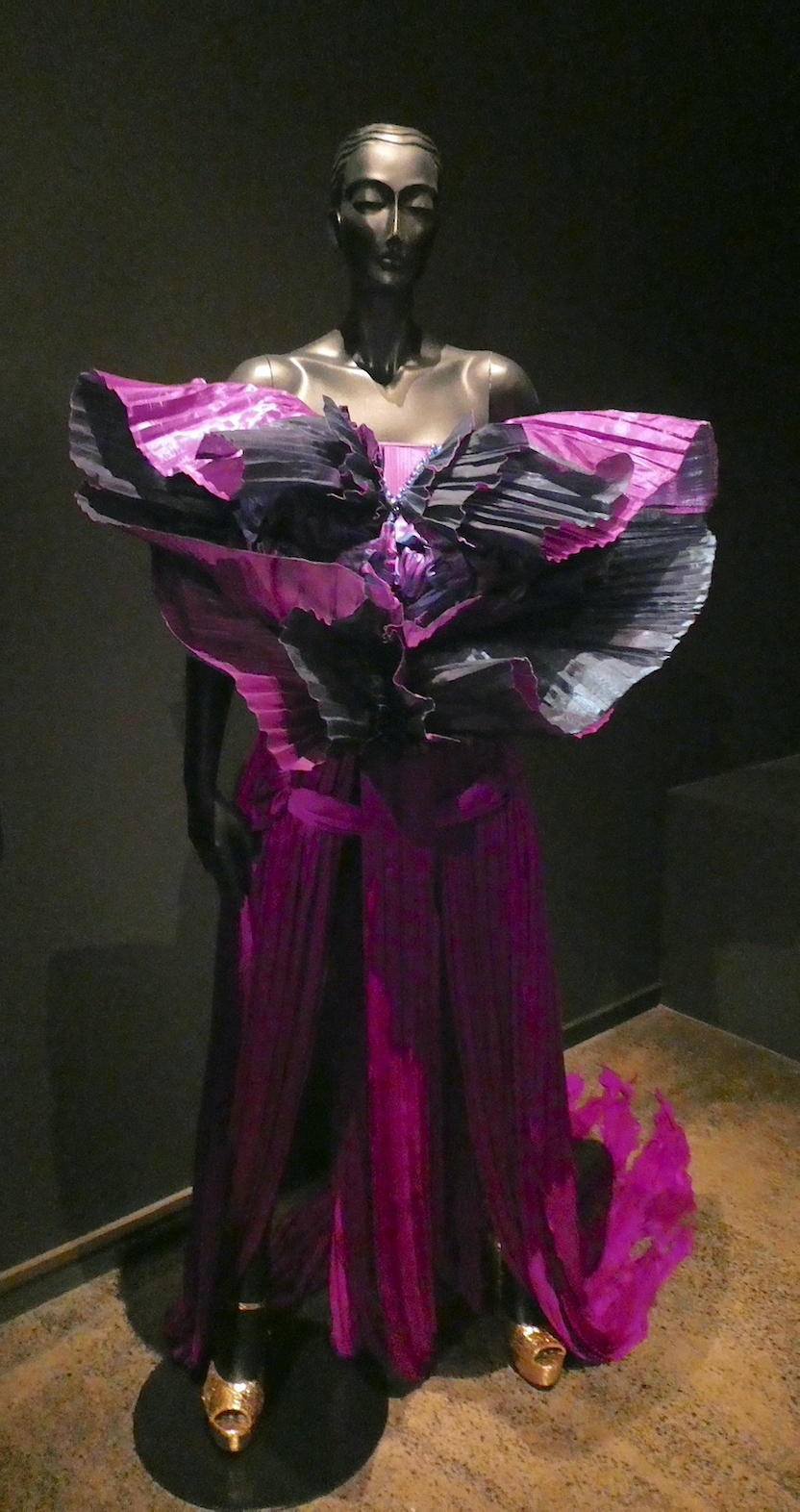
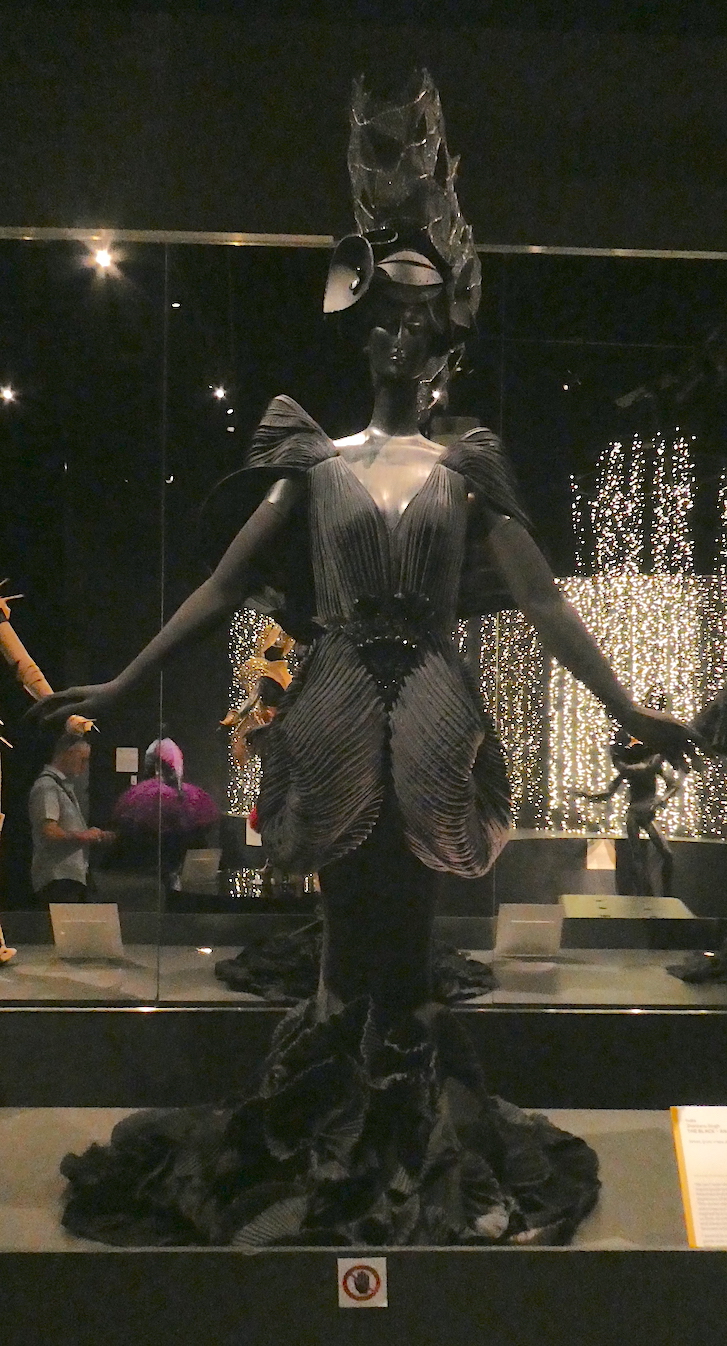
Shantanu Singh (India) surmises, ‘we can’t even imagine the world or universe without black’. Velvet, lycra, crepe, pleated taffeta and cords compose Black – an Inner Strength.
The faceless, menacing Dearth Exterm represents a strong, powerful female version of the Knave of Hearts. Nicola Rule (NSW) has combined leather and taffeta for her mysterious character.
With a few more sections to share, I am planning a second instalment. Stay tuned…..
Having run out of time on our first reconnaissance, we returned a few days later to continue our discovery of the artistic embellishments adorning the lanes of Darwin. As well as the annual Darwin Street Art Festival, the ‘Art to Street’ project in July 2019 invited local and emerging artists to create murals on seven public spaces across Darwin. Two of these colour the walls of West Lane Car Park.
Talented mural artist Lara Connor collaborated with local school student Caleb Schatz (aka Mr Calebdude) to fill the space with subtle colour and quirky characters.
Back to the festival…..a buffalo skull was the inspiration for Darwin contemporary artist Jimmy B4mble’s contribution, Rukus in 2019.
A little further down the lane, the enormous Gouldian Finch was painted for the inaugural festival in 2017 on a wall at the rear of the Darwin Hilton. Melbourne artist James Beattie (aka Jimmy Dvate) teamed with local Jesse Bell to present the three colour variations of the birds; the most common black-faced, the lesser known red-faced and the very rare yellow-faced. There are now fewer than 2500 Gouldian finch in the wild, their existence threatened by changing fire practices that reduce the availability of food and the aviary trade that saw thousands of birds trapped until it was banned in 1981.
With a career spanning four decades, celebrated Darwin artist Colin Holt contributed a vibrant treescape in 2020.
Larrakia, Wardaman and Karajarri artist Jason Lee (aka Choplee) painted the seven main seasons of the Gulumoerrgin (Larrakia) calendar in 2018: Dalirrgang (build-up, September to October) – flying fox, cocky apple and cycad nuts; Balnba (rainy season, November to December) – long bums, black plum and bush potatoes; Dalay (monsoon season, January to March) – crocodile laying eggs and big red apple fruiting; Mayilema (March to April) – dragonflies and bush cherry; Damibila (April to June) – black cockatoo and bush peanut; Dinidjanggama (heavy dew time, June to August) – Dugong and water lillies; Gurrulwa (big wind time, July to September) – stingray and yellow kapok.
There is no denying the overwhelming talent on display throughout this exposition and I was absolutely boggled by the image that emerged from this inconspicuous nook.
Portuguese artist, Odeith, has a special interest in perspective and shading, calling his style “sombre 3D”. On his first trip to Darwin in 2019, he wanted to create a truly Australian artwork, the spectacular result being a kangaroo standing atop a transit van.
Sistagirls are transgender Aboriginal Australians traditionally known in the Tiwi Islands, north of Darwin, as yimpininni. Melburnian artist, Kaff-eine, met with the sistagirls and, in 2018 painted an elegant portrait of Shaniquá to celebrate the strength, power, character & beauty of the sistagirl community.
Also in 2018, Melbourne-based artist, George Rose, drew on her appreciation of the Australian landscape for her colourful work featuring Sturt Desert rose, Hibiscus brennanii and Nymphaea violacea.
Born and raised in Darwin, Larrakia man Shaun Lee (aka Hafleg) combined traditional and contemporary designs to create a beautiful turtle and jellyfish mural in 2018.
Nearby, he collaborated with Trent Lee two years later on a stunning piece featuring barramundi.
Known as the ‘build up’ in the Northern Territory, the weather cycle where heat and humidity increase leads up to the wet season. Build Up/Melt Down by local artist Vincent Poke in 2018 is a depiction of what it is like to live through this experience in the Top End.
In 2017, NT artist Polly Johnstone completed a mural, For the Love of Reading, featuring the image of Darwin local Artia Ratahi. She returned the following year and once again chose Artia, with her Indigenous and Maori heritage, to represent the diverse backgrounds of the community. The vibrant colours reflect the Top End soil, the crystal blue waters and the pinks and purples of the sunsets.
The wall of Monsoons nightclub provided the canvas for a collaboration between Melburnian Cam Scale and NT artist Les Huddleston in 2017. The painting, entitled Monsoon, represents the new life brought to the billabongs after monsoonal rains. Brolgas descend on the billabongs to breed and feed on turtles and fish, depicted swirling amongst the water plants at the feet of the dancing brolgas.
Our connection to animals and the need to preserve our wildlife and their habitats inspired a striking piece by Melbourne- based Tayla Broekman in 2019. The White-Bellied mangrove snake is found in the mangroves of northern Australia, the bright colours are enhanced by the dark background illustrating the sky and vast, flat landscape of the NT desert.
I don’t think these planter boxes are part of the festival but they certainly brighten up the streetscape.
The Street Art Festival has now expanded from the CBD all the way to Alice Spring with more than 18 new murals painted in 2021. I might need a bit more time on my next visit.